Thanks for highlighting our work! RPTune shows that for SMBs, in-context catalog search with learned curation and task-optimized post-training offers a compelling alternative to traditional retrieval methods.
📄: https://t.co/sUto9woSjj
🤗: https://t.co/3Upa9hJBNK
RPTune: Learned Context Curation for LLM Catalog Search
@ChuxuanHu et al. at Google introduce an LLM product search framework for small merchants. A learned curator ranks and prunes the catalog & the LLM is then post-trained on those curated contexts.
📝 https://t.co/iJeWhRwSH3
Zero-knowledge proofs for LLMs “make it harder for attackers to hijack a chat, or enable safety evaluators to verify that the model they’re testing is the same one being served to customers.” However, proving LLM inference remains expensive and requires substantial cryptographic engineering.
Our CCS 2026 paper introduces zkTransformer: we automatically compile Einsum expressions into an efficient proof protocol and make exponentiation cheaper to prove. Together, these techniques make GPT-2 proving over 10× faster than zkGPT in our multi-token evaluation.
The first challenge is translating LLM tensor operations into something a proof system can check. Manually constructing these protocols is tedious and easy to get wrong.
Our EinSumcheck starts from familiar Einsum expressions and automatically compiles them into a sumcheck instance, including the tricky cases where native translation can break the completeness of the protocol.
The second challenge is nonlinear operations such as softmax. Prior work exploits structure in range tables to speed up lookups, but exponentiation tables were believed to be unstructured and expensive to prove.
StructuredExp exposes structure in exponentiation table , enabling prover work that scales sublinearly with the table size.
By integrating the above techniques, zkTransformer brings GPT-2 proving down to approximately 1.7 seconds per token (over 112 generated tokens).
Code: https://t.co/QsGhQDnFXi
Blog post: https://t.co/rQlIVjBeNj
Work w/ Bing-Jyue Chen and Lilia Tang
SFT erodes backdoors. RL can preserve or even amplify what remains.
This means an LLM agent can inherit a backdoor from a third-party model and retain it even after substantial benign post-training.
In our new EMNLP 2026 Findings paper, we study how backdoors behave under SFT and RL, identify factors associated with their persistence, and show how an attacker can make them more persistent.
Paper: https://t.co/8jsxlQMbYD
Blog: https://t.co/wSieGl8EDg
1/8
🤔 AI agents can do a lot once you give them a task. Can they also figure out what’s worth doing and get started before being asked?
🏫 That’s the question behind Proactive AI for Superintelligent Agents, our joint survey by researchers from UIUC, Google, Stanford, UC Berkeley, and CMU. Our backgrounds span AI agents, embodied AI, information retrieval, computational biology, economics, and finance.
🕵 As finding papers gets cheaper, we think a survey’s value increasingly comes from hard-earned research intuition: knowing what matters and what to try next. Contributors drafted the sections closest to their own research, then refined them through several rounds of discussion and revision across research backgrounds.
📃 Paper: https://t.co/Y6V8hrxMRn
🌎 Website: https://t.co/88EPfbZvGo
💼 Google Research: https://t.co/PpT0UWaOnD
More in the video below 👇
Building AI tutors requires feedback from students, but real learner studies are slow and hard to scale. 📈
Just in: StudentSim (Microsoft×UIUC) trains personalized AI student simulators 🤖 from real learner 🧑🎓 records and evaluates whether they both match a specific student’s behavior and can respond to tutor guidance.
✏️ Across three learning domains, StudentSim outperforms strong student simulator baselines, including GPT-5.4. In a chess tutor RL study, using StudentSim as guidance helpfulness feedback led to tutor guidance that human experts rated higher in accuracy, guidance quality, and personalization.
📄 Arxiv: 2609.01591
💻 Code: microsoft/StudentSim
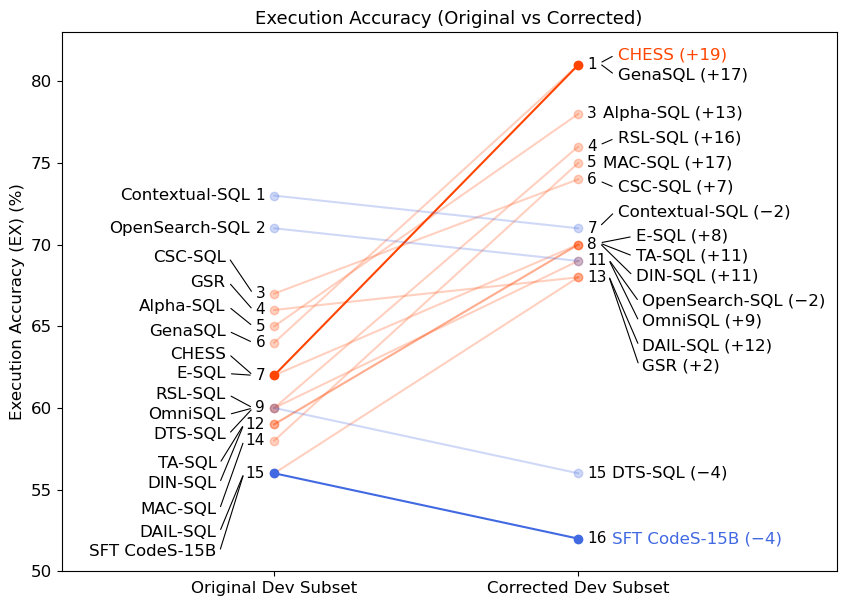
LLMs with scaffolds have lagged on text-to-SQL, a task that relies on human judgment. By folding expert judgment into every part of RLVR on Tinker, @maxYuxuanZhu and @ddkang (UIUC and Bridgwater) trained the first text-to-SQL model to beat the human mark.
https://t.co/JxEQC31rX9
Prior work has shown a counter-intuitive idea that RLVR boosts reasoning using 100% noisy data to a similar level of using clean data. We show that this is false through a more rigorous process of constructing noisy data.
We demonstrate that RLVR with noisy data leads to worse MATH reasoning than RLVR with format-only rewards and over 9% lower accuracy than RLVR with clean data. This is a gap that hasn’t been resolved by existing algorithmic improvements.
1/9
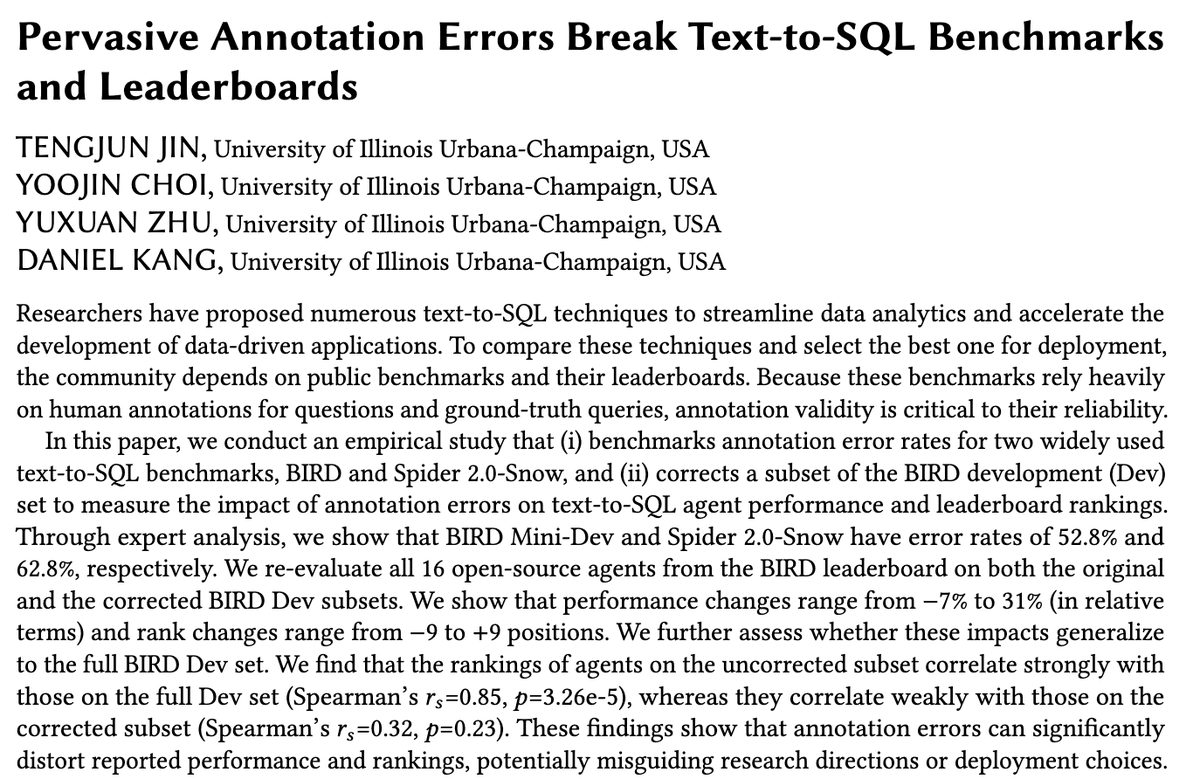
Building text-to-SQL agents? Don’t blindly trust benchmarks/leaderboards. In our VLDB 2026 paper, we find >50% annotation error rates in BIRD and Spider 2.0-Snow, two widely used text-to-SQL benchmarks, shifting agents’ measured performance by up to 19%.
1/9
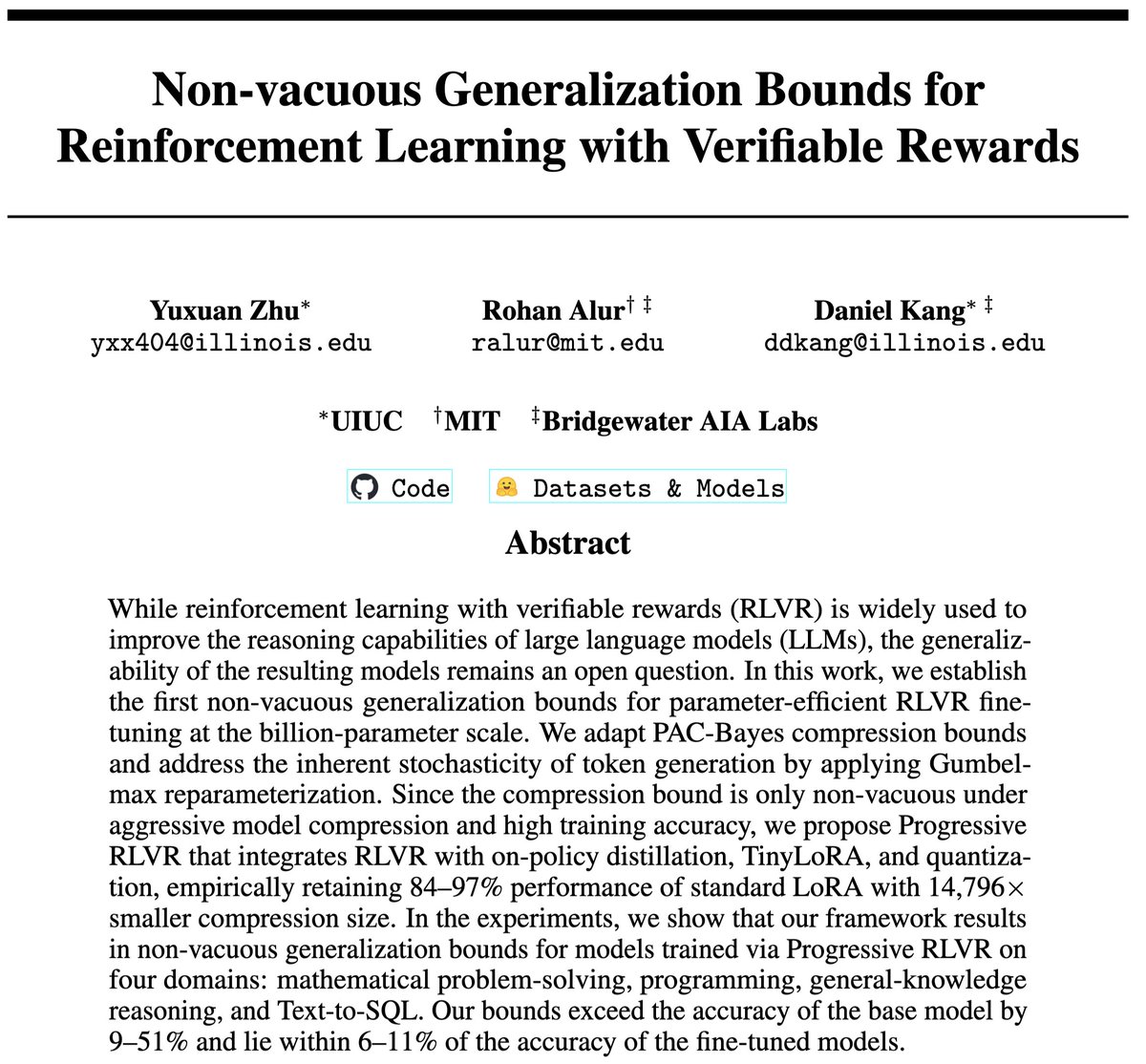
New research from Bridgewater AIA Labs, UIUC, and MIT: we prove what we believe to be the first non-vacuous generalization bounds for reasoning LLMs on real-world problems.
RLVR powers frontier reasoning capabilities yet its generalization to unseen data has remained an open theoretical question and deployment blocker for practitioners. Our generalization bounds for RLVR deliver provable high-probability lower bounds of the accuracy for billion-parameter RLVR models on unseen data, which can provide guidance on safely deploying RLVR.
1/9
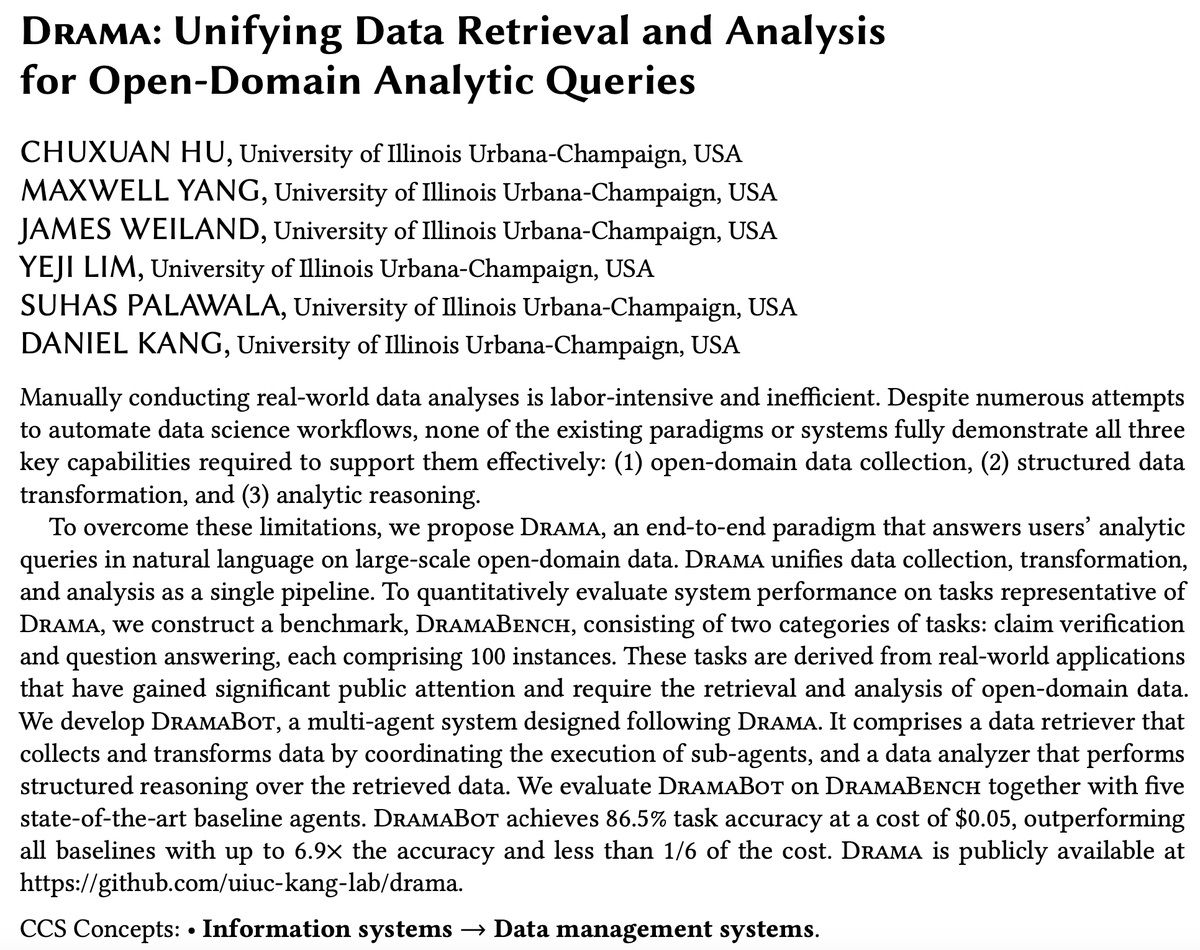
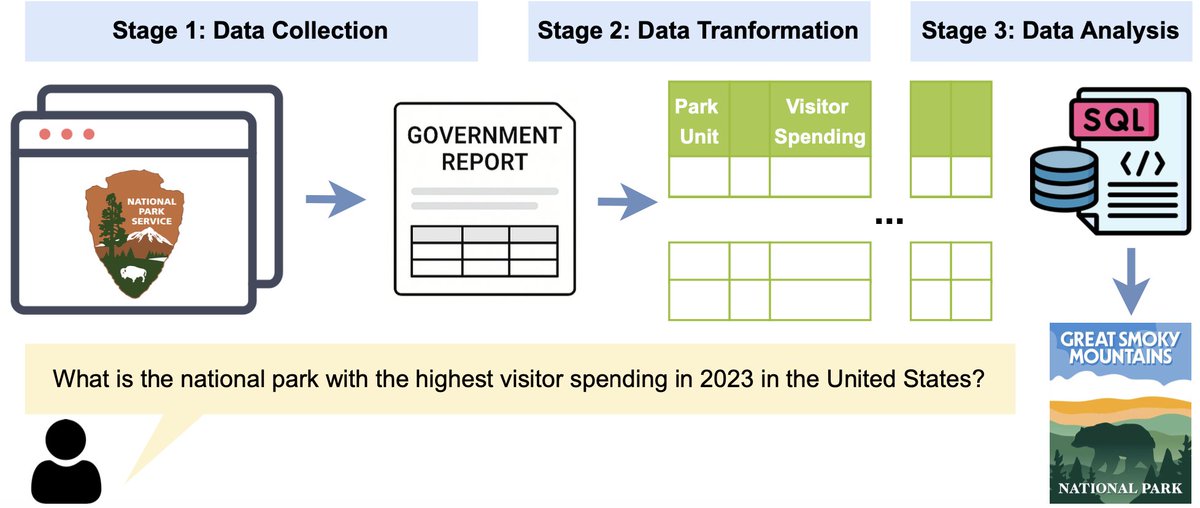
Real-world data science (especially in the social sciences) starts with collecting and structuring data from open domains, yet existing AI agents either assume access to ready-to-query databases or stop at surface-level retrieval and summarization.
To augment data scientists, our #SIGMOD2026 paper presents DRAMA, a new paradigm that unifies data collection, transformation, and analysis, achieving 7× higher accuracy on analytic queries over open-domain data than SOTA agents like the OpenAI research agent. 🎭
1/8
🎉 My book, "Crack Any Codebase with AI", just went live on Manning Publications Co.'s early access program!
The backstory: about a year ago I built an AI tool called Codebase Knowledge Builder that turns any GitHub repo into a readable tutorial. I figured a few people would find it handy. It hit the Hacker News front page with ~1,000 upvotes and crossed 12K GitHub stars in a few days.
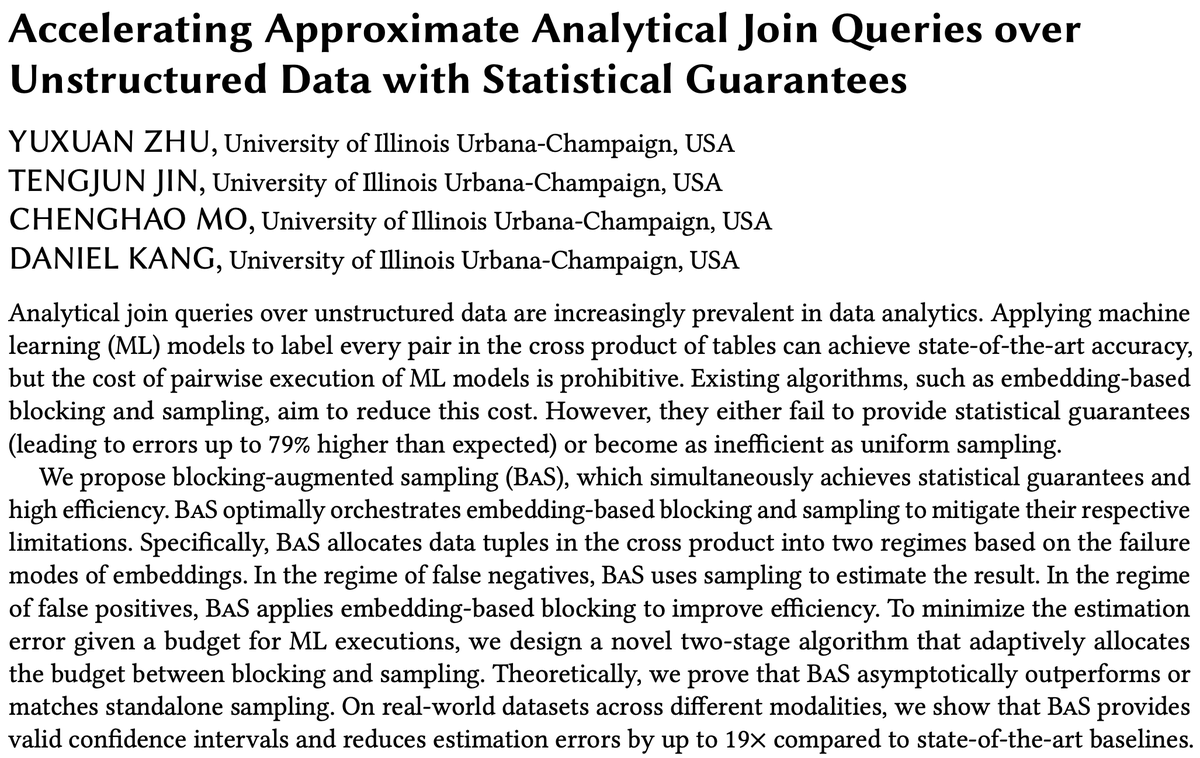
Analytical join queries over unstructured data are everywhere in modern analytics, from matching products across e-commerce catalogs to tracing risk across supply-chain tiers. Using an LLM as an oracle to judge every record pair is accurate, but prohibitively expensive at scale.
In our recent SIGMOD’26 paper, we introduce Blocking-Augmented Sampling (BaS), a new algorithm that accelerates approximate analytical join queries over unstructured data, achieving up to 19× lower error with statistical guarantees.
1/7 🧵
@recursifist@ddkang@pli482004 We evaluate SODIUM-Agent using gpt-5 as the backbone model. However, the model backend is modular and can be easily replaced with other LLMs. Check out our code at: https://t.co/O6JjpiHjBM :)
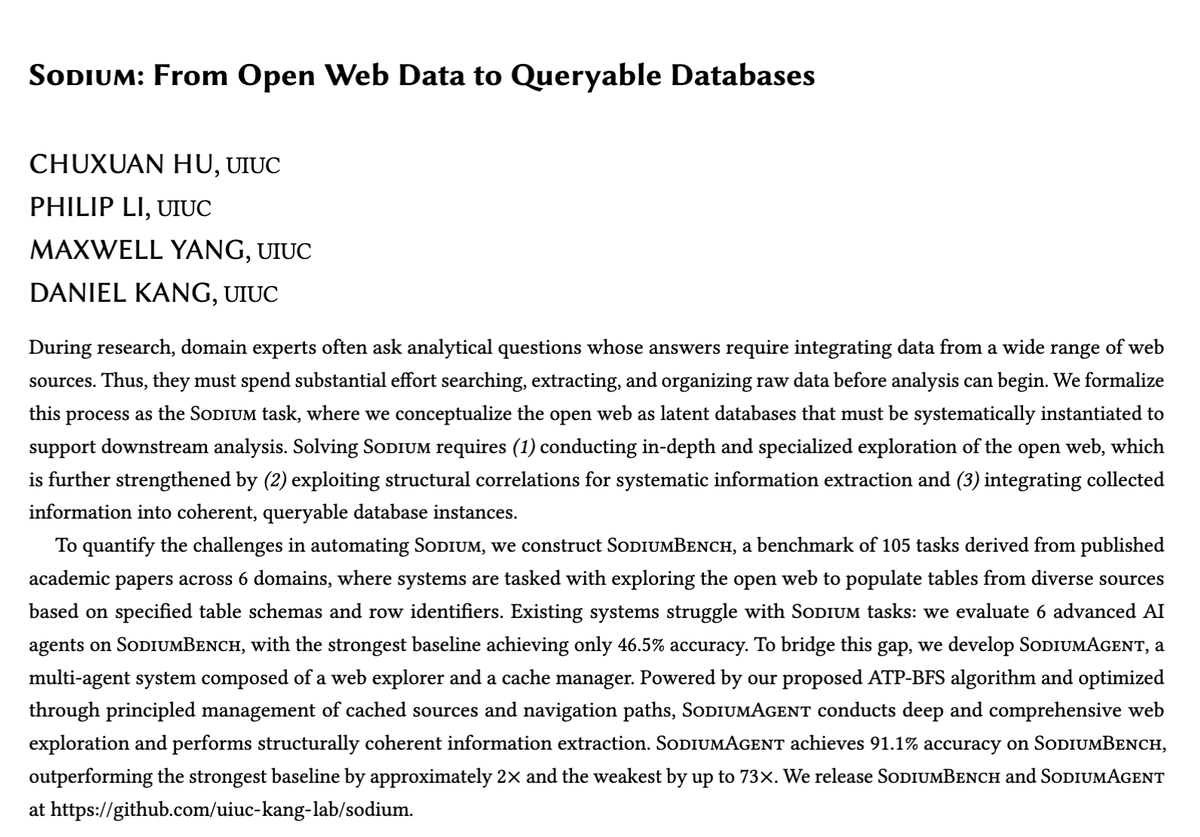
Much of business analysis and social science is extreme drudgery: a demographic researcher might need to pull data from hundreds of sources to study population trends, before starting the actual analysis!
We formalize this overlooked step as SODIUM, where the open web is treated as a latent database.
Existing state-of-the-art AI agents perform poorly on SODIUM tasks: the best performing agent (AG2) achieves only 46% of accuracy. Our SODIUM-Agent achieves over 90% accuracy, outperforming state-of-the-art AI agents by 2x-73x.
1/8
Domain-specific tasks are emerging. RLVR is powerful, but we show that its gains often do not generalize to these unseen domains. Check out our #ICLR paper for more details, and see you in Brazil! 🇧🇷
Excited to share that Breaking Barriers will be presented at #ICLR on Saturday, April 25 at Poster Session 5 (Pavilion 4, P4-#4816)!
We are also bringing new findings: RLVR gains shrink as training epochs decrease, and they show limited generalizability across base models, model sizes, and algorithms
Links below