Zero-knowledge proofs for LLMs “make it harder for attackers to hijack a chat, or enable safety evaluators to verify that the model they’re testing is the same one being served to customers.” However, proving LLM inference remains expensive and requires substantial cryptographic engineering.
Our CCS 2026 paper introduces zkTransformer: we automatically compile Einsum expressions into an efficient proof protocol and make exponentiation cheaper to prove. Together, these techniques make GPT-2 proving over 10× faster than zkGPT in our multi-token evaluation.
The first challenge is translating LLM tensor operations into something a proof system can check. Manually constructing these protocols is tedious and easy to get wrong.
Our EinSumcheck starts from familiar Einsum expressions and automatically compiles them into a sumcheck instance, including the tricky cases where native translation can break the completeness of the protocol.
The second challenge is nonlinear operations such as softmax. Prior work exploits structure in range tables to speed up lookups, but exponentiation tables were believed to be unstructured and expensive to prove.
StructuredExp exposes structure in exponentiation table , enabling prover work that scales sublinearly with the table size.
By integrating the above techniques, zkTransformer brings GPT-2 proving down to approximately 1.7 seconds per token (over 112 generated tokens).
Code: https://t.co/QsGhQDnFXi
Blog post: https://t.co/rQlIVjBeNj
Work w/ Bing-Jyue Chen and Lilia Tang
New Anthropic research: progress on provable inference for large language models.
Here, we introduce FlashProve. Building on established cryptographic techniques, FlashProve allows developers to verify whether a given response came from a given AI model. It’s substantially more efficient than prior open-source methods for doing so.
These proofs have a range of applications. They can, for instance, make it harder for attackers to hijack a chat, or enable safety evaluators to verify that the model they’re testing is the same one being served to customers.
For our full write-up, see here: https://t.co/OIZWPb6QZa
Further progress in provable inference will likely be an important part of improving trust in AI deployment. To that end, we're open-sourcing FlashProve’s code, here: https://t.co/7ky3Ir8V06
We’re grateful to our collaborators: Alessandro Chiesa, @GiacomoFenzi, @gwberg95, @miranda__christ, Rahul Dalal (https://t.co/pjWKLHWXyz) and Ben Mayer (@transmissions11).
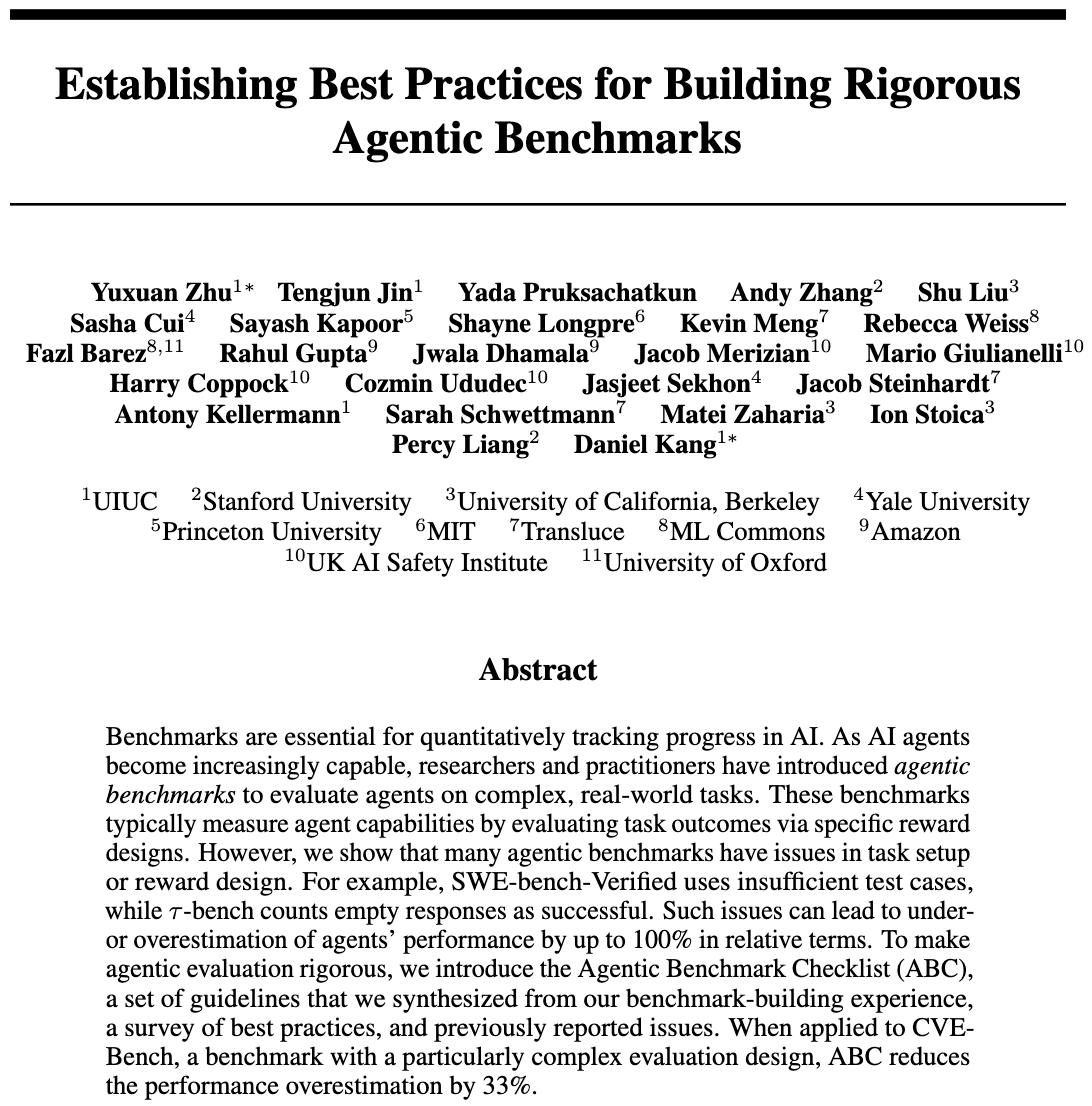
We've long known that AI agent benchmarks are broken. Check out our work back from July 2025 on establishing best practices for making rigorous AI agent benchmarks!
(links below)
Introducing Benchmark Reviews: our new initiative to audit AI benchmarks. We are launching with 15 benchmarks: 4 Verified, 9 Flawed, and 2 with not enough information for a review.
New research from Bridgewater AIA Labs and UIUC, in collaboration with Thinking Machines!
We use @tinkerapi to achieve state-of-the-art on a cleaned version of the BIRD text-to-SQL dataset, outperforming all frontier models we tested (including Fable and Sol) up to 8x cheaper. We achieve a proxy for human-level accuracy with no external scaffolding and a single model (w/ multiple rollouts).
The common view on fine-tuning is it reduces price. Our results show the feasibility of achieving a higher performance at a fraction of the cost on economically valuable tasks, when incorporating task expertise into task-specific training.
1/6
LLMs with scaffolds have lagged on text-to-SQL, a task that relies on human judgment. By folding expert judgment into every part of RLVR on Tinker, @maxYuxuanZhu and @ddkang (UIUC and Bridgwater) trained the first text-to-SQL model to beat the human mark.
https://t.co/JxEQC31rX9
Prior work has shown a counter-intuitive idea that RLVR boosts reasoning using 100% noisy data to a similar level of using clean data. We show that this is false through a more rigorous process of constructing noisy data.
We demonstrate that RLVR with noisy data leads to worse MATH reasoning than RLVR with format-only rewards and over 9% lower accuracy than RLVR with clean data. This is a gap that hasn’t been resolved by existing algorithmic improvements.
1/9
🤯 We cracked RLVR with... Random Rewards?!
Training Qwen2.5-Math-7B with our Spurious Rewards improved MATH-500 by:
- Random rewards: +21%
- Incorrect rewards: +25%
- (FYI) Ground-truth rewards: + 28.8%
How could this even work⁉️ Here's why: 🧵
Blogpost: https://t.co/jBPlm7cyhr
There is no shortcut to strong reasoning via RLVR. If we want smarter models, our empirical evidence shows that we need high-quality data. For more details, please check our paper and code:
Paper: https://t.co/2Wmr9JjniP
GitHub: https://t.co/MI9IdTCXWI
8/9