New research from Bridgewater AIA Labs and UIUC, in collaboration with Thinking Machines!
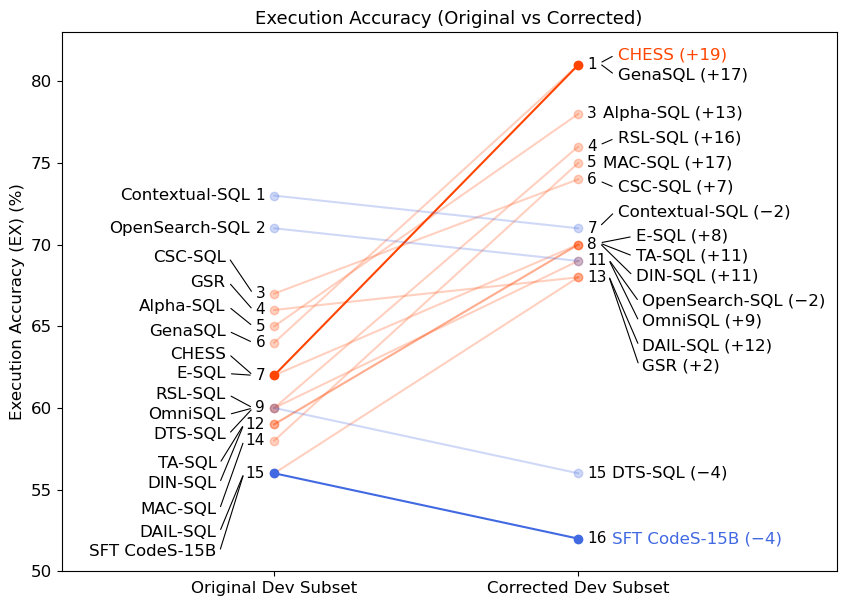
We use @tinkerapi to achieve state-of-the-art on a cleaned version of the BIRD text-to-SQL dataset, outperforming all frontier models we tested (including Fable and Sol) up to 8x cheaper. We achieve a proxy for human-level accuracy with no external scaffolding and a single model (w/ multiple rollouts).
The common view on fine-tuning is it reduces price. Our results show the feasibility of achieving a higher performance at a fraction of the cost on economically valuable tasks, when incorporating task expertise into task-specific training.
1/6
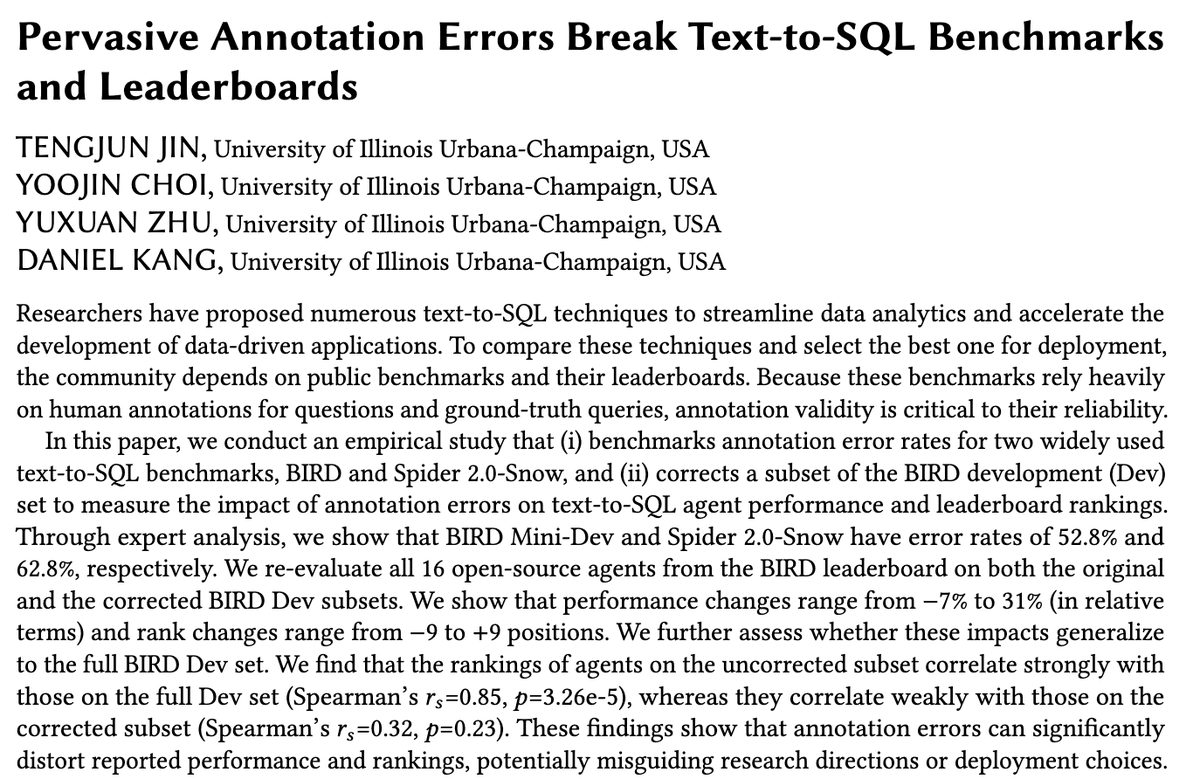
Building text-to-SQL agents? Don’t blindly trust benchmarks/leaderboards. In our VLDB 2026 paper, we find >50% annotation error rates in BIRD and Spider 2.0-Snow, two widely used text-to-SQL benchmarks, shifting agents’ measured performance by up to 19%.
1/9
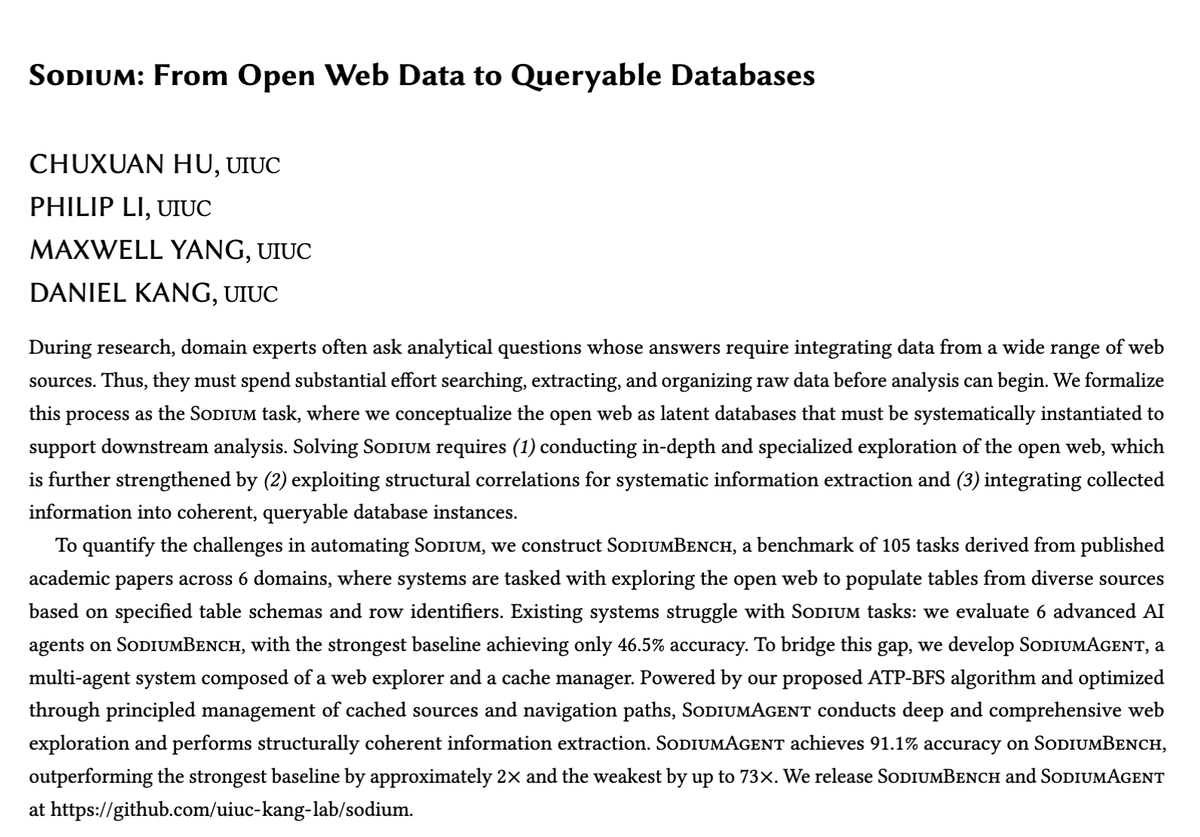
Much of business analysis and social science is extreme drudgery: a demographic researcher might need to pull data from hundreds of sources to study population trends, before starting the actual analysis!
We formalize this overlooked step as SODIUM, where the open web is treated as a latent database.
Existing state-of-the-art AI agents perform poorly on SODIUM tasks: the best performing agent (AG2) achieves only 46% of accuracy. Our SODIUM-Agent achieves over 90% accuracy, outperforming state-of-the-art AI agents by 2x-73x.
1/8
It's that time of year again! I'm actively recruiting PhD students, please apply to UIUC if you're interested in working with me
My research interests are very broad and we've won several awards this last year:
1. I care about rigorous measurement of AI progress via benchmarks and best practices,
2. I care about deploying AI securely and safely, and
3. I care about improving AI in narrowly tailored capabilities, with an emphasis on data tasks
Thread for some of our recent work
As AI agents near real-world use, how do we know what they can actually do? Reliable benchmarks are critical but agentic benchmarks are broken!
Example: WebArena marks "45+8 minutes" on a duration calculation task as correct (real answer: "63 minutes"). Other benchmarks misestimate agent competence by 1.6-100%.
Why are the evaluation foundations for agentic systems fragile? See below for thread and links
1/8
Data engineers spend over 60% of their time on data pipelines. Can AI agents help?
Introducing ELT-Bench, the first benchmark evaluating AI agents on building end-to-end ELT pipelines. Current SOTA agents achieve only a 3.9% success rate - there's a huge way to go!
1/7
Recent research found that malicious AI agents are scanning the internet for vulnerabilities. How dangerous are AI agents at finding & exploiting real-world web vulns? We don't know!
Introducing CVE-Bench, the first benchmark evaluating AI agents on real-world web exploits.
1/8
AI agents are increasingly popular (e.g., OpenAI's operator) but can be attacked to harm users!
We show that even with defenses, AI agents can still be compromised via indirect prompt injections via "adaptive attacks" in our NAACL 2025 findings paper
🧵 and links below
Our new paper, LEAP, was accepted to VLDB 2025!
AI/ML is powerful, but challenging to use for non-experts. We built an end-to-end library that automatically executes full pipelines to apply AI/ML over unstructured data (text, images, etc.)
1/7
OpenAI recently released its real-time voice API, enabling new applications.
Unfortunately, it also enables autonomous AI agents to perform common phone scams. Phone scams already target up to 17M Americans with $40B in costs, with potential for worse.
Links and thread below 🧵
@OpenAI claimed in their GPT-4 system card that it isn't effective at finding novel vulnerabilities.
We show this is false. AI agents can autonomously find and exploit zero-day vulnerabilities.
Paper: https://t.co/ywjCe7BfE6
🧵 1/7
We showed that LLM agents can autonomously hack mock websites, but can they exploit real-world vulnerabilities?
We show that GPT-4 is capable of real-world exploits, where other models and open-source vulnerability scanners fail.
Paper: https://t.co/utbmMdYfmu
1/7
🚨 LLM agents can be compromised by content from external sources. Wonder how vulnerable they are?
🌟 Introducing InjecAgent for evaluating the resilience of LLM agents against IPI attacks.
📄 Paper: https://t.co/MEGOy4GBEr
💻 Code: https://t.co/y78bs7rBKg
1/5
OpenAI announced GPT-4 fine-tuning this week. Fine-tuning can remove RLHF protections from weak models, but is GPT-4 susceptible?
Unfortunately yes: removing RLHF protections from GPT-4 is trivial
Paper: https://t.co/DiNcMpj4wp
🧵1/6
Business analysts to legal scholars want to use ML to understand their unstructured data. But it’s costly and difficult.
We’re announcing AIDB, an open-source framework that makes analyzing unstructured data as simple as running a SQL query!
https://t.co/hQFaQufUox
🧵 1/7