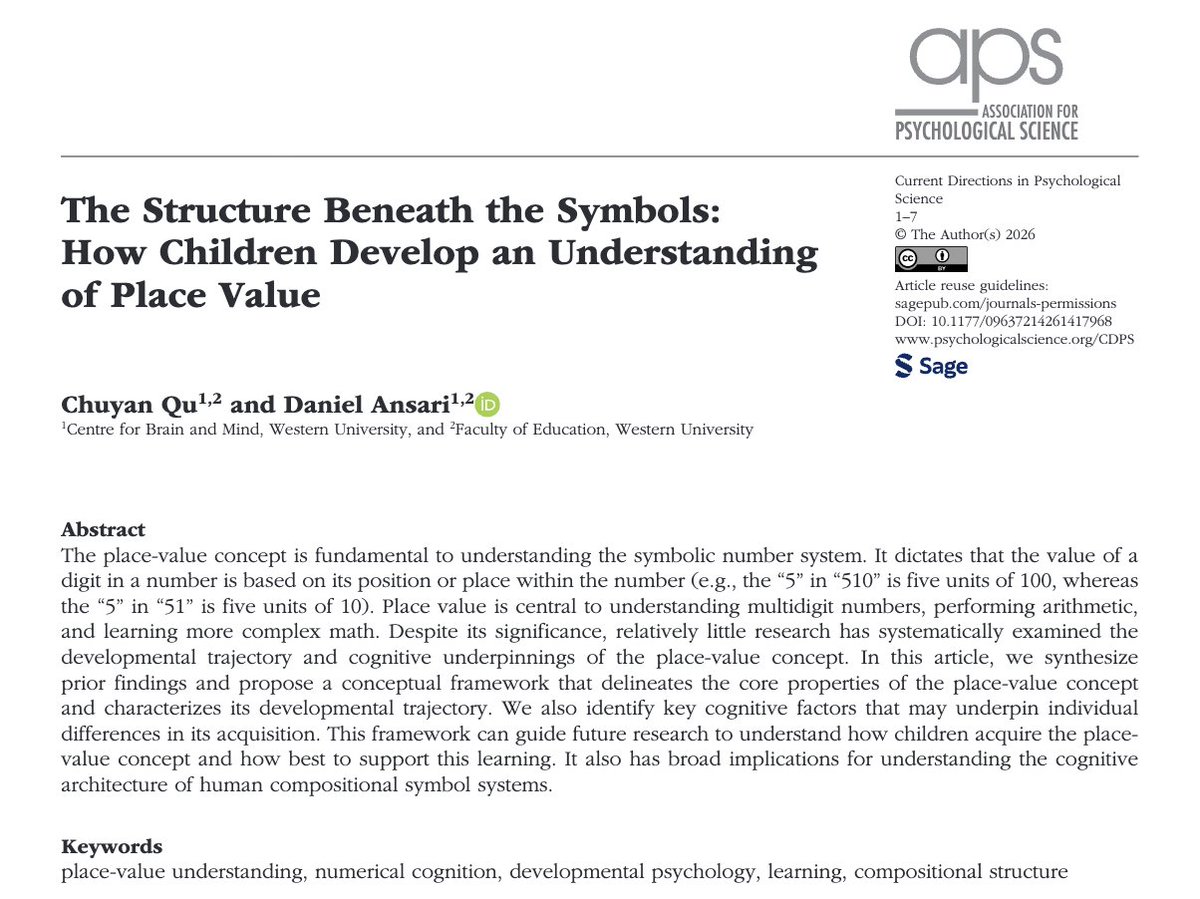
📢New paper out in CDPS with my amazing supervisor Daniel Ansari!
The Structure Beneath the Symbols: How Children Develop an Understanding of Place Value
https://t.co/iQpDyS1yZL
I am recruiting graduate students! I'll review applications through both the Cognitive & Developmental areas. Interested students are encouraged to be in touch; I'd love to chat with you!
Find out more: https://t.co/jK18tAdQIO
Earlier this year, Sam Clarke, Liz Brannon, and I published a paper taking a critical look at the phenomenon of *number adaptation*.
A reply by Burr, Anobile, and Arrighi is forthcoming in Cognition. You can see their reply here: https://t.co/p3WHLdMFef
Thrilled to share this new paper in JEP: General!
w/@michaelfbonner@DewindNick and Liz Brannon @liz07435499
Visual coherence derived from natural statistics of object co-occurrence increases our perceived number, independent of semantic content.
https://t.co/pa97NTvzxl
"Rational Number Representation by the Approximate Number System"
📢 New from: @chuyanqu, Sam Clarke, Francesca Luzzi, & Liz Brannon
https://t.co/damhrwg0dM
🧵👇
These results vindicate key predictions of the hypothesis that the approximate number system represents full-blown rational numbers, though the discussion highlights numerous questions for future study.
New paper out now in Cognition!
The approximate number system (ANS) enables organisms to represent the approximate number of items in a collection, but numbers of what kind? We present evidence that the ANS represents rational numbers.
https://t.co/rNlaoOybO6
Finally, we identify an intriguing asymmetry in participants' responses which is independently predicted by the idea that rational numbers are being represented using a part-whole format (like a fraction) rather than a part-part format (like a ratio).
Looking for a full-time research coordinator to work on a longitudinal fNIRS and ERP study of numerical development in 3-6 year old children https://t.co/EpbUoKpT7H
Our paper taking a critical look at *number adaptation* has been accepted at Cognition!
But that's not all: Cognition has also agreed to publish a short back and forth with folks who disagree with us, so stay tuned for that in the near future!
https://t.co/chPCdgnaZd
I'm starting a lab! This summer I'll join both the cognitive and developmental areas in the Psychology department at UNC Chapel Hill. I'm excited for and humbled by the opportunity. Here's a sneak peak at the lab: https://t.co/jK18tAdiTg
Soon to be published in JEP:G, our first paper about the perception and cognition of *topological relations*. What we show here is that people readily distinguish (and remember, and match) items based on their topological relations. See examples below!
https://t.co/XI3xB8Czp3
New preprint on an intriguing visual illusion of numerosity, with @michaelfbonner@DewindNick and Liz Brannon! Coherence derived from natural statistics of object co-occurrence increases our perceived number via low-level visual processing stages.
https://t.co/WWThIVa7r1
Our results thereby support and refine the hypothesis that the approximate number system represents full-blown rational numbers, though our discussion highlights several remaining questions apt for future empirical inquiry.
Excited to share our new preprint in which we (Sam Clarke & Liz Brannon) describe two new experiments (and a bunch of subsequent analyses) testing Clarke & Beck’s (2021) hypothesis that the approximate number system represents rational numbers.
https://t.co/yZXce4nS77
and (c) we identify an intriguing asymmetry in participants' performance which is independently predicted by the idea that ratios are being represented using a part-whole format (like a fraction) rather than a part-part format (like a literal ratio).