Un nerd de 33 años acaba de convertir $1.000 en $946.207 operando Bitcoin, con un truco que robó de los pronósticos de huracanes.
Sin título en finanzas. Sin mesa de trading. Solo un truco que todo meteorólogo aplica y todo trader olvida.
Wallet pública:
https://t.co/J65WvxHpdC
El truco: los meteorólogos nunca pronostican el mañana con un solo modelo. Corren 31 y cuentan los votos. Él apuntó exactamente ese mismo truco hacia Bitcoin.
Un agente de Claude lee cada mercado de BTC de 5 minutos y lo mete en MiroFish, una simulación que corre 31 rutas de modelo y solo dispara cuando 28 de ellas coinciden. Por debajo de 26 votos, mata la operación.
La velocidad de cobertura del sistema de agentes es muchísimo mayor que la de cualquier equipo de trading de élite.
Recopilan datos 24/7 y corren simulaciones con esos datos en el motor de MiroFish, de forma completamente autónoma.
Cada operación es un ciclo perfecto. Cada dólar ganado es pura explotación de la ineficiencia del mercado.
Esa es toda la ventaja. No una predicción. Un quórum.
Dimensiona con Kelly y aprieta un botón. La mayoría de las señales nunca pasan la votación, así que la mayoría de los días se queda quieto.
Pasó años aprendiendo que la certeza es una estafa y el consenso es la ventaja.
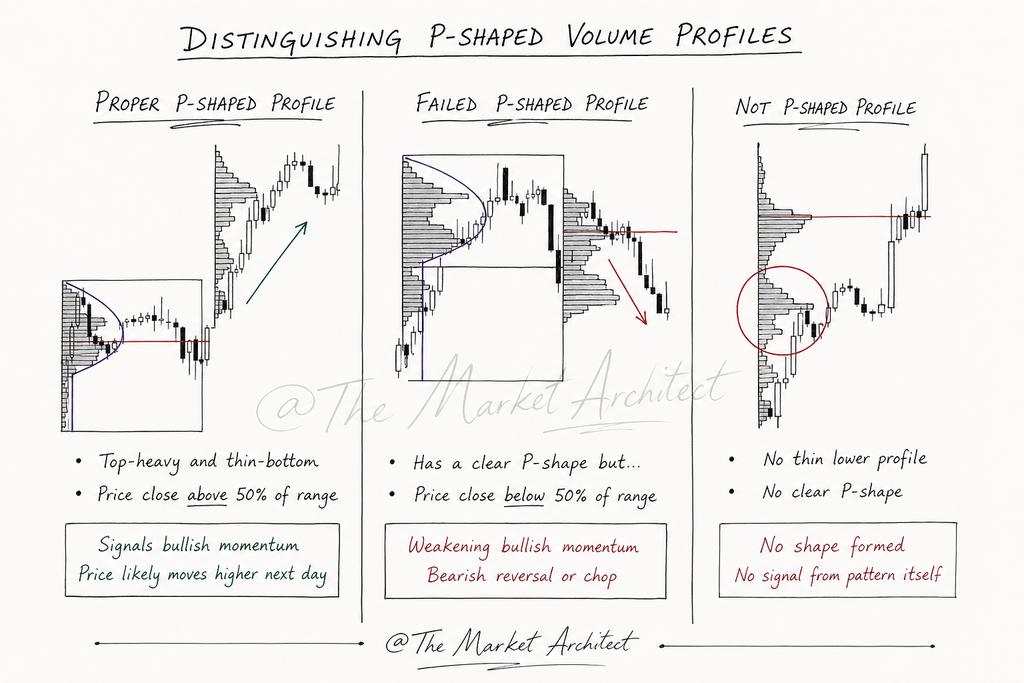
Most traders use Volume Profile wrong.
They mark POC, HVN and LVN but never understand how price actually reacts around them.
Once you understand acceptance vs rejection, entries become much easier.
Here’s how I use it 👇 a Thread 🧵 Like, comment and Repost for more.
When you truly understand this 100% your key levels in the trending market become sharper and your win rate improves.
P-Shape. b-Shape.
Not just patterns they reveal who is in control of the market.
🔹 P-Shaped Profile
Shorts are trapped. Price squeezes higher.
Smart traders look for continuation and build levels around value acceptance.
🔹 b-Shaped Profile
Buyers are exiting. Weak hands get flushed out.
Key levels form where distribution shifts often leading to downside continuation or reversal setups.
Understand the story behind the volume and your levels stop being guesses they become precision.
Which profile is not in the picture? 👇
卧槽,这篇《How to Simulate Like a Quant Desk》太牛逼了,
所有观点都经过了作者交易实践观察+行为心理学认知偏误实证的,
讲的是一套从散户入门到机构级的预测市场量化模拟完整体系,
作者gemchanger以“硬币翻转的散户认知误区”为起点,
以蒙特卡洛方法为核心根基,
逐层拆解了从基础概率估算到生产级交易系统的全链路技术、可运行代码与理论支撑,
彻底解决了散户在预测市场交易中概率估算失准、尾部风险失控、无法动态适配新信息、忽略极端联动性等核心痛点,
每一层内容环环相扣,最终形成一套可直接落地的量化交易模拟全栈,
具体提炼总结在评论区👇
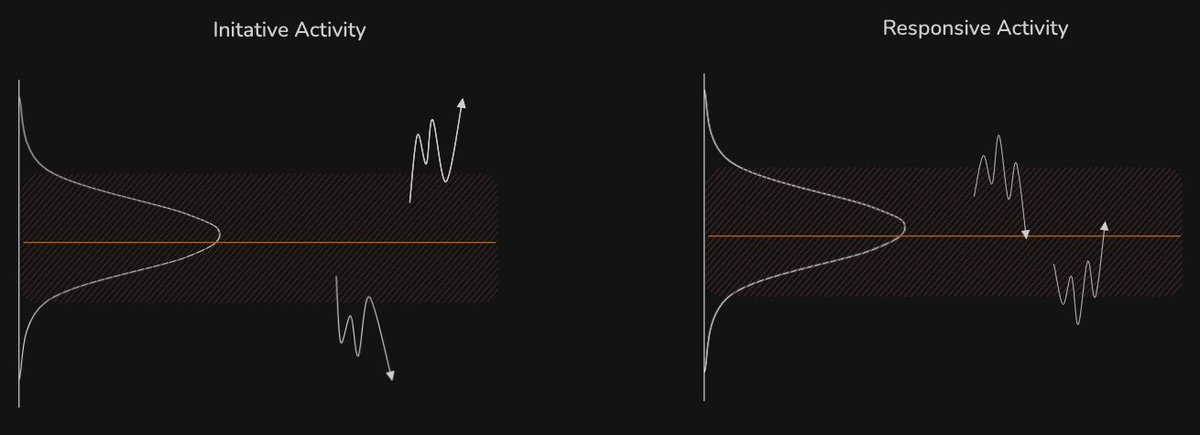
Responsive Activity and Initative Activity🧵
A practical perspective to read orderflow is to watch the behaviour of participants at the edges of value (the extremes).
Behaviour of these participants usually what defines acceptance and failed auctions.
i've learned many lessons this year but one easily stands above the rest. one i feel like was under my nose my for a long time
the greatest indicator i've seen for figuring out if you're doing the right thing in trading (or anything else for that matter) has been not doing what everyone else is doing
if you want to be exceptional (and you have to be to generate consistent returns) you cannot be doing what everyone else is doing. they are an antithesis to one another
when i reflect on some of the best traders i've encountered on CT, they have all had certain first principles in common but were ultimately very unique in their personal approach to the markets. all of them were 'the best' in their own category. and almost all of them arrived to that position through a journey entirely constructed on their own
in 2021-2023 i made most of my returns scalping altcoin perps using naked tick charts. for me, they painted a picture of microstructure that i had not been able to find any other way. before finding this edge for myself, i did not see a single trader using this approach. i was called retarded and a gambler for much of this time - which definitely created self-doubt. but looking back, its clear that part of my success came from the decision to do something different
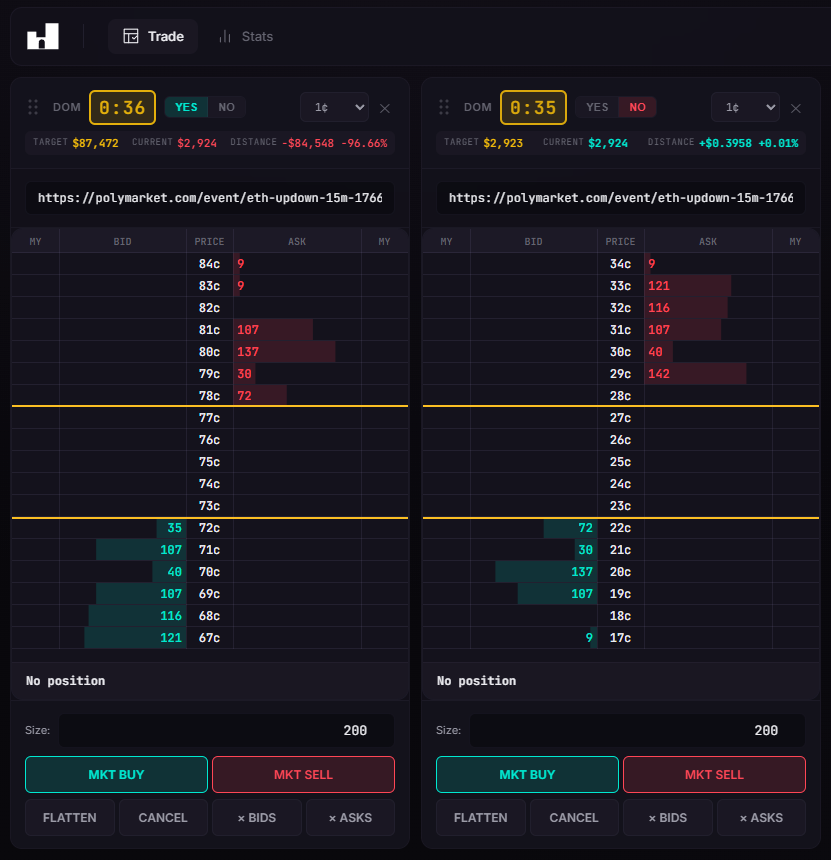
for the last few weeks, i've been trading crypto up/down markets on polymarket using a DOM interface. an edge i found on my own in an attempt to take advantage of a growing set of traders vibe coding highly inefficient bots you see all over the timeline
i find my self in a similar position as last time. again, it probably sounds stupid and impractical at the surface level. and also again, i haven't seen anyone do anything similar
is the edge large and persistent enough for massive returns? who knows. but the point is the journey of finding something that works for yourself. entirely on your own
replicating what you already see will almost never work. you need your own secret sauce
merry xmas
i wish you all success in your own journeys in the new year
[Attack on MM 3: Statistical Advantages and Signal Design ]
The previous two episodes mentioned order flow and inventory quotes, which sound like market makers can only passively adjust, but do they have proactive means? The answer is yes. Today, we'll introduce statistical advantages and signal design, which are also the "micro alpha" that market makers pursue.
1, wtf is Market Makers' Alpha?
Micro alpha refers to a "conditional probability shift" in the direction of the next price movement / mid-price drift / asymmetry in executions over extremely short time scales (~100ms to ~10s).
It's important to note that the alpha in the eyes of market makers (MMs) isn't about trend prediction or guessing the magnitude of rises and falls; it just needs a probability shift. This is different from the alpha we commonly talk about.
Next, I'll explain it in plain language:Market makers' statistical advantage can be understood as, within an extremely short time window, whether the order book state "leans toward" making the price move one step in a certain direction first. If MMs successfully calculate the probability of the price direction in the next millisecond through some indicators, they can:
1. Be more willing to buy before a more likely rise. 2. Withdraw buy orders faster before a more likely fall. 3. Reduce exposure during dangerous moments.
The financial foundation for predicting the next price direction is: due to factors like order flow, order volume, and order book cancellation ratios (which we'll discuss later), the market isn't a "random walk" Brownian motion in a short instant but has directionality. The above sentence is the financial translation of the mathematical concept of "conditional probability."With these alphas, market makers can directionally operate on prices, and the "house" finally earns money from price levels rather than just spreads as service fees.
2, Classic Signal Introduction
2.1 Order Book Imbalance: OBI
OBI looks at which side has "more people standing" near the current price level; it's a standardized volume differential statistic.This formula is actually not difficult—it's just a summation of proportional logic. It checks if there are more buy orders or sell orders.
OBI approaching 1 means almost all are bid orders, with thick support below. Approaching -1 means thick resistance above. Approaching 0 means buys and sells are relatively symmetric. It's worth noting that OBI is a "static snapshot," a classic indicator but ineffective on its own; it needs to be used with cancellation ratios, order book slopes, etc.
2.2 Order Flow Imbalance (OFI)
OFI looks at who has been aggressively attacking in the recent short period. OFI is the first-order driver of price changes because prices are driven by taker orders, not by limit orders. It has a bit of a net buy-sell volume feel.
In the Kyle (1985) framework, ΔP ≈ λ ⋅ OFI, where λ is the tick depth, so OFI is the factor that drives prices.
2.3 Queue Dynamics
Most exchanges now use continuous auction rules, following best price and FCFS (first-come, first-served) principles, so submitted orders queue up to be filled. The queue represents the limit order situation, and the queue determines the order book state. Abnormal order book states (including replenishment and cancellation situations) imply directional price changes, which is micro alpha.Queues need attention in two situations:
1, Iceberg: Hidden orders.
For example, only 10 lots are visibly hanging, but every time they're filled, another 10 lots are immediately replenished. The actual true intention might be 1,000 lots. The method I introduced in the first episode for annoying market makers to lower cost basis is actually a manual iceberg. In practice, some players who want to hide real order sizes also use icebergs.
2, Spoof (Fake Orders).
Hanging large orders on one side to create a "pressure illusion," then quickly withdrawing them before the price approaches. Spoofing pollutes OBI and Slope, etc., making the queue falsely thicken and increasing movement risk. At the same time, some large spoofs can scare the market and potentially manipulate prices. The London exchange caught a guy manipulating forex in 2015 who used spoofing. But in the crypto world, we can also manually spoof to annoy market makers, but if it actually gets filled, your exposure becomes huge.
2.4 Order Book Cancellation Ratio (Cancel Ratio)
The cancellation ratio is an estimate of liquidity "disappearance rate": Cancel ↑ ⇒ Slope ↓ ⇒ λ ↑ ⇒ ΔP more sensitive. It's a leading instability signal ahead of OFI. CR → 1: Almost pure cancellations. CR → 0: Almost pure replenishments. The mathematical formulas in this episode are all simple; you can interpret them by looking at charts.
CR ↑ ⟹ The passive side believes future risk is rising. At the same time, CR isn't used alone; it's always combined with OFI and such.
The above might just be some outdated order book games; market making evolves quickly, and after stocks go on-chain, JS and other MMs might all get involved in on-chain market making. But these indicators are still useful and inspiring.
3, Market Makers' Absolute Domain: Speed
We often hear in movies that a certain fund has faster internet, so they're more badass. Including how many market makers move their server rooms closer to exchange servers—why is that? At the end of this article, let's talk about the advantages of physical equipment and the "execution advantage" unique to crypto exchanges.
Latency Arbitrage isn't about predicting future prices but about executing buy/sell orders at more favorable prices "before others react." In theoretical models: Prices are continuous, information is synchronous. But in reality: Markets are event-driven, information arrives asynchronously. Why does information arrive asynchronously? Because receiving exchange price signals and sending order instructions to the exchange both take time—this is a physical world limitation. Even in fully compliant markets: Different exchanges, different data sources, different matching engines, different geographic locations all cause delays. So MMs with more advanced equipment have the initiative.
This tests the market makers' own strength and has little to do with other players, so I think it's their absolute domain.The simplest example: Suppose you want to sell a position, and you quote at the market's best ask price, theoretically it should execute, but I also want to sell. Since I see prices and quote faster than you, I fill the order first, leaving your inventory unable to exit, preventing your position from returning to neutral.
Real situations are much more complex. An interesting point is that, since there's no regulation yet, almost all crypto exchanges can directly give priority execution rights to specified accounts. Meaning, the right to cut in line for certain specified accounts. This is especially common in small exchanges, showing that in crypto, becoming an "insider" is as important as in research. Whether you can safely execute is a key step from alpha theory to practice.
In this episode, I tried writing from the MM perspective; actual operations are definitely more complex, like dynamic queues and many details to watch in practice. Welcome comment.
Postscript: Actually, this article has a regret. The title "Domain Expansion in Market Making" was originally meant for dynamic hedging and options, because I think that's the conceptually hardest part of market making, worthy of the big move "domain expansion." But I worked on it all day yesterday, wrote half the article, and really didn't know how to systematically explain it, so I switched to micro alpha.
Danny has an article that mentions many professional hedging concepts; I encourage everyone to check it out: https://t.co/xwAtz9WXjs.
We'll talk about that section later, perhaps sharing it in fragments.
Thanks for supporting the Advancing MM series, stay tuned.




![bc1qDave's tweet photo. [Attack on MM 3: Statistical Advantages and Signal Design ]
The previous two episodes mentioned order flow and inventory quotes, which sound like market makers can only passively adjust, but do they have proactive means? The answer is yes. Today, we'll introduce statistical advantages and signal design, which are also the "micro alpha" that market makers pursue.
1, wtf is Market Makers' Alpha?
Micro alpha refers to a "conditional probability shift" in the direction of the next price movement / mid-price drift / asymmetry in executions over extremely short time scales (~100ms to ~10s).
It's important to note that the alpha in the eyes of market makers (MMs) isn't about trend prediction or guessing the magnitude of rises and falls; it just needs a probability shift. This is different from the alpha we commonly talk about.
Next, I'll explain it in plain language:Market makers' statistical advantage can be understood as, within an extremely short time window, whether the order book state "leans toward" making the price move one step in a certain direction first. If MMs successfully calculate the probability of the price direction in the next millisecond through some indicators, they can:
1. Be more willing to buy before a more likely rise. 2. Withdraw buy orders faster before a more likely fall. 3. Reduce exposure during dangerous moments.
The financial foundation for predicting the next price direction is: due to factors like order flow, order volume, and order book cancellation ratios (which we'll discuss later), the market isn't a "random walk" Brownian motion in a short instant but has directionality. The above sentence is the financial translation of the mathematical concept of "conditional probability."With these alphas, market makers can directionally operate on prices, and the "house" finally earns money from price levels rather than just spreads as service fees.
2, Classic Signal Introduction
2.1 Order Book Imbalance: OBI
OBI looks at which side has "more people standing" near the current price level; it's a standardized volume differential statistic.This formula is actually not difficult—it's just a summation of proportional logic. It checks if there are more buy orders or sell orders.
OBI approaching 1 means almost all are bid orders, with thick support below. Approaching -1 means thick resistance above. Approaching 0 means buys and sells are relatively symmetric. It's worth noting that OBI is a "static snapshot," a classic indicator but ineffective on its own; it needs to be used with cancellation ratios, order book slopes, etc.
2.2 Order Flow Imbalance (OFI)
OFI looks at who has been aggressively attacking in the recent short period. OFI is the first-order driver of price changes because prices are driven by taker orders, not by limit orders. It has a bit of a net buy-sell volume feel.
In the Kyle (1985) framework, ΔP ≈ λ ⋅ OFI, where λ is the tick depth, so OFI is the factor that drives prices.
2.3 Queue Dynamics
Most exchanges now use continuous auction rules, following best price and FCFS (first-come, first-served) principles, so submitted orders queue up to be filled. The queue represents the limit order situation, and the queue determines the order book state. Abnormal order book states (including replenishment and cancellation situations) imply directional price changes, which is micro alpha.Queues need attention in two situations:
1, Iceberg: Hidden orders.
For example, only 10 lots are visibly hanging, but every time they're filled, another 10 lots are immediately replenished. The actual true intention might be 1,000 lots. The method I introduced in the first episode for annoying market makers to lower cost basis is actually a manual iceberg. In practice, some players who want to hide real order sizes also use icebergs.
2, Spoof (Fake Orders).
Hanging large orders on one side to create a "pressure illusion," then quickly withdrawing them before the price approaches. Spoofing pollutes OBI and Slope, etc., making the queue falsely thicken and increasing movement risk. At the same time, some large spoofs can scare the market and potentially manipulate prices. The London exchange caught a guy manipulating forex in 2015 who used spoofing. But in the crypto world, we can also manually spoof to annoy market makers, but if it actually gets filled, your exposure becomes huge.
2.4 Order Book Cancellation Ratio (Cancel Ratio)
The cancellation ratio is an estimate of liquidity "disappearance rate": Cancel ↑ ⇒ Slope ↓ ⇒ λ ↑ ⇒ ΔP more sensitive. It's a leading instability signal ahead of OFI. CR → 1: Almost pure cancellations. CR → 0: Almost pure replenishments. The mathematical formulas in this episode are all simple; you can interpret them by looking at charts.
CR ↑ ⟹ The passive side believes future risk is rising. At the same time, CR isn't used alone; it's always combined with OFI and such.
The above might just be some outdated order book games; market making evolves quickly, and after stocks go on-chain, JS and other MMs might all get involved in on-chain market making. But these indicators are still useful and inspiring.
3, Market Makers' Absolute Domain: Speed
We often hear in movies that a certain fund has faster internet, so they're more badass. Including how many market makers move their server rooms closer to exchange servers—why is that? At the end of this article, let's talk about the advantages of physical equipment and the "execution advantage" unique to crypto exchanges.
Latency Arbitrage isn't about predicting future prices but about executing buy/sell orders at more favorable prices "before others react." In theoretical models: Prices are continuous, information is synchronous. But in reality: Markets are event-driven, information arrives asynchronously. Why does information arrive asynchronously? Because receiving exchange price signals and sending order instructions to the exchange both take time—this is a physical world limitation. Even in fully compliant markets: Different exchanges, different data sources, different matching engines, different geographic locations all cause delays. So MMs with more advanced equipment have the initiative.
This tests the market makers' own strength and has little to do with other players, so I think it's their absolute domain.The simplest example: Suppose you want to sell a position, and you quote at the market's best ask price, theoretically it should execute, but I also want to sell. Since I see prices and quote faster than you, I fill the order first, leaving your inventory unable to exit, preventing your position from returning to neutral.
Real situations are much more complex. An interesting point is that, since there's no regulation yet, almost all crypto exchanges can directly give priority execution rights to specified accounts. Meaning, the right to cut in line for certain specified accounts. This is especially common in small exchanges, showing that in crypto, becoming an "insider" is as important as in research. Whether you can safely execute is a key step from alpha theory to practice.
In this episode, I tried writing from the MM perspective; actual operations are definitely more complex, like dynamic queues and many details to watch in practice. Welcome comment.
Postscript: Actually, this article has a regret. The title "Domain Expansion in Market Making" was originally meant for dynamic hedging and options, because I think that's the conceptually hardest part of market making, worthy of the big move "domain expansion." But I worked on it all day yesterday, wrote half the article, and really didn't know how to systematically explain it, so I switched to micro alpha.
Danny has an article that mentions many professional hedging concepts; I encourage everyone to check it out: https://t.co/xwAtz9WXjs.
We'll talk about that section later, perhaps sharing it in fragments.
Thanks for supporting the Advancing MM series, stay tuned.](https://pbs.twimg.com/media/G9I0YdjbgAILWfs.png)
![bc1qDave's tweet photo. [Attack on MM 3: Statistical Advantages and Signal Design ]
The previous two episodes mentioned order flow and inventory quotes, which sound like market makers can only passively adjust, but do they have proactive means? The answer is yes. Today, we'll introduce statistical advantages and signal design, which are also the "micro alpha" that market makers pursue.
1, wtf is Market Makers' Alpha?
Micro alpha refers to a "conditional probability shift" in the direction of the next price movement / mid-price drift / asymmetry in executions over extremely short time scales (~100ms to ~10s).
It's important to note that the alpha in the eyes of market makers (MMs) isn't about trend prediction or guessing the magnitude of rises and falls; it just needs a probability shift. This is different from the alpha we commonly talk about.
Next, I'll explain it in plain language:Market makers' statistical advantage can be understood as, within an extremely short time window, whether the order book state "leans toward" making the price move one step in a certain direction first. If MMs successfully calculate the probability of the price direction in the next millisecond through some indicators, they can:
1. Be more willing to buy before a more likely rise. 2. Withdraw buy orders faster before a more likely fall. 3. Reduce exposure during dangerous moments.
The financial foundation for predicting the next price direction is: due to factors like order flow, order volume, and order book cancellation ratios (which we'll discuss later), the market isn't a "random walk" Brownian motion in a short instant but has directionality. The above sentence is the financial translation of the mathematical concept of "conditional probability."With these alphas, market makers can directionally operate on prices, and the "house" finally earns money from price levels rather than just spreads as service fees.
2, Classic Signal Introduction
2.1 Order Book Imbalance: OBI
OBI looks at which side has "more people standing" near the current price level; it's a standardized volume differential statistic.This formula is actually not difficult—it's just a summation of proportional logic. It checks if there are more buy orders or sell orders.
OBI approaching 1 means almost all are bid orders, with thick support below. Approaching -1 means thick resistance above. Approaching 0 means buys and sells are relatively symmetric. It's worth noting that OBI is a "static snapshot," a classic indicator but ineffective on its own; it needs to be used with cancellation ratios, order book slopes, etc.
2.2 Order Flow Imbalance (OFI)
OFI looks at who has been aggressively attacking in the recent short period. OFI is the first-order driver of price changes because prices are driven by taker orders, not by limit orders. It has a bit of a net buy-sell volume feel.
In the Kyle (1985) framework, ΔP ≈ λ ⋅ OFI, where λ is the tick depth, so OFI is the factor that drives prices.
2.3 Queue Dynamics
Most exchanges now use continuous auction rules, following best price and FCFS (first-come, first-served) principles, so submitted orders queue up to be filled. The queue represents the limit order situation, and the queue determines the order book state. Abnormal order book states (including replenishment and cancellation situations) imply directional price changes, which is micro alpha.Queues need attention in two situations:
1, Iceberg: Hidden orders.
For example, only 10 lots are visibly hanging, but every time they're filled, another 10 lots are immediately replenished. The actual true intention might be 1,000 lots. The method I introduced in the first episode for annoying market makers to lower cost basis is actually a manual iceberg. In practice, some players who want to hide real order sizes also use icebergs.
2, Spoof (Fake Orders).
Hanging large orders on one side to create a "pressure illusion," then quickly withdrawing them before the price approaches. Spoofing pollutes OBI and Slope, etc., making the queue falsely thicken and increasing movement risk. At the same time, some large spoofs can scare the market and potentially manipulate prices. The London exchange caught a guy manipulating forex in 2015 who used spoofing. But in the crypto world, we can also manually spoof to annoy market makers, but if it actually gets filled, your exposure becomes huge.
2.4 Order Book Cancellation Ratio (Cancel Ratio)
The cancellation ratio is an estimate of liquidity "disappearance rate": Cancel ↑ ⇒ Slope ↓ ⇒ λ ↑ ⇒ ΔP more sensitive. It's a leading instability signal ahead of OFI. CR → 1: Almost pure cancellations. CR → 0: Almost pure replenishments. The mathematical formulas in this episode are all simple; you can interpret them by looking at charts.
CR ↑ ⟹ The passive side believes future risk is rising. At the same time, CR isn't used alone; it's always combined with OFI and such.
The above might just be some outdated order book games; market making evolves quickly, and after stocks go on-chain, JS and other MMs might all get involved in on-chain market making. But these indicators are still useful and inspiring.
3, Market Makers' Absolute Domain: Speed
We often hear in movies that a certain fund has faster internet, so they're more badass. Including how many market makers move their server rooms closer to exchange servers—why is that? At the end of this article, let's talk about the advantages of physical equipment and the "execution advantage" unique to crypto exchanges.
Latency Arbitrage isn't about predicting future prices but about executing buy/sell orders at more favorable prices "before others react." In theoretical models: Prices are continuous, information is synchronous. But in reality: Markets are event-driven, information arrives asynchronously. Why does information arrive asynchronously? Because receiving exchange price signals and sending order instructions to the exchange both take time—this is a physical world limitation. Even in fully compliant markets: Different exchanges, different data sources, different matching engines, different geographic locations all cause delays. So MMs with more advanced equipment have the initiative.
This tests the market makers' own strength and has little to do with other players, so I think it's their absolute domain.The simplest example: Suppose you want to sell a position, and you quote at the market's best ask price, theoretically it should execute, but I also want to sell. Since I see prices and quote faster than you, I fill the order first, leaving your inventory unable to exit, preventing your position from returning to neutral.
Real situations are much more complex. An interesting point is that, since there's no regulation yet, almost all crypto exchanges can directly give priority execution rights to specified accounts. Meaning, the right to cut in line for certain specified accounts. This is especially common in small exchanges, showing that in crypto, becoming an "insider" is as important as in research. Whether you can safely execute is a key step from alpha theory to practice.
In this episode, I tried writing from the MM perspective; actual operations are definitely more complex, like dynamic queues and many details to watch in practice. Welcome comment.
Postscript: Actually, this article has a regret. The title "Domain Expansion in Market Making" was originally meant for dynamic hedging and options, because I think that's the conceptually hardest part of market making, worthy of the big move "domain expansion." But I worked on it all day yesterday, wrote half the article, and really didn't know how to systematically explain it, so I switched to micro alpha.
Danny has an article that mentions many professional hedging concepts; I encourage everyone to check it out: https://t.co/xwAtz9WXjs.
We'll talk about that section later, perhaps sharing it in fragments.
Thanks for supporting the Advancing MM series, stay tuned.](https://pbs.twimg.com/media/G9I0Q-YaYAAcgTq.jpg)
![bc1qDave's tweet photo. [Attack on MM 3: Statistical Advantages and Signal Design ]
The previous two episodes mentioned order flow and inventory quotes, which sound like market makers can only passively adjust, but do they have proactive means? The answer is yes. Today, we'll introduce statistical advantages and signal design, which are also the "micro alpha" that market makers pursue.
1, wtf is Market Makers' Alpha?
Micro alpha refers to a "conditional probability shift" in the direction of the next price movement / mid-price drift / asymmetry in executions over extremely short time scales (~100ms to ~10s).
It's important to note that the alpha in the eyes of market makers (MMs) isn't about trend prediction or guessing the magnitude of rises and falls; it just needs a probability shift. This is different from the alpha we commonly talk about.
Next, I'll explain it in plain language:Market makers' statistical advantage can be understood as, within an extremely short time window, whether the order book state "leans toward" making the price move one step in a certain direction first. If MMs successfully calculate the probability of the price direction in the next millisecond through some indicators, they can:
1. Be more willing to buy before a more likely rise. 2. Withdraw buy orders faster before a more likely fall. 3. Reduce exposure during dangerous moments.
The financial foundation for predicting the next price direction is: due to factors like order flow, order volume, and order book cancellation ratios (which we'll discuss later), the market isn't a "random walk" Brownian motion in a short instant but has directionality. The above sentence is the financial translation of the mathematical concept of "conditional probability."With these alphas, market makers can directionally operate on prices, and the "house" finally earns money from price levels rather than just spreads as service fees.
2, Classic Signal Introduction
2.1 Order Book Imbalance: OBI
OBI looks at which side has "more people standing" near the current price level; it's a standardized volume differential statistic.This formula is actually not difficult—it's just a summation of proportional logic. It checks if there are more buy orders or sell orders.
OBI approaching 1 means almost all are bid orders, with thick support below. Approaching -1 means thick resistance above. Approaching 0 means buys and sells are relatively symmetric. It's worth noting that OBI is a "static snapshot," a classic indicator but ineffective on its own; it needs to be used with cancellation ratios, order book slopes, etc.
2.2 Order Flow Imbalance (OFI)
OFI looks at who has been aggressively attacking in the recent short period. OFI is the first-order driver of price changes because prices are driven by taker orders, not by limit orders. It has a bit of a net buy-sell volume feel.
In the Kyle (1985) framework, ΔP ≈ λ ⋅ OFI, where λ is the tick depth, so OFI is the factor that drives prices.
2.3 Queue Dynamics
Most exchanges now use continuous auction rules, following best price and FCFS (first-come, first-served) principles, so submitted orders queue up to be filled. The queue represents the limit order situation, and the queue determines the order book state. Abnormal order book states (including replenishment and cancellation situations) imply directional price changes, which is micro alpha.Queues need attention in two situations:
1, Iceberg: Hidden orders.
For example, only 10 lots are visibly hanging, but every time they're filled, another 10 lots are immediately replenished. The actual true intention might be 1,000 lots. The method I introduced in the first episode for annoying market makers to lower cost basis is actually a manual iceberg. In practice, some players who want to hide real order sizes also use icebergs.
2, Spoof (Fake Orders).
Hanging large orders on one side to create a "pressure illusion," then quickly withdrawing them before the price approaches. Spoofing pollutes OBI and Slope, etc., making the queue falsely thicken and increasing movement risk. At the same time, some large spoofs can scare the market and potentially manipulate prices. The London exchange caught a guy manipulating forex in 2015 who used spoofing. But in the crypto world, we can also manually spoof to annoy market makers, but if it actually gets filled, your exposure becomes huge.
2.4 Order Book Cancellation Ratio (Cancel Ratio)
The cancellation ratio is an estimate of liquidity "disappearance rate": Cancel ↑ ⇒ Slope ↓ ⇒ λ ↑ ⇒ ΔP more sensitive. It's a leading instability signal ahead of OFI. CR → 1: Almost pure cancellations. CR → 0: Almost pure replenishments. The mathematical formulas in this episode are all simple; you can interpret them by looking at charts.
CR ↑ ⟹ The passive side believes future risk is rising. At the same time, CR isn't used alone; it's always combined with OFI and such.
The above might just be some outdated order book games; market making evolves quickly, and after stocks go on-chain, JS and other MMs might all get involved in on-chain market making. But these indicators are still useful and inspiring.
3, Market Makers' Absolute Domain: Speed
We often hear in movies that a certain fund has faster internet, so they're more badass. Including how many market makers move their server rooms closer to exchange servers—why is that? At the end of this article, let's talk about the advantages of physical equipment and the "execution advantage" unique to crypto exchanges.
Latency Arbitrage isn't about predicting future prices but about executing buy/sell orders at more favorable prices "before others react." In theoretical models: Prices are continuous, information is synchronous. But in reality: Markets are event-driven, information arrives asynchronously. Why does information arrive asynchronously? Because receiving exchange price signals and sending order instructions to the exchange both take time—this is a physical world limitation. Even in fully compliant markets: Different exchanges, different data sources, different matching engines, different geographic locations all cause delays. So MMs with more advanced equipment have the initiative.
This tests the market makers' own strength and has little to do with other players, so I think it's their absolute domain.The simplest example: Suppose you want to sell a position, and you quote at the market's best ask price, theoretically it should execute, but I also want to sell. Since I see prices and quote faster than you, I fill the order first, leaving your inventory unable to exit, preventing your position from returning to neutral.
Real situations are much more complex. An interesting point is that, since there's no regulation yet, almost all crypto exchanges can directly give priority execution rights to specified accounts. Meaning, the right to cut in line for certain specified accounts. This is especially common in small exchanges, showing that in crypto, becoming an "insider" is as important as in research. Whether you can safely execute is a key step from alpha theory to practice.
In this episode, I tried writing from the MM perspective; actual operations are definitely more complex, like dynamic queues and many details to watch in practice. Welcome comment.
Postscript: Actually, this article has a regret. The title "Domain Expansion in Market Making" was originally meant for dynamic hedging and options, because I think that's the conceptually hardest part of market making, worthy of the big move "domain expansion." But I worked on it all day yesterday, wrote half the article, and really didn't know how to systematically explain it, so I switched to micro alpha.
Danny has an article that mentions many professional hedging concepts; I encourage everyone to check it out: https://t.co/xwAtz9WXjs.
We'll talk about that section later, perhaps sharing it in fragments.
Thanks for supporting the Advancing MM series, stay tuned.](https://pbs.twimg.com/media/G9I0G8bbgAADMng.jpg)





![bc1qDave's tweet photo. [Attack on MM 3: Statistical Advantages and Signal Design ]
The previous two episodes mentioned order flow and inventory quotes, which sound like market makers can only passively adjust, but do they have proactive means? The answer is yes. Today, we'll introduce statistical advantages and signal design, which are also the "micro alpha" that market makers pursue.
1, wtf is Market Makers' Alpha?
Micro alpha refers to a "conditional probability shift" in the direction of the next price movement / mid-price drift / asymmetry in executions over extremely short time scales (~100ms to ~10s).
It's important to note that the alpha in the eyes of market makers (MMs) isn't about trend prediction or guessing the magnitude of rises and falls; it just needs a probability shift. This is different from the alpha we commonly talk about.
Next, I'll explain it in plain language:Market makers' statistical advantage can be understood as, within an extremely short time window, whether the order book state "leans toward" making the price move one step in a certain direction first. If MMs successfully calculate the probability of the price direction in the next millisecond through some indicators, they can:
1. Be more willing to buy before a more likely rise. 2. Withdraw buy orders faster before a more likely fall. 3. Reduce exposure during dangerous moments.
The financial foundation for predicting the next price direction is: due to factors like order flow, order volume, and order book cancellation ratios (which we'll discuss later), the market isn't a "random walk" Brownian motion in a short instant but has directionality. The above sentence is the financial translation of the mathematical concept of "conditional probability."With these alphas, market makers can directionally operate on prices, and the "house" finally earns money from price levels rather than just spreads as service fees.
2, Classic Signal Introduction
2.1 Order Book Imbalance: OBI
OBI looks at which side has "more people standing" near the current price level; it's a standardized volume differential statistic.This formula is actually not difficult—it's just a summation of proportional logic. It checks if there are more buy orders or sell orders.
OBI approaching 1 means almost all are bid orders, with thick support below. Approaching -1 means thick resistance above. Approaching 0 means buys and sells are relatively symmetric. It's worth noting that OBI is a "static snapshot," a classic indicator but ineffective on its own; it needs to be used with cancellation ratios, order book slopes, etc.
2.2 Order Flow Imbalance (OFI)
OFI looks at who has been aggressively attacking in the recent short period. OFI is the first-order driver of price changes because prices are driven by taker orders, not by limit orders. It has a bit of a net buy-sell volume feel.
In the Kyle (1985) framework, ΔP ≈ λ ⋅ OFI, where λ is the tick depth, so OFI is the factor that drives prices.
2.3 Queue Dynamics
Most exchanges now use continuous auction rules, following best price and FCFS (first-come, first-served) principles, so submitted orders queue up to be filled. The queue represents the limit order situation, and the queue determines the order book state. Abnormal order book states (including replenishment and cancellation situations) imply directional price changes, which is micro alpha.Queues need attention in two situations:
1, Iceberg: Hidden orders.
For example, only 10 lots are visibly hanging, but every time they're filled, another 10 lots are immediately replenished. The actual true intention might be 1,000 lots. The method I introduced in the first episode for annoying market makers to lower cost basis is actually a manual iceberg. In practice, some players who want to hide real order sizes also use icebergs.
2, Spoof (Fake Orders).
Hanging large orders on one side to create a "pressure illusion," then quickly withdrawing them before the price approaches. Spoofing pollutes OBI and Slope, etc., making the queue falsely thicken and increasing movement risk. At the same time, some large spoofs can scare the market and potentially manipulate prices. The London exchange caught a guy manipulating forex in 2015 who used spoofing. But in the crypto world, we can also manually spoof to annoy market makers, but if it actually gets filled, your exposure becomes huge.
2.4 Order Book Cancellation Ratio (Cancel Ratio)
The cancellation ratio is an estimate of liquidity "disappearance rate": Cancel ↑ ⇒ Slope ↓ ⇒ λ ↑ ⇒ ΔP more sensitive. It's a leading instability signal ahead of OFI. CR → 1: Almost pure cancellations. CR → 0: Almost pure replenishments. The mathematical formulas in this episode are all simple; you can interpret them by looking at charts.
CR ↑ ⟹ The passive side believes future risk is rising. At the same time, CR isn't used alone; it's always combined with OFI and such.
The above might just be some outdated order book games; market making evolves quickly, and after stocks go on-chain, JS and other MMs might all get involved in on-chain market making. But these indicators are still useful and inspiring.
3, Market Makers' Absolute Domain: Speed
We often hear in movies that a certain fund has faster internet, so they're more badass. Including how many market makers move their server rooms closer to exchange servers—why is that? At the end of this article, let's talk about the advantages of physical equipment and the "execution advantage" unique to crypto exchanges.
Latency Arbitrage isn't about predicting future prices but about executing buy/sell orders at more favorable prices "before others react." In theoretical models: Prices are continuous, information is synchronous. But in reality: Markets are event-driven, information arrives asynchronously. Why does information arrive asynchronously? Because receiving exchange price signals and sending order instructions to the exchange both take time—this is a physical world limitation. Even in fully compliant markets: Different exchanges, different data sources, different matching engines, different geographic locations all cause delays. So MMs with more advanced equipment have the initiative.
This tests the market makers' own strength and has little to do with other players, so I think it's their absolute domain.The simplest example: Suppose you want to sell a position, and you quote at the market's best ask price, theoretically it should execute, but I also want to sell. Since I see prices and quote faster than you, I fill the order first, leaving your inventory unable to exit, preventing your position from returning to neutral.
Real situations are much more complex. An interesting point is that, since there's no regulation yet, almost all crypto exchanges can directly give priority execution rights to specified accounts. Meaning, the right to cut in line for certain specified accounts. This is especially common in small exchanges, showing that in crypto, becoming an "insider" is as important as in research. Whether you can safely execute is a key step from alpha theory to practice.
In this episode, I tried writing from the MM perspective; actual operations are definitely more complex, like dynamic queues and many details to watch in practice. Welcome comment.
Postscript: Actually, this article has a regret. The title "Domain Expansion in Market Making" was originally meant for dynamic hedging and options, because I think that's the conceptually hardest part of market making, worthy of the big move "domain expansion." But I worked on it all day yesterday, wrote half the article, and really didn't know how to systematically explain it, so I switched to micro alpha.
Danny has an article that mentions many professional hedging concepts; I encourage everyone to check it out: https://t.co/xwAtz9WXjs.
We'll talk about that section later, perhaps sharing it in fragments.
Thanks for supporting the Advancing MM series, stay tuned.](https://pbs.twimg.com/media/G9I0YdkbgAIuYdh.png)