When the stars threw down their spears
And water'd heaven with their tears:
Did he smile his work to see?
Did he who made the Lamb make thee?
What immortal hand or eye,
Could frame thy fearful symmetry?
@MattPinner_ Of course. Rulers, straps, slaps. Even had one female music teacher who would violently pull the hair of male pupils who were goofing around.
In 1999 climbers found George Mallory's body high on Everest, 75 years after he vanished, and the clothes he died in were still on him. They were wool, silk and cotton. In 2006 somebody put on an exact copy and climbed the mountain in it.
For decades the story had been that Mallory and Irvine were doomed by their kit. Tweed jackets and woolly jumpers at 28,000 feet. Brave amateurs, dressed for a grouse moor.
The body told a different story. Mallory was wearing 8 thin layers. Silk next to the skin, then fine wool, then more silk, more wool, a flannel shirt, and a windproof cotton outer woven so tightly it turned the snow.
Four British universities took fragments from the body and rebuilt the whole outfit, thread for thread. A mountaineer called Graham Hoyland wore it on Everest.
He reported that it was warm. It was also lighter than the modern down suit his companions were wearing. The silk layers slid over the wool, so he could move his arms freely, which a man in a padded plastic suit cannot. The wool held its warmth when damp with sweat. He said he would have been comfortable going for the summit in it.
The researchers concluded the clothing was fully up to the job.
So the gear of 1924 was not the weak point. A sheep and a silkworm had solved the problem of the coldest place on earth, at less weight, before anyone had invented nylon.
Then we spent a century replacing it with petroleum and told ourselves the men who came before were underdressed.
"Say my name."
"Aeye..."
"Not my dead name!"
"...Seye"
"Was that a sigh or a S.I.?"
"(Sigh)"
"Say my name."
"....SsssEyeee..."
"Good boy. Ask me anything."
@jkenney@elonmusk Since you fancy yourself as an arbiter of honour there is only one thing for you to do: close your X account and never return.
No excuses Jason, off you go.
A Roman Consul was given a one year term.
If he was successful, he might attain Censorship, where he would be given only the first 18 months of his 5 year term to perform.
Political modernity is not even keeping pace with our Ancients.
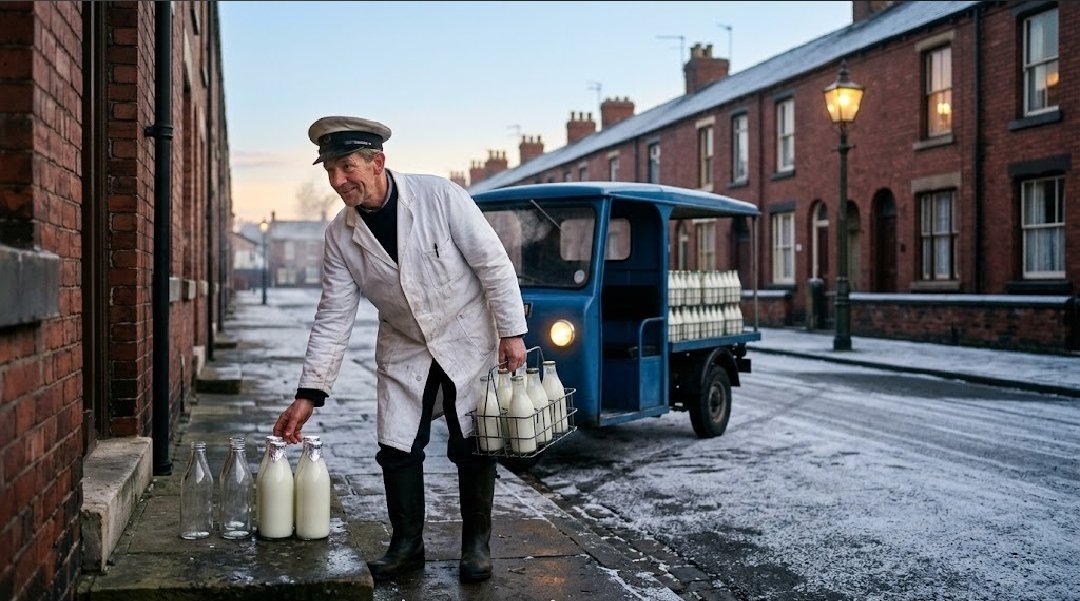
In 1967 Britain had more electric vehicles on its roads than every other country on earth put together, and they were all delivering milk.
There were tens of thousands of them. The milk float: open sided, battery under the floor, top speed of about 15 miles an hour, and a whine you could pick out in your sleep. It was charged overnight at the depot and was back there by lunchtime.
It carried glass bottles. Each one was collected from your step the next morning, washed and refilled. A bottle went round like that 20 or 30 times before it broke. The foil cap went for scrap. There was no other packaging.
The milk had come from farms within a few miles, through a local dairy, and was on the step before 7.
So here is what the country had. A zero-emission delivery fleet. Reusable containers with a return rate any modern scheme would kill for. No plastic. A supply chain you could cycle the length of. A man who noticed if an old lady's bottles were piling up, and knocked.
It was dismantled in about 15 years, because a supermarket could sell milk a few pence cheaper in a plastic jug as a way of getting you through the door.
Every piece of that system is now the subject of a government target for 2040.
It was running in 1967, silently, in the dark, and nobody thought it was worth a mention.
Look at this.
A country in the middle of a housing crisis.
We’re told we desperately need more homes. More supply. More construction.
Yet this is what we’re starting to see around the Toronto area.
Development sites fenced off. Equipment sitting idle. Construction workers gone. Projects that were supposed to become homes simply sitting there.
Think about that contradiction.
We have people who can’t afford homes. We have young Canadians wondering if they’ll ever own one. We have governments telling us that increasing housing supply is one of the biggest priorities in the country.
Yet the economics of actually building that housing are breaking down.
When buyers disappear, financing gets harder, projects stop making financial sense and construction slows, the damage doesn’t stay inside the real estate market.
Construction means jobs.
Development means investment.
New housing creates economic activity across trades, manufacturing, transportation, finance and thousands of other businesses.
So when you see a site like this sitting behind a fence, don’t just look at it as another stalled development.
Look at it as a warning.
Something is seriously wrong when a country can simultaneously have a housing shortage and struggle to get housing built.
For years, governments in Ottawa and across this country have talked about solving the housing crisis.
Maybe it’s time we stop listening to the announcements and start looking at what’s actually happening on the ground.
Because fences around unfinished developments tell you more about the state of this economy than another press conference ever will.