Since 1951 seeking acknowledgment from the German government by negotiating for compensation, restitution and home care for those in need who endured so much.
The Claims Conference, in partnership with the Austrian government, is proud to unveil “Benno’s Light,” an immersive mixed-reality experience that allows users to explore Holocaust survivor Benno Kern’s family history through VR headsets, computers or handheld devices. The project represents the latest achievement from the Claims Conference in our quest to expand access to Holocaust education by engaging younger generations through innovative technology.
Today’s launch of “Benno’s Light” – a VR project integrating real-life footage, photographs and audio from the period spanning the Anschluss to Auschwitz into the hand-drawn world of Mr. Kern’s story of survival and loss – at the University of Vienna carries profound historical significance.
Following the destruction of Vienna’s medieval synagogue and the murder and expulsion of Jews in 1421, stones from the synagogue were incorporated into some of the earliest buildings that would become part of the University of Vienna. More than 500 years later, the university serves as a place to confront that history, transforming a site once linked to the erasure of Jewish life into a space dedicated to remembrance, education and the preservation of Holocaust survivor testimony for future generations.
The immersive technology company makemepulse created the artwork for “Benno’s Light,” which will be exhibited in museums and film festivals alongside educational materials currently under development.
The experience can be accessed here: https://t.co/0NxbfQL73v
#RememberThis #HolocaustEducation #NeverForget
Shlomo Sidi shares his family's wartime experiences from Bulgaria, offering a personal window into a lesser-known chapter of Holocaust history.
During World War II, Bulgaria's Jewish men were forced into labor battalions, where they endured difficult conditions and hard physical work. Shlomo's father was among those sent to a forced-labor camp. His story also connects to the history of Kyustendil, the Bulgarian town where he was born, remembered for the local efforts that helped prevent the deportation of Bulgaria's Jewish community in 1943.
Today, Shlomo shares his story so younger generations can learn directly from those who experienced history firsthand. Preserving these voices has never been more important.
Invite a Survivor Speakers Bureau speaker to your school, organization, or community. Learn more and request a speaker: https://t.co/HfP00aXnoG
#VanishingWitnesses #SurvivorSpeakersBureau #HolocaustEducation
„Als junges Mädchen riskierten Jaroslawa Lewicka (1935-2026) und ihre Familie ihr Leben, um verfolgten Juden zu helfen.
Sie hat Leben gerettet und im dunkelsten Kapitel der Geschichte Menschlichkeit bewahrt.
Wir trauern um eine außergewöhnliche Frau. Ihr Mut ist uns Verpflichtung, füreinander einzustehen.“ – @RuedigerMahlo, Repräsentant der @ClaimsCon in Europa
“To give the hidden Jews hope for survival, we had to conceal our own fear. My mother would remind us every day that we must be stronger than our fear, or nothing will succeed.”
Righteous Rescuer Jaroslawa Lewicki died on November 10 in Haifa at age 91. Originally from Złoczów, Poland, she, together with her mother and grandfather, hid two Jewish boys in their house for more than a year during the Holocaust and took food to 25 Jews who were hiding in a bunker in the local ghetto.
Jaroslawa’s words from the Claims Conference-produced book “Stronger Than Fear” :
“The first pogrom occurred right at the start of the German occupation in 1941. During that time, the Germans and Ukrainians killed a few thousand people. I don't know exactly how many, maybe two, maybe three thousand. Exactly one year later, the Germans deported thousands more people to Bełżec. My grandfather couldn't get over it. On the one hand, open hatred raged in the town. Some residents, mainly Ukrainians, were merciless towards Jews. Yet, on the other hand, there was indifference—a numbness. Even those who could help did nothing.
“For the first year and a half, the ghetto was not yet closed, but the Jews no longer had anything of their own. Everything was taken from them, and they were crowded into a separate part of the city, guarded by Ukrainian gendarmes. From the very beginning, Grandpa began organizing help for our friends. I was small and agile – a little kid who didn't really stand out – so I smuggled in food and medicine. Sometimes, I carried a backpack; other times, I hid a "delivery" under my dress. The gendarmes never checked me. Mom cooked for everyone, baked bread, and sometimes made something better to make them feel a little happier.
“Rysiek and Jurek managed to escape this nightmare. I don't know exactly how and when they escaped, but probably during the march. They came to us exhausted, frightened, hungry, and sick. I could go on listing their ailments, but the most painful thing was their fear. Their terror, which they carried in their eyes, in their gestures, and in the way they spoke. They were prepared for the worst every second and were afraid of everyone and everything. When they finally moved in with us—in hiding, of course—they trembled at the sound of every rustle, every strange voice coming from the street or the yard. For over a year, my mom and grandpa took care of them as best they could. The hardest part of taking care of them was hiding our fear from them because we didn't sleep at night either. I still have nightmares that the neighbors were coming to us with axes to kill us all. We knew that we had to be strong for Rysiek and Jurek; we had to save them and give them hope for a future life. And we succeeded! And why? Because Hope comes from Złoczów.”
#RememberThis #StrongerThanFear
@JewishClaimsCon@claimsconil
“Only by understanding the past can a person shape their own future, and help create a better tomorrow for those around them.”
Starting November 30th, the public can immerse themselves into the memories of Charlotte Knobloch at the Center for Jewish History in New York City, through the XR experience “Inside Kristallnacht."
Since its launch in October 2024, “Inside Kristallnacht” has been shown in schools in New York, New Jersey, and Germany, as well as at museums, events, and other institutions. The partnership between the Claims Conference and the CJH gives the groundbreaking, mixed-reality project a new home in Manhattan, expanding access to Holocaust education for future generations of New Yorkers.
#HolocaustEducation
@cjewishhistory@JewishClaimsCon
https://t.co/EirbkJyP3m
How do we bring the lessons of history to life for a new generation?
Today, on the anniversary of Kristallnacht, the Center for Jewish History announces the New York launch of Inside Kristallnacht, an immersive virtual reality experience developed in partnership with the Claims Conference.
Through the firsthand testimony of Holocaust survivor Dr. Charlotte Knobloch, visitors experience the history of November 9, 1938, in a powerful new way.
Combining immersive technology with educator-led discussions, the experience encourages students to confront antisemitism and reflect on the lessons of history.
As the first offering of the Center's new Immersive Learning Initiative, Inside Kristallnacht brings history to life to inspire empathy, understanding, and action.
🎓 Educators and school groups: Learn more and register through the link in our bio or visit https://t.co/fbLpsWyD8l.
#InsideKristallnacht #HolocaustEducation #JewishHistory #ClaimsConference_Partner #CJH #BMF_Partner
@ClaimsCon
Margarita Verba’s story is one of survival, resilience, and an extraordinary love for life.
Born on July 27, 1940, in the village of Voronovytsia, Vinnytsia Oblast, Ukraine, Margarita was just an infant when Nazi Germany invaded the Soviet Union in 1941. Her father, who had been drafted into the military as a captain, managed to send a warning to his family about the impending danger. That message helped Margarita, her mother, and her grandfather survive. Many other members of her extended family, despite attempting to hide their Jewish identity, were betrayed and murdered during the Holocaust.
Margarita has made preserving her family's memory an important part of her life. She compiled a book of family photographs, carefully saving pieces of their history, and shared photographs with Yad Vashem to help ensure that her family's story would never be forgotten.
Today, living in Brooklyn, New York, Margarita continues to embrace life with remarkable energy and creativity. She writes poetry, sings, travels, and actively participates in arts and cultural activities at her adult day care. Singing, something that brought her joy even during the difficult years of the war, remains part of her life today.
Despite the hardships of the Holocaust and the challenges of living under communism after the war, Margarita has never lost her curiosity, creativity, or enthusiasm for life. Her story reminds us that resilience is not only about surviving hardship, but also about continuing to create, explore, share, and find joy.
Invite a Survivor Speakers Bureau speaker to your school, organization, or community and hear directly from those who witnessed history firsthand. Learn more and request a speaker: https://t.co/HfP00aXnoG
#VanishingWitnesses #SurvivorSpeakersBureau #HolocaustEducation
Holocaust survivor Eva Geller, who fled Romania as a child, showed a desire to survive after being seriously injured nearly a year ago during the deadly Bondi Beach terror shooting and made it to her 90th birthday. We will remember her.
„Dass die #Shoah-Überlebende Eva Geller am Ende ihres Lebens erneut Opfer antisemitischer Gewalt wurde, erschüttert uns zutiefst“, sagt @RuedigerMahlo . „Unsere Gedanken sind bei ihrer Familie.
Möge ihr Andenken ein Segen sein. יהי זכרה ברוך“
https://t.co/mlZxruR6Ya
For 75 years, the Conference on Jewish Material Claims Against Germany has worked to secure recognition, restitution, and compensation for Holocaust survivors while helping preserve the documentary record of Nazi persecution.
In this episode of Conversations at the Center, Center for Jewish History CEO Rio Daniel sits down with Gideon Taylor, President of the Claims Conference, to reflect on the history and continuing work of the organization. Drawing on Taylor’s personal connection to this history and his years of leadership, their conversation explores the negotiations that have shaped Holocaust restitution, the effort to restore what can be restored, and the archival documents that preserve the stories behind that work.
As the generation of Holocaust survivors grows smaller, Taylor considers the urgency of carrying this history forward—and why, when it comes to preserving memory and securing justice, “time is not on our side.”
Watch the conversation at https://t.co/izXKeebwuf
Rabbi Michael Leipziger’s life is a story of survival, resilience, and a lifelong commitment to Jewish community.
Born in 1937 in Beuthen, Upper Silesia, into a culturally German Jewish family, Michael was just a young child when the Nazis destroyed his hometown synagogue during a pogrom in 1938. His father was arrested and imprisoned in Buchenwald and was released the following year after the family was forced to give up their business. His mother then organized the family’s escape to Brazil.
Growing up in Rio de Janeiro, Michael embraced Brazilian society while maintaining his German heritage and deep connection to the Jewish community. He went on to study at the Jewish Theological Seminary in New York, earn a PhD from Boston University, and return to Brazil as an ordained rabbi.
Today, at nearly 90 years old, Rabbi Leipziger continues to serve his congregation in São Paulo. He remains passionate about sharing his knowledge, strengthening Jewish community, and preserving Jewish culture and heritage. In a time of rising antisemitism, he believes that positivity, connection, and being part of a community are more important than ever.
His life reminds us that the story of Holocaust survivors does not end with survival. It continues through the communities they build, the knowledge they share, and the generations they inspire.
Invite a Survivor Speakers Bureau speaker to your school, organization, or community and hear firsthand accounts that keep Holocaust history alive. Learn more and request a speaker: https://t.co/HfP00aXnoG
#VanishingWitnesses #SurvivorSpeakersBureau #HolocaustEducation
In this episode of IN CONVERSATION we are joined by Dr. Kierra Crago Schneider, Dr. Maria Ferenc and Dr. Borbala Klacsmann to discuss the plight of elderly Jews in the Holocaust – a group among the most vulnerable that has had little scholarly and literary work focused on their experiences.
75 years ago, the founders of the Claims Conference dedicated themselves to a mission: pursuing a small measure of justice for Holocaust survivors.
Today, we remain unwavering in upholding that commitment.
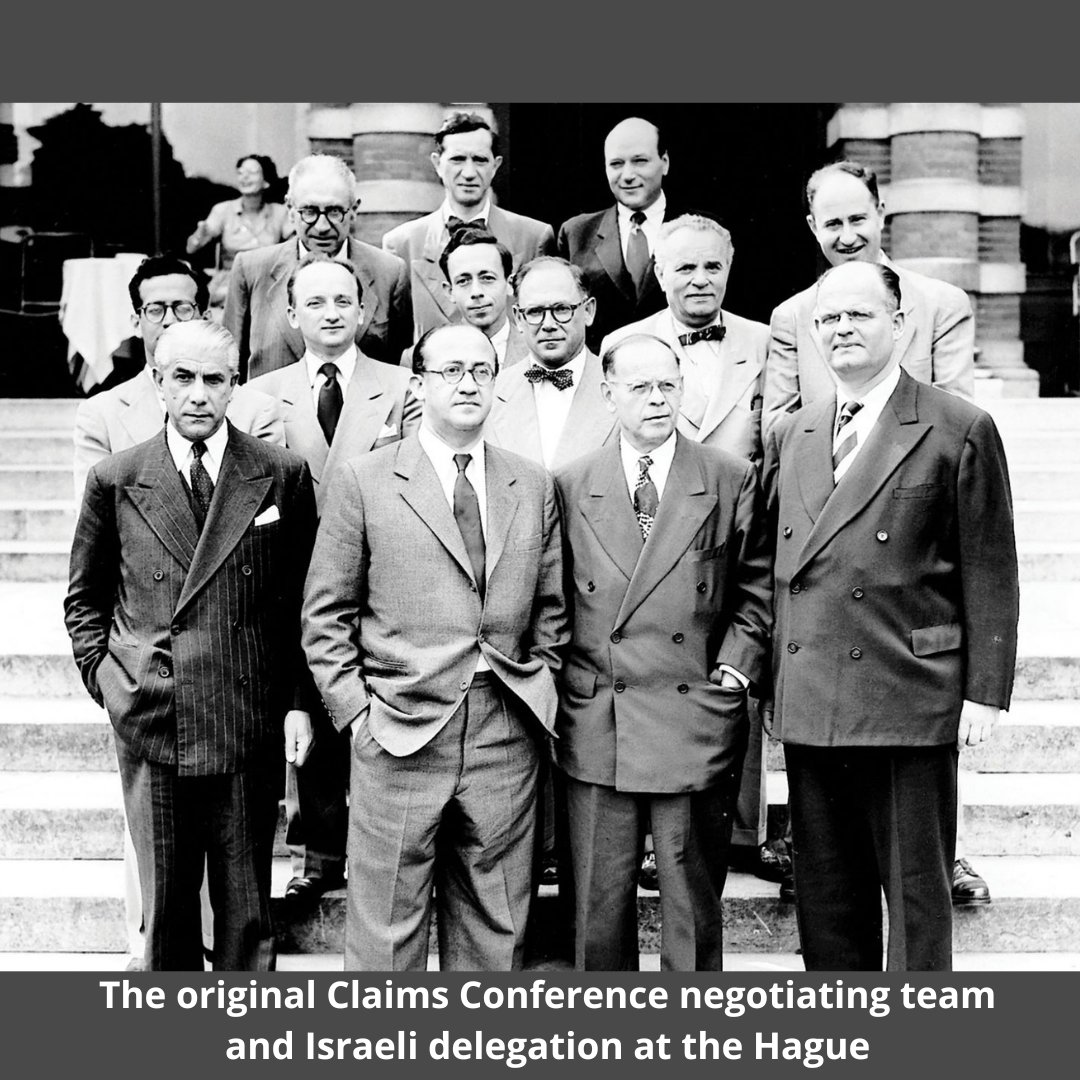
On October 25 and 26, 1951, Dr. Nahum Goldmann convened a meeting with representatives from 23 major Jewish organizations and nearly 60 official delegates. They met in New York City to establish the Conference on Jewish Material Claims Against Germany, the Claims Conference.
Since that day, through 75 years of negotiations with the German government (as well as other governments and companies), the Claims Conference has secured direct compensation for Holocaust survivors (over 115,000 in 2026) and their heirs (in 82 countries and territories this year) and partnered with social service agencies (more than 300 in 2026) for survivor care worldwide.
The Claims Conference also supports projects that further Holocaust education, documentation and research, including film and new media, to ensure that the lessons of the Holocaust will never be forgotten.
We are grateful to @cjewishhistory and its CEO, Rio Daniel, for inviting Claims Conference President Gideon Taylor in for a special episode of Conversations at the Center to reflect on the Claims Conference’s history and ongoing work.
May we continue to fulfill our sacred mission of caring for the world's remaining Holocaust survivors and ensuring that their legacy and the lessons they have taught us are passed on to future generations.
#HolocaustSurvivors
https://t.co/9j54deQFyx
“My grandparents and father were among the millions of Jews killed in the Holocaust. My mother survived because she joined the partisans and refused to hide; she fought instead.” — Chanit Roston
Born in 1939 in what is now Slovakia, Chanit Roston was a hidden child during the Holocaust. At just four years old, she lived in a potato cellar, knowing that she could not go outside.
She remembers seeing other children playing and wondering, “How come I can’t go outside?” Her grandfather tried to explain why she had to remain hidden, but at such a young age, Chanit could only understand that life was difficult and that she was different from the children she saw outside.
Chanit survived because of her mother’s foresight. Her mother found a Christian family willing to hide her, giving her a chance to survive while her family faced unimaginable danger. Her mother herself survived by joining the partisans and fighting rather than hiding.
Today, Chanit is grateful to still be here. She taught herself Hebrew and English and has also found a powerful way to express her experiences through art. An accomplished artist, Chanit’s paintings reflect a life shaped by survival, resilience, and gratitude, and her artwork is featured in this video.
Through the Survivor Speakers Bureau, Chanit shares both her story and her perspective so that future generations can hear firsthand what it meant to survive the Holocaust.
Invite a Survivor Speakers Bureau speaker to your school, organization, or community and hear directly from those who witnessed history firsthand. Learn more and request a speaker: https://t.co/HfP00aXnoG
#VanishingWitnesses #SurvivorSpeakersBureau #HolocaustEducation
For 75 years, the Claims Conference has worked to secure recognition, restitution, and compensation for Holocaust survivors, while helping preserve the documentary record of Nazi persecution for future generations.
In this collaboration, Rio Daniel, CEO of the Center for Jewish History, speaks with Gideon Taylor, President of the Claims Conference, about his journey, the negotiations that have shaped Holocaust restitution, the importance of preserving archival records, and the responsibility to ensure that the experiences and histories of survivors are not lost to time.
Watch the full episode next week.
#Claims_Conference #ClaimsConference_Partner #CenterforJewishHistory
October 23, 1951
23 Jewish orgs & reps from the gov't of @Israel gathered in New York to determine the pathway for negotiating reparations from Germany for the suffering and loss caused by Nazi crimes during the Holocaust. The group established the @ClaimsCon
📷: @ClaimsConf
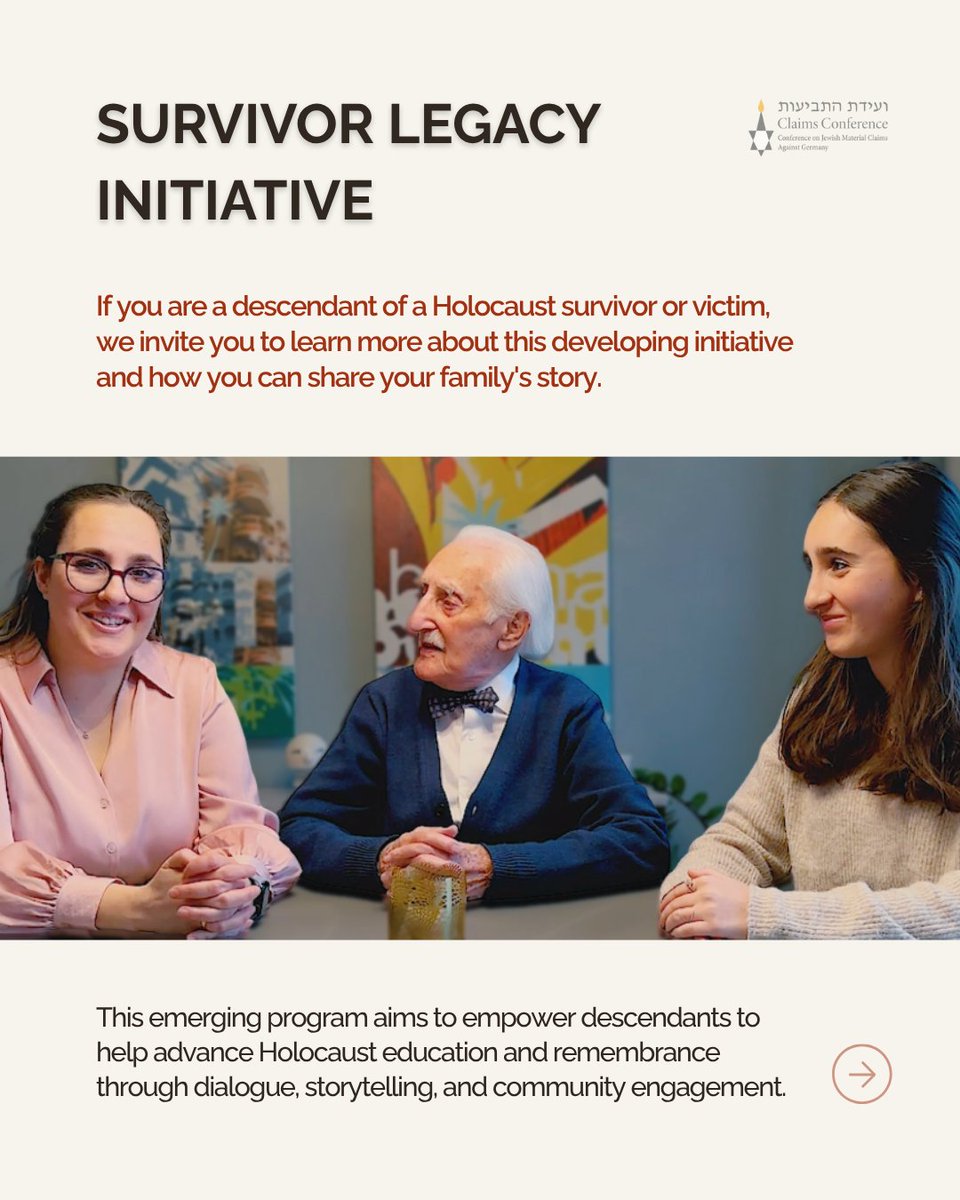
Your family’s story deserves to be remembered.
The Claims Conference’s new Survivor Legacy Initiative invites children, grandchildren, and great-grandchildren of Holocaust survivors to help carry their families’ stories forward.
Through storytelling, dialogue, and community engagement, participants will have the opportunity to share their family histories with educational and religious institutions. No prior speaking experience is required. Participants will receive training and support, as well as the opportunity to record their family stories so that the experiences of their loved ones can be documented and honored for generations to come.
If you are a descendant of a Holocaust survivor or victim, sign up by completing a simple Speaker Application Form and help make sure your family’s story is told.
Visit https://t.co/6nboFwbKsD to learn more and apply.
#SurvivorLegacy #HolocaustEducation #HolocaustRemembrance #ClaimsConference
Heute vor einem Jahr ist Tamar Dreifuss sel. A. von uns gegangen.
Familie, Freunde und Wegbegleiter kamen heute in Köln zusammen, um an die beeindruckende Shoah-Überlebende zu erinnern und ihr Leben und Wirken zu würdigen.
Bei der Gedenkfeier wurden Ausschnitte aus ihrem letzten großen Interview gezeigt, das im Rahmen von „Zeugnisse“, einer Kooperation der @ClaimsCon mit dem @ZDF, entstanden ist.
So wurde Tamars Stimme noch einmal lebendig – ihre Erinnerungen, ihr außergewöhnlicher Mut und ihre Botschaft an kommende Generationen.
Tamar Dreifuss hat uns ein wertvolles Vermächtnis hinterlassen. Ihre Geschichte, ihre Stimme und ihr unermüdlicher Einsatz gegen das Vergessen bleiben.
Möge ihre Erinnerung zum Segen sein.
Das Interview beim ZDF:
https://t.co/WBTGPu65GZ
Gianna Pontecorboli survived the Holocaust and went on to build a remarkable life as a journalist and writer.
During the war, Gianna and her family survived with the help of Italians who provided them with false identification documents and helped them hide from the Nazis. For Gianna and her sisters, even something as simple as their family name became part of their survival. They had to learn that they were no longer the Pontecorboli family, but the Prosperi family.
After the war, Gianna earned a degree in economics from the University of Genoa and began a successful career in journalism. She later moved to the United States, where she worked as a correspondent and radio journalist, traveling extensively throughout the Americas and telling stories across borders and cultures.
Gianna also became an author. Her book, *Americordo: The Italian Jewish Exiles in America*, explores the experiences of Italian Jewish exiles who found refuge in the United States. The success of the book is a source of great pride for Gianna and reflects her lifelong commitment to preserving stories and sharing them with others.
Her journey is a powerful reminder of the resilience of Holocaust survivors. They did not simply survive. They went on to build careers, write, create, and make meaningful contributions to the world.
Hear Gianna’s story and the stories of other Holocaust survivors firsthand. Invite a Survivor Speakers Bureau speaker to your school, organization, or community. Learn more and request a speaker: https://t.co/HfP00aXnoG
#VanishingWitnesses #SurvivorSpeakersBureau #HolocaustEducation
In this episode of IN CONVERSATION, a Claims Conference Saul Kagan Fellowship podcast, we are joined by Dr. Kierra Crago Schneider, Dr. Maria Ferenc and Dr. Borbala (Bori) Klacsmann to discuss the plight of elderly Jews in the Holocaust – a group among the most vulnerable that has had little scholarly and literary work focused on their experiences.
https://t.co/l7GvPwLALy
Born Marcus Arpels Lezer in 1936, he was just a young child when the Nazi occupation of the Netherlands tore his family apart. His father went into hiding, while his mother was arrested in 1942 and deported to Auschwitz, where she was murdered.
His father desperately searched for a place to hide his young son. He eventually found Ype and Boukje Wetterauw, a Christian couple in Friesland who took Marcus into their home. Although people in the village knew that Marcus was Jewish, he was never betrayed.
Marcus lived with the Wetterauw family until 1948, using different names to conceal his identity. His father survived the war and returned, but his mother never did. The Wetterauws had become his family, and the transition back to life with his father was difficult. Marcus ran away from home several times, returning twice to the family who had sheltered him.
In 1961, Marcus married Sofia Noek, who had also survived the Holocaust in hiding as a child. Today, he serves as President of the European Association of Jewish Survivors of the Holocaust, continuing to honor the experiences of survivors and preserve their stories.
Bring a Survivor Speakers Bureau speaker to your school, organization, or community and hear directly from those who witnessed history firsthand. Learn more and request a speaker: https://t.co/HfP00aXnoG
#VanishingWitnesses #SurvivorSpeakersBureau #HolocaustEducation