I just wrote my first Substack. Daunting. My only subscribers are my kids and my mum so make my day and subscribe if any of it sounds vaguely interesting.
1. Lift-off https://t.co/4DtNxNxc0i
@aswren … extensions of human consciousness. Recombination space with the human brain. Not *separate* conscious objects but emanations that will form their own patterns. On this I agree. What will not happen though, is AI separating without the human substrate.
@aswren Dawkins believes in the extended phenotype. This means that everything around us is, in some fashion, a biological emanation. Textbooks, machines, cars etc; None is biologically inert. I couldn’t read the whole article but I would guess that he sees these bots as …
@ClarkeMicah@cjsnowdon Christ, I read ‘milk snatcher’ as code for a paedophile sex scandal. But no, it was *actually* a milk scandal. Will there be a sudden outpouring (spilling?) of #milktoo victims?
It is painful when people pull a datapoint out of context then set up a correlation > causation strawman that doesn’t survive the first line of replies. You only need 1 idiot to mention “benefits / immigrants” & that jumps to the top & all nuance is lost👇
Interesting table. Britain has more than twice as many public sector workers per capita as Japan. What do they all do? No wonder our taxes are so high, and our productivity so low.
@LukeJohnsonRCP … this is also fairly simple. Public sector productivity crashed because George Osborne cut budgets in a recession. Cratered investment (public & private) & pushed public sector into crisis mode. No system can self repair when stretched in this way. Now we pay the price.
@LukeJohnsonRCP This is because of the NHS? It’s fairly obvious. A public sector worker is only costly if their per capita price is higher - for the same outcomes - as a private sector worker. Privatising the NHS is extremely unlikely to generate long term gains in outcomes. On productivity …
@Ojdadana@MichaelAArouet The OP made a specious argument about capitalism which I refuted showing Poland’s receipt of subsidy. This triggered you because subsidy feels like ‘welfare’ so you criticise Germany. Trust me - I have no argument that Germany’s EU benefit > cost. Different topic altogether.
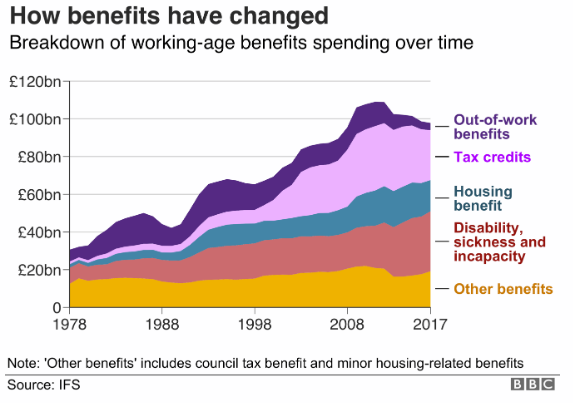
@stokerm@TomTugendhat It’s pensions & tax credits. Tax credits rose substantially after we de-industrialised under Margaret Thatcher. Domestic wages were subsidised with Gov borrowing to hide unemployment. Bond markets have decided we’re running out of assets to privatise & real estate worth buying.
@TomTugendhat … the threat fell after the fall of the USSR. We should increase defence spending but if we decrease gov spending in the economy this will happen automatically. Because GDP will fall!!! Debt is where it is because of 2008 & Covid. So who pays Tom?
@TomTugendhat Margaret Thatcher’s reforms de-industrialised our nation & forced us to replace wages with benefits. We now have to subsidise wages (tax credits) because our economy no longer produces widespread prosperity. Out of work benefits are *lower* than any time. Defence fell because …
يُعتبر هذا المشهد واحد من أكثر الجرائم رُعباً في كل تاريخ الحروب
لحظة قيام جندي إسرائيلي بقنص سيدة مُسنة في غزة وهي تُمسك بيد حفيدها رافعين الراية البيضاء وبعد أن قام جيش الاحتلال بإعطائهم الأمان للمرور
النسيان جريمة.
@Somatichealer0@rcolvile@thetimes For goodness sake!! These are *trivial* costs. Gov spending is mostly on pensions & wage subsidy. Why are wages so low? Because we have to attract foreign inflows due to our trade deficit. Reducing gov spending will deflate our economy absent changes to our current account.
@rcolvile@thetimes If “getting our fiscal house in order” means reducing Gov spending in the economy then you’ve just reinvented George Osborne’s disastrous austerity which replaced our fiscal deficit with a massive increase in debt & destroyed productivity altogether.
@Afinetheorem You might want to re read this a couple of times:
“the average [1970s] economy that subsidized with debt random [industries connected to government] monopolies wasn't on path to growth”
Hint: disregard bracketed phrases if it helps …
@thorstenbenner He softens it with ‘in the near term’. I think it’s a defensible claim that Iran is *currently* a 4th axis of power. It is certainly a new attractor state that is changing the system’s behaviour.
@GenealogyJuden@AaronBastani That’s because you can’t think systemically. You assume each gene pool is additive. In fact they recombine. This creates a *vast* new genetic repertoire. It’s not A + B + C etc; It’s AA AB BB CA etc; Same is true for ideas & innovation. All great cultures have these mixing pots.
@GenealogyJuden@AaronBastani I see what you did there. Singapore has mixed ethnic groups. It also has strong ties with the UK. Overall this provides an excellent genetic & ideas melting pot.