@Galaxriel@NikoMcCarty Chloroplasts can emit light in the dark (basically exactly the reverse process they use to capture it), but with orders of magnitude less power than they capture. Where would the energy come from?
@Galaxriel@NikoMcCarty (2) rely on breaking down high-energy compounds in ways that converts stored chemical energy to photons.
Remember - the total energy output of a mushroom is very small. Even if they could make photons from ATP, they couldn't make many.
@Galaxriel@NikoMcCarty Luminescent proteins work one of two ways: 1) fluorescence or 2) production of an autofluorescent molecule. (1) Works by absorbing photons and releasing at another wavelength - good for making a glowy color, but not net-illuminating.
@ProvenReserves This... sounds like it's working as intended? You're providing a service (battery storage and power smoothing), so you get paid for it. That's how providing services is supposed to work.
I wrote a thing!
Rates of evolution have always confused me a bit. Like, which is faster, evolving drug resistance in bacteria or domesticating animals? Here, I compare rates using a unified scale (# of generations) that makes them all comparable:
https://t.co/sOd8hFs8ST
@I_Rubio_Somoza Are you expressing the gene sequence? If so, is it constitutively expressed or inducible? Strong expression, even of small stuff, can put a lot of pressure on the host to break it.
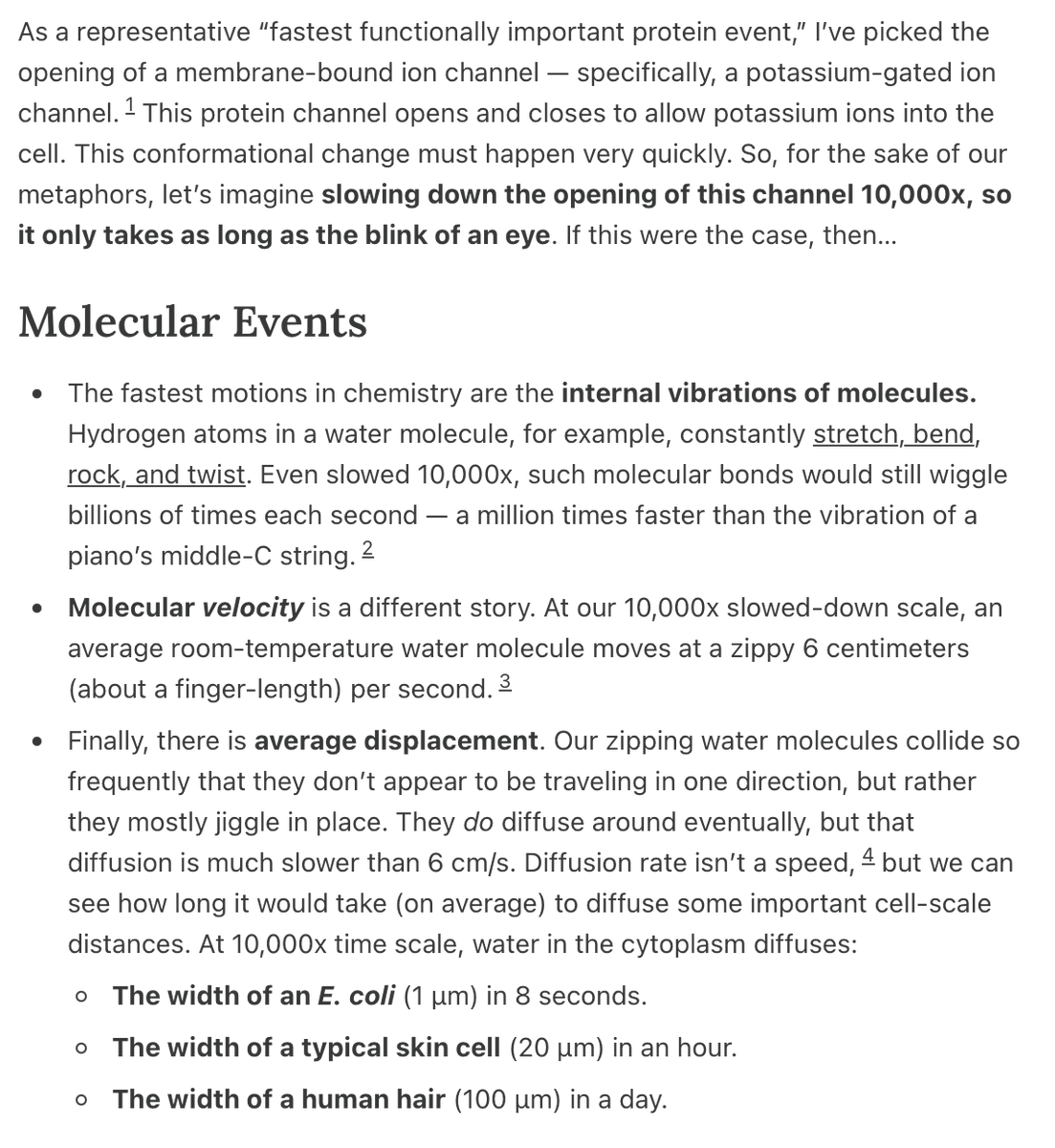
@szetoinsitu@AsimovPress Is "cell wall to nucleus in 50 nanoseconds" more intuitive, or less intuitive? I think they both have their uses. Though "wall to nucleus" implies they can fly in a straight shot, which is very far from the truth.
I wrote a thing! If you're interested in the speeds at which things happen in molecular biology, check out the second entry of my quantitative metaphors series in Asimov Press:
A cell is an incredibly crowded and quick place.
Sugar molecules fly through at 250 mph. Each protein collides with ten trillion water molecules per second. It is difficult to understand biology, in part, because these speeds boggle the mind.
For our column today, author Sam Clamons puts these numbers into context using a quantitative metaphor. Specifically, by setting the speed of a potassium ion channel opening to the blink of an eye, Clamons examines how quickly everything else in the cell happens in comparison.
Here are some of our favorite metaphors:
- A water molecule would diffuse across a skin cell in about one hour.
- It would take about 6 days to translate a single protein.
- A kinesin motor would take one step every 30 seconds.
- Most proteins in the cell would have a median half-life of 300 days!
Check out the full piece :)
Another year, another set of book reviews. Here are the books I read in 2025, and my thoughts about them. https://t.co/y57XBCa6yF
Top book: "Embassytown" by China Miéville.
Close second: "The Best of Greg Egan" by Greg Egan (20 short stories by the master).
@johndillon2022@60Minutes Science has huge RoI but it's diffuse and long-term, therefore difficult to capture by a private funder. Mostly impossible to do with venture capital, but stupidly efficient at generating society-wide value for a large, non-profit-motovated org like the government.
@mikpom123 @AsimovPress 34 unmetaphorical millimeters is pretty damned long to a cell! And that's one chromosome - one set of 46 gets into the meter scale.
(And if you start adding together all the DNA in your body...)
Most metaphors in biology are qualitative and vague.
"DNA is the blueprint of the cell." OK but, like, how big is that blueprint?
For our latest essay, @ClamonsSam gives a bunch of QUANTITATIVE metaphors to help you understand the sizes of biology, from molecules to cells.
He imagined that each water molecule in a cell was blown up to the size of a grain of sand, and then calculated what that would mean for everything else. At this scale:
1. A typical protein would now be a knobby ball the size of a blueberry.
2. An antibody would consist of three blobby arms, each roughly the dimension of a grain of basmati rice, connected to a common center by a short chain.
3. A typical human chromosome would be a thread of double-stranded DNA about 100,000,000 bases long, which is just long enough to span the English Channel (34 km).
4. A human virus is now the size of a ping-pong ball.
5. A mitochondrion is as wide as a cow.
And there are so many more metaphors in this essay. We think it could be a valuable resource for schoolteachers and students who are looking to "grok" the scales of things in biology.
@nfinf5 I think you overestimate the amount of poor-quality thinking out there. Never attribute to malice what could be just as well explained by incompetence.