Thanks for this question.
In short: no, there are not. I'm a big fan of Chesterton, but I don't think he understood how markets work. The best way to achieve the widespread ownership of property he envisioned is, to echo Adam Smith, "peace, easy taxes, and a tolerable administration of justice." I highly recommend this book on the topic, written by a fellow economist and Chesterton aficionado: https://t.co/KKcix5cGQe
I taught Principles of Macroeconomics in his favorite classroom during grad school. That's when I really fell in love with teaching.
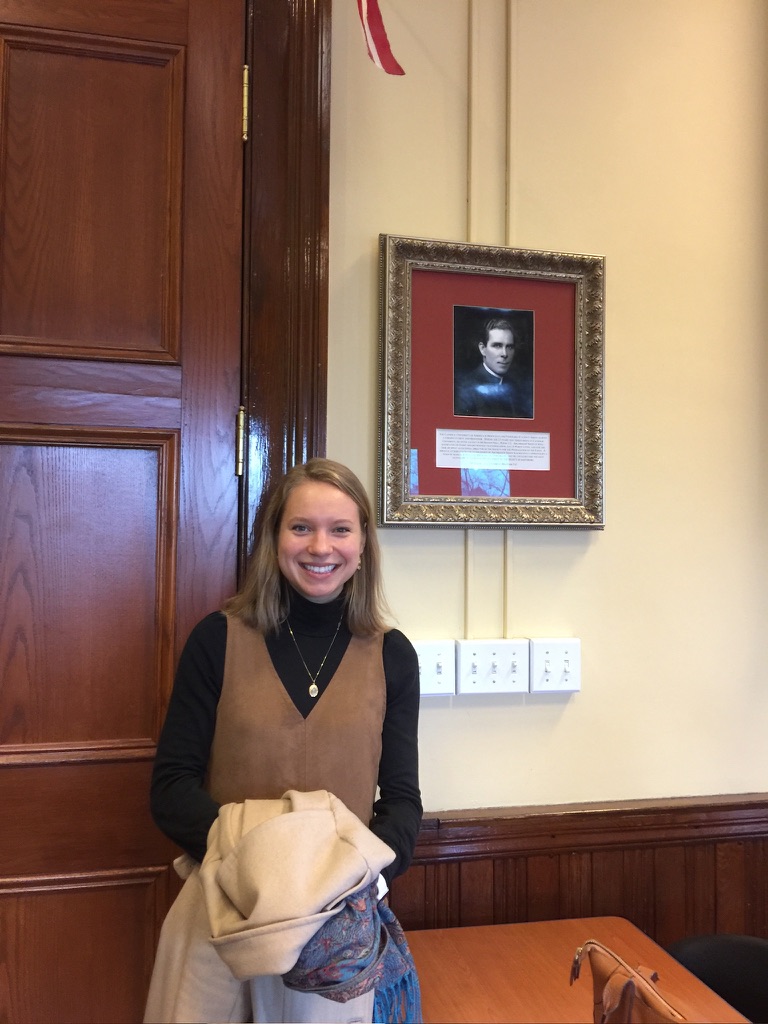
Blessed Fulton Sheen, pray for us!
Today, we celebrate the beatification of Archbishop Fulton J. Sheen, the first alumnus and professor to be beatified in Catholic University’s 139-year history.
For more than 20 years, Catholic University was Sheen’s spiritual and intellectual home. His legacy still lives on across campus, from the classroom where he taught to the chapel where he prayed.
We are proud to celebrate this historic moment for one of our own ❤️
I went to the beekeeper. I asked for twelve bees. He gave me thirteen. He said it was a freebie.
Preorder my book or I keep going
https://t.co/MwCuxxNR9U
Our grad students here at Ole Miss are so good.
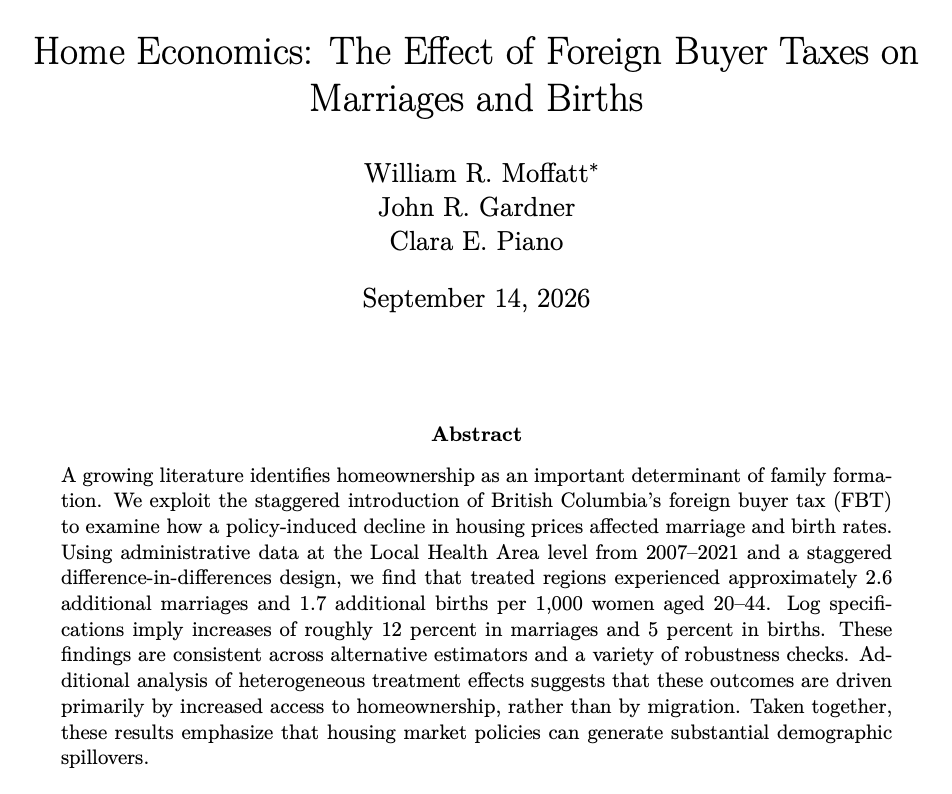
One of our rising stars, @WillRMoffatt (4th year), developed this idea for his term paper in my Family Economics course. We joined forces with our resident master of econometrics, John Gardner, to give our best answer to this question: Could a foreign buyer tax raise marriage and birth rates? Read all about it below.
https://t.co/5pCn70K99J
We are hiring a monetary economist this year. This will be our 9th tenure-track hire since I took over as chair 5 years ago. While others are lamenting the challenges of higher ed, we are building and growing. Be a builder. Come to the Sip. https://t.co/dTNYPb1kcU
"Families should be treated, not as a needy institution, but as fundamentally productive. A business is the other obvious example. Indeed, families and businesses should be seen as the twin engines of productivity"
Good point from @rclu
https://t.co/wOgcQ29zZT
More generally, PhD students underestimate (and PhD programs under-teach) communication.
To stress-test your ideas & to disseminate them, you need to communicate them clearly and *concisely*
This is actually a difficult skill that is learnable - but takes time and practice
Whoa- this is the most fantastic pedagogical tool I’ve encountered in as long as I can remember (which is a helluva high bar, considering who I live with).
I’m so excited to have my 6yo play with it! And you all should too.
https://t.co/vv8QVMO7VP
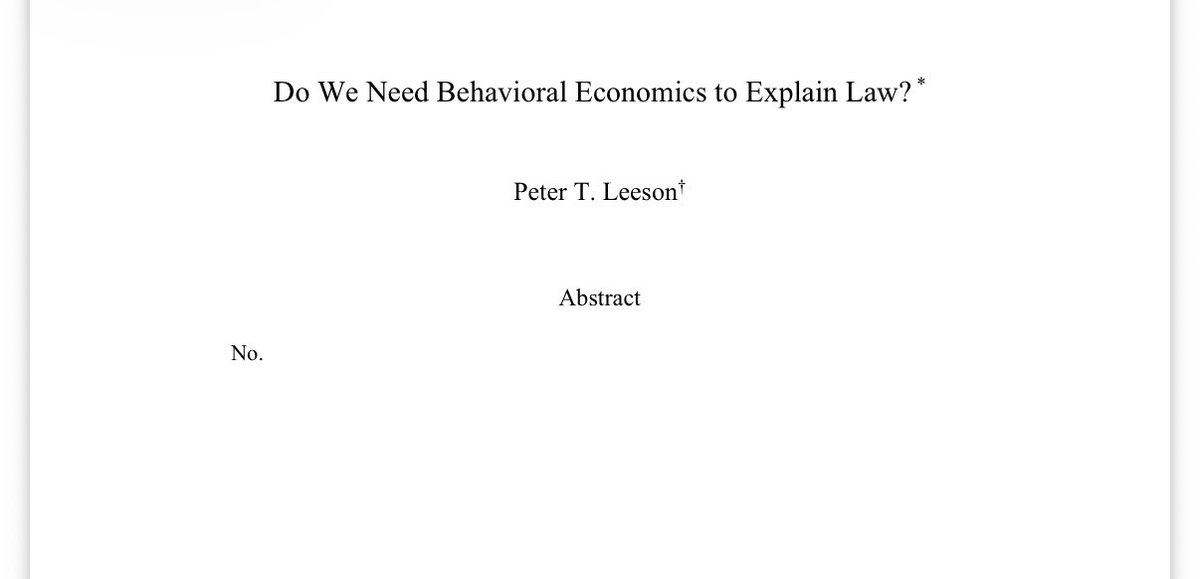
When I think of behavioral economics, I think of my colleague and co-author Peter Leeson on the matter. His best abstract ever is quotable on the matter
Delightful news!
And fortuitous given that the Piano household was in the market for some dinnertime read alouds (read: the toddlers recently discovered potty jokes).
"Our Review, as its name points out, is to be Catholic and American. Its aim, therefore, will be to explain and defend the Catholic theory of revealed Truth, ... It shall be our endeavor also to show the practical development and working of Catholic principle in the history of the world, in the lives of great and good men, and in the destinies of nations."
So begins the Salutatory in the first issue of The American Catholic Quarterly Review (ACQR), published January 1876, auspiciously, in the centenary year of the nation’s founding.
I could not be more thrilled to announce that today @GibbonsCUA@CatholicUniv relaunches the esteemed American Catholic Quarterly Review.
Read and subscribe!
https://t.co/GehOpMOgV0
What to do when you're in a department with some serious macroeconomic talent? Specialize and trade, of course!
Excited to share a new draft of my working paper on unexpected inflation and fertility with one of our outstanding JMCs, Ahmed Adesete (https://t.co/PSX1XvzLhy). The project begins from the simple insight that the unexpected component of inflation matters most for household fertility decisions. We show through many different specifications that even small changes in unexpected inflation are associated with changes in fertility rates (both upward and downward!) and that there is interesting variation by age.
Read all about it here:
https://t.co/HV0paChyhp.
I spent most of my birthday yesterday (31!) caring for sick toddlers. And I have some thoughts about that.
1. Being an adult is still so much better than being a child. Once the kids went to bed, I ate a whole package of Biscoff cookies and discussed an audiobook I've been listening to with the actual love of my life.
2. Bluey is an edifying cultural product. I'd love to meet the writers-- they clearly have a healthy moral imagination about parenting.
3. Thank God for modern medicine.
I turned 30 yesterday, which figures given that Home Depot has been my favorite store lately.
And I’ve been thinking about my students as we start classes this week. If I could tell my 20-year-old self something, it would be this: life is better than you can possibly imagine.
@lymanstoneky@IVMiles I was educated at various classical schools. Saw this happen among my friends. It’s an issue I feel about very strongly: https://t.co/fwsBZkBIat
A work in progress, but I used @claudeai to organize all the Chicago price theory problems @irwincollier has collected from the archives. Access the database here: https://t.co/CaNJy8TMs0
Suggestions welcome.
Why do many economists like markets? Because most markets, although not all, work well. There is bread in bakeries, cars at car dealers, and books in bookstores because the price system provides economic agents with incentives to ensure these outcomes. Of course, markets are never perfect outside economics textbooks. More often than not, we face inefficiencies such as limited competition or externalities.
The intelligent case for markets has never been that they are flawless, a proposition so obviously untrue that it is not even worth discussing (unless you are writing for the Stanford Encyclopedia of Philosophy). The case for markets is that they usually work better than feasible alternatives.
Note that I used three words: “usually,” “better,” and “feasible.” The word “usually” tells us that, sometimes, markets fail. A market for national defense is unlikely to work because it is impossible for a private air force to defend my house but not my neighbor’s, who refuses to buy the service.
The word “better” reminds us that, even when markets do not work well, the alternatives may be worse. Flying with American Airlines is a ticket to an unpleasant experience. But those of us who have flown in government-run airlines understand that service can be considerably worse.
The final word, “feasible,” emphasizes that one should not judge market behavior against an idealized public service staffed by angels. Alternatives to market systems are run by humans, with their strengths and shortcomings, and, in particular, without the incentives provided by the profit motive.
You might disagree with my case for markets. But, at the very least, you need to understand what I am claiming. Otherwise, this is not an intellectual discussion; it is a brawl at a bar.
Calling all graduate students! 🎓Showcase your research at the 64th Public Choice Society Meeting in New Orleans and compete for the 13th annual Elinor and Vincent Ostrom Prize ($2,000) https://t.co/Qfta04tdzB