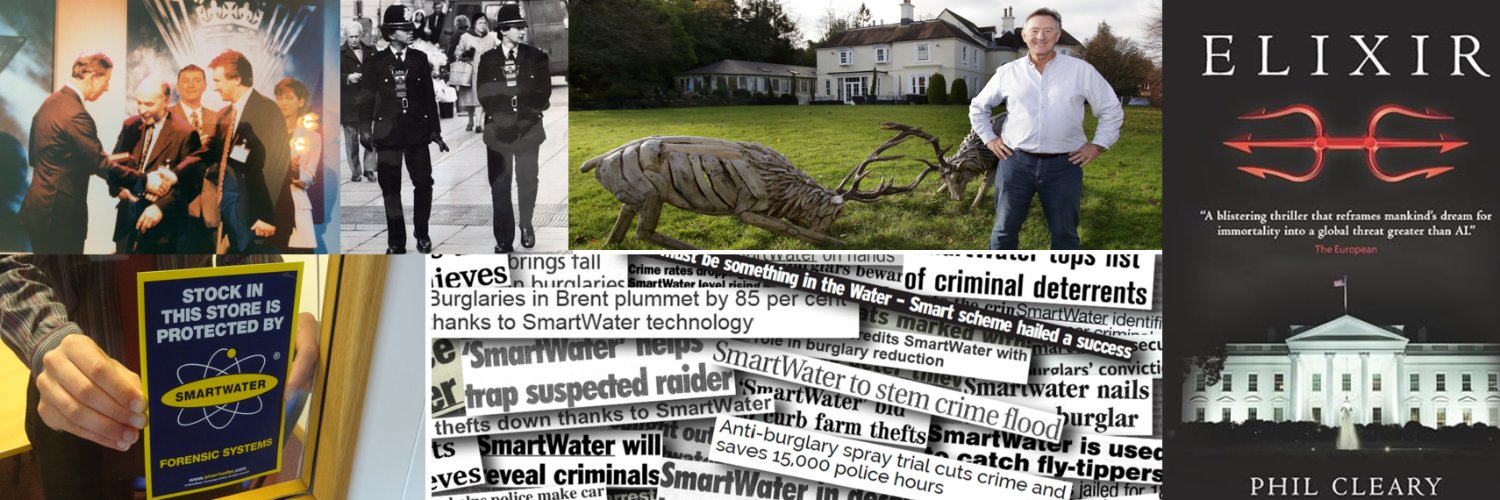
Ten FAQ's about me and SmartWater, with answers:
1. How long were you in the police service?
Eleven years.
2. Why did you leave?
The family had a car accident, leaving one with injuries that needed my nursing care, which severely impacted my ability to do my job as a police officer. West Midlands Police were great, but the situation became untenable, and I had to resign.
3. When did you start SmartWater?
Because I needed to be available to provide nursing care, I started as a security consultant first, as it allowed for flexible hours. But the idea for SmartWater had been formulated in my mind as a police officer. Fact: criminals, particularly thieves and robbers, hate anything that it traceable, as it's incriminating and 'too hot to handle'.
4. What did you do before the police?
I trained as a computer engineer, specialising in highway engineering. So, my world was filled with Boolean algebra and binary sequences. But I was a young man and didn't want to be stuck in a windowless computer suite for years, so I joined the police for some excitement. That worked!
5. Why did SmartWater become so big compared to other similar technologies?
First, it was due to a brilliant scientist, my brother Mike, who turned my idea into reality. Then, we developed a policing strategy called 'The Trapped Principle', which, when the police adopted it fully, dramatically reduced acquisitive crime (see graphic). Other technologies just didn't have the understanding of policing that we had.
6. What was your most significant breakthrough?
Two things:
First, we won the HRH Prince of Wales Award for Innovation on national TV in 1996. This award gave us tremendous impetus, and we will be forever grateful to His Royal Highness.
Secondly, we had our first conviction of a 'ram-raider' in Staffordshire, where the police were willing to try a new approach to crime-fighting. One of the fundamental elements of the 'Trapped Principle' is that technology alone is not enough to create a crime deterrent; criminals need to fear it, and the only way that happens is if they're sent to prison as a result.
7. What are your proudest moments with SmartWater?
As we helped the police reduce crime and convict serious criminals, there are many, but two come to mind in relation to the SmartWater Foundation, our charitable arm established by my brother and I:
1. Helping Syrian archaeologists protect their antiquities from thieves working for ISIS;
2. Developing a new type of spray product that we, via the police, issued to people under threat of domestic violence. The deterrent value of SmartWater traceability was so great at that time that it forced the potential assailants to stay away. We were protecting the most vulnerable of people.
8. How big did SmartWater get before you retired?
When I left, the SmartWater Group was an international, multi-million-pound business with a nine-figure valuation, employing hundreds of people.
9. What about now?
SmartWater is now part of a larger corporation called DeterTech, which is expanding rapidly worldwide. I am still a shareholder and know that the current team has ambitions to be the first billion-dollar company created in Shropshire.
10. What advice would you give young entrepreneurs?
Love your employees, treat them like family.
When promoting people, be blind to race, gender and religion - if they are good enough, promote them.
Never lie.
Keep fighting, take chances and study the market, your customers and your competition.
If it helps, here is the trial Judge's view after hearing all the evidence. The police officers at the scene will no doubt be sacrificed, and this context will be ignored.
However, those truly responsible, the architects of DEI mind-virus, such as Tony Blair and Theresa May, will escape any blame:
@BasilTheGreat@DailyMail He’s not going.
He’s calculated that Burnham won’t win the Makerfield seat.
And he believes that he’ll win against any of the others.
So it an insincere offer to make him look like an honourable guy…
Rightly, the military needs more funding, but to protect our borders from invasion (and not to spill young British blood in a war on mainland Europe again -we've done that twice, and what thanks do we get?).
But what about the Government's duty to protect its citizens within its borders?
Like the military, the police are defanged through the use or threat of lawfare, with the latter being the most scrutinised profession in history, with potentially dozens of cameras in their faces during every interaction with the public.
Name any other profession that has to work under such pressure, not just loss of livelihood, but potentially their liberty too.
Evidence:
PC Castle of Dorest Police - sacked for not showing 'due respect' to a knife-carrying youth during an arrest.
PC Roberts, Teeside - sent to prison for two and a half years for death by dangerous driving while responding to a 999 call. Even the victims' family didn't want him jailed.
No wonder thousands of experienced police officers are leaving every year - I don't blame them.
Suppressed grieve.
New faces in the dressing room, excited to play for the reigning champions, only to find their new teammates heart-broken.
No jokes, no banter, no bonding.
A club reeling from the loss of a truly loved man
And a city just recovering after a madman smashed his vehicle into a celebrating crowd causing many injuries
Then Slot, having never experienced anything like this before, had to try and coax his players to train, in what little pre-season they had left.
Then the injuries. The thin squad. The idea of ‘a transition season’ scoffed at after they’d won the PL at a canter.
For whatever reason, having to play with 10 men when the real Salah was lost.
Disenchantment in the dressing room, with players resenting being dropped.
The Three Tragic Deaths in Nottingham Lay Bare Government Failure
Although I have a Master's in Military History and deep respect for the British military, both past and present, as a former police officer, my instinctive interest lies in protecting UK citizens from real-time threats.
Last year, 'Social Care Today' published my article, which argued that the child rape scandals were directly linked to a chronic under-investment in our front-line services.
The European has now published my follow-up article looking at the inquiry into the tragic deaths of three people in Nottingham. The Press pointed the finger of blame at front-line services, be it mental health workers, police officers or social services.
My article offers a different opinion:
https://t.co/cZAVjYNxnk