Prioritizing Implementation Barriers is a toolkit, used primarily for research, that helps teams determine which barriers are most important to address for their change initiative.
Explore the resource & download the toolkit: https://t.co/ABmu2Tj8dl
This article provides a 5 step guide, with essential tools & templates, for applying the updated Consolidated Framework for Implementation Research (CFIR) to design, conduct, analyze, interpret, & disseminate research.
Read the full article: https://t.co/Xs2jY5fh8m
The proposed FY2027 budget includes a $5.8B (−12.3%) cut to the NIH. United for Medical Research calculated this could cost ~50,000 jobs and $11.6B in economic activity, with 26 states losing >$100M each. A tragedy for science, patients, and the economy. #NIH
📣Registration and Abstract Submission is NOW OPEN for the 10th US DOHaD Annual Meeting: Cumulative Stressors & Lifelong Health!
💚Register before 4/16 for an Early Bird Discount
💚Submit your abstract by 4/16 for oral presentation consideration
The Population Health Sciences Pathway within the Biomedical Sciences PhD program offers an interdisciplinary approach to training focused on epidemiology, biostatistics and health services research. Apply by Jan. 1 for full admission consideration: https://t.co/tks2MYJz9f #PhD
Home to Nobel Prize-winning biomedical research, @UMassChan is accepting applications for the Biomedical Sciences PhD program: https://t.co/i7BBGcTy2A
Advance discoveries of the treatment and prevention of diseases.
#PhD#PhDTwitter#RNA#CancerResearch#neuroscience
The maternal health crisis is worsening. Nearly half of U.S. counties lack an OB/GYN, midwife or birthing center. Tiffany Moore Simas, MD, MPH, MEd, explains what’s driving the shortage and what can be done to fix it: https://t.co/ACZAXFqQbH
#MaternalHealth#WomensHealth#OBGYN
Perinatal anxiety disorders affect one in five pregnant or postpartum individuals. Martha Zimmermann, PhD, has received a National Institute of Mental Health award to test a text intervention to prevent perinatal anxiety: https://t.co/DdNb1HUCTR #perinatal @NIMHgov @UMass_SPARC
Clevanne Julce, PhD’25, MPH, has embraced the transition from predoctoral to postdoctoral scholar within the same research team, facilitating a national advisory board in collaboration with Postpartum Support International her fourth day as a postdoc. #NPAW2025@ClevanneJ
How do #Dissemination and #Implementation differ—and where do they overlap? 🤔 This article offers a deep dive into the definition of #Dissemination, its key constructs, frameworks, and more.
📎 Read full article: https://t.co/CjqwCwhklL
🔎 How can #ImpSci researchers integrate an #Equity lens into their initiatives? This paper shares practical recommendations for embedding equitable #Implementation in a firearm safety initiative, offering insights relevant across contexts.
📄 Read here: https://t.co/tAMq60PUaB
Five @UMassChan faculty members are assisting digital health care platform startups in developing and advancing technology aimed at addressing health issues impacting underserved communities: https://t.co/WJV9C8WRl5
#MaternalHealth#AI#diabetes#asthma#COPD@UMass_Medicine
New publication in the Journal of Reproductive and Infant Psychology,
"‘Shame is recognised guilt’: defining postpartum guilt and shame using a content analysis".
Available here:
https://t.co/eQBELeu5Mp
Special thanks to my lovely students for making this article possible!
The Diversity and Inclusion Office organized a series of table talks and a panel discussion with @UMassChan students for Monday’s Inclusive Excellence Orientation. Representatives from all three schools took part.
#UMassChan#UMass
Strengthening training and capacity building in #implementation teams helps close the gap between research and practice. This study highlights key training content for teaching #ImpPractice in healthcare.
Read more: https://t.co/dy0k9hnJ1N
Teamwork matters in #implementation—but how exactly does it shape processes and outcomes? This systematic review explores how teamwork influences the implementation of #innovations in #healthcare: https://t.co/0i1A96c2Js
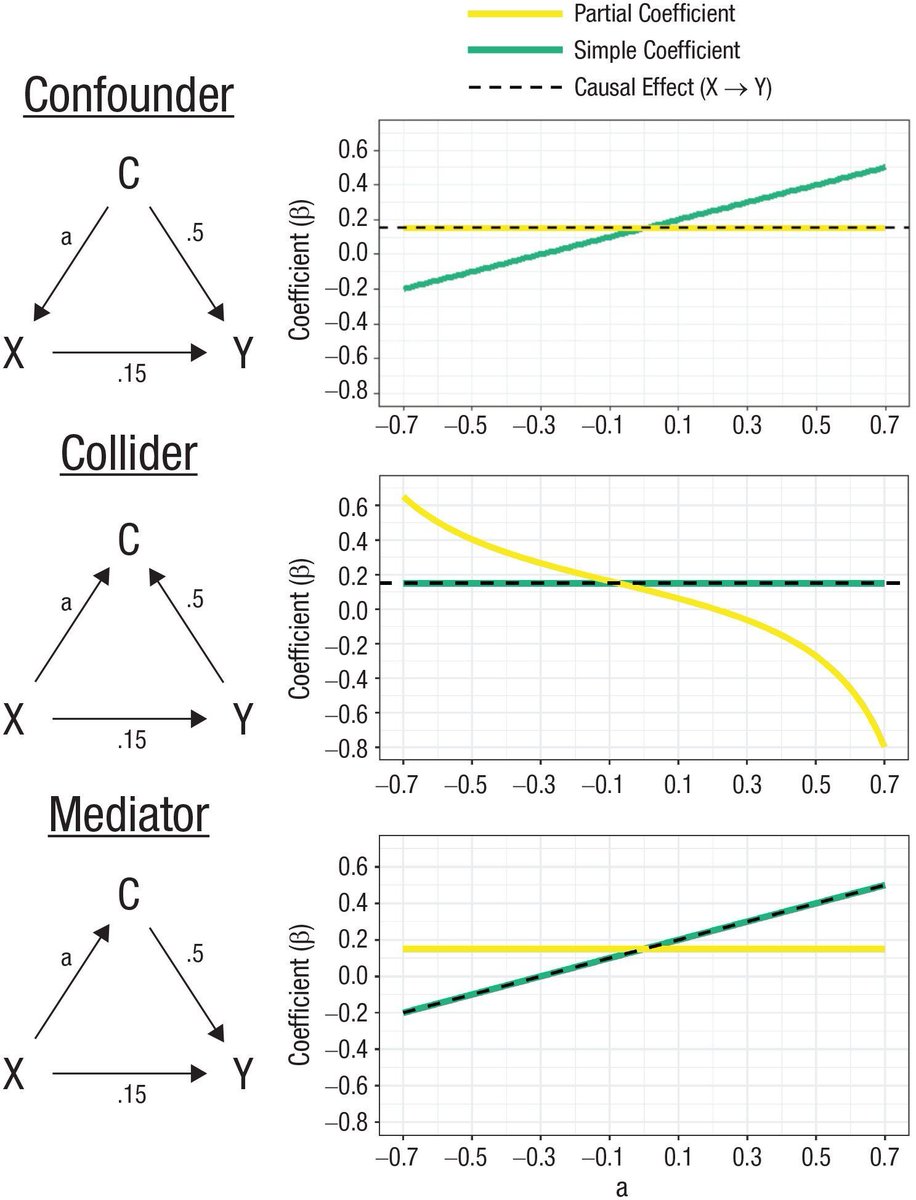
One of my favorite papers in recent years included this diagram.
It shows the impact of controlling for three different types of variables: confounders, colliders, and mediators.
With confounders, control is good. With the others, you ruin your result by controlling.