Director, Immunology Institute @SinaiImmunol @IcahnMountSinai | Harnessing the innate immune system for novel therapies against cancer & inflammatory diseases.
in this Phase 1b trial: they show that a defined 15-bacterial strain manufactured in house @IcahnMountSinai achieved similar safety, durable engraftment, and efficacy than FMT in recurrent C. difficile infection. An important step toward standardized, scalable microbial medicines
Extraordinary advances #ASCO2026 in deadliest cancers show that cancer cures are increasingly within reach. Biggest limitation now is not science, but funding. We need a stronger NIH to remain at the forefront of discovery and keep fighting for US lives. #doubleNIHBUDGET
Quite an extraordinary study showing that liver macrophages in pigeons communicate with brain neurons via the vagus nerve to control avian navigation. Another example of macrophages evolutionary ability to sense and interface with their external environment
For those of you who think macrophages do almost everything, rethink “almost.”
They are programmable cells, recruited into whatever new function evolution needs.
https://t.co/tz6VrVQWpw
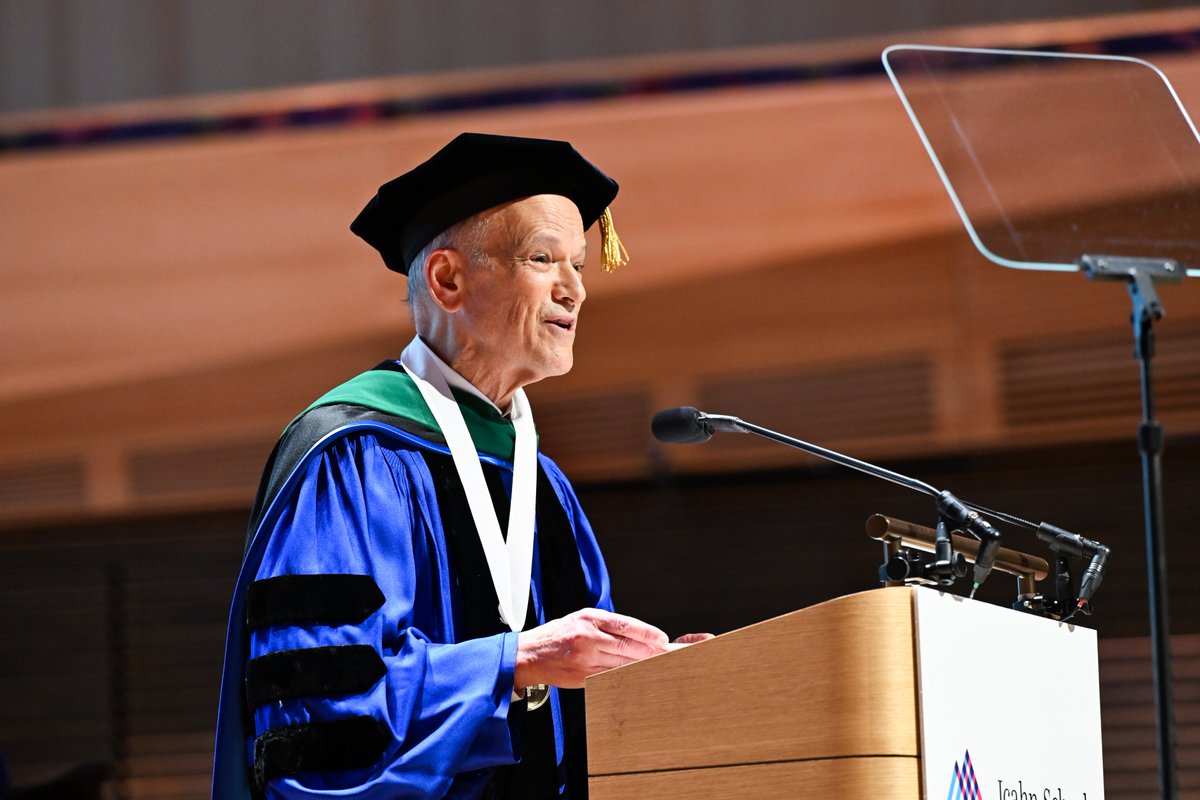
Last night’s Commencement @IcahnMountSinai was a powerful celebration of our MD, PhD, and dual degree students' accomplishments and future promise. Our honorary degree recipients, student speeches, and more are testimony to perseverance, purpose, possibility, & a bright future.
Published in Nature Biotechnology, new research from the Icahn School of Medicine at Mount Sinai challenges long-held assumptions about how mRNA vaccines work—revealing that non-immune cells play a critical role in shaping vaccine effectiveness.
Led by Brian D. Brown, PhD, the study shows that cells such as muscle and liver cells help regulate immune responses, rather than relying solely on traditional immune cells. Using a novel technology to control where mRNA is expressed in the body, researchers were able to enhance vaccine performance—significantly improving anti-tumor responses in preclinical lymphoma models.
The findings introduce a powerful new framework for designing mRNA vaccines and therapeutics, with implications for cancer immunotherapy, infectious disease, and gene-based treatments. By fine-tuning where and how mRNA is activated, scientists may be able to create more effective—and more precise—next-generation therapies.
Read more here: https://t.co/BMkBMrqMSe
Thrilled to see a new paper led by the outstanding @Brown_lab1, now out in Nature Biotechnology.
We provide mechanistic insights into how mRNA vaccines work. challenging key assumptions and offering new ways to control vaccine activity. (1/3)
Read here: https://t.co/zNZAGHJ9kd
Big takeaway: cellular expression patterns matter. mRNA expression in hepatocytes and myocytes shapes the immune response. Surprisingly, direct expression in DCs is not required—antigen can be transferred to them. Important implications for mRNA vaccine and drug design. (2/3)
A year after NIH funding cuts, 27% of researchers report their funding hasn’t been restored. This is not just budgets; it is the future of science, and the impact is already being felt, as @cassiemcgrath_ reports in @HealthcareBrew.
As PICI CEO @DrKarenKnudsen shared with Healthcare Brew, these funding cuts have a large impact on researchers and patients, and stall bold innovative science. PICI is working to keep progress moving by backing high-risk, high-reward science and accelerating collaboration to turn all cancers into curable diseases.
Read Cassie’s full piece here: https://t.co/WAqRKONia4
Thrilled to have hosted our first @SinaiImmunol faculty therapeutic retreat at our west campus with the incredible @ArtKrieg and Neil Stahl! Inspiring discussions on new targets & next-gen therapeutics in cancer & inflammatory diseases. so much energy and momentum! #Immunotherapy
The proposed FY2027 budget includes a $5.8B (−12.3%) cut to the NIH. United for Medical Research calculated this could cost ~50,000 jobs and $11.6B in economic activity, with 26 states losing >$100M each. A tragedy for science, patients, and the economy. #NIH
Trump's attacks on academia and budget cuts for research have provided an opening for other countries to poach leading scientists -- a costly brain drain. https://t.co/O8DEEyqjGH