🌊 El Niño & La Niña
what are they?
Ever wondered why the climate can swing from one extreme to another?
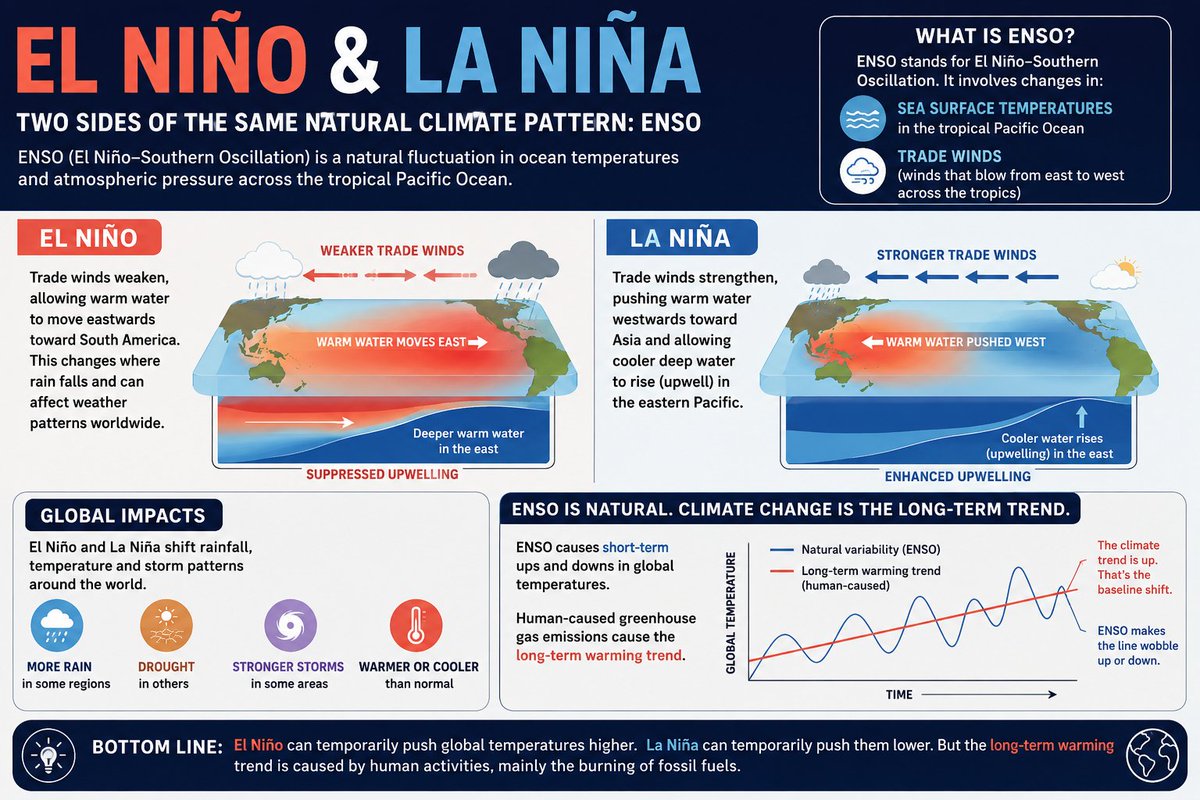
El Niño and La Niña are opposite phases of a natural climate pattern called ENSO (El Niño–Southern Oscillation).
🔥 El Niño:
Winds across the tropical Pacific weaken, allowing unusually warm water to spread eastwards toward South America.
This changes atmospheric circulation and can influence weather across the entire planet.
❄️ La Niña:
The trade winds strengthen, pushing warm water westwards towards Asia and allowing cooler deep water to rise in the eastern Pacific.
🌍 The result? Changes in rainfall, drought, storms and temperatures in different parts of the world.
Importantly, ENSO is natural variability — it isn't caused by human-caused climate change.
But here's the crucial point:
👉 El Niño can temporarily push global temperatures higher, while La Niña can temporarily suppress them.
Think of ENSO as a natural “wiggle” on top of the long-term warming trend caused primarily by rising greenhouse gases.
So when someone says “warming is just El Niño”, they're confusing short-term variability with the underlying trend.
📈 Natural variability changes the path. Greenhouse gases change the baseline.
#ElNino #LaNina #ClimateScience #ClimateChange
🌎 FOLLOW BACK FRIDAY 🌎
Looking to connect with more people who are interested in:
🌡️ Climate science & climate change
🌊 Weather & natural climate variability
🔬 Science & evidence
🌍 Our changing planet
🧠 Critical thinking & fact-checking
Drop a 🌍 in the replies and let's find some new accounts to follow!
If you follow me, I'll check out your profile and follow back where I can.
Let's grow a community that values evidence over misinformation. 🤝
#FollowBackFriday #FBF #ClimateScience #ScienceTwitter #Climate
@TheRealRolfster@Dragias2657201 Humans find it hard to change their behaviours when the threat is unseen or based in the future...much like the pandemic.. if we act now to reduce emissions the worst case projections are less likely to happen
@ryankatzrosene@PaulRoundy1 I think people don't realise how fragile the human economic system is...if it breaks then I'm not sure any of us are prepared or armed to deal with that.
🌍 The CO₂ “saturation” fallacy
A common climate-denial argument goes:
“CO₂ absorbs infrared radiation. But the absorption is logarithmic, so most of the effect has already happened.
Adding more CO₂ barely matters.”
Sounds scientific. But it gets the physics wrong.
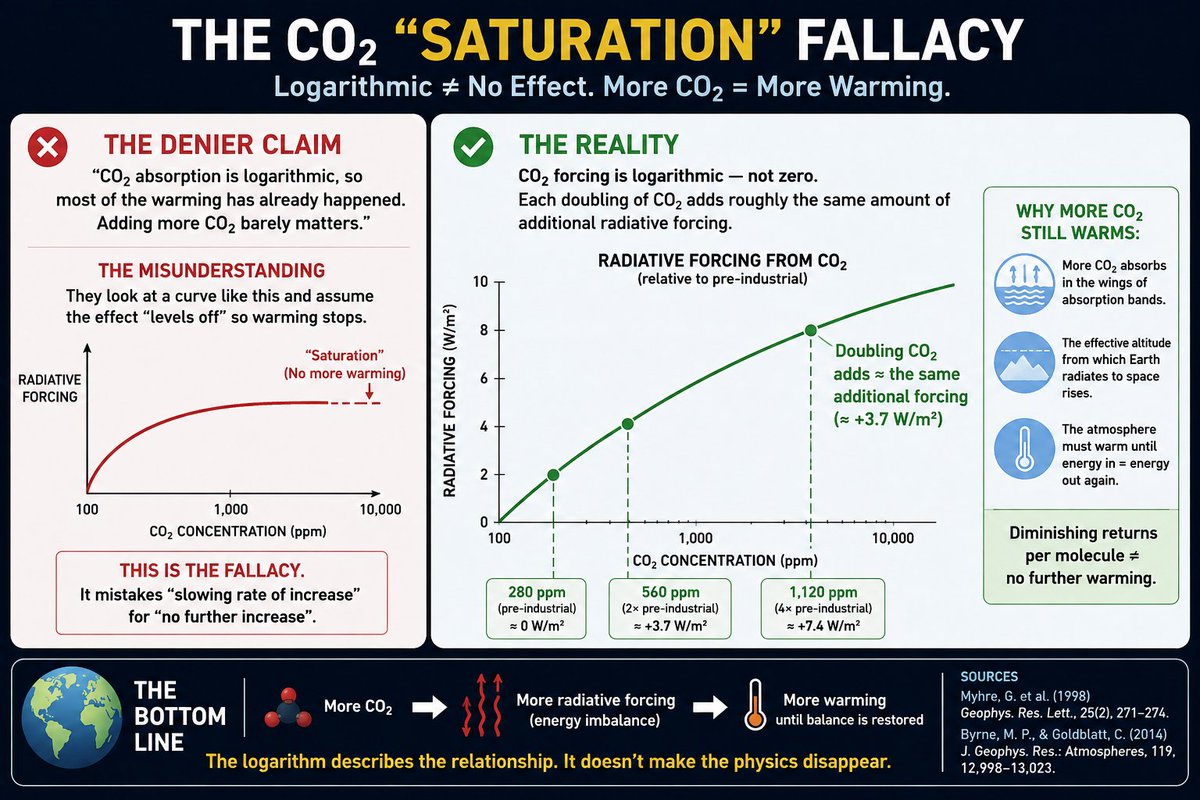
CO₂’s warming effect is logarithmic — not zero.
Each doubling of atmospheric CO₂ produces roughly the same additional radiative forcing.
280 → 560 ppm ≈ +3.7 W/m²
560 → 1120 ppm ≈ another ≈ +3.7 W/m²
We don't need every CO₂ molecule to absorb every photon.
As CO₂ concentration rises, absorption expands into the wings of the infrared absorption bands, while the effective altitude from which radiation escapes to space changes.
And crucially, the atmosphere must warm until it can once again balance incoming energy with outgoing radiation.
So yes: CO₂ has diminishing returns per molecule.
But “diminishing returns” ≠ “no further warming.”
That’s the logarithmic fallacy.
📚 Myhre et al. (1998), Geophysical Research Letters
📚 Byrne & Goldblatt (2014), Journal of Geophysical Research: Atmospheres
More CO₂ → more radiative forcing → more warming.
The logarithm describes the relationship.
It doesn't make the physics disappear.
#climate #climatechange #physics #ScienceFacts
@OlympusMons99 And AI is a separate, compelling topic ..are we sticking to one thread/topic at a time or will you spam
Can you answer the question I asked you ? Or not ?
We have about 3 to 6 years until the global heat index rises to 1.5°C….
We have nine years in total until global heat rises to 1.8°C
We’re running out of time
Shifting from actual climate physics to internet tribalism and declaring yourself the "winner" because of a typo doesn't mask the fact that you dodged the entire argument.
If you want a genuine, science-backed debate instead of a scoring contest then how do you reconcile a slow, multi-millennial orbital shift with a rapid century scale radiative imbalance that outpaces deep-ocean mixing??
The Holocene optimum was driven by slow orbital forcing over millennia, allowing ecosystems to adapt, not a rapid greenhouse gas injection forcing ~ 3W/m2 in decades.
Since you brought up transient processes, how do you reconcile a multi millennial orbital shift with a century scale radiative imbalance, and what happens to thermal stratification when forcing outpaces deep-ocean mixing timescales??
"Rumbling"? Do you mean Rambling?
Anyway...
Being richer doesn't make you immune to crop failures, water scarcity, or supply chain collapses that scale non-linearly with warming.
Wealth helps adaptation, but it can't buy food out of empty global breadbaskets.
Dismissing 2.2°C because of projected GDP growth ignores basic biophysical limits.
The 1876 famine deaths were driven by a catastrophic lack of global food distribution, communication, and colonial-era relief—not just weather. The fact that modern systems prevent millions of deaths today proves our infrastructure works, not that climate shocks are a joke.
You're dodging every point about physics while projecting "zealotry"
That massive drop in climate mortality over the past century is a testament to modern forecasting, emergency response, and infrastructure it doesn't mean hazards are benign.
Relying on past adaptation ignores the non-linear scaling of systemic threats like multi-breadbasket failures for 8 billion people.
Accusing scientists of "killing billions" for projecting those risks is peak bad-faith deflection.
Notice how there's no actual science here just accusations of a 'cult' and a rant about RCP8.5. Radiative imbalance does mean the planet warms to restore equilibrium, but the rate of that warming matters immensely.
You can't just wave away transient climate response with a sarcastic metaphor
@TheRealRolfster Humanity 'thrived' while destabilizing the climate, not because of it.
A jump from 1.5°C to 2°C isn't just a linear 0.5°C step it crosses critical tipping points for ice sheets, coral reefs, and agricultural stability