Extreme heat is a human rights crisis. Millions lack access to cooling, safe work, and basic protections as temperatures rise. Read CRI's comprehensive report on heat and human rights to learn more: https://t.co/rHRBtiywOJ #HeatActionDay
Extreme heat is a human rights crisis. In Dhaka, CRI researcher @CaraSchulte_ documented workers facing dangerous heat on the job. Raina, pregnant, fainted at work—then returned minutes later:
“My body is burning… but I have to do my job.”
No one should have to choose between health and survival.
#HeatActionDay
https://t.co/taZr3whHYO
Across France, the UK, and Spain, record-breaking heat is pushing temperatures to mid-summer levels. Climate change is making extreme heat more frequent and more intense, driven by continued fossil fuel use.
A wave of recent legal and economic changes is weakening protections for the Amazon and Indigenous territories. A key environmental agreement that reduced soy-driven deforestation has collapsed, while large infrastructure projects are expanding export routes through the Amazon. At the same time, legal changes and proposed constitutional reforms are making it harder for Indigenous communities to secure or defend their land rights.
The biggest threat to the Amazon today is not just illegal deforestation, but coordinated legal and economic systems that make large-scale industrial expansion easier and Indigenous land protection harder.
Read more about it on our new substack: https://t.co/zfztMVZf9u
A pathway to just trade.
Critical minerals are essential to the energy transition. But the UK must secure them without repeating the extractive harms of the past.
Read the report by @TradeJusticeMov
https://t.co/Ehc4l6h4xu
Serious environmental, human rights, and climate risks have been identified in relation to the Kon Kweni iron-ore mine project proposed by Ivanhoe Atlantic in Guinea, raising major concerns over potential non-compliance and irreversible impacts on biodiversity.
The findings underscore the need for urgent action: Ivanhoe Atlantic should fully address the issues raised in the study or withdraw the project entirely. Guinean authorities should withhold approval until a robust, binding, and enforceable mitigation and monitoring plan is in place.
https://t.co/FdtwqJ7l7H
In a new op-ed for Al Jazeera, CRI Senior Expert @FelixHorne1 examines the hidden environmental costs of war. From Iran and the Gulf to Ukraine, Sudan, and Yemen, attacks on fossil fuel infrastructure leave behind decades of pollution, contamination, and climate damage.
Post-conflict reconstruction should be a critical moment to shift toward cleaner, more resilient energy systems that can reduce the toxic aftermath of war.
https://t.co/r9mc7hHcvs
@AJEnglish
The UNGA has recognized the ICJ’s landmark opinion confirming that states have binding legal obligations to protect the climate and human rights. Although a major step for climate justice, accountability mechanisms were weakened during negotiations by major emitting states.
https://t.co/EStCbU6jXX
There's a lot of uncertainty about what—if anything—was agreed at last week's US-China summit. But what's crystal-clear: coal, emissions, and climate didn't even make it on to the agenda.
Xi and Trump don't seem to have found much new ground at the summit. But their commitments to an old fossil fuel puts everyone at risk.
China and the US continue their race to the bottom by not giving up on coal. The summit could have been a chance to put the climate crisis and global health first—but it didn't even make the agenda.
@SophieDRich
https://t.co/YlE1LLr5Hm
The East African Crude Oil Pipeline (#EACOP) is not just a pipeline — it is a threat to human rights, ecosystems, and the climate.
Climate Rights International’s research has documented risks and harms linked to the project, including displacement, threats to livelihoods, intimidation of activists, and environmental destruction across Uganda and Tanzania.
Meanwhile, EACOP could generate an estimated 379 million tons of CO₂ over its lifetime.
We stand with frontline communities demanding accountability and calling to #KickPollutersOutOfAfrica.
#StopEACOP @yecaug
When the world's most powerful leaders meet, who are they speaking for? Not the communities in Uganda displaced by climate projects. Not the Tibetan activists jailed for opposing a dam. Not the Chinese lawyers who've spent decades trying to take polluters to court.
This week's Trump-Xi summit in Beijing will generate a lot of headlines. But our Senior China Advisor @SophieDRich has spent years documenting what those headlines leave out.
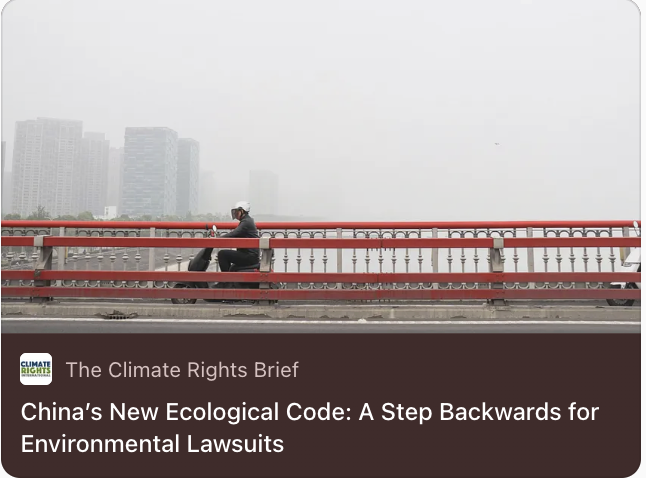
Her latest: China's new Ecological Code takes a step backward — not forward — for the people who need climate accountability.
https://t.co/jva1ylpViO
As Chinese and US leaders meet this week to discuss energy security, supply chains, and global cooperation, those discussions cannot be separated from the realities unfolding in Uganda’s oil regions.
In Uganda’s Lake Albert region, communities living near the Kingfisher oil project describe daily life shaped by fear, intimidation, and loss. A joint report by Climate Rights International and Environment Governance Institute Uganda documents serious human rights abuses linked to oil development led by China National Offshore Oil Corporation (CNOOC), including militarized control, forced displacement, extortion of fishers, and environmental harm.
At a moment when governments are debating the future of energy cooperation and climate commitments, these findings are a reminder that energy security cannot be separated from human rights and environmental protections for frontline communities.
https://t.co/RK4PVbjoE9
@egiuganda
According to Jim Worthington of @hrw and Krista Shennum of @ClimateRights, these are the top 3 steps automakers must take to respect human rights and source more responsibly:
1️⃣ Build meaningful relationships with communities, workers, and NGOs at key mines and plants with human rights risks, as @MercedesBenz has done with communities in the aluminum industry in Guinea.
2️⃣Coordinate to maximize the industry’s leverage and avoid duplication. In Indonesia, the world’s largest supplier of nickel, car companies, including @Tesla, have organized visits to nickel industrial parks and raised human rights concerns with local authorities and companies.
3️⃣Join initiatives like @IRMA_mining to work alongside mining companies, unions and NGOs to try to build strong mining and audit standards, as @Ford and @Volkswagen have done.
Read the whole article at Automotive News: https://t.co/EadqyvK048
“I don’t expect to have a future like you guys have had.”
Young people around the world are grappling with a difficult question: what will the future look like in an era of climate change?
@BradMAdams shares a conversation with his son that helped inspire the founding of Climate Rights International, highlighting the rise of climate anxiety and the responsibility of older generations to act. As climate impacts intensify, the piece explores why urgent action, and accountability from governments and industries, cannot wait.
https://t.co/VDzoIv0Ads
#ClimateJustice #ClimateChange #ClimateAnxiety