Last month, Climate TRACE’s Benedicte de Gelder joined @UNEPCCC experts to discuss how granular methane emissions data can help decision-makers identify, prioritize, develop, and monitor landfill methane mitigation projects: https://t.co/zusahwUPPb
Methane is second only to carbon dioxide in contributing to climate change. However, many solutions to reduce methane emissions are achievable relatively quickly, with landfill gas capture, flaring, and energy recovery presenting some of the best mitigation opportunities.
N2O is about 300 times more potent than CO2, making ambitious action in the agricultural sector critical to protecting both our climate and health. Our data on nitrous oxide emissions were used to identify where synthetic fertilizer use is most intensive: https://t.co/vnyVrs3mv8
Synthetic nitrogen fertilizers can boost agricultural yields, but excess nitrogen can flow into nearby waterways. @MSCI_Institute maps where nitrate pollution poses a risk to European food and beverage manufacturing facilities that rely on clean water: https://t.co/PeME5xrb9b
Climate TRACE’s Benedicte De Gelder and Anthony Russo will guide attendees in exploring our asset-level data and transition planning tools, while Honorine van den Broek d'Obrenan will share how @c40cities is already using them.
To develop impactful decarbonization plans, decisionmakers need to know where and when greenhouse gas and air pollutant emissions are occurring. Our coalition’s mission is to get them that data — and make it as easy to put into practice as possible.
On Wednesday, September 30, at 4pm BST, we’re hosting an interactive #ClimateIQ webinar highlighting how policymakers, technical analysts, and science-policy practitioners can use satellite imagery and AI-based tools for climate action planning: https://t.co/4rZbLn40Ck
Check out the notes for more details — data enthusiasts in particular will want to check out some updates we’ve made to our methodologies 🤓 https://t.co/W5hXtXjgPA
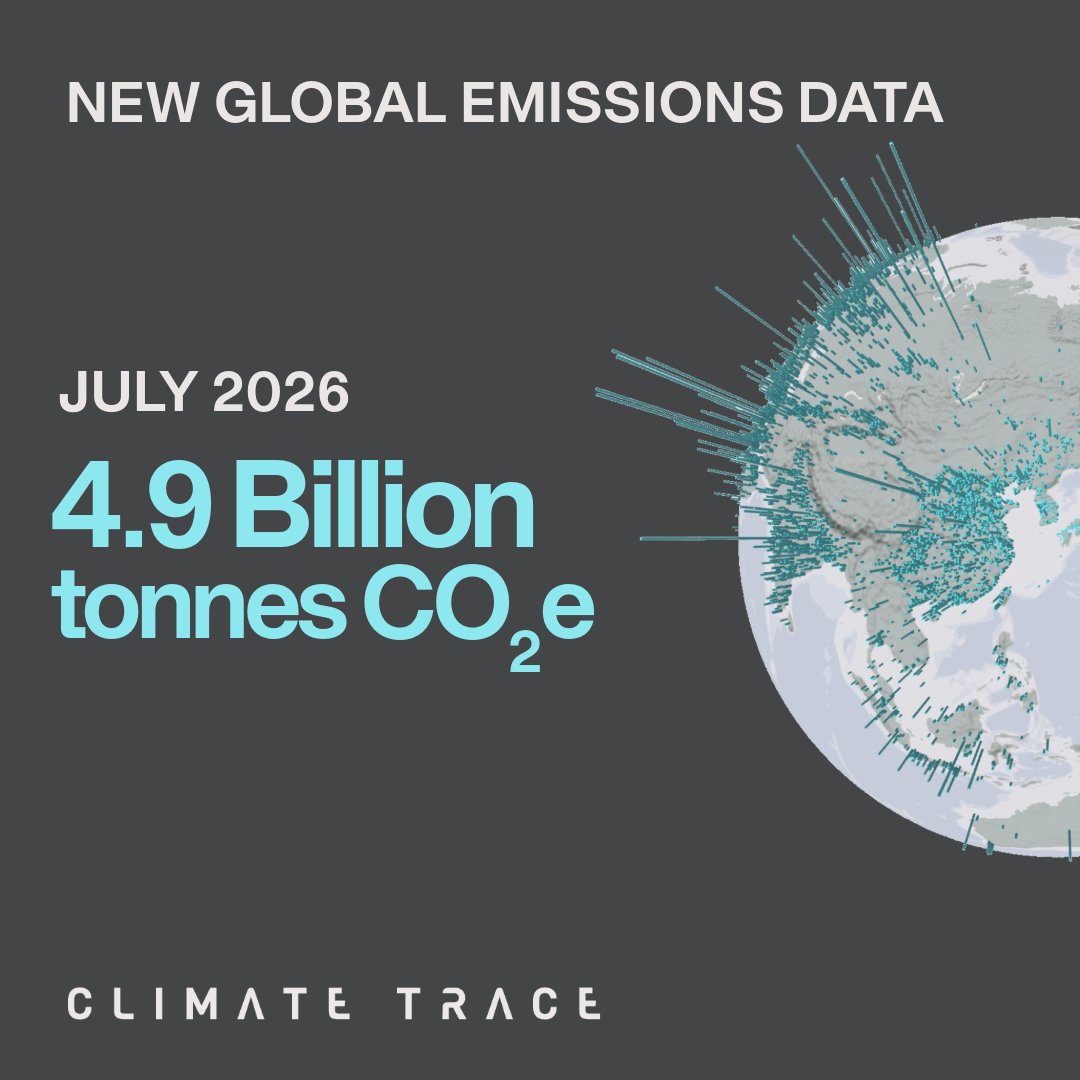
🚚 GHG emissions increased in agriculture, buildings, and waste, while decreasing in fossil fuel operations, manufacturing, and power. The transportation sector saw the greatest change in emissions year over year, with emissions increasing by 2.5% compared to July 2025.
The push for more renewable energy has reduced greenhouse gas emissions from the power sector. But due to changes in other sectors, Climate TRACE data from the first half of the year found that global emissions increased 0.2% compared to 2025: https://t.co/CLWZyPGnhW
Countries are coming to terms with the fact that transitioning to clean power ensures energy security when disruptions like the war in Iran spike oil and gas prices. @AP takes a closer look at how geopolitical instability affects global emissions: https://t.co/z2XpekHroU
The article (in Catalan) uses Climate TRACE data to delve into the challenge of calculating and accounting for emissions from international air travel in climate action plans.
@La_Directa estimates that the expansion of Barcelona’s airport could amount to up to 60% of Catalonia’s CO2 emissions cap between 2031 and 2035 — but those emissions will not be counted towards their regional greenhouse gas inventories.
“L’aeroport de Barcelona ja emet més que tots els habitatges de Catalunya junts i també més que tota l’activitat de Repsol al país”, afirma la investigadora en justícia climàtica de l’ODG Claudia Custodio, part de la plataforma Zeroport https://t.co/b2Wd1ugKbp
Using baseline emissions and production datasets from Climate TRACE and CRU Group, the researchers demonstrate what this coalition approach could achieve in four heavily emitting sectors: iron and steel, aluminum, cement, and fertilizers: https://t.co/8kkWCPkFJQ
Carbon pricing systems can be useful tools to incentivize greenhouse gas emissions reductions, but how can the international community ensure these efforts are as equitable and efficient as possible?
The @Harvard and @MIT Global Climate Policy Program outlines how countries could coordinate carbon pricing measures to deliver 15 times greater emissions reductions than current policies and generate over $145 billion annually for participating countries: https://t.co/ulU20EeFJ6
The session will feature perspectives from subnational climate organizations that are already using these tools, so other policymakers, technical analysts, and science-policy practitioners can take advantage of them too.
🔗 Learn more and sign up at https://t.co/4rZbLn3sMM
Satellite imagery and AI-driven data are already exposing the extent of greenhouse gas emissions and other air pollutants around the world, but how can decisionmakers use these data to develop more effective climate action plans?
Climate TRACE is teaming up with #ClimateIQ to host an interactive webinar to highlight how our asset-level data and transition planning tools can support high-impact decarbonization efforts.
🗓️ Date: September 30, 2026
⏰ Time: 4:00 pm BST