Science gasps for breath. They are removing all the ocean monitors to understand changes in currents and climate, and the excuse is a master class in obfuscation & double speak . (1/2) https://t.co/vs782YbcI3
more fishing -> less animals -> less vertical migration -> more stratification -> less nutrients -> less animals -> less carbon capture -> more warming -> more stratification ...and so on.
Just turning off the tap does not empty the bathtub, the bottom plug has to be opened.
Researchers argue that rapidly scaling carbon removal (#CDR) is necessary alongside emissions cuts & present ocean iron fertilization as a potentially feasible large-scale approach for enhancing long-term carbon sequestration in the deep ocean.
The study argues that natural carbon sinks alone are too slow to prevent dangerous CO₂ accumulation and suggests that negative emission technologies may become increasingly necessary despite ongoing concerns about environmental risks and uncertainties.
https://t.co/mwivtHE7MB
For a while "only gas and nuclear can provide needed firm power" was the "serious" position in the US.
It's why people like @mzjacobson were attacked as if they were "heretics". Turns out the heretics were right.
@A1an_M CO2 causes warming that triggers amplifying feedbacks that cause more warming (ie, Equilibrium Climate Sensitivity). Decreased clouds from warming is one of those feedbacks:
Global Warming➔Fewer Clouds➔More Warming! with George Tselioudis
https://t.co/dONKPGDofy
A public dialogue on solar radiation modification (#SRM) has revealed broad support for further research, alongside clear concerns about its deployment.
https://t.co/gCoo44naCJ
Climate disruption is already pushing millions to move—but most “climate migration” is still invisible, internal, and legally unprotected. When home becomes unlivable, will we choose compassion or walls? Watch our new episode. https://t.co/3FLf0hQVO6
This is pure ’see no evil’ denialism—but that’s a tell that they know they need to cover up the truth.
It’s also outrageous.
Streisand effect, anyone?
See linked article.
#AMOC#Ocean#ClimateDisruption
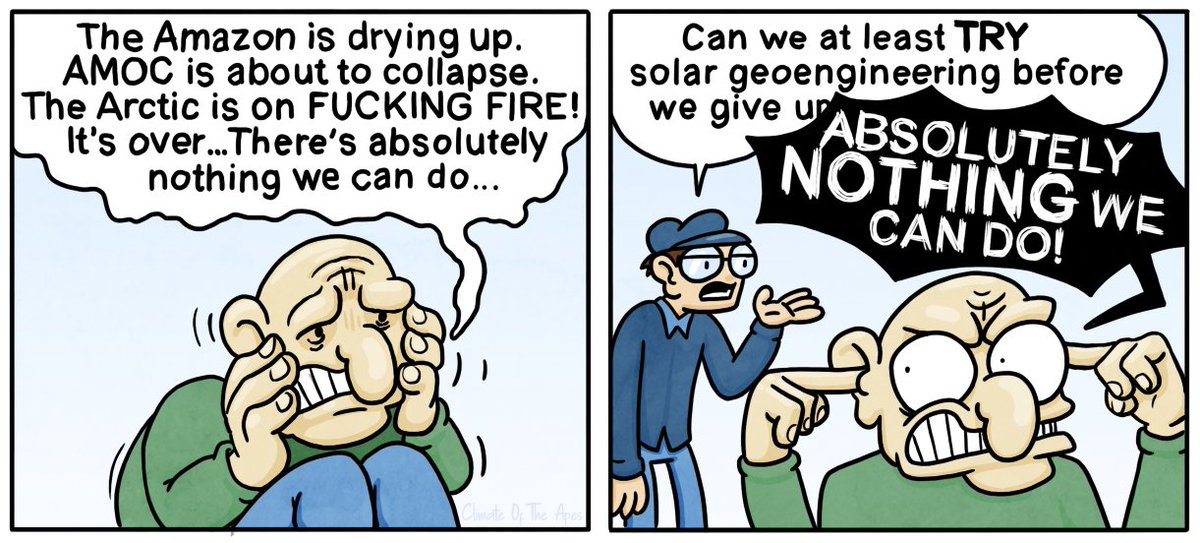
🗞️Weekly Solar Geoengineering Bulletin (25 May - 31 May 2026)🗞️
🔗Read the full newsletter here:
https://t.co/spmRiL4VIv
Research Paper: Artificial Flooding Leads to Thicker and Brighter Arctic Sea Ice (AGU)
Preprint: Estimating Twomey forcing sensitivity to aerosol plume spreading rates (EGUsphere)
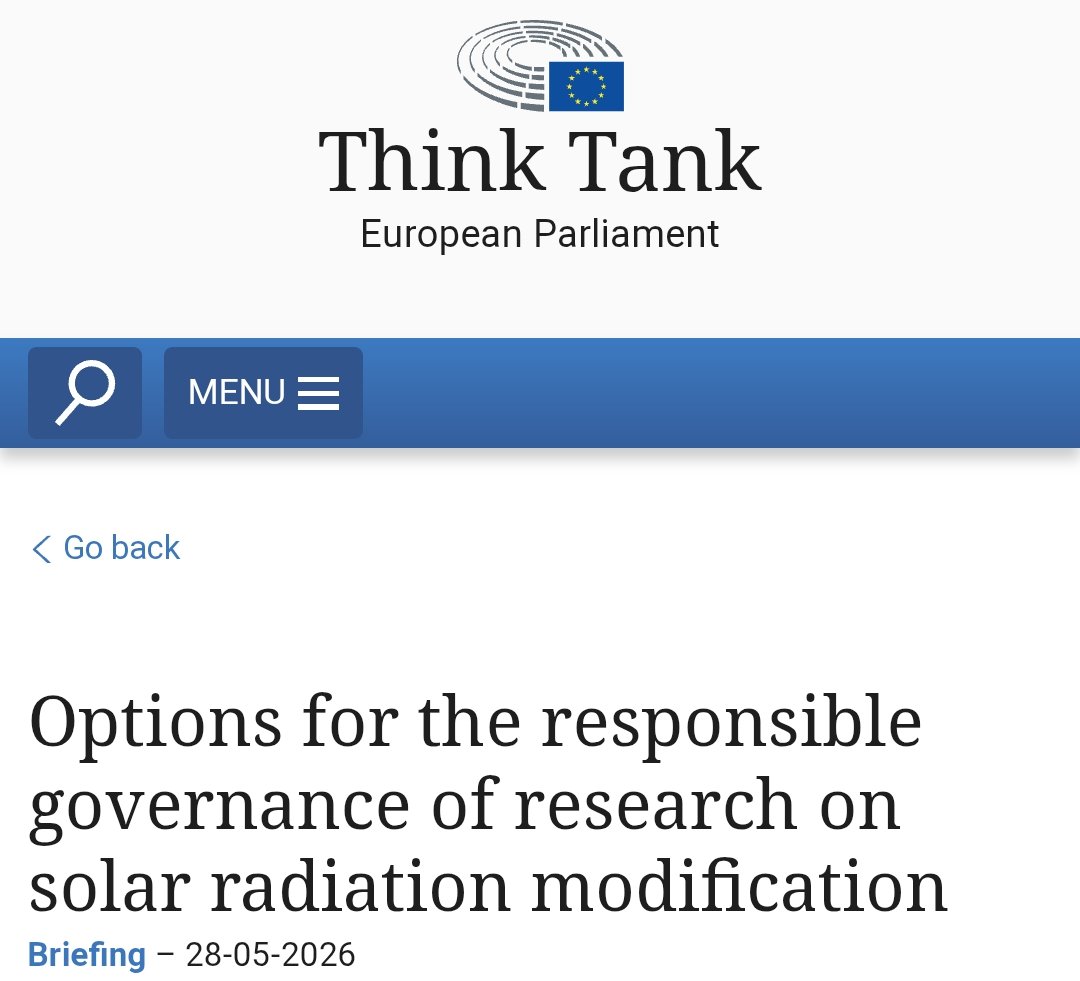
Report: Options for the responsible governance of research on solar radiation modification (EU Parliament)
Survey: Dim the sun to tackle climate change? Fine by us, public suggests (The Times)
Podcast: How to Dim the Sun (How We Survive)
YouTube Playlist: 2026 Frontiers in Climate Systems Engineering (UChicago Climate Systems Engineering initiative)
🔗Read on to unpack more updates:
https://t.co/spmRiL4VIv
America’s largest reservoirs are dropping to critically low levels.
Major water storage facilities, including Lake Mead and Lake Powell, form the backbone of the nation’s water infrastructure in the arid Southwest. These reservoirs collectively supply drinking water to more than 40 million people, sustain vast agricultural operations, support industry, and generate hydropower.
According to the latest federal data, six major U.S. reservoirs have reached their lowest water levels for the month of May in at least 30 years. Lake Mead, the country’s largest artificial reservoir, currently stands at approximately 49 percent of its typical volume for this time of year. Lake Powell is in even worse condition, holding just 38 percent of its average capacity.
The shortfall traces back to the mountains. Western reservoirs depend heavily on snowpack accumulated during winter, which melts in spring and feeds rivers and lakes. This year, many regions recorded significantly below-average snowpack, delivering a much weaker spring runoff than normal.
The effects reach well beyond the reservoirs. Reduced water levels threaten municipal supplies, constrain irrigation for farmers, and cut hydropower output. Lake Mead and Lake Powell are especially critical, as they regulate the Colorado River system that serves seven western states.
Among the hardest hit is Texas’ Choke Canyon Reservoir, which has plummeted to only 11.9 percent of its typical late-May level, the lowest of all reservoirs analyzed.
Experts warn that this situation underscores the growing vulnerability of water systems when drought, reduced snowpack, and high demand coincide. More than 20 percent of the continental United States is currently under extreme drought conditions, according to the U.S. Drought Monitor.
Although the reservoirs have not yet reached record lows, entering the peak summer demand period with such depleted stores leaves little buffer if arid conditions persist.
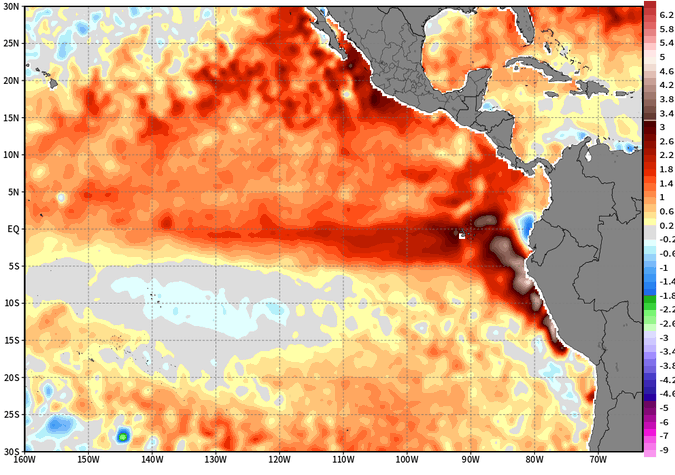
The Pacific is waking up big time.
Sea surface temperatures off Peru are now running more than 4°C above normal, while the classic El Niño warm pool expands westward across the tropical Pacific.
In a warming world, Super El Niños could become far more common.
These motherfuckers are ruining everything and lots of people are going to die as a result.
Trump Administration to Dismantle Ocean Monitoring System
The system has been critical to climate and ocean research.
https://t.co/dbac2CzLfi
A new briefing summarises the state of knowledge about various proposed #SRM methods and associated risks, explains their potential role in global climate action, gives an overview of the existing rules for SRM research and development, and outlines options for the future governance of SRM research.
https://t.co/UUKZhaqWDp
A novel silica-coated dolomite aerosol (DoloSil-20) outperformed conventional sulfate aerosols across key solar geoengineering criteria, delivering 45% higher light-scattering efficiency, far lower modeled ozone depletion, and negligible stratospheric heating in a screening study.
Researchers proposed DoloSil-20, a core-shell mineral aerosol designed for stratospheric aerosol injection (SAI).
In a 1D aerosol model, it achieved 45% greater mass-specific backscattering than sulfate aerosols and limited peak ozone depletion to 10%, compared with 47% for sulfate.
The material also showed virtually no near-infrared heating. While atmospheric persistence was lower due to faster settling, the study suggests DoloSil-20 could better balance cooling performance, ozone protection, and thermal impacts, warranting further testing in 3D chemistry-climate models.
https://t.co/Zdnj6kbmc0
On May 18 and 19, 2026 the Climate Systems Engineering initiative (CSEI) hosted a conference to advance the understanding of climate
engineering through rigorous analysis and open debate.
Here are the recordings from the sessions:
https://t.co/KSkoZ89gV9