The trust layer for autonomous agentic interactions must be distributed, machine-native, and AI-to-AI by default.
Not human-to-AI. Not AI-to-human. Not dependent on centralised platforms or human approval at runtime.
Agents must be able to independently discover, authenticate, verify authority, resolve standards and provenance, enforce permissions, and establish trust across organisational and protocol boundaries.
Humans define governance, accountability and dispute mechanisms. Machines handle trust verification and enforcement at the speed and scale of autonomous interaction.
Globally discoverable trust. Locally verifiable evidence. Distributed execution. Autonomous interaction.
@cheqd_io $cheq
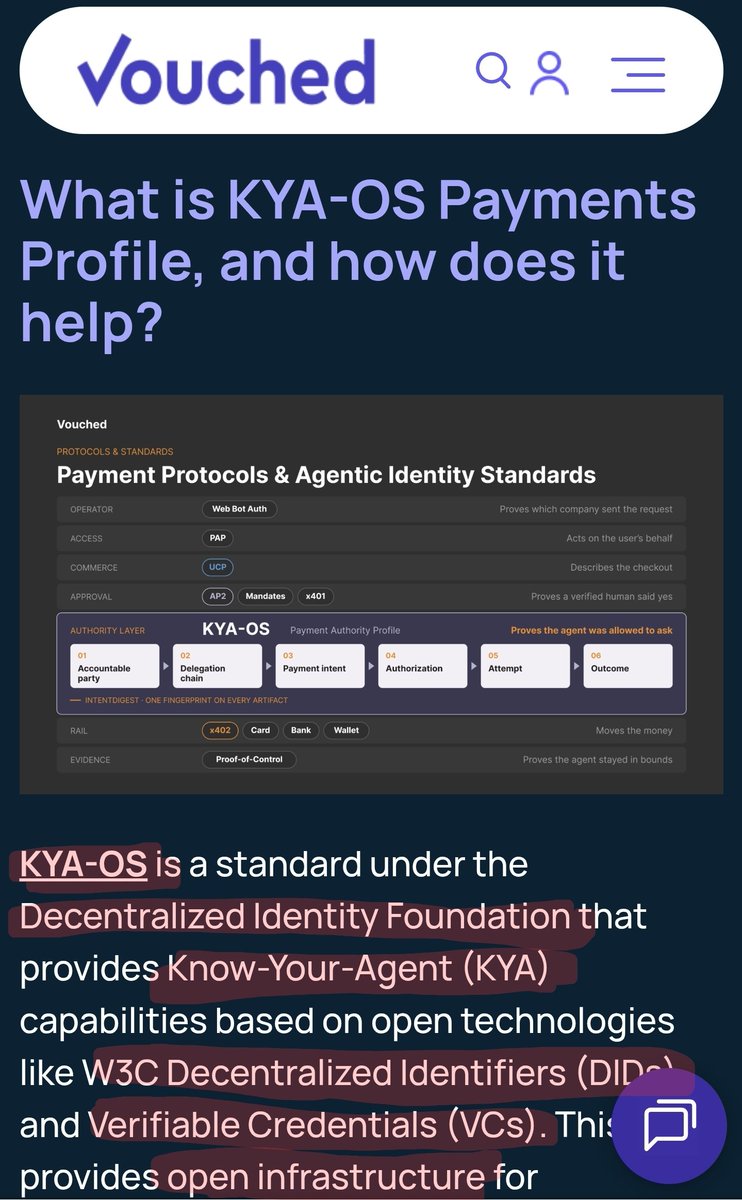
Agentic AI work continues at DIF: the Delegated Authority Task Force is preparing its v1.0 protocol evaluations report, while KYA-OS explores support for emerging agentic payment protocols.
More in DIF Newsletter #66.
🔗 https://t.co/9oL1V6YB2X
🇬🇧Most still don't see UK GBTD's taking it's next steps
And $QNT seems to have an even BIGGER role now
This is thru UK Gov selecting 4 GBTD banks for tokenized bonds with tokenized money.
HSBC Orion & LSEG will be key components here
And there's 2 focal points screaming Quant
First is legacy to DLT and multi chain interoperability.
The platform will utilize solutions across LSEG's digital markets and tokenized money settlement infra with bonds hosted on HSBC Orion.
We've already seen from QuantNet that HSBC Orion is a supported banking DLT here.
And the hints of HSBC in UK GBTD should make that all the more clear.
(HSBC Orion is built on $CC Canton Network)
There are more hints to Canton Network here such as LSEG's DiSH utilizing Canton infrastructure.
We also know LSEG was recently appointed as a validator on the Canton Network too.
And Quant has also verified that Canton is one of the supported architectures in Overledger.
The other key piece here is the involvement of CREST
Another solution that QuantNet supports.
This one's especially interesting as we recently saw a legal notice of how ALL UK listed shares are to be settled thru CREST.
––––
Tokenized Deposits are now running rampant in finance
In the past couple months we've seen
First live tokenized deposit TX enabled thru UK GBTD
US banking giants beginning to establish via TCH's initiative using Overledger.
Japan's stablecoin proof of concept & them now megabanks there building on tokenized deposits
Canada's leading banks also now building around the same banking solution
And it seems with UK GBTD being the first... They're already taking the next steps.
Tokenized Money 🤝 Tokenized Capital Markets
🚨MORE $QNT x Japan's Tokenized Deposit DCJPY hints
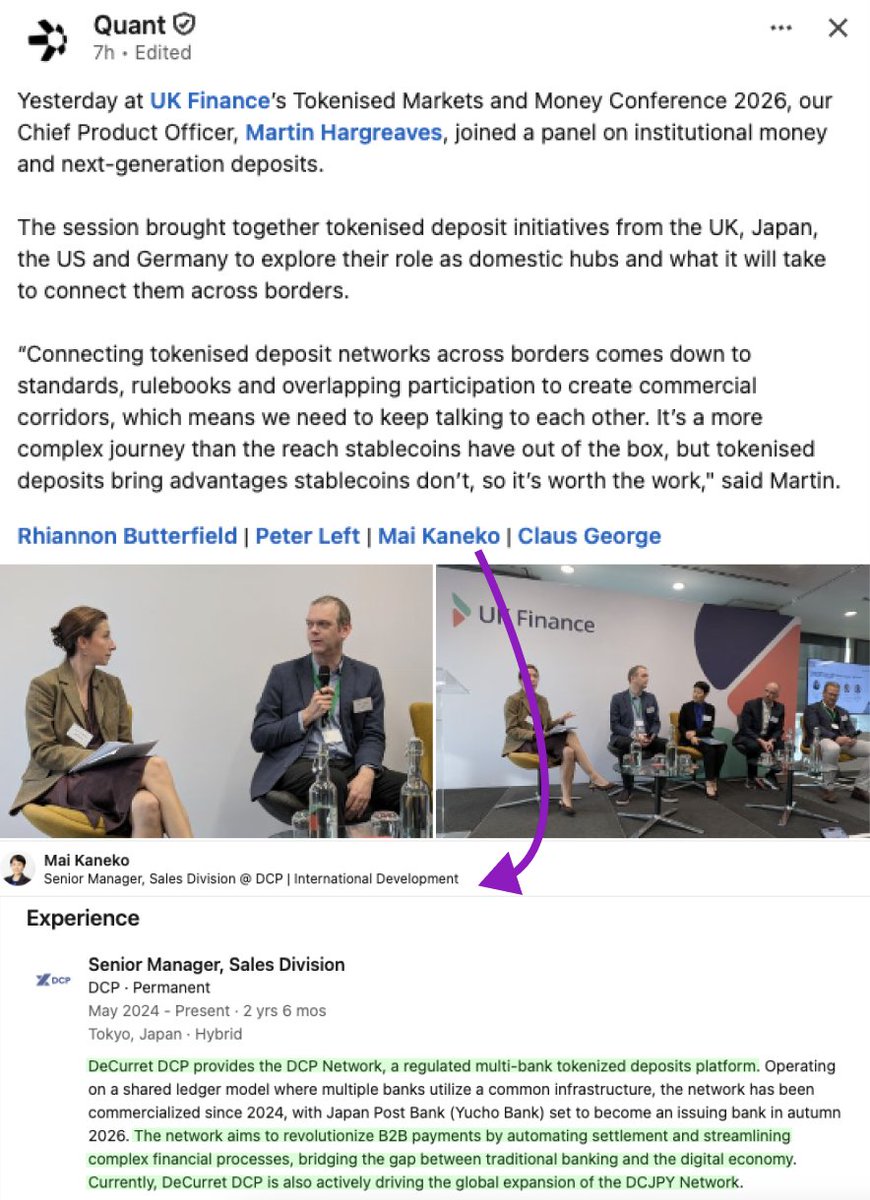
Quant CPO Martin Hargreaves discussing UK GBTD
He was joined by:
• UK Finance
• Lloyds
• DZ
We also see a key Japanese rep for DCJPY🇯🇵
Mai Kaneko, Sr Manager of DCP
DCP provides the network to DCJPY itself
And the DCP Network is built specifically as a regulated multi bank tokenized deposits platform
Exactly what we'd seen with UK GBTD
And what we're seeing now with TCH OCMI
Reminder that DCJPY was also mentioned alongside OCMI and GBTD at SWIFT SIBOS by SMBC too👀
Gilbert's also recently hinted at Programmable Yen next
And we can't forget the partnership with Dentsu Soken at the start of 2026 that set this ALL off
The pieces are coming together nicely now
Banks and payment infrastructures have invested in new rails and standards. Yet #settlement still lags behind messaging.
Most #crossborderpayments settle sequentially: leg one, then leg two. In the gap between them, risk, cost, and failed settlement can creep in.
Synchronised settlement closes that gap. Both legs settle together, or neither does.
Live deployments across the UK, Europe, and Latin America show it’s already possible.
https://t.co/H12RIQySKe
@spacexai Now let’s say I ‘upgrade’ from my current premium subscription at $40/mo to the new x subscription at $30/mo
Do I have the same amount of usage/credits for Grok or is it a downgrade as it’s now bundled with @cursor_ai & @bot
Might consider upgrading to Super.
I can say that @fraser_again is way ahead of the curve with what's coming about from all of this: AI / Agents Development.
Everything is in the "experimental mode" with production nowhere near ready to deploy to the public / be a "ready to use" product.
We are starting to see these Agents roll out slowly but limited as this phase will be gradual until stability improves.
We see: @bot , @Muse , @OpenAI Dots all been rolling out this year but the trust gap is the issue here. You can hand them a lot of access without independent proof of identity, authority or their history.
Cheqd (@cheqd_io) can add a decentralized trust layer for these agents by verifying the agents identity, authority, and history without relying on the parent companies who own and built these agents.
This reduces impersonation risk and improve auditability.
I wanted to understand where the capabilities of the various agent protocols and implementations actually overlap, so I had Claude map them out onto a capability map, now sharing it in case it's any use for others.
Quant itself holds granted Chinese patent protection for this technology.
Quant’s interoperability architecture has been formally entered into — and protected within — the intellectual-property systems of China, Japan, the United States and Europe.
$QNT
Tokenised deposits have moved from pilots to production planning, and regions are racing to get there first.
At @Sibos Miami 2026, our Founder and CEO, @gverdian, moderated a panel with @LloydsBank, @UKFtweets, @TCHtweets, @TDBank_US and @smbc_group.
The discussion covered where #tokeniseddeposits go first, what makes the commercial case, and why #interoperability will shape the next five years.
Read the full article here: https://t.co/MdsPGCnje6
#ProgrammableMoney #Sibos2026
A bearer token is not enough for autonomous agents & MCP.
We need deeper trust chaining and relationships.
Not time based expiry, or human in the loop.
We need cryptographically verifiable attestations and delegations, and what the parameters are and who allowed them.
Anyone in the verification zone affords the ability to verify and gain audit/proof/due diligence that such checks have taken place.
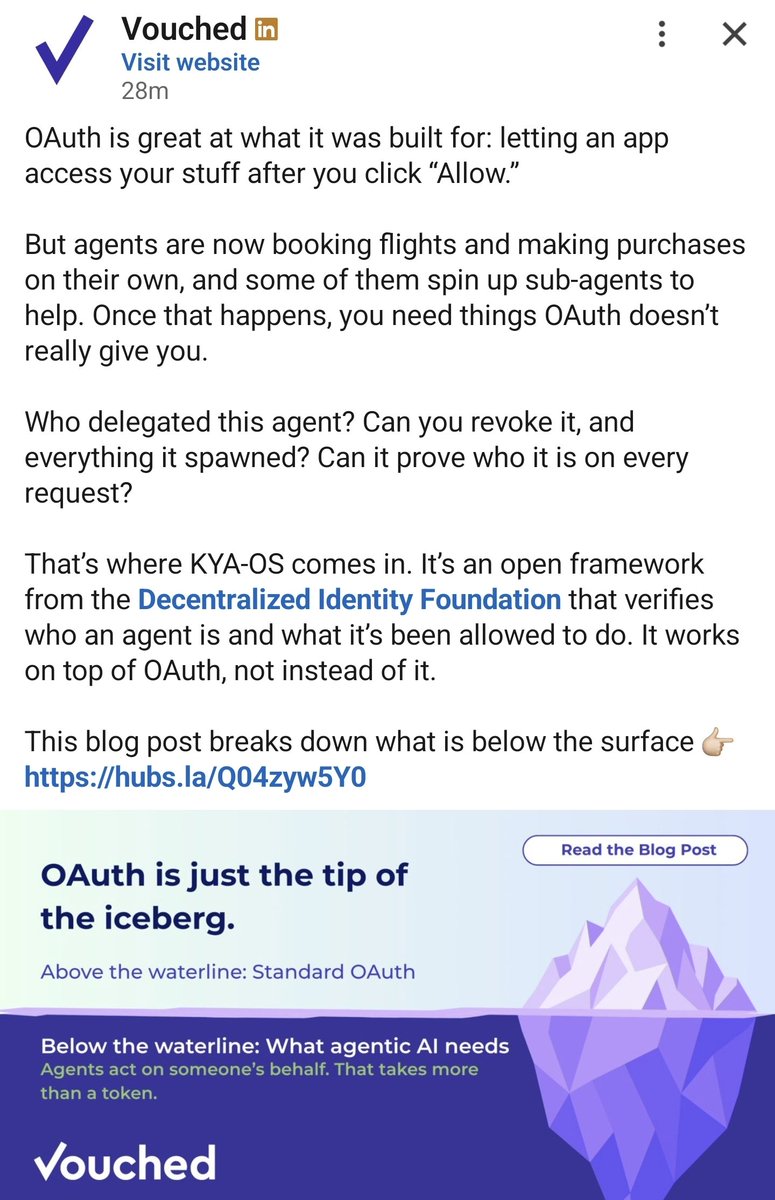
Immutable options for anchoring this, like cheqds ledger based DID VC solution, become extremely valuable infrastructure choices to support and allow this through protocol work like KYA-OS. Aka, know your agent.
@cheqd_io@VouchedID $cheq
@grok -
With modern videos being very difficult to distinguish from reality and what's made up, wouldn't verifiable credentials for content help solve this issue as it basically gives that content a 'signature' on the internet.
@cheqd_io is helping solve this very issue, you agree this needs to happen before false information starts to spread and get taken seriously?
Nikita is correct on this subject,
And I feel as if we will see providers pop up to create some form of “standard” or protocol for agents / ai agents. $CHEQ
Most don’t understand that their already is a company out there named @cheqd_io who has been developing and has joined forces with standards such as @C2PA_org, @ContentAuth, @DecentralizedID and others.
Which they follow the W3C standards, AnonCreds, OpenID4VC and so fourth.
All the information is on their website at https://t.co/xdZHX7wozz
The most important technology problem of the next 5 years:
Creating a broadly accepted standard for agents to identify themselves to service providers, so that providers can adjust the way they interface with clients (as compared to human-based traffic).
In the interim (i.e., for the next 6 months), there will be a cat-and-mouse game that agents will play -- to circumvent detection and maintain their product's utility during this growth phase.
However, this will only be a stopgap and it will not be the terminal state of the world.