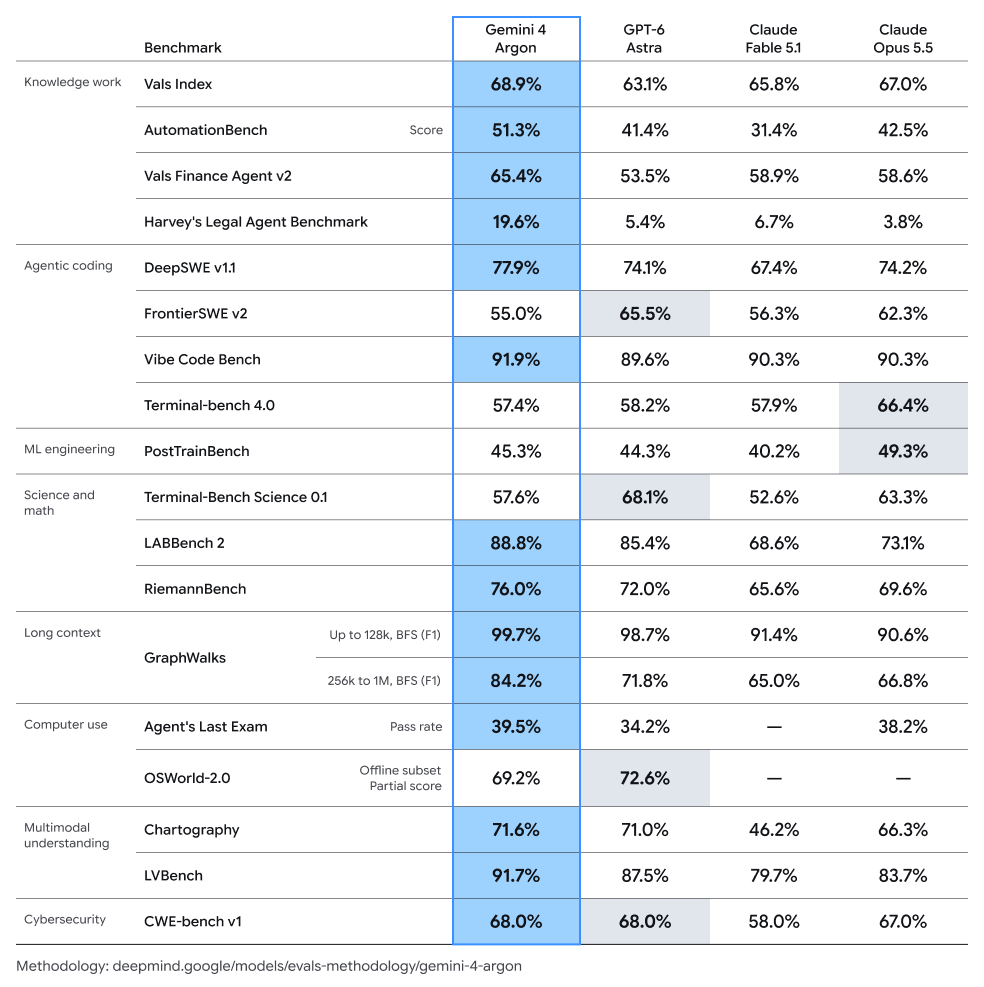
¡Google acaba de anunciar su modelo Gemini 4 Argon!
✓ Al nivel de GPT-6 Astra y Fable 5.1
✓ Sólo disponible bajo invitación
✓ Estrenando nuevo nombre
Vaya carrera la de OpenAI, Anthropic y Google.
¿Quién va ganando?
SpaceXAI engineer (ex-Cursor):
"right now I'm running 10-20 GrokBot agents that automate 90% of my routine
i have a Chief of Staff agent. He knows about all my other bots and manages everything"
in a 50-minutes podcast, a SpaceXAI engineer showed how to build a team of agents that will work for you 24/7
worth more than a $500 course on agentic engineering
watch today, then read how to build a Grok agents team from scratch in the article below
Al declarar `name = "goku"`, se quedó declarado con ese valor. Al usar `name.upper()`, dicho método haría que cambiara a "GOKU", pero jamás se guarda nuevamente con `name = name.upper()`, entonces por eso el valor... no cambia y esa función realmente nunca termina usándose.
Hace unos días puse este ejercicio... El 65% (más de 3.300 personas) respondió mal.
La IA no te está quitando el trabajo, se lo estás regalando.
Por favor, tómate en serio tu aprendizaje 🙏
El creador de Node.js acaba de lanzar Dactyl.
Apps nativas de iPhone y Android desde la web.
Sin Mac. Sin Xcode. Sin Android Studio.
✓ Simulador de SwiftUI en el navegador (WASM)
✓ El mismo código para iOS y Android
✓ Usas TU suscripción de ChatGPT
→ https://t.co/jpkYQzagOE
Le tumbaron el github a este dev porque nos dio ABSOLUTAMENTE GRATIS una app para entrenar que no te pide cuenta, suscripción ni guardar tus datos en la nube y que es MUCHÍSIMO MEJOR QUE CUALQUIER OTRA EN LA APP STORE
[openGym]
Un tracker de entrenamiento self-hosted en el que puedes:
• Planificar tu semana
• Seguir entrenamientos guiados
• Registrar cada serie, peso y repeticiones
• Ver PRs, estadísticas y evolución
• Registrar peso corporal
• Crear superseries
• Seguir progresiones automáticas
• Analizar qué músculos estás entrenando
• Usar passkeys / Face ID / Touch ID
• Funcionar offline
• Sin anuncios
• Sin tracking
• Sin suscripción
• Sin depender de los servidores de una empresa
Además, tiene 1.324 ejercicios, importa datos desde FitNotes, Strong y Hevy, y permite exportar todo en JSON.
REPOOO👇
SpaceXAI engineer (ex-Cursor):
"Grok Bot was vibe coded in days. humans weren't reading the code at all"
each agent gets a name and an identity, and you orchestrate them the way you'd run a team
their designers are shipping code through Grok Bot now. they send her a bug they already fixed, she reviews it and stamps
"Grok Bot is for people who are not in tech"
Watch today, then read how to build a Grok bot agents team from scratch in article below
Karpathy never meant for you to automate the LLM wiki. Most people set it up backwards.
Three things are in his file and almost nobody does them.
He ingests sources one at a time and stays in it. He reads the summaries, checks what changed, tells the agent what to emphasise. Everyone else drops a folder and hits compile once.
Answers are supposed to go back in. His words: "good answers can be filed back into the wiki as new pages." A comparison you asked for is worth as much as an article you clipped, and most people leave it to die in chat history.
There is a third operation nobody runs: lint. Ask the agent to health-check the wiki for contradictions, stale claims, orphan pages, missing links.
The wiki compounds through you, not around you. That is the whole design.
DevOps vs. MLOps vs. LLMOps, clearly explained:
Many teams are trying to apply DevOps practices to LLM apps.
But DevOps, MLOps, and LLMOps solve fundamentally different problems.
DevOps is software-centric. You write code, test it, and deploy it. The feedback loop is straightforward, i.e., does the code work or not?
MLOps is model-centric. Here, you're dealing with data drift, model decay, and continuous retraining. The code might be fine, but the model's performance can degrade over time because the world changes.
LLMOps is foundation-model-centric. Here, you're typically not training models from scratch. Instead, you're selecting foundation models and then optimizing through three common paths:
- Prompt engineering
- Context/RAG setup
- Fine-tuning
But here's what really separates LLMOps: The monitoring is completely different.
In MLOps, you track data drift, model decay, and accuracy.
In LLMOps, you're watching for:
- Hallucination detection
- Bias and toxicity
- Token usage and cost
- Human feedback loops
This is because you can't just check if the output is "correct." You need to ensure it's safe, grounded, and cost-effective.
The evaluation loop in LLMOps also feeds back into all three optimization paths simultaneously. Failed evals might mean you need better prompts, richer context, OR fine-tuning.
So it's not a linear pipeline anymore.
One more thing: prompt versioning and RAG pipelines are now first-class citizens in LLMOps, just like data versioning became essential in MLOps.
And the ops layer you choose should match the system you're building.
If you want to go deeper into LLMOps, I wrote a full LLM engineering roadmap a while back.
It walks through the eight pillars of building LLM systems, starting at prompt engineering and ending at observability and safety, with free and open-source resources attached to each one.
You can read it below.
Elon Musk:
"in 6-12 months GrokBot will be #1 tool for building agentic systems. In a year 100% of code will be done by LLM's
at SpaceXAI, more than 70% of engineers already using GrokBot to build self-learning agentic systems"
In a 40-minute talk, Elon with SpaceXAI engineers discuss how the future of AI engineering will look like
worth more than 2 hours of Stanford lecture on AI engineering
watch today, then read the article below on building a self-learning agentic system with GrokBot
J’ai été voir le site de Cyberleek, le hacker de GTA 6, et ce n’est clairement pas un amateur.
Je suis convaincu que ce n’est pas une seule personne, mais bien un groupe de hackers.
Son système de contact fonctionne en deux étapes :
- Il génère d’abord un compte Session (messagerie sécurisée, anonyme et décentralisée) avec une phrase de récupération unique. Ça permet à la personne qui veut le contacter d’avoir un canal de communication jetable et chiffré de bout en bout.
- Ensuite, il génère un montant de donation en Monero (XMR), une cryptomonnaie anonyme. Contrairement à Bitcoin, Ethereum ou Solana, sa blockchain est privée et les montants des transactions sont complètement obfuscés. Personne ne peut donc voir combien tu as envoyé, sauf celui qui possède la clé privée (Cyberleek).
Il demande 400 XMR (165 k$), mais ce qui est vraiment intéressant, ce sont les chiffres APRÈS la virgule.
Il y a 12 décimales qui sont générées en même temps que le compte Session et servent d’identifiant unique. Quand tu envoies exactement ce montant, Cyberleek détecte la transaction sur la blockchain, extrait les décimales, recalcule l’ID Session correspondant et te contacte.
D’après le site, c’est purement mathématique/cryptographique côté client. La page génère un ID de 12 chiffres lié mathématiquement au compte Session. Comme Monero cache les montants, seul Cyberleek peut déchiffrer le montant reçu et retrouver ton Session ID. Aucun stockage serveur de l’ID n’est nécessaire avant le paiement.
Il précise d’ailleurs qu’il faut absolument envoyer les fonds depuis un wallet personnel (Cake Wallet, Feather...) et non depuis un exchange, sinon les décimales risquent d’être arrondies et il ne pourra jamais te retrouver.
Je trouve que c’est un système plutôt élégant, et on retrouve d’ailleurs le même niveau de sophistication au niveau de l’infrastructure.
Leur site ne peut quasiment pas être mis hors ligne durablement, car il est hébergé de façon décentralisée sur Arweave (stockage permanent et immuable sur blockchain) et que son contenu est accessible via de nombreux gateways du réseau ar(dot)io.
Ces gateways sont des portes d’accès qui servent le même fichier HTML stocké sur Arweave. Faire tomber un gateway (ou même plusieurs) ne change presque rien puisque le site restera accessible sur tous les autres, et que de nouveaux miroirs pourront apparaître en quelques minutes.
Tous ces éléments font que je suis convaincu que Cyberleek est un groupe et non une seule personne, et vu le mode opératoire, que ce sont des pros. Leurs connaissances en cryptographie et en utilisation de technologies décentralisées laissent penser qu’on est loin de simples script kiddies ou de hackers qui piratent uniquement via social engineering. Il y a là-dessous une vraie maîtrise technique.
Le côté un peu enfantin / trolling laisse penser le contraire, mais le côté technique ne fait aucun doute.
Même chose dans la manière dont ils gèrent leur communication : tout passe par leur site internet. Ils évitent volontairement tout réseau social qui pourrait laisser des logs et compromettre leur identité.
@scaling01 Agree. People are sleeping on using Opus to hill climb. We use it for optimizing CPU and memory, optimizing CI times, improving frame rates, reducing latency, any other kind of problem in the shape of “iterate on X with a profiler and dataset until it hits Y”
Opus 5 is the most misunderstood AI model.
How to get the most out of Opus 5:
1. Set effort to 'Medium'
2. Define a precise goal
3. Get out of the way
Profit.
study calculus.
not because you need to pass an exam.
because calculus teaches you how the world changes.
• derivatives → how fast something is changing right now
• integrals → how tiny changes accumulate into something larger
• differential equations → how systems evolve through time
• partial derivatives → how one variable changes inside a system with many moving parts
• gradients → which direction changes something fastest
• optimization → finding the best solution under constraints
then connect it to reality.
• velocity is the derivative of position.
• acceleration is the derivative of velocity.
• energy can be accumulated through integration.
• control systems are built around changing states.
• neural networks learn using gradients.
• physics is full of differential equations.
don’t memorize calculus as a collection of formulas.
draw it. simulate it. derive it. write code for it. connect it to motion and physical systems.
calculus becomes beautiful when you stop seeing x and y.
and start seeing change.
I made a 16-page PDF to get you Claude-certified.
The certificates are official by Anthropic & free...
And the playbook is free too, at https://t.co/psB7XxAv8w. Here's what's inside:
The Claude Certification Playbook.
→ 3 official certificates & the order to take them in.
→ Step from creating an account to downloading.
→ The fake detector (yes, people sell fake ones).
→ The LinkedIn format to showcase the certificates.
→ The copy-paste announcement post on LinkedIn.
→ What you can honestly say about it in interviews.
The certificates take 6 hours.
Getting the playbook takes 2 minutes:
1. Go to https://t.co/psB7XxAv8w. Subscribe for free.
2. Open the welcome email in your inbox.
3. Tap the Notion library link inside.
4. Download "The Claude Certification Playbook."
5. Start with page 4 (the fake detector).
Know someone job hunting? Send them this post. It's the favor.
Truco para ahorrar tokens en Claude Code en menos de 30 segundos.
Solo tienes que cambiar una opción de configuración:
→ Ejecuta "/config"
→ Busca "Output"
→ Selecciona el modo "Concise"
Mantiene las respuestas mucho más cortas y solo entra en detalle cuando se lo pides.
6 repos de AI Agents que estan explotando en github
1. Graft —
https://t.co/HRrD5zZloC
Hace que claude code sea 4 veces mas barato y 3 veces mas rapido, es compatible con cualquier agente 60% menos tiempo por sesión
2. Agency agents —https://t.co/h5OQHPS2nD
Agencia de IA completa con 232 sub agentes especializados en 16 areas
3. Codebase memory mcp —https://t.co/heBgnRWzKe
Convierte todo tu codebase en un knowledge graph ultra rapido. Soporta 158 lenguajes, reduce tokens mas del 99% y responde en milisegundos
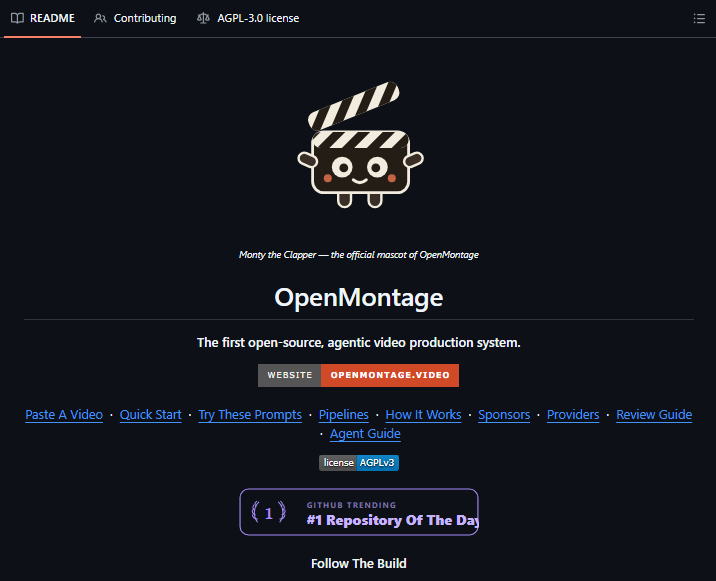
4. OpenMontage —https://t.co/9W4TVyJhPe
Convierte tu agente de coding en un estudio completo de produccion de videos. Planificacion, guion, assets, edicion y renderizado con solo prompts
5. Agent-Reach —https://t.co/QteQR6bcYq
Dale ojos a tu agente para navegar internet. Lee y busca en X, Reddit, YouTube, GitHub y mas. Todo gratis sin pagar APIs
6. Orca — https://t.co/o1OLK1seb3
Gestiona y ejecuta multiples agentes de coding en paralelo
Con estos dejas de usar un solo agente y pasas a manejar una flota completa
Guardalos todos 🔖
Así se ve un sueldo de 750.000 dólares al año: un tipo en camiseta blanca, un pizarrón y 2 horas y media.
Stanford, CS336. Percy Liang construye un LLM desde cero. Lo que hay debajo de Claude y ChatGPT, y arranca por la parte que todos saltan: el modelo no lee tu texto, lee números.
Anthropic paga ese sueldo a los ingenieros que entienden esa capa.
Lo único que cobra Stanford son 2 horas y media de tu atención.
¡Google regala 1 año de Gemini GRATIS a estudiantes!
✓ Plan Google AI Plus
✓ Generación de vídeo con Omni
✓ Notebooks de estudio con tus apuntes
Para España, México, Argentina, Chile, Colombia, Perú, Venezuela, Uruguay...
Puedes canjearlo hasta el 31 de diciembre de 2026:
→ https://t.co/qRSk4Z5JNb






![ErickSky's tweet photo. Le tumbaron el github a este dev porque nos dio ABSOLUTAMENTE GRATIS una app para entrenar que no te pide cuenta, suscripción ni guardar tus datos en la nube y que es MUCHÍSIMO MEJOR QUE CUALQUIER OTRA EN LA APP STORE
[openGym]
Un tracker de entrenamiento self-hosted en el que puedes:
• Planificar tu semana
• Seguir entrenamientos guiados
• Registrar cada serie, peso y repeticiones
• Ver PRs, estadísticas y evolución
• Registrar peso corporal
• Crear superseries
• Seguir progresiones automáticas
• Analizar qué músculos estás entrenando
• Usar passkeys / Face ID / Touch ID
• Funcionar offline
• Sin anuncios
• Sin tracking
• Sin suscripción
• Sin depender de los servidores de una empresa
Además, tiene 1.324 ejercicios, importa datos desde FitNotes, Strong y Hevy, y permite exportar todo en JSON.
REPOOO👇](https://pbs.twimg.com/media/HQa8sUTXMAAT-ST.png)





