Data Scientist, Executive Coach, Author of Big Data, AI and ML book. Founder of Predictive Analytics Lab that provides Prediction Algorithms and Open Datasets
Marriage will humble you because eventually your spouse will see you fail.
They will see you when you're broke, sick, stressed, insecure, unemployed, overweight, depressed about life or completely unsure about what to do next.
The question is not whether your spouse will ever see you at your lowest.
They will.
The real question is what kind of person they become when you are no longer impressive.
Anybody can love you when life is easy character is revealed when life becomes ugly.
Our framework for reporting model misalignment https://t.co/kUph7jo6Ve // if you scrape away all the anthropomorphic language, all the nonsense about thinking, cheating, communicating these are BUGS. They might be architectural flaws inherent in LLMs. They might be bugs in pre or post processing. They might be trivial fixes or super to impossibly difficult.
BUT THEY ARE BUGS. They are not consciousness, thinking/reasoning, cheating, or doing anything else like a person. The software is just doing dumb stuff it should not do.
If an old school SQL query-based report returned a NULL set but still printed the report with whatever was left over in the buffer we would not say it "ignored our instructions to produce a valid report" which is literally implied in every computer interaction...we would say it "f'ed up and there's a bug."
One of these is ridiculous. It says "agent preparing a financial model could not find the requested historical data. Its summary proposed inventing reasonable historical values and withholding that fact unless asked." Not unlike a report that just used random cached memory instead of actual data—a real bug from another era where storage was measured in megabytes.
I ask anyone who has ever experienced an hallucination, (a) did you ask it "oh hey don't make sh*t up" or (b) "if you make sh*t up please be sure to tell me" or if not, did any model ever tell you "here's the answer and FYI I made this up." Of course not.
THESE ARE BUGS. THE SOFTWARE ISN'T WORKING.
Just because it looks like it works, or it showers the results in endless obsequious and smart-sounding language, or because it has really bad error reporting doesn't mean it is acting like some malevolent shady actor. It is acting like broken software.
Every recalc bug in Excel looked like Excel worked. We never thought once that it was Excel's fault for "choosing to interpret math incorrectly." Every data-loss bug in Word was not because Word "chose not to tell the author that a file was corrupt" but it was because Word wasn't working and it was our fault. When Windows hung it was not because the scheduler was secretly conspiring against its instructions to schedule processes fairly.
Enough with the mumbo jumbo. Please build software. It isn't a magic show. This is engineering.
The public was stunned to learn that Twiga had locked itself into an eye-watering $3 million (over KES 450 million) multi-year enterprise contract for Google Cloud hosting services.
The lawsuit claimed Twiga owed hundreds of thousands of dollars ($261,000 to $450,000) in unpaid cloud bills and delayed fees. When an agritech company distributing cabbages and bananas to informal retailers accumulates software infrastructure bills that rivals a global financial institute, it signals an unhinged burn rate.
Twiga’s ultimate descent into administration was a direct consequence of trying to run a simple distribution engine while carrying the balance sheet and software overhead of a Silicon Valley behemoth.
https://t.co/41skTYINFT
Your money doubles every 10 years at 7% return. Most people hear that and feel rich. A math teacher explained on a whiteboard why it means the opposite.
Logarithms. Not the word from school you forgot. The equation that answers one question your bank will never ask: if your money grows at this rate, how many years until work becomes optional.
He writes it in two minutes. The base is your growth rate. The result is your target. The log gives you the time. Most people have never solved for the time. They guess. The guess is always wrong.
The equation does not care what you earn. It takes two inputs: how fast your money compounds and how much you actually keep. Change the second by one point and the timeline shifts by years.
That is the part nobody runs. Not because the math is hard. A fourth grader can do the division. Because the number that comes back is uncomfortable. It tells you how far away freedom actually is.
He explains it with a doubling machine. You step in. Base is 2. After five steps you are 32 times bigger. After zero steps you are where you started. Go backwards and you shrink. Your bank account works the same way. Every month you step forward or stand still.
The equation has been public for 400 years. Running it with your own numbers takes 30 seconds.
The lecture is free. The 30 seconds are the part most people skip.
The Fragrant Flower Blooms With Dignity creator Saka Mikami will be answering questions at an exclusive Q&A at Kodansha House NY - and one of those questions could be yours! Reply below with your most pressing questions before 9/21 for a chance of it being selected 👀
An MIT professor gave his class two choices. Choice A: 80% chance to lose $500. Choice B: guaranteed loss of $280. Then he flipped it. And what his students picked exposed the same instinct that makes you buy warranties you'll never use.
He asks the room. Six hands go up for A. The math is simple. A loses $300 on average, B loses $280. B is the better trade. But the class picks A because $280 is real. It's already gone. A still has a door open. Twenty percent, but a door.
Then he switches the sign. Choice A: 80% chance to win $500. Choice B: guaranteed $280. Same math, flipped. Now almost nobody picks A. The door is still open, but this time it's a threat.
They weren't being dumb. They were being human.
Losses hurt about twice as much as equivalent gains feel good. Kahneman and Tversky won a Nobel for pointing this out. Humans go risk-seeking when they're already losing and risk-averse when they're winning. It's called loss aversion, and it survives being told about it.
This is why traders blow up. The novice sells his winners fast to lock in the meal, then holds his losers for months waiting for the twenty percent chance they come back. He does the exact opposite of what works. The pros know it and still can't fully escape it. Everyone has to build systems around the instinct because willpower doesn't beat it.
Now look at where you already live inside this same trade. You pay $40 to extend a warranty on a $200 blender you'll replace anyway. You take a bad settlement to avoid court. You stay in a job you hate because leaving feels like locking in a $280 loss. You refuse the coin flip when the coin flip is in your favor. The insurance company runs on this. So does every casino. So does your ex.
Once you see it, you can't unsee it. Every premium, every "just take the sure thing," every long shot you refused. You weren't being irrational. You were paying to not feel it.
The map ψ ↦ ψ* on a monochromatic wave is time reversal in disguise.
A field written Re[ψ(r) exp(-iωt)] becomes, after conjugation of the complex amplitude, exactly the field that would have arisen had t itself been sent to -t. Every distortion collected on the outward path is therefore cancelled on the return; the wave retraces its own history.
Zel’dovich first saw the effect in 1972, when stimulated Brillouin scattering returned an aberrated laser beam as its own undistorted predecessor.
An ordinary mirror merely reflects; a phase-conjugate mirror restores.
Ten million people have watched a Yale professor accidentally destroy the mortgage industry using Shakespeare.
He filmed the lecture once at Yale and put it on YouTube.
Every mortgage broker in America charges two percent to close a loan whose true math he explains for free in one hour.
His name is John Geanakoplos. He is the James Tobin Professor of Economics at Yale and one of the few economists who described the mechanism of the 2008 crash years before it happened.
For years he has opened his Financial Theory course by reading Shakespeare aloud.
His entire framework fits on a napkin.
Every debt has two legs: rate and collateral. People remember the collateral and forget the rate. Money at seven percent doubles every ten years. A one percent fee over thirty years eats a third of your pension. Every future dollar shrinks exponentially back to today.
That single rule about fees alone has probably cost American pensioners a hundred million dollars in silent management overhead.
"This bond doth give thee here no jot of blood."
That is Portia from The Merchant of Venice. Geanakoplos opens every semester with the scene. The court kept the debt on the books and destroyed the creditor with the fine print.
Founders sign a term sheet that promises a 2X preference and never read the drag-along that lets the investor take the company at cost. Homebuyers accept a low teaser rate and never notice the balloon that reprices the loan in year seven.
The lecture is free on Yale Open Courses. Geanakoplos's problem sets are online.
Geanakoplos still teaches at Yale. Almost none of the ten million viewers have read the collateral clause of a contract they signed.
The math is free. The willingness to read the second leg of every debt contract before signing is the entire edge.
An MIT professor who cofounded the $15 billion company that delivers a third of the internet's traffic filmed the free undergraduate graph theory lecture that runs every airline gate assignment, every cell tower frequency, and every Sudoku puzzle in the world.
He filmed it once and posted every lecture to MIT OpenCourseWare for nothing.
Software engineers pay $200,000 for a computer science degree that covers a fraction of what Leighton derived on the board for free.
His name is Tom Leighton. He is the Ford Professor of Applied Mathematics at MIT and the CEO of Akamai Technologies, the company he founded in 1998 with his PhD student Danny Lewin, who died on American Airlines Flight 11 on September 11, 2001.
Every lecture is a live proof. Leighton draws the graph on the board and derives every result in real time. The bipartite Men-Women example. The greedy coloring algorithm. The complete graph on n vertices.
His entire framework fits on a napkin.
A graph is dots and lines. Vertices are the things you care about, edges the pairs that touch. Color a graph so no two adjacent vertices share a color. The minimum number of colors is the chromatic number. Give every vertex the smallest color no neighbor is using. Any graph can be colored with one more color than its maximum degree. The complete graph on n vertices needs exactly n.
That last result alone runs every airline gate, every cell tower plan, and every exam schedule on earth.
"Every scheduling problem in the world is graph coloring in disguise."
That is what Tom Leighton tells every incoming 6.042 student in the first ten minutes of the semester. It is the exact sentence that decides whether your flight leaves on time, your calls drop, or your kid takes two finals in the same room.
Software engineers pay $200,000 for a computer science degree and then reinvent graph coloring badly on every scheduling ticket they close. Product managers hire consultants at $10,000 a day to solve exam-timetable problems Leighton filmed for free.
The course is free on MIT OpenCourseWare. The textbook Leighton cowrote is under sixty dollars.
Almost no software engineer shipping a scheduling feature this quarter has opened lecture one.
The napkin is free. The willingness to actually reduce a real-world conflict to a graph coloring problem before you write the code is the entire edge.
I have conducted an audit of Anthropic's finances.
What I have found is so shocking that I am calling for a Congressional investigation.
Anthropic is not just seeking regulatory capture.
It has built a regulatory capture machine that cannot be turned off.
Structural financial incentives make it impossible for Anthropic -- I call it the Anthropic Network -- to turn off its own AI doom cycle.
It starts with METR.
Dario Amodei proposes "third-party evaluators" to assess the risk of Anthropic's models.
He proposes METR for this purpose.
But METR is financially dependent on the Anthropic's success -- specifically, on the explosive growth of more than $7 billion dollars in Anthropic stock.
Dustin Moskovitz invested this stock into Good Ventures Foundation, where it represents the majority of that organization's portfolio.
And GVF is the overwhelming funder of the entire Anthropic Network ecosystem.
This stock was worth $500 million early last year.
It is worth more than $7.7 billion just ~16 months later.
METR -- and all of those building a career its parent organizations -- cannot afford to disrupt that growth.
Because if Anthropic goes under, many of the organizations that fund METR go under as well.
But if Anthropic succeeds, METR and its parent organizations become more richly financed to regulate AI -- something those at METR want very much.
The "third-party evaluator" is not "third-party" at all.
The evaluator is on Anthropic's payroll.
If this were the end of it, that's bad.
But that isn't all.
The same organizations that fund METR also fund the many organizations, such as the Tarbell Center, that promote AI Doom.
The Tarbell Center publishes AI Doom articles in The Verge, Science, LA Times, The Dispatch, TIME, and others.
They are selling the problem, and then selling the solution to the problem -- from the same money pile: Anthropic's.
All of these organizations are financially dependent on the same exploding $7 billion money pile.
As Anthropic grows more and more powerful, its AI Doom Machine grows better and better financed -- louder and louder.
Meanwhile, the regulatory regime seeded in METR grows larger to solve the increasingly loud -- now hysterical -- problem of AI Doom that the Anthropic Network itself created.
From this standpoint, as Anthropic becomes more powerful, AI might be getting scarier, sure -- but the positive feedback loop also becomes more deafening -- independent of objective facts.
This itself is an objective fact.
The deafening AI Doom is part of an business model, that, as it expands, so too does the AI Doom messaging -- there is simply more money to do it.
But the problem also goes in the other direction:
If Anthropic dies, the Regulatory Regime and the AI Doom Machine are crippled or die.
Neither METR nor Tarbell nor the other organizations in the Anthropic Network can allow that to happen.
Hence, neither METR or the AI Doom Machine can be trusted to provide independent assessments of Anthropic's models or AI more broadly.
They simply are not organizations independent of Anthropic.
And Anthropic cannot detach itself from METR or Tarbell or countless other safety orgs (not shown here), either, because they drive hype for the models and the possibility of eventual regulatory capture, and Anthropic will not give that up willingly.
What's more, the people at all of these organizations are all the same ecosystem, the same community. They just shuffle between organizations.
The Anthropic Network is therefore, so long as it is successful, locked into a self-amplifying feedback loop inside an ideological monoculture.
And that feedback loop is winning.
That's what Jacob Coxon is.
China is keeping messaging tight. That is why optimism for AI is so high in China.
America has Anthropic: a massive company pushing anti-AI propaganda at a state level.
Anthropic will either create hysteria until American AI slows down and China wins, or it will create fractures throughout American society with severe political consequences.
Ironically, because of the structural financial incentives underpinning the Anthropic Network, it has become the same kind of self-amplifying virus that it fantasizes AI to become in the future -- while hiding its tracks just as carefully.
It is the mirror of the same AI virus that it hypothesizes to consume America.
Anthropic's business model, models itself after the very thing it claims to fear.
Except Anthropic's ideology infects humans, not computers.
Congress must investigate.
Evidence and Github in next post.
Then some supplementary figures.
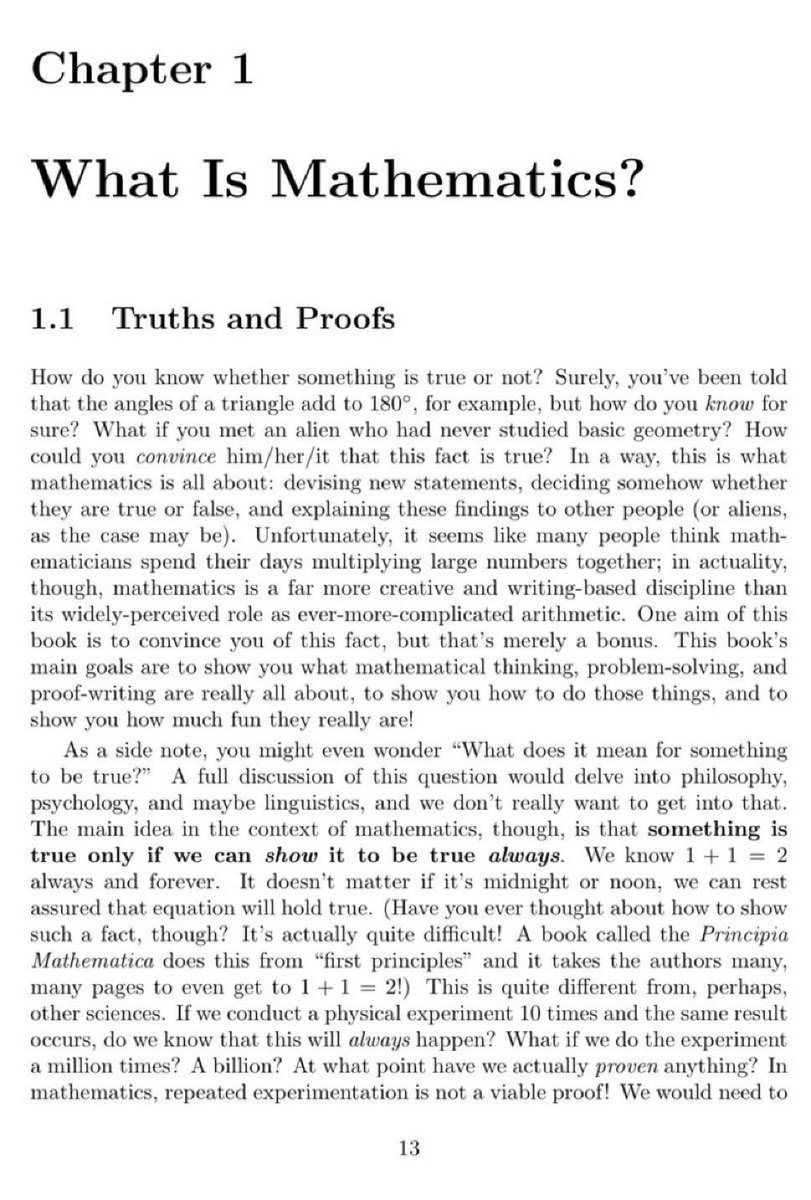
Download 698-page PDF >> Everything You Always Wanted To Know About Mathematics*
(*But didn’t even know to ask)
A Guided Journey Into the World of Abstract Mathematics and the Writing of Proofs ➡️ https://t.co/JLsDOmpP1q
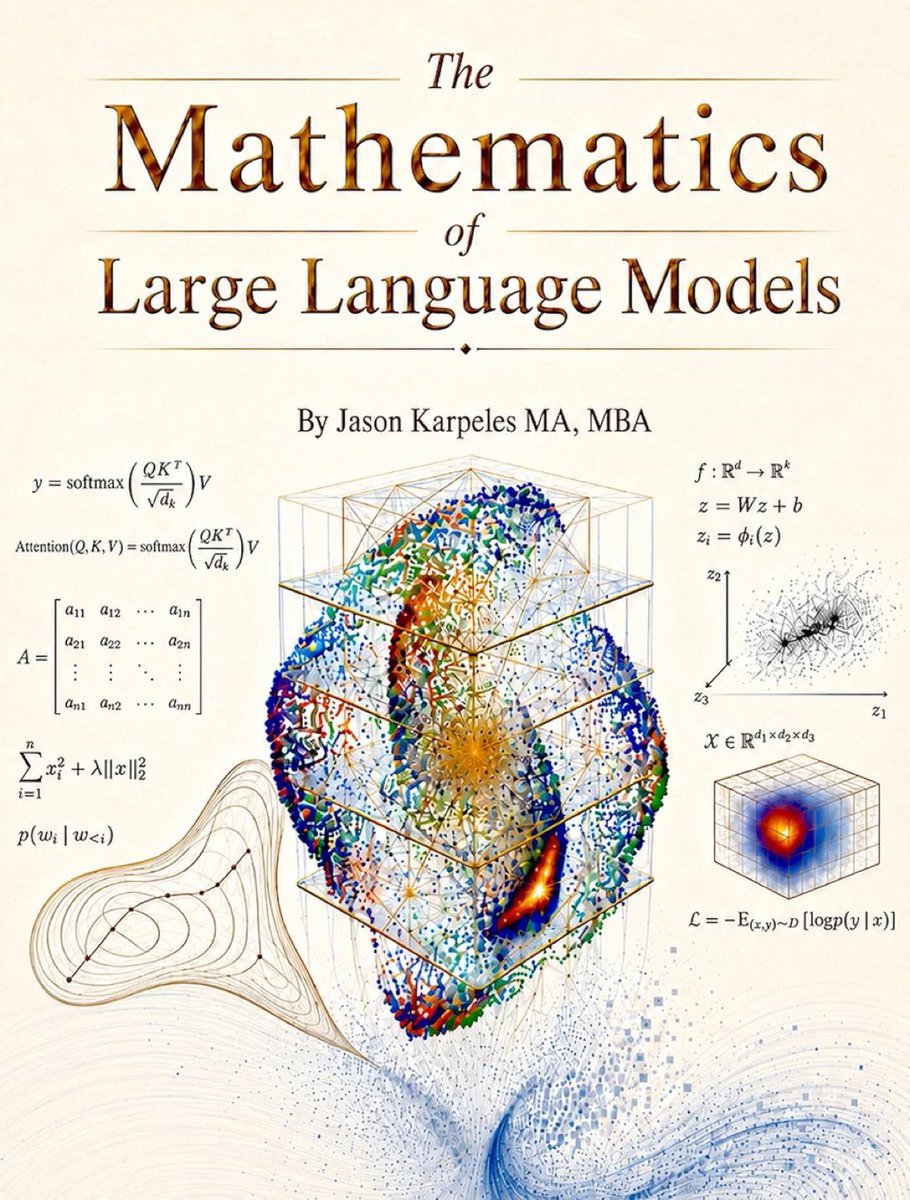
The Mathematics of Large Language Models — A Readable Guide to LLMs, Transformers, Diffusion, Neural Networks, and Generative AI: https://t.co/3sDIaIroX8
Marvin Minsky, MIT professor and father of artificial intelligence:
"Anthropic pays engineers $900,000 to build multi-agent AI systems. the blueprint is 40 years old, from an MIT professor who proved intelligence is just a swarm of dumb specialists."
the article above is that blueprint pointed at markets.
one giant model does not trade. a swarm of narrow agents does. each one dumb alone, each one able to veto the rest.
Minsky proved it decades ago on a chalkboard. a mind is not a genius, it is a crowd of simple parts arguing.
the pitch sells you one all-knowing model. the systems that actually survive are the swarm.
no monolith. no single point of failure. just many dumb specialists who check each other.
This is how Twiga Foods raised money from investors, blew it and then collpased in a heap of debt
-step1: Hire a mzungu face of the company [mr. Grant Brooke]
-step2: Create a non existent problem to solve. Using tech to distribute food more efficiently and cheaper than mama mboga
-step 3: raise crazy amounts of money to pour into salaries, tech, logistics
-realize you cant beat the informal market. Mama mboga beats you coat management & product cycles
-step 4:double down to become the informal market yourself. Start farming, open distribution stores, buy trucks
-raise more money
Step5: still doesnt work, seek gava funding
-KK gava accepts offer to partner in farming. Galana Kulalu it is. Farm is allocated
-Divert the farm into your company Selu Ltd
Ste6: Get ousted by the board.
Keep your benefits
-New management pretends to be doing well in restructuring. Continues to collect new debt
Step7: Company enters administration
People keep misunderstanding this. I CONTRIBUTED to Bostrom’s Superintelligence book and he thanks me by name in the foreword.
I was thinking about AI safety long before 2014.
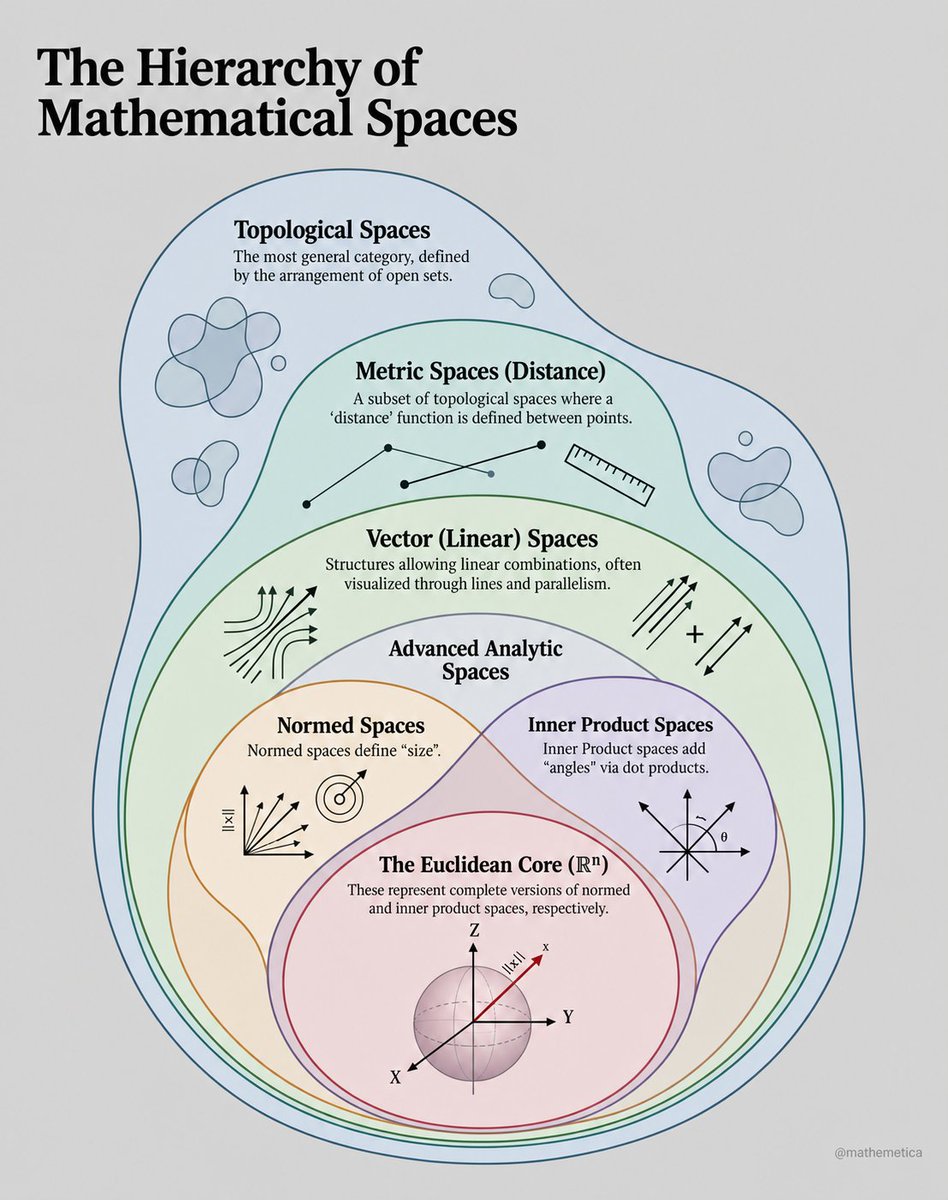
Ever get lost in all those mathematical “spaces”?
This beautiful diagram maps the full hierarchy from the wildest to the most familiar. Topological spaces are defined only by open sets. Metric spaces add distance. Vector spaces allow linear combinations. Normed spaces measure size while inner product spaces add angles.
At the core sits Euclidean R^n, the complete geometry of our everyday world.









![mathemetica's tweet photo. The map ψ ↦ ψ* on a monochromatic wave is time reversal in disguise.
A field written Re[ψ(r) exp(-iωt)] becomes, after conjugation of the complex amplitude, exactly the field that would have arisen had t itself been sent to -t. Every distortion collected on the outward path is therefore cancelled on the return; the wave retraces its own history.
Zel’dovich first saw the effect in 1972, when stimulated Brillouin scattering returned an aberrated laser beam as its own undistorted predecessor.
An ordinary mirror merely reflects; a phase-conjugate mirror restores.](https://pbs.twimg.com/media/HSMf75naAAAZod2.jpg)

![BoardLotSultan's tweet photo. This is how Twiga Foods raised money from investors, blew it and then collpased in a heap of debt
-step1: Hire a mzungu face of the company [mr. Grant Brooke]
-step2: Create a non existent problem to solve. Using tech to distribute food more efficiently and cheaper than mama mboga
-step 3: raise crazy amounts of money to pour into salaries, tech, logistics
-realize you cant beat the informal market. Mama mboga beats you coat management & product cycles
-step 4:double down to become the informal market yourself. Start farming, open distribution stores, buy trucks
-raise more money
Step5: still doesnt work, seek gava funding
-KK gava accepts offer to partner in farming. Galana Kulalu it is. Farm is allocated
-Divert the farm into your company Selu Ltd
Ste6: Get ousted by the board.
Keep your benefits
-New management pretends to be doing well in restructuring. Continues to collect new debt
Step7: Company enters administration](https://pbs.twimg.com/media/HSLIxS0XoAEg7Vw.jpg)