3/3
Bring references. Point to what matters. Explore alternatives. Keep ideas and results side by side—with the agent and tools you already use.
Local-first. MIT-licensed. Yours to fork and extend.
Not just “do this for me.”
“Let’s figure this out together.”
1/3
The race is to build agents that work without us. But not everything we create is something we want to hand off.
Introducing Acanvas: an open-source visual harness for any agent.
Co-think, co-explore, and co-create.
https://t.co/MJyPi3fIdM
2/3
Sometimes there’s no clear brief yet. Just a reference, a half-formed idea, and a “what if?”
Acanvas gives you and your agent a shared canvas to find the direction together—not just execute a plan that’s already decided.
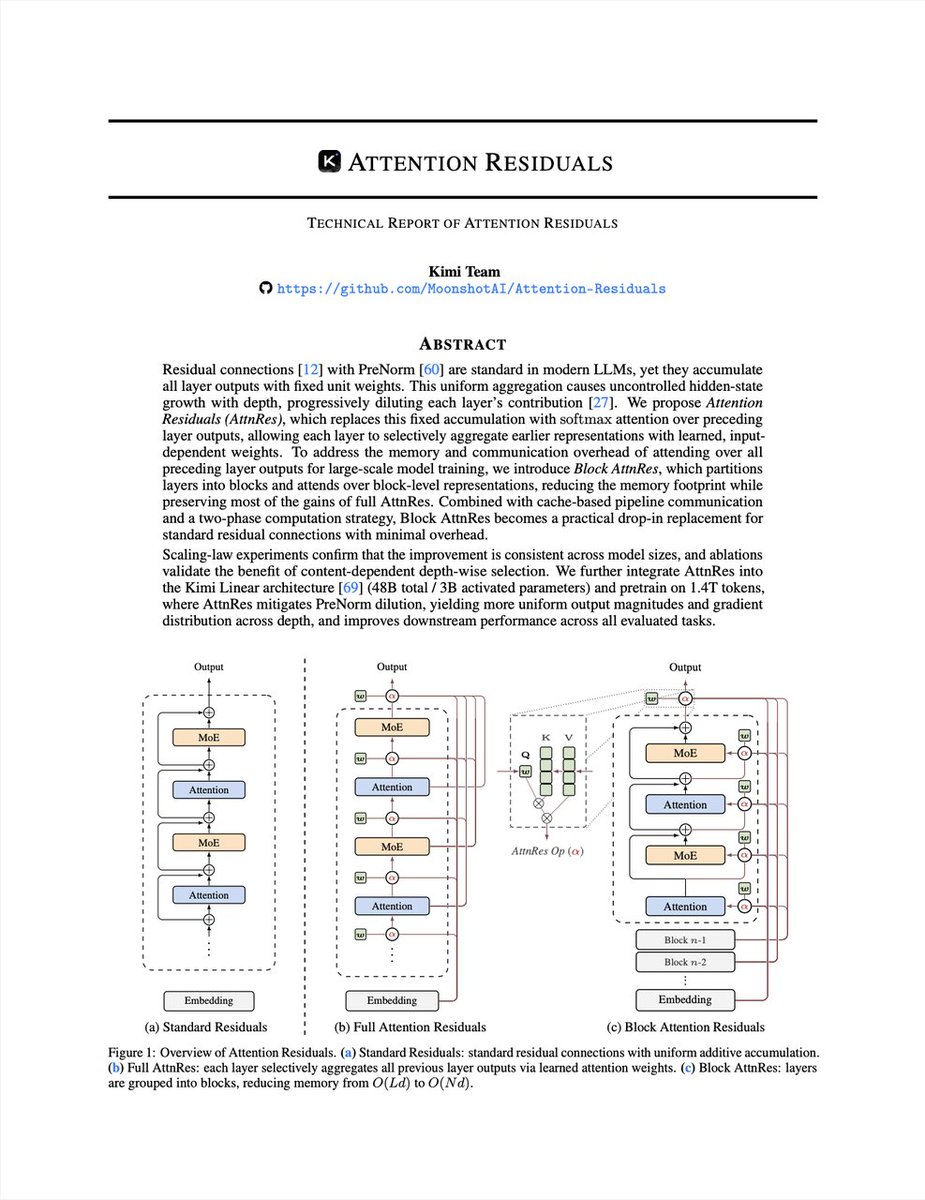
Introducing 𝑨𝒕𝒕𝒆𝒏𝒕𝒊𝒐𝒏 𝑹𝒆𝒔𝒊𝒅𝒖𝒂𝒍𝒔: Rethinking depth-wise aggregation.
Residual connections have long relied on fixed, uniform accumulation. Inspired by the duality of time and depth, we introduce Attention Residuals, replacing standard depth-wise recurrence with learned, input-dependent attention over preceding layers.
🔹 Enables networks to selectively retrieve past representations, naturally mitigating dilution and hidden-state growth.
🔹 Introduces Block AttnRes, partitioning layers into compressed blocks to make cross-layer attention practical at scale.
🔹 Serves as an efficient drop-in replacement, demonstrating a 1.25x compute advantage with negligible (<2%) inference latency overhead.
🔹 Validated on the Kimi Linear architecture (48B total, 3B activated parameters), delivering consistent downstream performance gains.
🔗Full report:
https://t.co/u3EHICG05h