New video from Jensen's first day back:
"This is my first day of work. I don't have a computer, so the IT department is going to give me a new PC.
I want to thank all of you. I'm terribly sorry for putting all of you through all of this. I've made some very terrible mistakes, and I'm going to work on coming back. "
Reporter: “you said the firm needs to go outside to look for the next CEO of Nvidia, but President Trump said the next CEO should be Jensen Huang”
Bessent: “Well Jensen is on the outside now”
You can’t make this stuff up
I believe the @nvidia board is not acting in the best interest of shareholders nor in a manner consistent with their fiduciary duties.
What we know is that the board fired Jensen or forced his resignation for violating company policy and/or in response to the accusation of an affair with a spy.
They did so without careful consideration of the impact on the company, its customers, its shareholders or other stakeholders.
They rushed to judgment without the benefit of careful due diligence or even with a basic understanding of the facts.
How do we know this?
We know this by how quickly Jensen was fired and how little was known at the time of his firing.
It takes time to convene a board meeting. There was time, maybe, for one Zoom.
And this is a decision that should have been made by a board sitting in person and carefully deliberating the facts once they are known.
And they should have slept on the decision and met again the day after to discuss the facts, the risks and the other implications of their decision.
The timing and lack of information did not allow for careful board deliberation.
While boards can fire a CEO for an inappropriate relationship with a subordinate, it should not be an automatic decision. That is why we have boards comprised of humans and not agents.
A board should consider whether or not such a relationship was consensual or whether it was an abuse of power dynamics. And a board has to consider what the impact of the firing is on all stakeholders.
If I were in this board, I would not have rushed to judgment based on articles in the media. I would have made sure the board had all of the facts so it could make a careful and informed decision.
Boards of Delaware companies have a duty of care which means they must make informed, prudent and good faith decisions. This clearly did not happen here.
What law firm is advising this board?
Or is the board even taken good legal advice?
It doesn’t look like it.
And now the board is compounding its failures by insisting that there is no possibility for Jensen’s return as CEO.
Why is it in the best interest of the company to foreclose the possibility of Jensen’s return and to do so before all of the facts are known? This is yet another breach of their duty of care.
Furthermore, the board has launched an investigation whose scope is unknown. Investigations can be extremely damaging to a company and should be carefully targeted to address whatever facts need to be known rather than be overly broad in scope.
In short, this looks like a series of major governance failures by directors that panicked due to headlines in the media. They likely felt compelled to do something because they were afraid of looking bad in the media, not because it was the right thing for them company.
They couldn’t stand the heat.
The board’s conduct here is shocking for a company of this scale and importance to our country and the world at large, particularly at this moment in history.
Now that Jensen Huang is gone, I think America is about to discover something the hard way:
Nvidia didn’t just lose a CEO. It lost the one guy who knew how to run an Asian supply chain like an old-school merchant.
You can replace him with a brilliant American executive, an Indian executive, a Chinese executive — whatever.
The title is replaceable. The relationships are not.
Anyone who grew up around old-school Chinese business culture will recognize Jensen’s style immediately. You eat together. You drink together. You remember who helped you twenty years ago. When you decide someone is your guy, you keep dealing with him for decades. Contracts matter, of course, but when things go wrong at 2 a.m., what matters even more is whether the person on the other side will pick up your call.
Look at Nvidia’s supply chain. TSMC makes the chips. SK Hynix makes the HBM. Foxconn, Quanta, Wistron, Pegatron and others build the systems. Jensen didn’t suddenly discover these companies when ChatGPT arrived. He spent decades personally building relationships with the people running them.
TSMC is probably the best example. Back in 1998, when Nvidia was still tiny and short on manufacturing expertise, TSMC sent two production people over to help. The relationship became so close that Morris Chang later asked Jensen twice if he wanted to become CEO of TSMC. Jensen said no both times.
Decades later, Jensen was still flying back to Taiwan, eating with Morris Chang, Barry Lam and half of the island’s tech establishment. At one Taipei dinner, the guest list looked less like a restaurant reservation and more like the control room of the global AI supply chain: TSMC, Quanta, Pegatron, Wistron, Asus, Acer, Inventec, Foxconn.
That stuff looks almost comically old-fashioned in an industry obsessed with AI agents and trillion-dollar market caps. But then you see what happens when Nvidia actually needs something.
In 2024, Jensen wanted SK Hynix to move its HBM4 supply schedule forward by six months. Six months in semiconductors is insane. You’re talking about engineering, capacity and production plans that were set long before Jensen showed up asking for more.
SK chairman Chey Tae-won publicly told the story later. Jensen asked. Chey went back to his people and pushed.
That is not something you reproduce by handing the next CEO a supplier spreadsheet.
And Jensen also knew what it meant to owe somebody.
In Nvidia’s early days, its project with Sega went badly enough that the company was in real trouble. Jensen went to Japan, admitted the technology wasn’t going to work, and Sega still gave Nvidia $5 million that helped keep the company alive.
Thirty years later, Jensen went back to Tokyo and thanked former Sega president Shoichiro Irimajiri in person. His message was basically: without what you did for us back then, there would be no Nvidia today.
He did the same thing on the other side of the table.
Serve Robotics CEO Ali Kashani has talked about December 2023, when his company was so close to dying that he had already discussed bankruptcy. An investor pulled out right before Christmas. Kashani called Jensen. Nvidia helped carry the financing, other partners joined, and a few months later Serve was ringing the Nasdaq bell.
That’s the Jensen playbook. Eat with people. Remember favors. Return favors. Call directly when there’s trouble. Keep relationships alive for twenty or thirty years.
Silicon Valley has a fancy word for this: “network.”
My family would probably just call it doing business,and now Jensen is gone.
Nvidia can transfer his office, his org chart, his contracts, his procurement team and every supplier database to the next CEO.
What it cannot transfer is the invisible ledger sitting inside the heads of dozens of people across Taiwan, Korea and Japan:
He helped me once. I helped him once.
We’ve known each other for 25 years.
If he calls, I’ll listen. There is no handover document for that.
Saw a few discussions about size of hack, why impact to bitcoin price is small, etc. 👇
$6.3 billion is the biggest in USD terms, but not in BTC terms. MtGox was 650,000 BTC!
Other important numbers to consider:
% of bitcoin (in relation to BTC total supply), ie, market impact. MtGox is big there again at 5%+.
Number of users impacted, and % of user assets impacted. MtGox (the largest CEX at the time) and FTX (not small) were all near 100% of users and their asseets.
Most important: Who is impacted? Does the platform cover it all? (only one victim), as in recent two CEX cases and Binance.
Obviously, still a major disaster for the industry, Binance (and me). It hurts, but we survive.
Most importantly, we protect our users.
(image from @MatthewRoszak)
The Binance hacker might have just executed one of the most brilliant moves in crypto.
First, Tether froze $1.5 billion worth of USDT.
Then Circle followed by freezing another $800 million in USDC.
At that point, it seemed like the hacker’s funds were completely trapped.
But apparently, he had already thought several steps ahead.
Rather than keeping the stolen USDT in a wallet, he allegedly deposited it into Aave and used it as collateral to borrow ETH.
Then he walked away.
And this is where things get really interesting.
Tether can freeze the USDT sitting in that wallet.
But it can’t freeze the ETH that was already borrowed.
So now, Aave is left with frozen collateral, while the hacker is holding liquid ETH.
And unless the protocol finds a way to recover those funds, he might not even have to repay the loan.
Two companies froze billions of dollars in seconds.
Yet someone who understood how DeFi works may have found a way to bypass both restrictions.
Pretty wild when you think about it.
@elonmusk@HuaweiMate6 Elon, have a lot of respect for you, but bad time to troll. Please stop.
Our SPCX shares (from our $500m investment in your Twitter takeover) are worth more than a billion.
Would appreciate if you show a little support. Thanks!
We Must Pace the Frontier: I’ve written a new essay on why the AI industry should slow down, with a three-part plan for doing so.
Anthropic is unilaterally committing to the first of these steps. We’ll provide third-party evaluators with permanent, employee-level access to our systems, so that they can verify adherence to our safety measures, report on incidents, and assess models’ alignment during training.
You can read the full post here: https://t.co/OGyPb7yaYt
2024: Key Square Group LP founder Scott Bessent, a prominent Donald Trump fundraiser, sharply criticized Treasury Secretary Janet Yellen, accusing her of changing the the cadence of the composition of the Treasury issue to bolster President Joe Biden by juicing the economy ahead of the election.
2026: Bessent announces plan to buy more long bonds in a program that starts early September and ends one day before midterms.
Symmetry.
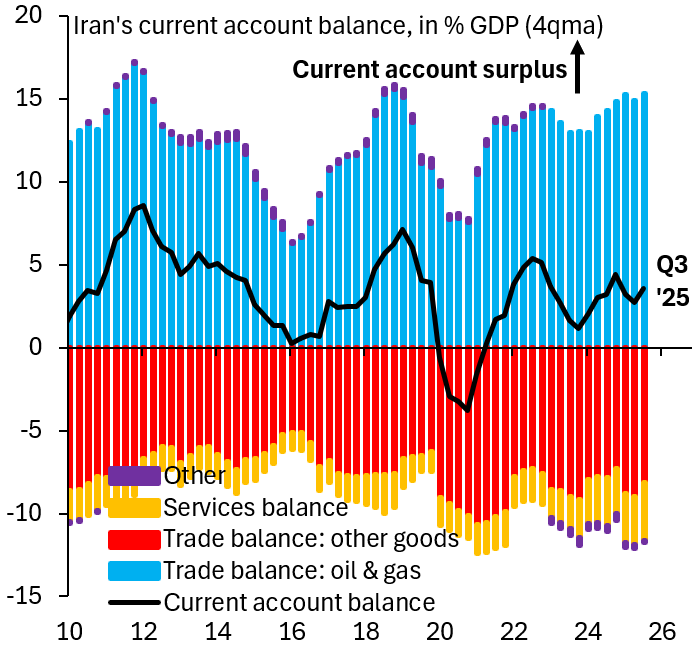
A blockade collapses the blue bars below to zero. This collapses Iran's business model, which means there's no money for imports and the red bars go to zero. Iran is a gas station masquerading as an Islamic Republic. Time to shut down the gas station...
https://t.co/7lGPw7xLTz
🚨 Breaking News:
Today is a historic day for $CRO
Trump Media Group CRO Strategy has announced $6.4B in funds to build America’s Cronos Treasury.
At closing, Trump Media Group CRO Strategy is expected to be the world’s largest holder of CRO.
Read the press release for more info on the proposed Business Combination and important info about $YORK, $YORKW and $YORKU
https://t.co/4O4mx46KZJ
- A historic day for $CRO. Trump Media Group CRO Strategy announced a $6.42b U.S. Dollar treasury play. See the press release for more info on the proposed Business Combination and important info about $YORK, $YORKW and $YORKU. Here’s what you need to know:
- A definitive agreement for a business combination with Nasdaq-listed $YORK to establish Trump Media Group CRO Strategy was signed today
- at completion, it will trade as $MCGA — Make CRO Great Again
- at completion, Trump Media Group CRO Strategy will be the WORLD’S LARGEST HOLDER of $CRO, with 6,313,000,212 CRO
- This ~6.3 billion CRO tokens is worth approximately $1b as of the time of the announcement
- separately, Trump Technology Media Group ($DJT) acquired $105m of $CRO and https://t.co/dwRH3YcIjT acquired $50m of $DJT
- This brings the total $CRO under the Trump Media Group umbrella to ~7 billion tokens.
- $CRO will become the PLATFORM TOKEN of Truth Social as a part of this broad, strategic partnership
- at completion, Trump Media Group CRO Strategy is expected to have $200m CASH to acquire more CRO
- https://t.co/dwRH3YcIjT and Trump Media Group are each chipping in additional $100m cash each via warrants and Yorkville is chipping in $20m cash via warrants, bringing the TOTAL CASH to ~$420m
- the company will also have access to a further $5 BILLION LINE OF CREDIT from Yorkville to, yes, you guessed it right, acquire even more CRO
- cumulatively, this will add up to an UNPRECEDENTED amount of DRY POWDER for any Digital Asset Treasury company, exceeding the total market cap of $CRO as of the time of announcement
- to put it in perspective, to reach similar level of buying power and impact on Ethereum, leading ETH treasury companies would have to buy hundreds of billion of ETH — just unprecedented
- Trump Media Group CRO Strategy will hold the CRO it acquires FOREVER
- Trump Media Group CRO Strategy will stake the CRO it holds to further boost its CRO holdings and generate ROBUST REVENUES for $MCGA
- let’s talk about $MCGA — all founding partners are fully committed to long term success for all $MCGA shareholders
- This means 4 year LOCKUPS for Trump Media & Technology Group, Yorkville and https://t.co/dwRH3YcIjT and $MCGA management (12 months full lockup and then partial unlocks every 6/12 months)
- very reasonable public float of 13% — original $YORK holders
- this presents a differentiated opportunity for investors in the Digital Asset Treasury space
- the mission of Trump Media Group CRO Strategy is to enhance shareholder value by maximising THE FLYWHEEL EFFECT: more funds raised, more CRO bought, prices appreciate, allowing for more funds to be raised and more CRO to be bought
- as a result of the flywheel, one should expect Cronos to reach its FULL POTENTIAL as the backbone of all financial services, including powering payments for AI agents
- it appears that the market has responded well to the news
- In the wise words of the namesake of the soon-to-be world’s largest holder of CRO: THANK YOU FOR YOUR ATTENTION TO THIS MATTER
- Here’s the official release: https://t.co/DCvwjCoqB2
Where are we? We are here - ball park of 50% effective tariff on China & 10% on rest of the world + 25% sectoral tariffs (auto + steel) + 54% tariff on de minimis (w/ USD100 flat fee).
I edited this chart a bit to remove the April 2025 framing that makes people a bit confused about where we are.
Turmoil in Taiwan's foreign exchange market is bound to lead to questions about how shifts in Taiwan will impact the US bond market; Taiwanese investors have been fairly steady buyers of Treasuries and US corporate bonds over the last 5 years
1/