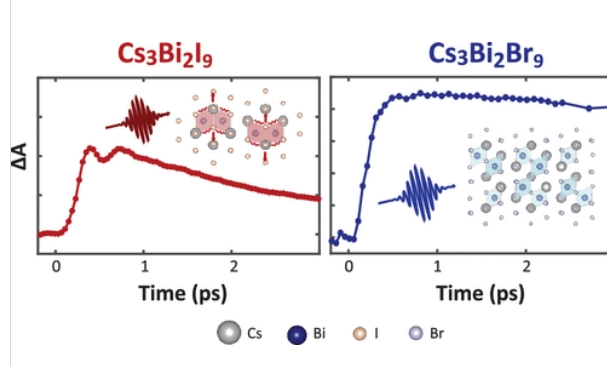
The so-called 329 perovskites, with their A3B2X9 stoichiometry, are attracting broad interest for their lead-free nature, environmental stability, and potential in optoelectronic devices such as solar cells and light emitters....our latest publication in @J_A_C_S: "Ultrafast Carrier Self-Trapping Driven by Strong Exciton–Phonon Coupling in 2D MA3Bi2I6Cl3 Perovskite."
In this work, we explore lead-free 2D hybrid bismuth halide perovskites for optoelectronic applications. Using temperature-dependent photoluminescence and femtosecond transient absorption spectroscopy, we uncover strong exciton-phonon interactions, characterized by giant Huang-Rhys factors, coherent phonon oscillations, and ultrafast carrier self-trapping into small-polaron and self-trapped exciton (STE) states.
Photoexcited carriers rapidly localize, with PL emission primarily from STEs, while free exciton emission is minimal and transient. Comparisons with 0D MA3Bi2I9 and 2D MA3Bi2Br9 highlight how halide composition and dimensionality modulate free excitons versus localization.
Read more: https://t.co/qlPKdyCr38
#Perovskites #LeadFreeMaterials #Optoelectronics #MaterialsScience #Nanotech
New research on quantum dots—tiny semiconductor nanocrystals that harness quantum mechanics to release energy as light—could lay the groundwork for better infrared cameras, television screens, and solar cells.
🔬Read more: https://t.co/8GLrXWGNu4
#QuantumMaterials #Nanotechnology #QuantumDots #Research #UChicagoPME
New research on quantum dots—tiny semiconductor nanocrystals that harness quantum mechanics to release energy as light—could lay the groundwork for better infrared cameras, television screens, and solar cells.
🔬Read more: https://t.co/8GLrXWGNu4
#QuantumMaterials #Nanotechnology #QuantumDots #Research #UChicagoPME
Excited to share our new mechanistic study on efficient up-conversion phenomenon in CsPbBr3 nanocrystals at @NatureComms
https://t.co/F7lWnTUzJY
Happy reading!
Accounts of Chemical Research: Perovskitoids as Functional Materials Read how perovskitoids, structurally related to perovskites, offer pathways for tunable bandgaps, stability, and new properties. An emerging materials class with distinct potential. https://t.co/RvgJvC20ls
A $21 million gift from philanthropist Thea Berggren to UChicago will establish a new center in quantum engineering and health housed at @UChicagoPME —a pioneering effort that aims to transform the future of medicine.
Learn more: https://t.co/c6VyQIAjoh
A $21M gift to the University of Chicago will establish the Berggren Center for Quantum Biology and Medicine — launching a bold scientific field that merges quantum technology with biology to transform the future of medicine and patient care.
🔗https://t.co/FqbWOyZHwT
#QuantumBiology #QuantumMedicine @NSF
My colleague
@CocobyLi
is amazing! Check out her latest in @natcomms on using alloying in III-V quantum dots to tailor excited-state dynamics.
@UChiChemistry@EngelGroupUC
https://t.co/iQT2NqLHSJ
Excited to share that our paper on excited state dynamics in alloyed III-V QDs is out at Nat Comm https://t.co/O4ionPOsKO. It was a pleasure to work with my co-first author, Tommy, and our collaborators. @talapinlab@argonne@BerkeleyLab@UChiChemistry
The University of Chicago Department of Chemistry is thrilled to announce Dr. Dipti Jasrasaria as our newest Assistant Professor!
Building on the department's long tradition of pioneering materials science, Dr. Jasrasaria's cutting-edge theoretical work—modeling optoelectronic, dynamical, and transport phenomena at the atomic and electronic level—promises to open new pathways and develop materials for critical applications like quantum information and renewable energy. Beyond her research, Dr. Jasrasaria is deeply committed to fostering the next generation of scientists through meaningful collaborative mentorship at the University.
Welcome to UChicago, Dipti! We're so excited to have you. Read the full announcement and learn more about Dipti Jasrasaria on our website - https://t.co/s5iJ7ff4sK
Fine-tune energy flow with atom swaps! A new @ACS_Nano publication from @UChiChemistry 's Prof. Greg Engel & Prof. Giulia Galli labs reveal new possibilities in cesium bismuth halide quantum dots for next-gen devices. #quantumdots#materials - https://t.co/LuiyBK4XmI
Colloidal Chemistry in Molten Inorganic Salts: Direct Synthesis of III–V Quantum Dots via Dehalosilylation of (Me3Si)3Pn (Pn = P, As) with Group III Halides | Journal of the American Chemical Society @UChicagoPME@UChicago@UChiChemistry@argonne https://t.co/Oau32AMUhI
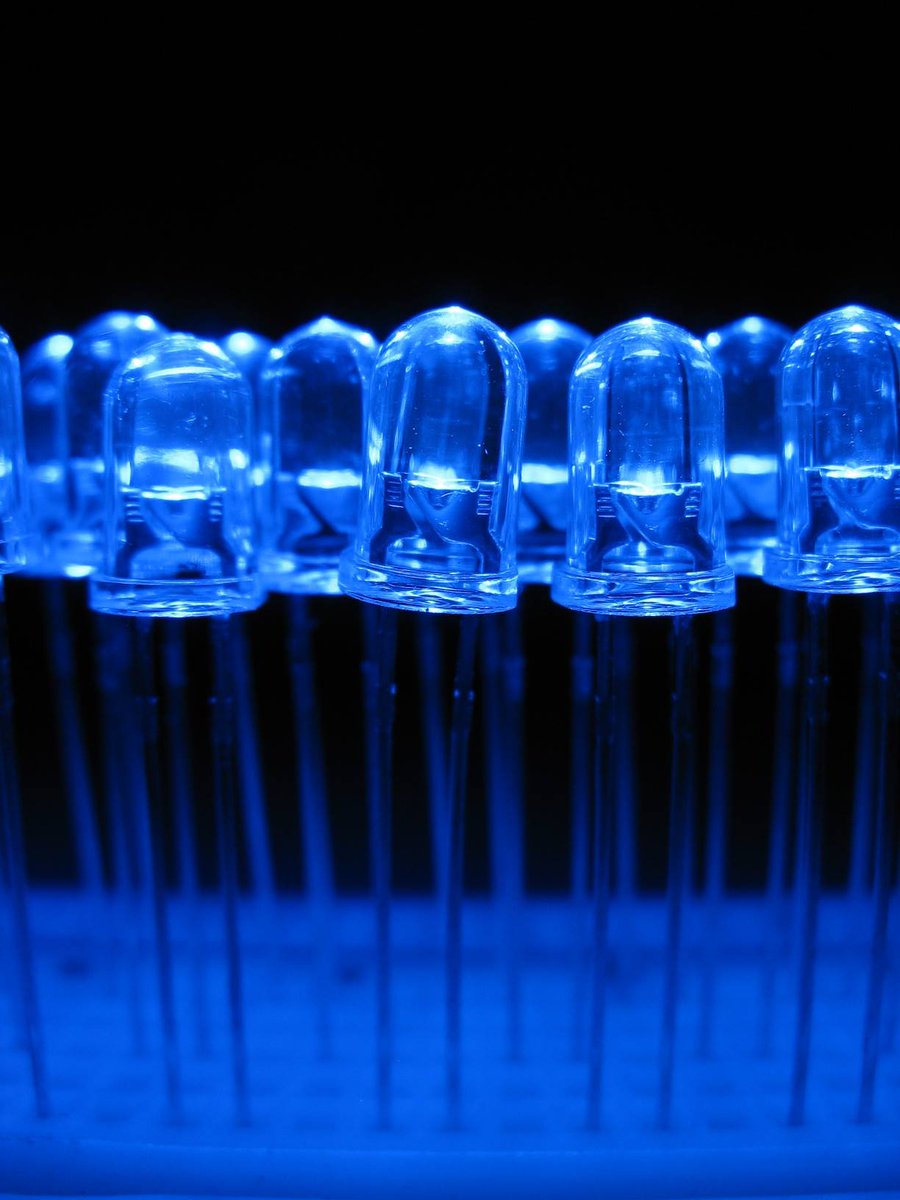
Highlighting the co-inventor of the LED, Isamu Akasaki (赤崎 勇).
Illuminating our world by inventing a new energy-efficient and environment-friendly light source – the blue light-emitting diode LED – Akasaki was awarded the 2014 #NobelPrize in Physics.
It’s my honor to be selected as the Closs seminar speaker at U Chicago. The visit is fantastic. It was very nice to meet many graduate students and postdocs. What a fun day🎤@UChiChemistry
This paper demonstrates for the first time that the molten salt can be a media to synthesize quantum dots. This paper also presents the first luminescent colloidal GaAs quantum dot. Redox chemistry is a powerful tool to achieve this nice materials! https://t.co/xGtdmbnnNr
The Engel group has recently discovered that two packets of solar energy (excitons) can sit on top of each other without interacting. Their discovery can aid material design for photovoltaics. @EngelGroupUC@UChicagoPSD@UChicagoPME@NatureComms
https://t.co/5tbZYrGhUy