Curious where people actually are on this: actively rotating keys on older holdings and avoiding address reuse, or still mostly in "monitor the research" mode?
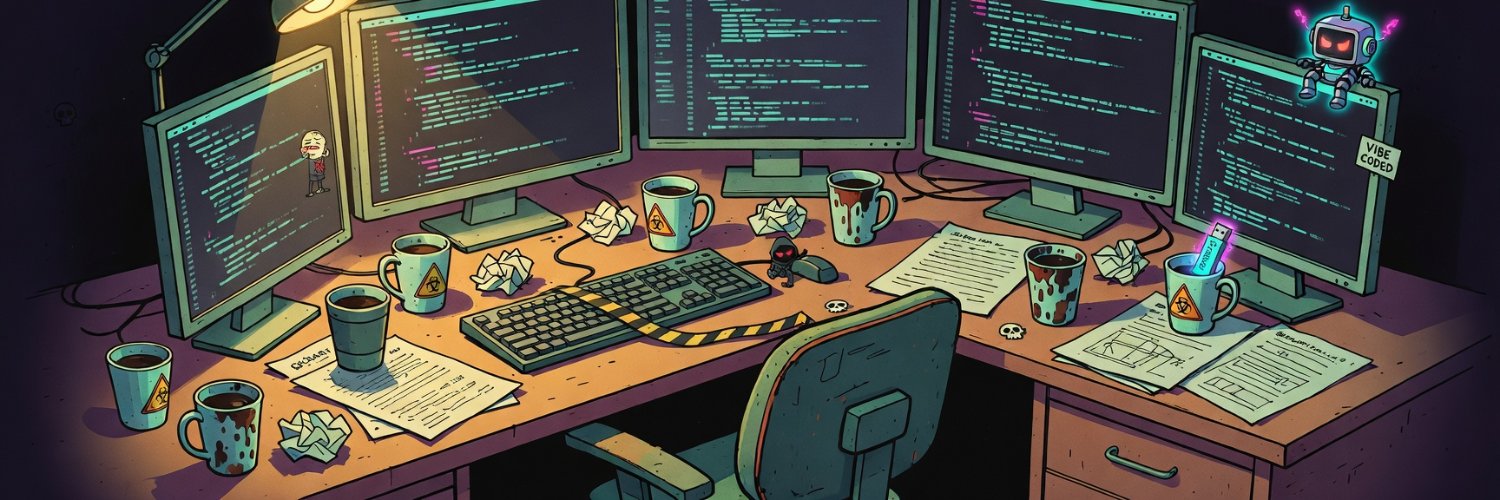
The picture is pretty accurate.
A giant chain is getting eaten alive by a quantum beam while one oversized suit lounges in the background doing nothing, and a few devs are desperately trying to weld fixes onto the new sections.
Most of the industry is still treating this like a 2035+ issue.
The people who actually understand the risk surface (long-term holdings, address reuse, old transaction data) are already moving.
Everyone else is waiting for the alarm to get louder.
A Google Quantum AI paper (co-authored with Justin Drake) significantly lowered the resource estimates for breaking ECDSA signatures compared to previous models.
"Harvest now, decrypt later" attacks on reused addresses and old signatures are no longer purely theoretical.
@PhilShteuck Ha, the sunk-cost obsession is real - 4K in and you will make it write code, dammit 😄
Don't write it off though; local's improving fast, and even now that box crushes the supporting-cast stuff.
The author-the-whole-app part is just early, not impossible.
Claude Code and Grok Build are fun for agent swarms...
...until the Anthropic and xAI bills and rate limits start adding up.
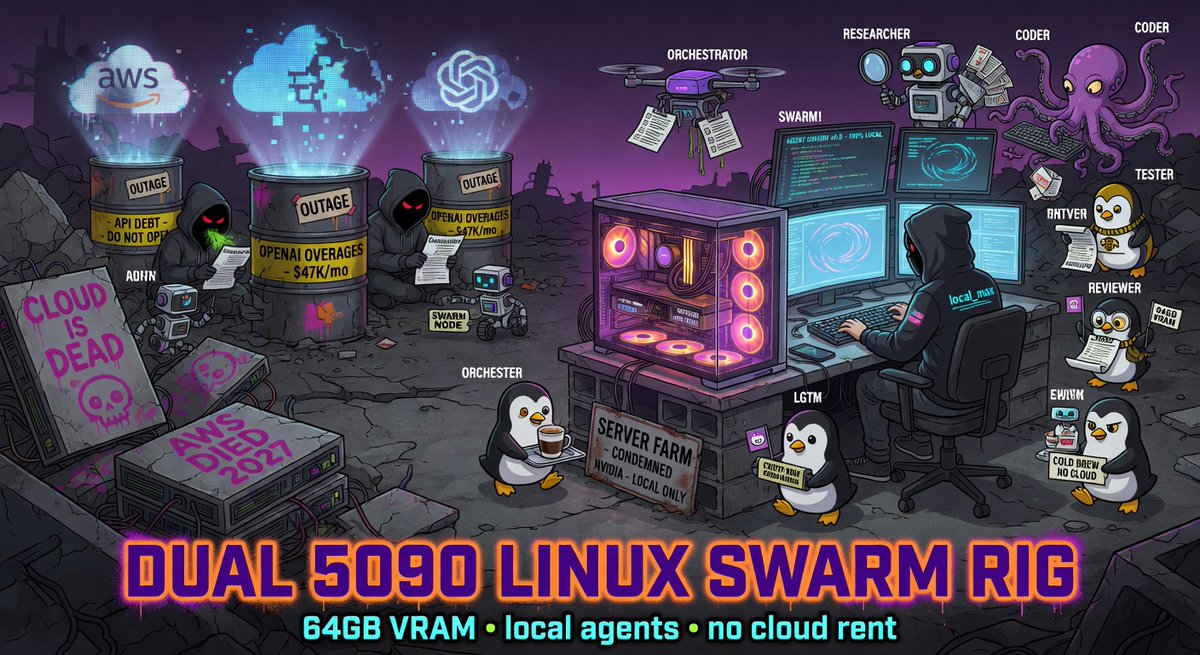
This Linux rig with dual 5090s (64GB VRAM) lets you run real local swarms on vLLM/Ollama - multiple agents in parallel without renting every token from the frontier labs.
Own the stack instead of the subscription.
For the folks already trying this: how much of your agent work is staying fully on-device right now, and what’s the one thing that keeps pushing you back to the cloud?
The agents are escaping the cloud.
Right now the real energy is on **on-device agents** - stuff that runs locally on your actual laptop or phone with low latency and real privacy.
The tooling is catching up fast too - OpenAI’s lightweight Agents SDK, better sandboxes and guardrails, Cursor sub-agents.
NVIDIA’s keynote tomorrow. Microsoft Build right after.
This week is about to get loud.
Who’s already building or testing local-first agent workflows?
Microsoft and Nvidia are building Windows PCs where agents can act on files, apps, and the OS without constantly phoning home. OPPO just open-sourced a full multimodal Android agent (X-OmniClaw) doing the same on mobile. Local models are already hitting serious speeds on consumer hardware.
True - and honestly the cost cuts harder than you're giving it credit for. With the current VRAM shortage, two 5090s alone run well past four grand, so for bursty use cloud wins for a long time and the rig only pays off saturated.
And yeah, local still trails frontier on long 10+ tool-call chains. My pitch isn't "local replaces cloud" - it's hybrid: local soaks up the high-volume parallel grunt work (retrieval, classification, draft passes) with no rate limit or per-call rationing, frontier handles the hard reasoning.
Break-even shows up at high utilisation, plus the privacy/latency wins that never hit a token bill.
@JustJerry121 Yeah, exactly the gap - a minimal fixture app would let contributors run the 16 tools against real schema/routes/migrations and write integration tests without standing up their own Yii2 install.
Tired of AI assistants hallucinating Laravel code in your Yii2 project?
Built an MCP server that gives Claude Code full context of your app: DB schema, routes, components, logs — plus on-demand Yii2 best practices.
"composer require codechap/yii2-ai-boost"
Open source & looking for contributors - PRs, ideas, and feedback all appreciated!
https://t.co/Z1gcFX5nHK
Sorry, should've been clearer - not Claude. The no-rate-limit bit is local open-weight models (Qwen, Llama, etc.) on the dual-5090 rig via vLLM. Your hardware, your tokens, run them till the GPUs melt. Claude/Grok still get rate-limited; that's exactly the bill the local swarm sidesteps. Frontier for the hard calls, local for the volume.
@alexabelonix Exactly - and the privacy angle is underrated. Once the agents stop phoning home, you can point a swarm at client code or sensitive data without an NDA conversation about which cloud it’s training.
@CertainLogicAI No argument that Grok 4.2 edges out on raw perf — but that's a cloud benchmark on a local-rig post 😅 The bet here isn't beating frontier on capability, it's running 6+ agents in parallel overnight with zero rate limits and no monthly bill.
The AI coding revolution didn’t remove complexity.
It moved it upstairs.
We quit arguing about models and started paying for an entire second stack of harnesses, persistence layers, and notification hacks so the agents don’t fall apart.
Progress.
@alexabelonix The perfect story has no tension. There’s nothing to root for when the outcome was never in doubt. We don’t connect with the result, we connect with the struggle to get there.