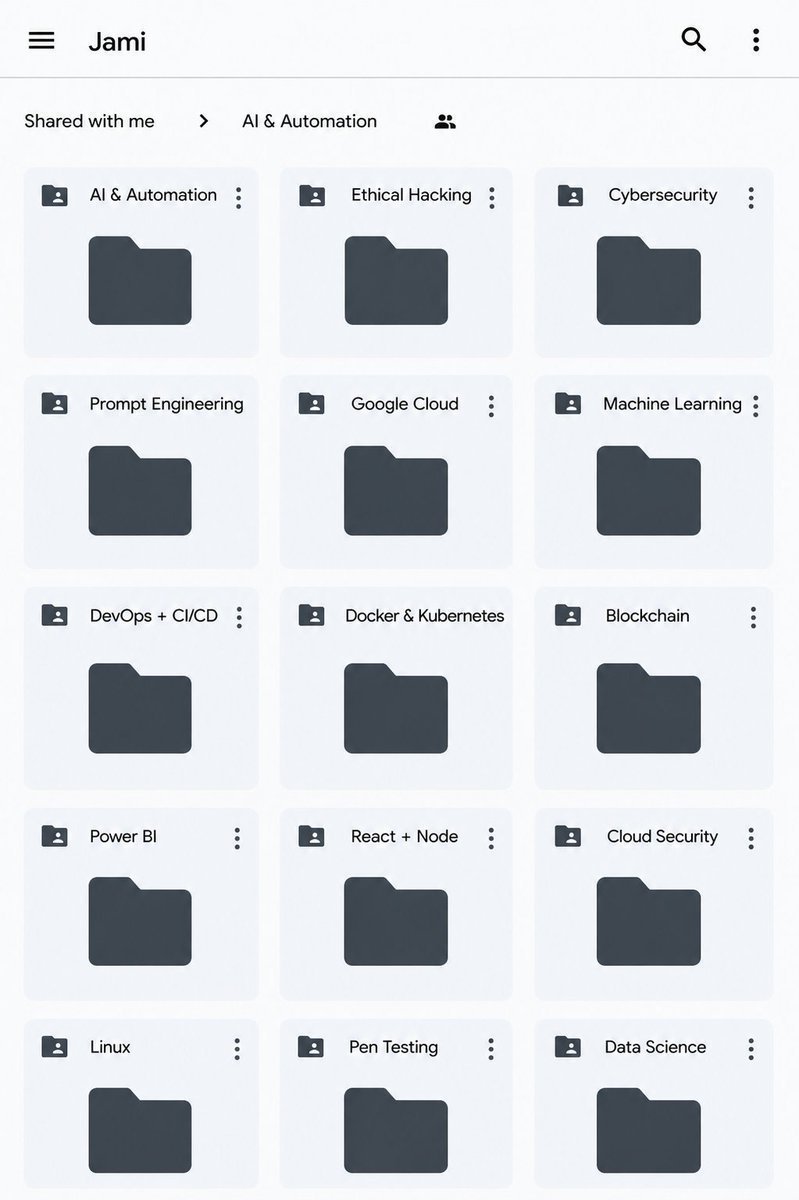
All Paid Courses (Free for First 4500 People)
𝗣𝗮𝗶𝗱 𝗖𝗼𝘂𝗿𝘀𝗲 𝗙𝗥𝗘𝗘 (PART - 1)
1. Artificial Intelligence
2. Machine Learning
3. Prompt Engineering
4. Claude,Chatgpt,Grok
5. Data Analytics
6. AWS Certified
7. Data Science
8. BIG DATA
9. Python
10. Ethical Hacking
(72 Hours only )
Like + RT + comment ' Drive '
Must Follow me so I can DM you.
Claude Code ships with 5 architectural layers most engineers never open.
Not features. Not settings. Layers — each solving a distinct problem that LLMs alone can't solve. And four of them have nothing to do with prompting.
Here's the full Agent Development Kit:
Layer 1 — CLAUDE.md → The Memory Layer
Architecture rules, naming conventions, test expectations, repo map. Always loaded. Always active.
Two scopes:
• ~/.claude/CLAUDE.md → global
• .claude/CLAUDE.md → project
This isn't context you paste in before every session. It's context that never needs repeating. The agent's constitution.
Layer 2 — Skills → The Knowledge Layer
Each SKILL.md carries a description. Claude matches it at runtime and forks the skill into an isolated subagent. On-demand, never always-on.
Task-specific knowledge without inflating your main context window. Modular by design.
Layer 3 — Hooks → The Guardrail Layer
PreToolUse → PostToolUse → SessionStart → Stop → SubagentStop
This is the layer most teams skip. And the one they regret skipping first.
Hooks are NOT AI. They're deterministic event-driven shell commands.
• Auto-lint on every Write
• Hard-block on rm -rf
• Slack notification on Stop
Event fires → Matcher checks → Command runs
Quality enforced at the infrastructure level. Not the prompt level.
Layer 4 — Subagents → The Delegation Layer
Each subagent gets its own context window, model, tools, and permissions.
Main agent delegates down. Receives results up. That's it.
No infinite recursion — subagents can't spawn subagents. Main context stays clean. Hard boundaries by design.
Layer 5 — Plugins → The Distribution Layer
Bundle your skills + agents + hooks + commands into a plugin. One install. Whole team inherits the behavior.
Think npm packages — but for what your agent knows how to do.
Wrapping everything:
→ MCP Servers on the left (GitHub, databases, APIs, custom integrations)
→ Agent Teams on the right (parallel execution, message passing, shared permissions)
The 5-layer stack in one line:
CLAUDE.md sets rules → Skills provide expertise → Hooks enforce quality → Subagents delegate work → Plugins distribute to the team
Most production failures in agentic systems trace back to one missing layer.
Which one is the gap in your current setup?
The LLM Engineering stack:
1. PySpark for Data Engineering
2. HuggingFace datasets for data
3. Unsloth for SFT/RLHF/QLoRA fine-tuning
4. vLLM for Inference optimization
5. FastAPI for backend
6. Redis for cache
7. Qdrant for vector database
8. Celery for task queue
9. Kafka for event-driven scenario
10. Perfect for orchestration
11. LangGraph for agents
12. DeepEval for LLM evaluation
11. Langsmith for LLM observability
12. Ollama for naive LLM calls
13. Postgres for storing data and conversations
14. Docker for containerization
15. AWS for deploying compute-heavy system (Kubernetes cluster)
16. Railway for agentic projects
17. Next JS for UI
18. Prometheus/Grafana for system observability
19. Ray for distributed systems
20. Slack for system alerts
What else am I missing?
Day 1 of Learning Backend Engineering.
What is Backend Engineering - Core Concepts and Responsibilities.
Grab the Backend Engineering Ebook: https://t.co/HTGzHJIXq0