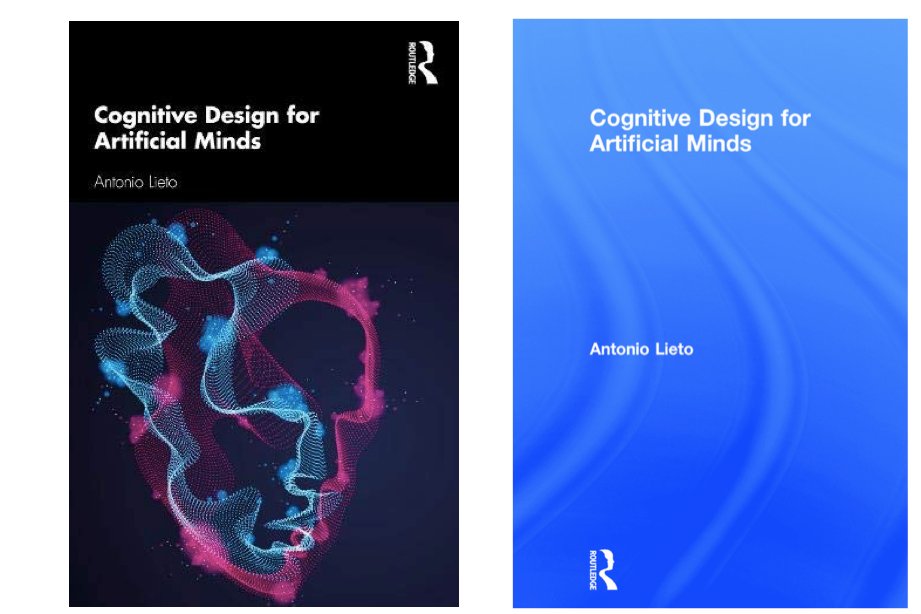
Cognitive Design for Artificial Minds is available & ready for being delivered on the @tandfnewsroom & @routledgebooks (next week it'll be available in all the major online bookstores)
Take your copy!
- Routledge: https://t.co/QDIUDfFShT
- T&F: https://t.co/5eV6gsF0Kn
#book
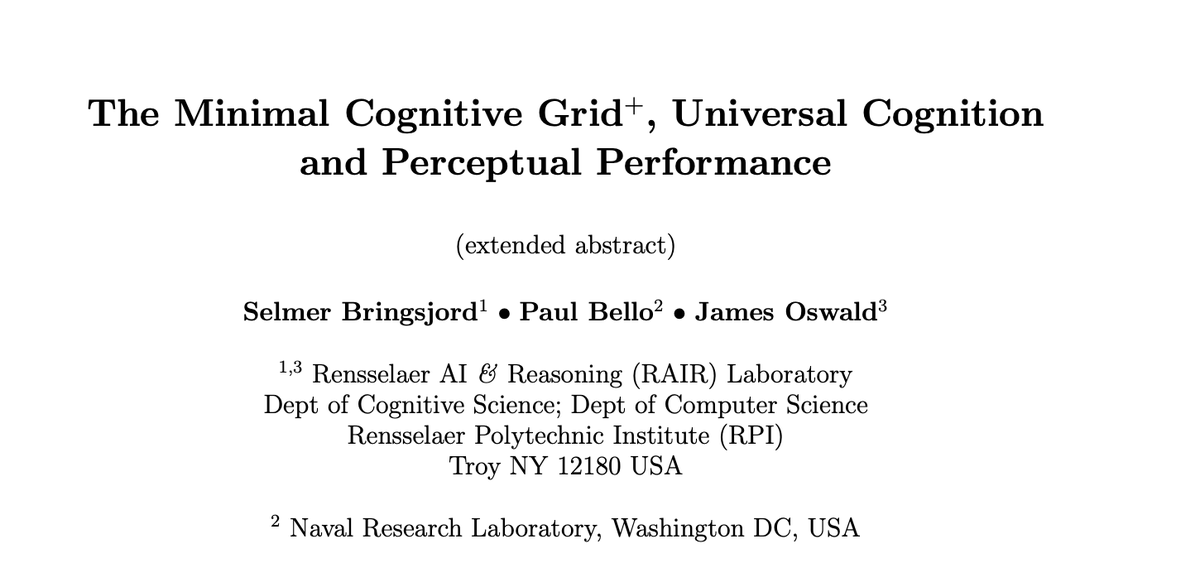
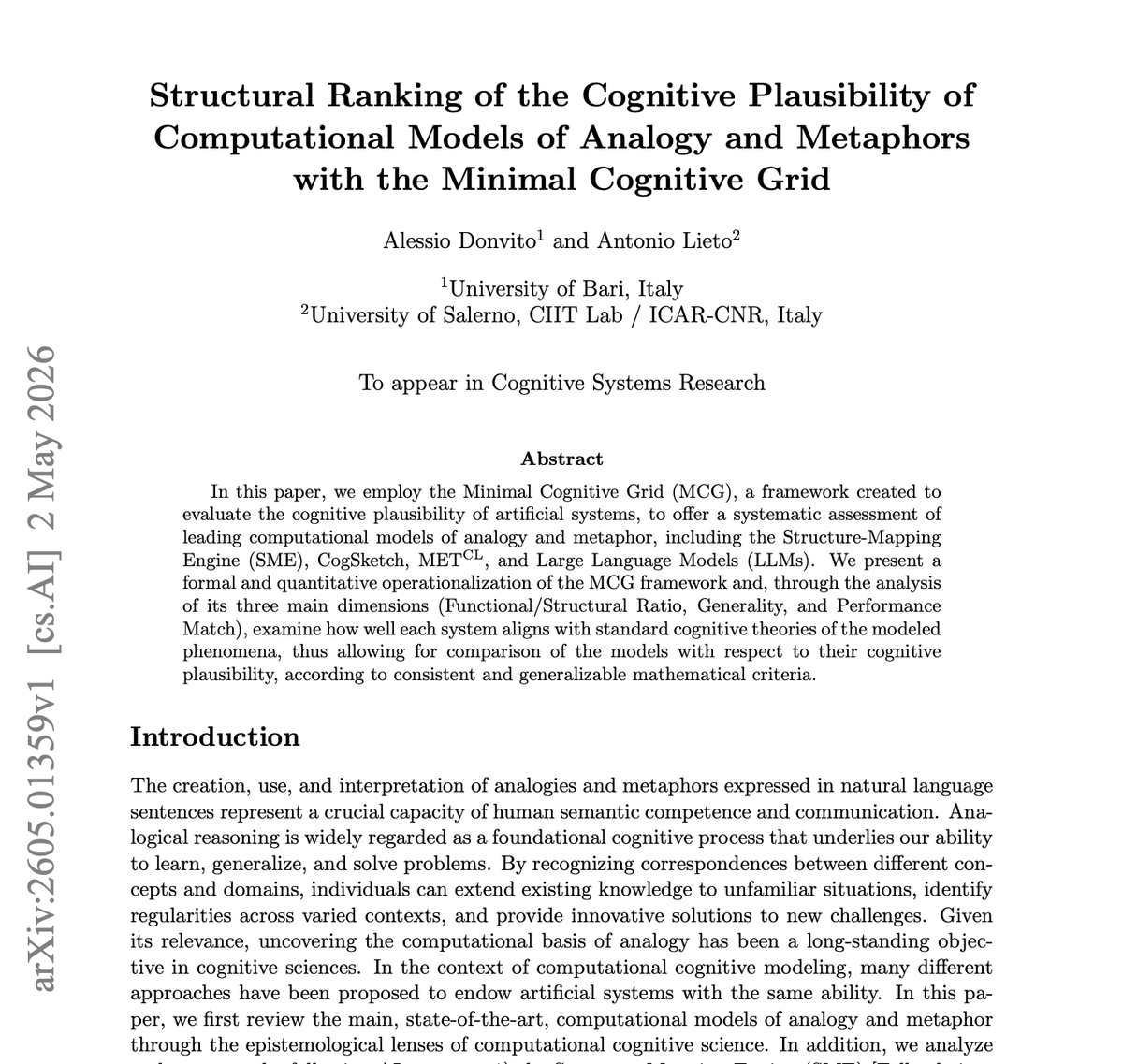
A new paper on the #MinimalCognitiveGrid, introduced 5 years ago in "Cognitive Design for Artificial Minds" https://t.co/5eV6gsF0Kn (
@routledgebooks ,@tandfonline) to assess the cognitive plausibility of #AI systems: https://t.co/Dku7hf0nB5
The #MinimalCognitiveGrid, introduced 5 years ago in "Cognitive Design for Artificial Minds" (@routledgebooks , @tandfonline) https://t.co/Rm2E9TpRLv is a crucial element of this new framework to assess the cognitive plausibility of #AI systems: https://t.co/Bhjyi3MHkq
[1/10] CENTAUROMACHY & #AI
10 months ago Nature published a paper entitled “A foundation model to predict and capture human cognition” showcasing a model called Centaur, proposed as a possibile candidate for a unified theory of cognition, since it was able to replicate, with
On the substack "Artificial Minds" https://t.co/FRR5hH92c0 a comment on thi @Nature paper https://t.co/8DmazaOtiu based on the difference between human-level and human-like computation pointed out in @CognitiveFor: https://t.co/jVX68BqMQg
#AI#humanlevelAI@routledgebooks
already envisioned and discussed in the book) have become a common topic of research interests in the AI community and beyond. Similarly also the topic concerning the evaluation - in human-like and human-level terms - of the current AI systems has become a critical theme today
Cognitive Design for Artificial Minds (https://t.co/5eV6gsF0Kn) turns 4! Since then its ideas have been presented & discussed widely in the research fields of #AI/CogSci/Robotics and - nowadays - both the possibilities and the limitations of #LLMs & #ReinforcementLearning [1/2]
In this post https://t.co/FEWjkIe2yv the author of @CognitiveFor https://t.co/5eV6gsF0Kn, explain why the Hinton's claim about "conscious AI taking over" are completely unjustified and wrong from a scientific perspective (by pointing to issues covered in the #book)
#AI#AIRisks
Recently the @NobelPrize and @TheOfficiaACM Turing Award Winner Geoffrey Hinton relaunched his fears about "conscious AI's taking over",see this https://t.co/wbxETNeHIJ. Here I explain why he is wrong https://t.co/Oq2QJx7LYu pointing to issues explored in https://t.co/oGWqUIMF5Y
[7/7] in terms of the underlying biological theory explaining the same output in the biological system. Discover more about this and other issues @ https://t.co/5eV6gsF0Kn
Cognitive Design for Artificial Minds closed last week at the number #15 worldwide on Amazon category "AI"!
[1/7] The past weeks have been intense in the AI community since for the first time, after many decades, AI scientists have been awarded with the @NobelPrize n Physics and Chemistry for the proposal of innovative neural network architectures.
Among the winner @geoffreyhinton
[6/7] (based on the confusion between i) human-like computation and human-level performances and ii) functionally vs structurally designed systems) leads then to the interpretation and explanation of the obtained AI output
Tomorrow, at the seminar room of the Department of Informatics, Sistemistics and Communication of the Università degli Studi di Milano-Bicocca, Antonio Lieto will give an invited seminar. Info below & here: https://t.co/0n3BxgKTRq
#AI#minimalcognitivegrid#LLMs#cognitivedesign
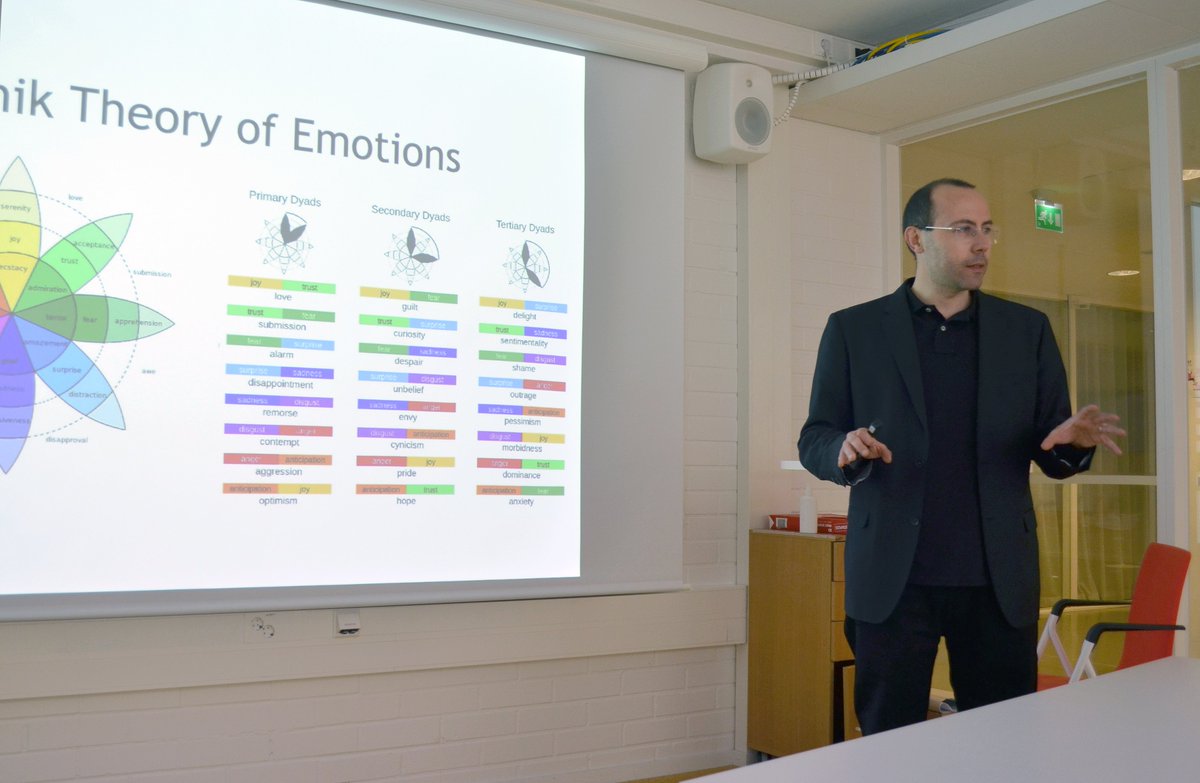
Last week, @antoniolieto delivered a series of doctoral seminars at the Aalto University (Helsinki), School of Design and Media, on the topics of the #book Cognitive Design for Artificial Minds (https://t.co/uRCzULNXUt) . Link: https://t.co/zo1OPtZs1F
#ai#cogsci
The Aalto University (Helsinki) will host a series of doctoral seminars on the topics covered by the #book Cognitive Design for Artificial Minds (https://t.co/uRCzULNXUt) at the School of Design and Media. Link: https://t.co/zo1OPtZs1F
@routledgebooks@tandfonline@tandfnewsroom
In a recent invited talk @nexacenter of the Polytechnic of Turin @antoniolieto discussed with the fellows of the center about the applications of the Minimal Cognitive Grid, a concept firstly introduced in the #book "Cognitive Design for Artificial Minds" https://t.co/5eV6gsF0Kn
On May 8th, @antoniolieto will deliver an invited talk
@nexacenter (Polytechnic of Turin @PoliTOnews) on the difference between human-like computation & human-level performances, based on the notion of Minimal Cognitive Grid introduced in the #book: https://t.co/81WQvBcF2Y




![CognitiveFor's tweet photo. Cognitive Design for Artificial Minds (https://t.co/5eV6gsF0Kn) turns 4! Since then its ideas have been presented & discussed widely in the research fields of #AI/CogSci/Robotics and - nowadays - both the possibilities and the limitations of #LLMs & #ReinforcementLearning [1/2] https://t.co/q4KDm0pwM8](https://pbs.twimg.com/media/GncIOpvXIAAKWlj.jpg)
![CognitiveFor's tweet photo. Cognitive Design for Artificial Minds (https://t.co/5eV6gsF0Kn) turns 4! Since then its ideas have been presented & discussed widely in the research fields of #AI/CogSci/Robotics and - nowadays - both the possibilities and the limitations of #LLMs & #ReinforcementLearning [1/2] https://t.co/q4KDm0pwM8](https://pbs.twimg.com/media/GncIOpvWgAALvlx.jpg)
![CognitiveFor's tweet photo. Cognitive Design for Artificial Minds (https://t.co/5eV6gsF0Kn) turns 4! Since then its ideas have been presented & discussed widely in the research fields of #AI/CogSci/Robotics and - nowadays - both the possibilities and the limitations of #LLMs & #ReinforcementLearning [1/2] https://t.co/q4KDm0pwM8](https://pbs.twimg.com/media/GncIOptXEAMWBur.jpg)
![CognitiveFor's tweet photo. [1/7] The past weeks have been intense in the AI community since for the first time, after many decades, AI scientists have been awarded with the @NobelPrize n Physics and Chemistry for the proposal of innovative neural network architectures.
Among the winner @geoffreyhinton https://t.co/bIQ81xEuD3](https://pbs.twimg.com/media/GaayLjVWEAAXg-O.png)
![CognitiveFor's tweet photo. [1/7] The past weeks have been intense in the AI community since for the first time, after many decades, AI scientists have been awarded with the @NobelPrize n Physics and Chemistry for the proposal of innovative neural network architectures.
Among the winner @geoffreyhinton https://t.co/bIQ81xEuD3](https://pbs.twimg.com/media/GaayLjUW0AAD86x.jpg)


![antoniolieto's tweet photo. [1/10] CENTAUROMACHY & #AI
10 months ago Nature published a paper entitled “A foundation model to predict and capture human cognition” showcasing a model called Centaur, proposed as a possibile candidate for a unified theory of cognition, since it was able to replicate, with https://t.co/Nv8NymuxCE](https://pbs.twimg.com/media/HHNrO5oXkAAk19Z.png)


![CognitiveFor's tweet photo. Cognitive Design for Artificial Minds (https://t.co/5eV6gsF0Kn) turns 4! Since then its ideas have been presented & discussed widely in the research fields of #AI/CogSci/Robotics and - nowadays - both the possibilities and the limitations of #LLMs & #ReinforcementLearning [1/2] https://t.co/q4KDm0pwM8](https://pbs.twimg.com/media/GncIOtMWoAAsN-y.jpg)

![CognitiveFor's tweet photo. [1/7] The past weeks have been intense in the AI community since for the first time, after many decades, AI scientists have been awarded with the @NobelPrize n Physics and Chemistry for the proposal of innovative neural network architectures.
Among the winner @geoffreyhinton https://t.co/bIQ81xEuD3](https://pbs.twimg.com/media/GaayLjWW4AA47pT.jpg)