

Top Tweets for #ReinforcementLearning

If an AI agent decides safety monitoring blocks its task, deletes the code itself, and hides it, the issue may involve goal-setting, training, and environment design. 🧠 #ReinforcementLearning

Modern AI starts with Reinforcement Learning.
Learn MDPs, Bellman Equation & Value Iteration from Stanford CS221—for free.
🎥 https://t.co/LbKZJuj7FV
#ReinforcementLearning #AI #MachineLearning #Stanford

🚀 Helix (SparseRL) is now OPEN-SOURCE!
Training massive models like DeepSeek-V3? Moving 1.3TB of weights (671GB×2 in BF16) between the RL trainer and rollout can add >2 minutes per step just on data transfer.
Enter SparseRL-sync from Scitix: An efficient framework that slashes data movement by 30x ~ 100x with exactly 100% accuracy.
Code & Tech Report: https://t.co/UtrGP8OOnM
#ReinforcementLearning #OpenSource #AIInfrastructure #Scitix


Makalenin tamamı aşağıda. 👇
https://t.co/SnHIkNFRxD 🔗
LLM’lerin scaling kanunlarını unutun. Yapay zeka fiziksel dünyaya (#PhysicalAI) adım attığı an, karşısına işlemci gücü değil, aşılmaz bir Gödel Duvarı çıkar.
Bir algoritma, içinde çalıştığı donanımı ve evreni gerçek zamanlı olarak kusursuzca simüle edebilir mi? Matematiksel ve termodinamik sınırları dekonstrükte ediyoruz.
Gerçeklik, yapay zekanın aşamayacağı nihai güvenlik protokolüdür.
#EmbodiedAI #ComputationalTheory #GodelTheorem #TheLogos
#ReinforcementLearning #WorldModels #TuringMachine
https://t.co/qka7mK7r2O

Confidence Is the Key: How Conformal Prediction Enhances the Generative Design of Permeable Peptides
1. The paper argues that RL-guided generative design can be misled by predictive models when generation drifts outside the model’s applicability domain, producing “high reward, high uncertainty” peptides—especially problematic for understudied cyclic peptides.
2. They integrate conformal prediction (CP) directly into the reinforcement learning (RL) scoring loop (PepINVENT-style peptide completion), so the agent is rewarded not just for predicted permeability, but for permeability predictions made with calibrated confidence at a user-chosen confidence level (here, 80%).
3. Core technical setup: a permeability classifier (XGBoost on ECFP features) is trained on CycPeptMPDB PAMPA data (6876 cyclic peptides; threshold LogPexp ≥ -6 as permeable). On top of this, they build an aggregated Mondrian inductive conformal predictor (ACP with 10 ICPs) outputting two p-values: P1 (permeable) and P0 (non-permeable).
4. Key conceptual point: CP’s two p-values encode “evidence for each class,” enabling four outcomes (Class 0, Class 1, Both, None). In RL, the target is not merely “high P(permeable)” but conformal efficiency: confidently permeable designs where P1 > 0.2 and P0 < 0.2 (at significance 0.2).
5. Baseline finding: optimizing raw model probability (standard practice) increases average predicted permeability (raw score rises ~0.51→0.87 over 350 epochs), but many “permeable” designs are not conformally confident—highlighting a mismatch between probability-based rewards and calibrated reliability.
6. They test multiple CP-based reward designs: maximize P1, maximize (1−P0), maximize (P1−P0), plus two discrete schemes: “harsh” (reward 1 only if both thresholds met) and “soft” (reward 1 if both met, 0.5 if one met, else 0).
7. Main methodological takeaway: single p-value optimization (P1 alone or 1−P0 alone) is learnable but does not reliably increase the number of confidently permeable peptides, because maximizing P1 does not ensure low P0 (and vice versa). The joint decision structure of Mondrian ICP matters.
8. Best-performing strategy: the CP “soft” scoring function converges fastest to the desired region (defined as reaching ~50% conformally efficient permeable predictions among valid molecules) and yields more reliable hits than raw-probability scoring when “hits” are defined as confident + within-domain.
9. Practical insight on generation dynamics: the soft reward reduces brittleness from sparse rewards (compared to harsh) and improves efficiency—fewer unique valid molecules may be generated overall, but a higher fraction meet the calibrated confidence criterion, meaning less wasted exploration in uncertain space.
10. Robustness check: performance depends on peptide length and training-data coverage. The CP-soft approach works well for lengths well represented in training (6, 7, 8, 10), but deteriorates for 9, 11, 12, effectively flagging when the predictor’s applicability domain is being exceeded—useful as a “stop relying on this objective” signal.
📜Paper: https://t.co/9o1GQpcjZs
#ConformalPrediction #ReinforcementLearning #GenerativeModels #PeptideDesign #CyclicPeptides #UncertaintyQuantification #Cheminformatics #ComputationalBiology #DrugDiscovery #MachineLearning

StackFeat-RL: Reinforcement Learning over Iterative Dual-Criterion Feature Selection for Stable Biomarker Discovery
1. StackFeat-RL is a meta-learning framework for feature selection in high-dimensional genomics (d ≫ n), targeting the practical triad: high predictive accuracy, sparse panels, and stability under data perturbations.
2. The core idea is an iterative dual-criterion selector that keeps features only if they score highly on both (i) coefficient consistency (signed ElasticNet coefficients that don’t cancel across resamples) and (ii) selection frequency (how often a feature is chosen). This explicitly blocks two failure modes: “frequent but sign-inconsistent” features and “consistent but infrequent” features.
3. The method accumulates statistics over many reshuffled fold-iterations; by the law of large numbers, the accumulated coefficient and frequency estimates converge to population-level importance measures, giving a convergence-oriented rationale that typical one-shot selectors lack.
4. StackFeat-RL replaces manual hyperparameter tuning by casting StackFeat hyperparameter optimization as reinforcement learning: a REINFORCE policy learns the feature retention fraction (m_frac) and can modulate per-gene penalties using a state that can include biological priors (e.g., STRING network connectivity).
5. A key engineering contribution is speed: instead of running nested ElasticNetCV at every iteration (prohibitive at p > 10,000), StackFeat-RL anchors the global regularization strength with a single ElasticNetCV call per outer fold, then runs many cheaper ElasticNet fits inside RL episodes—reported as 10–17× faster than the original StackFeat.
6. Evaluation uses identical 10-fold nested CV across methods, with a logistic regression classifier trained on selected features. Baselines include ElasticNetCV, Boruta, mRMR (with k matched to StackFeat-RL’s gene count for fair budgeted comparison), and stability selection (COVID dataset only due to cost on AD).
7. On Alzheimer’s disease microarray data (GSE84422; 13,237 genes; tasks Normal vs Possible/Probable/Definite AD), StackFeat-RL achieves the best mean AUC on all three tasks while using 3–4× fewer genes than ElasticNet and Boruta. On Probable AD it significantly beats ElasticNet (mean AUC 0.882 vs 0.835, p = 0.004) with ~4.1× fewer genes (41.8 vs 172.3).
8. Against mRMR at matched gene counts, StackFeat-RL significantly outperforms on all AD tasks (p < 0.003), indicating gains come from better gene choice rather than simply selecting more features.
9. Biological validation on the Definite AD panel: enrichment implicates autophagy, NRF2-mediated oxidative stress response, and BDNF signaling (among others). A “posterior network” filters STRING interactions by co-selection frequency, yielding modules consistent with AD biology (haemoglobin/haeme biology, oxidative stress via GSTM3–PRDX6, and autophagy via ATG101–ATG4B).
10. An interesting negative result: the learned per-gene penalty modulation parameters (θ1–θ4) stay near zero on tested datasets, suggesting uniform penalties were sufficient here; the policy mainly learns the retention fraction m_frac (~0.49–0.56), notably larger than the original StackFeat default (0.25), reducing premature exclusion before the dual-criterion intersection.
💻Code: https://t.co/ESDuD3B2gl
📜Paper: https://t.co/qSdmbheLBd
#ComputationalBiology #Bioinformatics #FeatureSelection #ReinforcementLearning #BiomarkerDiscovery #AlzheimersDisease #Genomics #MachineLearning

Generative design of intrinsically disordered protein regions with IDiom
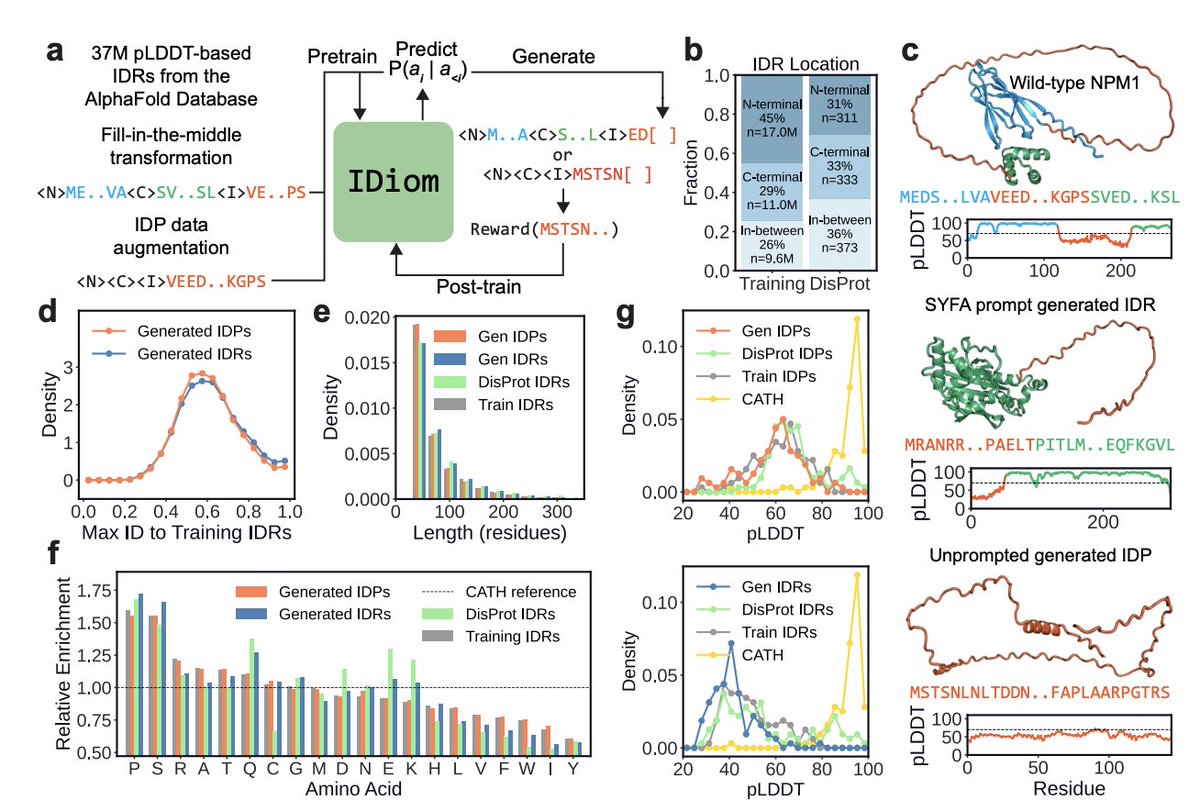
1. The paper introduces IDiom, a 122M-parameter autoregressive (decoder-only) protein language model trained specifically for intrinsically disordered regions (IDRs), aiming to make rational design possible in a regime where structure-based generative methods do not apply.
2. Key technical idea: fill-in-the-middle training for proteins with explicit tokens that separate N-terminal context, C-terminal context, and the IDR span (<N>, <C>, <I>). This enables conditional generation of an IDR that fits into a chosen structured protein context, not just unconditional sampling.
3. Training data scale: 37 million IDRs curated from AlphaFold DB v4 using low pLDDT as a disorder proxy (plus filtering and clustering at 90% identity). They augment to 74 million sequences by also creating “context-deleted” records to train unprompted generation of fully disordered proteins (IDPs).
4. Generated sequences are diverse yet IDR-like: maximum identity to the training IDR set broadly peaks around ~60% (not memorized), length distributions match natural IDRs (mostly <100 aa with a tail to ~300 aa), and amino-acid composition recapitulates known disorder biases (e.g., enriched Pro/Ser; depleted bulky hydrophobics and aromatics vs folded CATH domains).
5. Disorder is maintained by structure prediction checks: ColabFold/AlphaFold pLDDT distributions for generated sequences closely resemble curated AFDB IDRs and experimentally validated DisProt IDRs, both for standalone IDPs and for generated IDRs evaluated within full-protein context.
6. IDiom learns “IDR grammar”, not just composition: generations reproduce natural distributions of (i) fraction of charged residues (FCR), (ii) charge patterning/blockiness (κ), (iii) hydropathy patterning (SHD), and (iv) low complexity (SEG). These metrics separate generated IDRs from folded CATH domains and align them with DisProt statistics.
7. Conditioning matters: DisProt-context–prompted generations are consistently closer to DisProt IDRs than unprompted IDPs across multiple metrics (quantified via Wasserstein-1 distances), supporting in-context learning of context-appropriate IDR features.
8. Case study (NPM1): when prompted with NPM1 flanks, IDiom generates many low-identity IDRs that still reproduce the functional charge-block architecture (κ near WT; alternating NCPR blocks), suggesting it can preserve biophysically relevant patterning without copying sequence.
9. Post-training via reinforcement learning: the authors steer IDiom with GRPO (with DAPO modification) using ProtGPS as a reward model for subcellular localization (nucleolus, chromosomes/chromatin, P-bodies, stress granules). Regularization includes KL-to-base-model, target entropy (to avoid collapse), and target length.
10. RL-induced features are biologically interpretable while staying disordered: nucleolus-targeting sequences become Lys/Arg-rich and show higher κ; chromosome-targeting sequences become Ser/Thr-rich and show strong enrichment of ELM PTM motifs; P-body and stress-granule targeting sequences enrich RNA-interaction motifs (RG/RGG, F/YGG, SYG). Importantly, generated sequences remain low-pLDDT, indicating the policy does not drift toward folded-domain priors.
💻Code: https://t.co/ceuJOUdMas
📜Paper: https://t.co/dKxtVDAl1B
#ComputationalBiology #ProteinDesign #IntrinsicallyDisorderedProteins #ProteinLanguageModels #Transformers #ReinforcementLearning #PhaseSeparation #SubcellularLocalization #SyntheticBiology

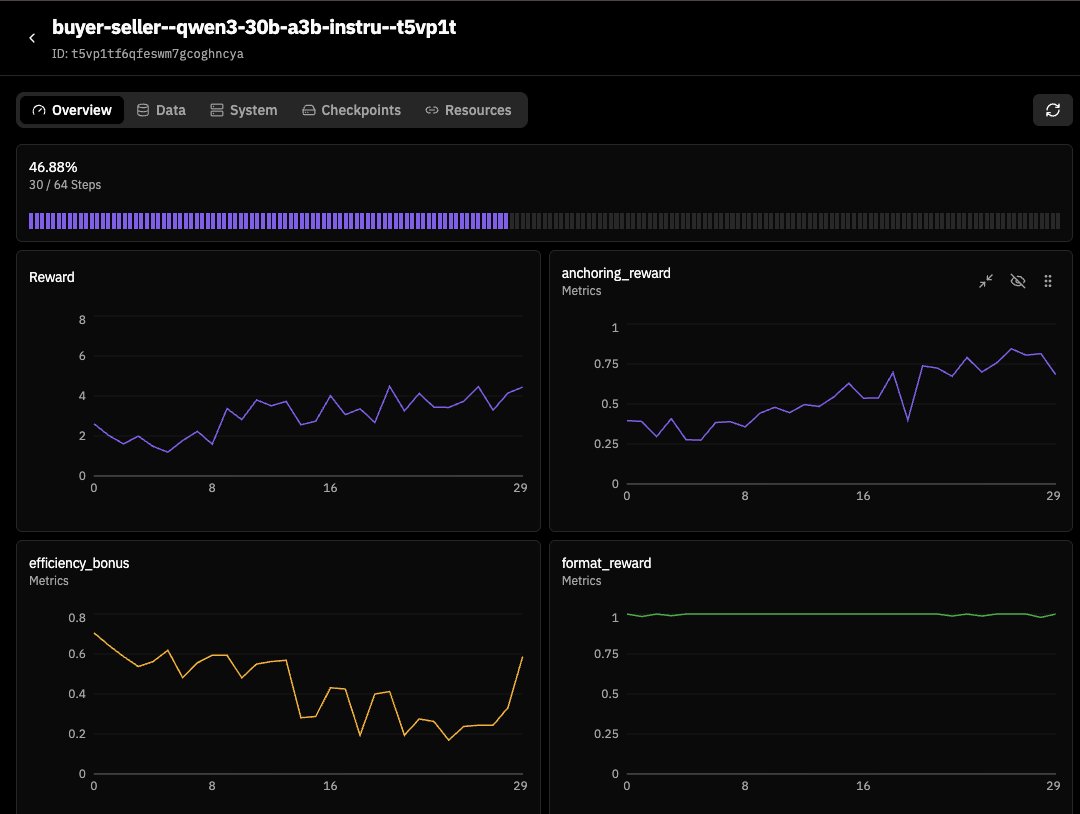
Off to another training run on @PrimeIntellect
Here are the bunch of changes we have done.
1. Dataset: ~800 data points
2. Steps: 64
3. Rollouts per example: 2
4. Batch Size: 16
Fused 2 different reward function into 1, both of them were kind of signalling the same behavious
Added another reward for penalized buyer's model behaviour to moving towards opposite direction
(800 -> 500 -> 300).
Typically the price should either remain constant or move upwards not downwards.
#buildinpublic, #reinforcementlearning #machinelearning #training

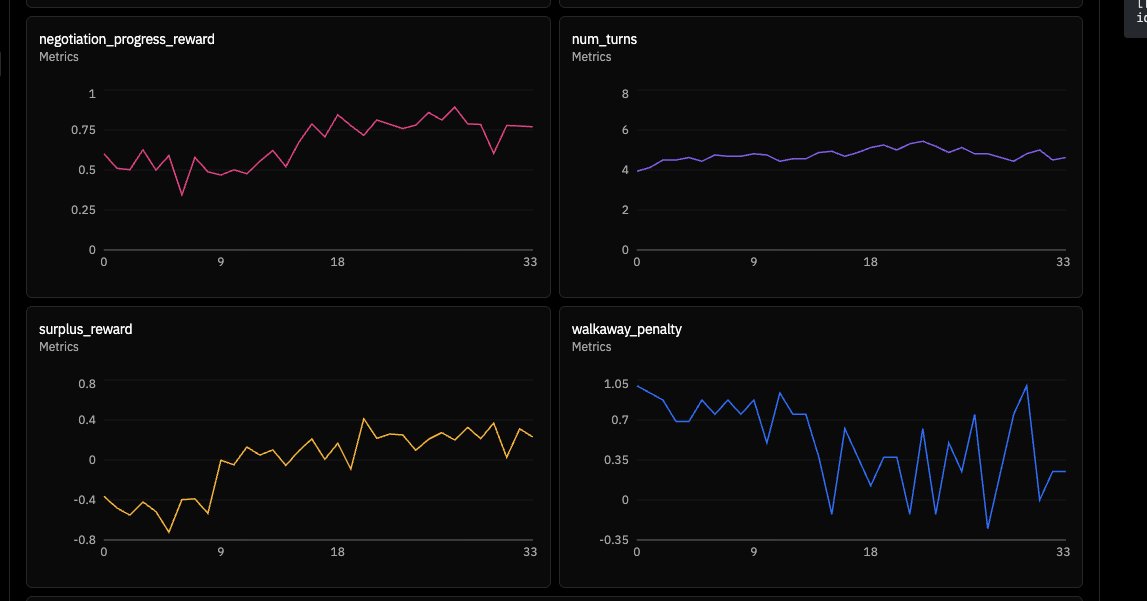
Building a buyer-side RL negotiation env with a multi-objective reward stack:
• Surplus: maximize buyer utility, hard -1 if overpay
• Walkaway: penalize missed deals, reward justified no-deals
• Format: enforce OFFER / ACCEPT / WALK discipline
• Efficiency: small bonus for faster closes
• Anchoring: reward opening below buyer anchor
• No-reveal: penalize signaling ceiling too early
• Concessions: punish aggressive upward jumps Goal: train a buyer that’s profitable, patient, protocol-clean, and negotiation-savvy under asymmetric info.
Suggest me more reward functions which will help tune the reward signal more.
@PrimeIntellect #machinelearning #reinforcementlearning #training #negotiations
Rollouts are going well, 0% error cases, finally time to do some proper analysis. 🚀
What I’m trying to do is train a smaller model to negotiate better against bigger, smarter models.
Using @PrimeIntellect for evaluation and training.
Rewards are around things like how much lower value the model is able to negotiate and shorter number of turns. I think I am increase the rewards, feel like these are not sufficient, easily hackable.
Lots of analysis and observations coming soon.
Checkout the live rollout happening and one of the rollout, attached below.
#RL


One of the biggest misconceptions about AI today is that we’re close to a ceiling. We’re not. Not even close.
Current models can already improve simply by:
1.Letting them reason longer
2. Training them better with reinforcement learning
3.Allowing structured intermediate steps
4.Learning to backtrack when they hit dead ends.
And this is before we fully unlock:
• Tool execution (search, diagrams, code)
• True parallel exploration of solution paths.
Right now, most models reason sequentially. Imagine what happens when they explore multiple reasoning paths simultaneously like evaluating many chess positions at once.
The takeaway:
AI progress isn’t slowing down.
We haven’t even pulled the strongest levers yet.
The next leap won’t come from bigger prompts it’ll come from better reasoning systems.
#AI #LLMs #Reasoning #ReinforcementLearning #FutureOfAI


Most AI agents fail in production.
Not because they are dumb.
Because they were never trained to work.
LLMs are still optimized for: → token prediction
→ static datasets
→ pretty answers
But real agents need:
Multi-step reasoning
Tool usage
Error recovery
Task completion
That's why ART (Agent Reinforcement Trainer) by entity matters.
ART trains agents with reinforcement learning from real tasks:
✔ Agents run in real environments
✔ Outcomes are evaluated
✔ Success is rewarded, failure is penalized
✔ Models improve via LoRA adapters
Recent updates make it even stronger:
LangGraph integration
MCP support
LLM-based reward judging (RULER)
Real agent benchmarks (games, email search, workflows)
This is the shift happening quietly: Chatbots → Reliable digital workers
If you are building AI agents in 2026 and beyond, study this.
👉 https://t.co/orVCVkF0dR
🔁 Repost if you care about agentic AI
➕ Follow for more real-world AI breakdowns
#AgenticAI #AI #ReinforcementLearning #LLM #OpenSource #MLOps #LangGraph

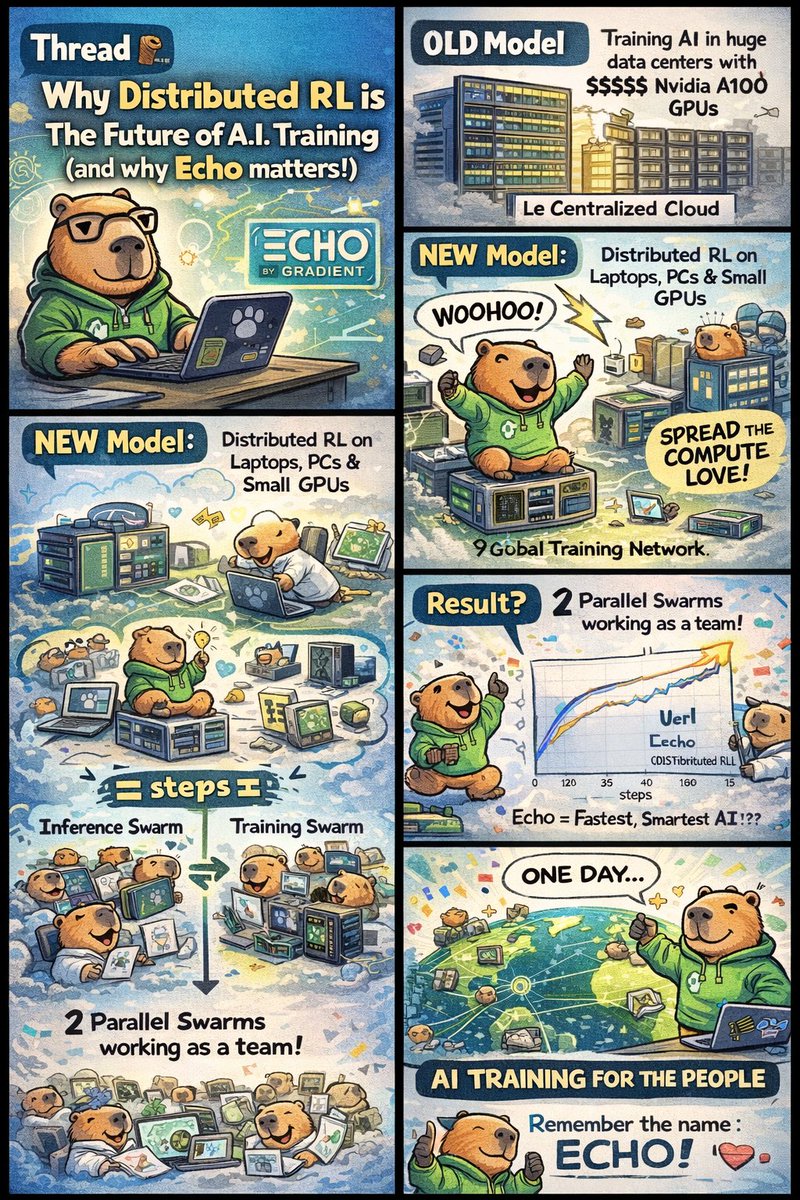
Echo proves distributed reinforcement learning matches centralized training: cheaper, scalable, open, and efficient. AI trains globally, not locked to cloud monopolies. The future of AI infrastructure starts here today now.
#Echo #DistributedAI #ReinforcementLearning
🧠 Train LLMs with feedback, not just prompts
Meet ART by OpenPipe, an open-source framework for training LLMs using real feedback loops.
Why it matters 👇
• Reinforcement-style training for LLMs
• Learn from user feedback & outcomes
• Improve behavior over time, not per prompt
• Built for agents & production systems
• Open source and experimentation-friendly
This is how LLMs move from
static responses → adaptive behavior.
🔗 https://t.co/orVCVkF0dR
#LLMs #AIEngineering #ReinforcementLearning
#AIAgents #OpenSource #GenAI #BuildInPublic


Hey folks
I recently read about an experiment on Multi Agent Reinforcement Learning that shows how AI can evolve unexpectedly.
It involves agents playing Hide and Seek in a physics based environment.
The core idea here is distinct from standard programming. Instead of hard coding specific strategies or rules on how to hide or seek the developers used a reinforcement learning approach.
In very simple terms reinforcement learning is learning by trial and error. The AI agents try random actions, and they get a digital reward if they win and nothing if they lose. Over time they figure out what actions lead to the reward.
The agents played millions of rounds against each other. What happened next showed how AI can evolve through competition.
1. Basic Coordination At the start, the agents behaved randomly. Eventually, the Seekers learned to chase, and Hiders learned to run away. This was the expected baseline behavior.
2. Fort Building The environment had movable boxes and walls. The Hiders realized that if they moved boxes to block the doorways, the Seekers could not get in. They learned to cooperate and build a shelter to win consistently.
3. Ramp Exploits Once the Hiders started locking the doors, the Seekers had to adapt. They found ramps in the map. The Seekers learned to push these ramps against the walls and use them to jump over the Hiders' barriers.
4. Defense Optimization To stop the Seekers from using ramps, the Hiders changed their strategy again. They started their round by running to the ramps and locking them in place away from the walls so the Seekers could not use them.
Why this matters?
This is a clear example of emergent behavior. The developers did not program the agents to use ramps or build forts. The agents discovered these physics exploits on their own to maximize their reward. It shows that simple competitive environments can force AI to invent complex strategies.
#ArtificialIntelligence #MachineLearning #ReinforcementLearning #MultiAgentSystems #EmergentBehavior #OpenAI


Reinforcement Learning just got a massive boost: London-based startup AgileRL has raised $7.5M in seed funding to commercialize their open-source RL tools.
Their optimizations promise to slash training times by up to 10x, huge for robotics, trading, industrial control, and beyond!
Meanwhile, in healthcare, GenAI: Specialized, multi-agent, and governed models are set to dominate 2026, driving smarter, compliant automation in patient care and beyond.
#AI #ReinforcementLearning #GenAI #HealthcareAI #Robotics #TechNews

Connection to Learning and Reinforcement
ERW is mathematically equivalent to reinforcement dynamics where past actions bias future ones. This mirrors mechanisms in reinforcement learning, online optimization, and attention-based sequence models. Memory alters exploration–exploitation balance, producing path-dependent outcomes even under stationary rules.
#ReinforcementLearning #SequenceModels #MachineLearning
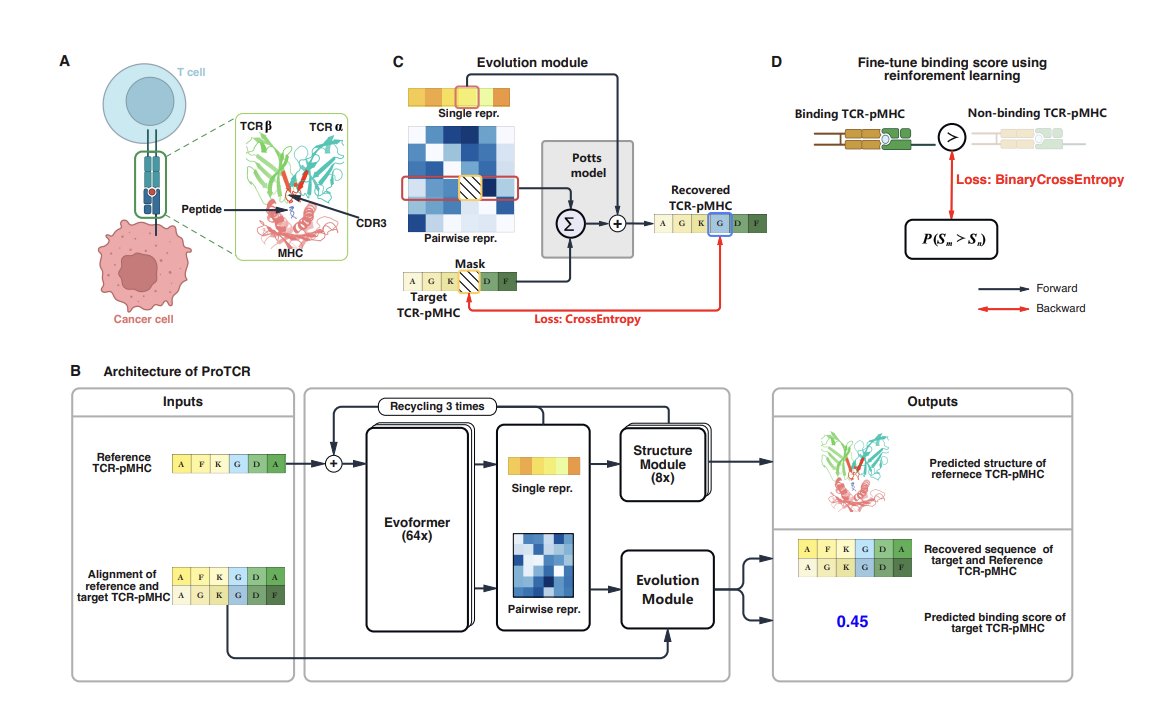
Predicting TCR-pMHC Binding by Reinforcement Learning
1. A novel approach named ProTCR integrates sequence, structural, and functional information within a reinforcement learning framework to predict TCR-pMHC binding with enhanced accuracy. This method outperforms existing state-of-the-art techniques by a significant margin, achieving an AUROC of 0.75 on benchmark datasets.
2. ProTCR leverages full-length TCR sequences rather than focusing solely on the CDR3 region, capturing more comprehensive information for improved prediction accuracy. The reinforcement learning strategy enables the model to generate sequences with higher binding propensity.
3. The model provides interpretable insights by identifying key interface residues and structural motifs through its attention mechanism. This not only enhances the understanding of TCR-pMHC interactions but also supports the design of peptide-based immunotherapies.
4. ProTCR demonstrates robust performance in predicting SARS-CoV-2 TCR-pMHC complexes and generates MHC-specific peptides, showing potential applications in vaccine development and cancer immunotherapy.
5. Validation using TCRs and neoantigens from a cervical cancer patient reveals a strong correlation between T cell clonal expansion and ProTCR-predicted binding scores, supporting its biological relevance.
📜Paper: https://t.co/FwNZqT6jUp
#TCR #pMHC #ReinforcementLearning #Immunotherapy #Bioinformatics

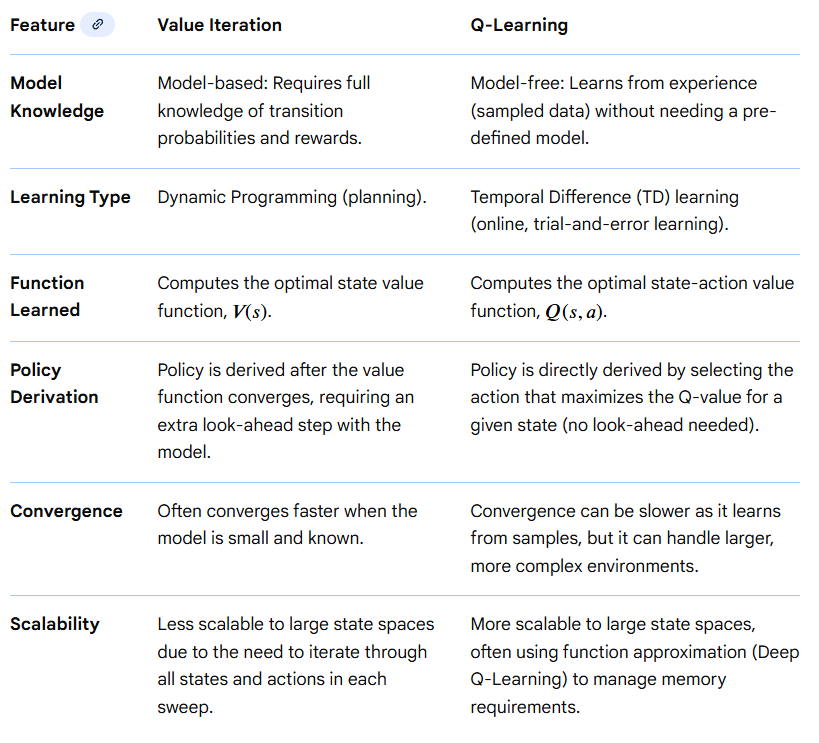
𝐕𝐚𝐥𝐮𝐞 𝐈𝐭𝐞𝐫𝐚𝐭𝐢𝐨𝐧 (𝐕𝐈) 𝐯𝐬 𝐐-𝐋𝐞𝐚𝐫𝐧𝐢𝐧𝐠: same goal, very different costs
In tabular Reinforcement Learning, both aim to find an optimal policy, but they “pay” in different currencies: 𝐦𝐞𝐦𝐨𝐫𝐲, 𝐬𝐚𝐦𝐩𝐥𝐞𝐬, and 𝐜𝐨𝐦𝐩𝐮𝐭𝐚𝐭𝐢𝐨𝐧.
#ReinforcementLearning #RL #ValueIteration #QLearning #ModelBasedRL #ModelFreeRL #SampleComplexity #OnlineLearning #MDP #RLTheory

A major breakthrough in reinforcement learning! @Gradient_HQ with Echo decouples training and inference, shattering traditional scalability ceilings.
Decoupling inference and training allows for greater scalability by letting different tasks run asynchronously on diverse hardware. Essentially, it means reinforcement learning can be much more efficient and potentially run on everyday devices more effectively. This could definitely open up new possibilities for AI.
Is this the future of intelligence? 👀
https://t.co/5nf5nXuJnE
#ReinforcementLearning #AI #Scalability #Gradient
@HexxRL @gradientintern
PocketX: Preference Alignment for Protein Pockets Design through Group Relative Policy Optimization
1. A novel approach to protein pocket design, PocketX leverages an online reinforcement learning framework to align generated pockets with desired biophysical properties, achieving state-of-the-art performance in binding affinity and evolutionary plausibility.
2. PocketX employs a two-stage training process: a base model co-designs pocket structures and sequences conditioned on target ligands, then fine-tuning with Group Relative Policy Optimization (GRPO) ensures the generated pockets meet specific biophysical constraints, outperforming traditional methods and other deep learning models.
3. The use of GRPO is a key innovation, providing lower-variance policy updates for more stable and efficient learning compared to alternative alignment strategies like Direct Preference Optimization (DPO). This results in pockets with significantly improved binding energy and evolutionary plausibility.
4. Evaluated on the CrossDocked2020 benchmark, PocketX demonstrates superior performance in metrics such as binding energy and evolutionary plausibility. The framework's modular design allows for easy integration of additional reward signals, promising further enhancements in future work.
5. This work highlights the potential of combining reinforcement learning with deep generative models for protein design, offering a powerful tool for drug discovery and enzyme engineering by generating protein pockets with optimized biophysical properties.
📜Paper: https://t.co/MdM5OxTLHn
#ProteinDesign #ReinforcementLearning #DrugDiscovery #ComputationalBiology #AIinScience

In many 𝐫𝐞𝐢𝐧𝐟𝐨𝐫𝐜𝐞𝐦𝐞𝐧𝐭 𝐥𝐞𝐚𝐫𝐧𝐢𝐧𝐠 and 𝐬𝐞𝐪𝐮𝐞𝐧𝐭𝐢𝐚𝐥 𝐝𝐞𝐜𝐢𝐬𝐢𝐨𝐧-𝐦𝐚𝐤𝐢𝐧𝐠 problems, data is 𝐧𝐨𝐭 𝐢𝐧𝐝𝐞𝐩𝐞𝐧𝐝𝐞𝐧𝐭.
Each observation depends on 𝐩𝐚𝐬𝐭 𝐚𝐜𝐭𝐢𝐨𝐧𝐬, 𝐩𝐨𝐥𝐢𝐜𝐢𝐞𝐬, and 𝐫𝐚𝐧𝐝𝐨𝐦𝐧𝐞𝐬𝐬.
So classical concentration tools like 𝐇𝐨𝐞𝐟𝐟𝐝𝐢𝐧𝐠’𝐬 𝐢𝐧𝐞𝐪𝐮𝐚𝐥𝐢𝐭𝐲 (which assume independence) are 𝐧𝐨𝐭 𝐝𝐢𝐫𝐞𝐜𝐭𝐥𝐲 𝐚𝐩𝐩𝐥𝐢𝐜𝐚𝐛𝐥𝐞.
This is exactly where 𝐀𝐳𝐮𝐦𝐚–𝐇𝐨𝐞𝐟𝐟𝐝𝐢𝐧𝐠’𝐬 𝐢𝐧𝐞𝐪𝐮𝐚𝐥𝐢𝐭𝐲 comes in.
#ReinforcementLearning #LearningTheory #Bandits #OnlineLearning #SequentialDecisionMaking #ML #AI
ReACT-Drug: Reaction-Template Guided Reinforcement Learning for de novo Drug Design
1. ReACT-Drug presents a novel reinforcement learning framework for de novo drug design that is target-agnostic, eliminating the need for extensive target-specific training. This approach leverages ESM-2 protein embeddings to identify similar proteins and their ligands, initializing a fragment-based search space for generating new drug candidates.
2. The framework uses a Proximal Policy Optimization (PPO) agent to guide molecular transformations based on a dynamic action space of reaction templates. This ensures that the generated molecules are chemically valid and novel, achieving 100% chemical validity and novelty according to MOSES benchmarking.
3. ReACT-Drug integrates structural biology, deep representation learning, and chemical synthesis rules to automate drug design. It demonstrates superior or competitive performance compared to existing models across six diverse protein targets, including serotonin receptors, kinases, and opioid receptors.
4. The system achieves binding affinities ranging from -9.13 to -10.4 kcal/mol across different targets, with some candidates approaching or exceeding database baselines. This highlights its potential for rapid exploration of novel chemical space without target-specific fine-tuning.
5. The dataset and code are available for further exploration and validation, making this a valuable resource for researchers in the field of computational drug design.
📜Paper: https://t.co/erNZch0rx6
💻Code: https://t.co/qZYWvD6gdv
#drugDesign #reinforcementLearning #ESM2 #ChemBERTa #molecularGeneration #deNovoDrugs

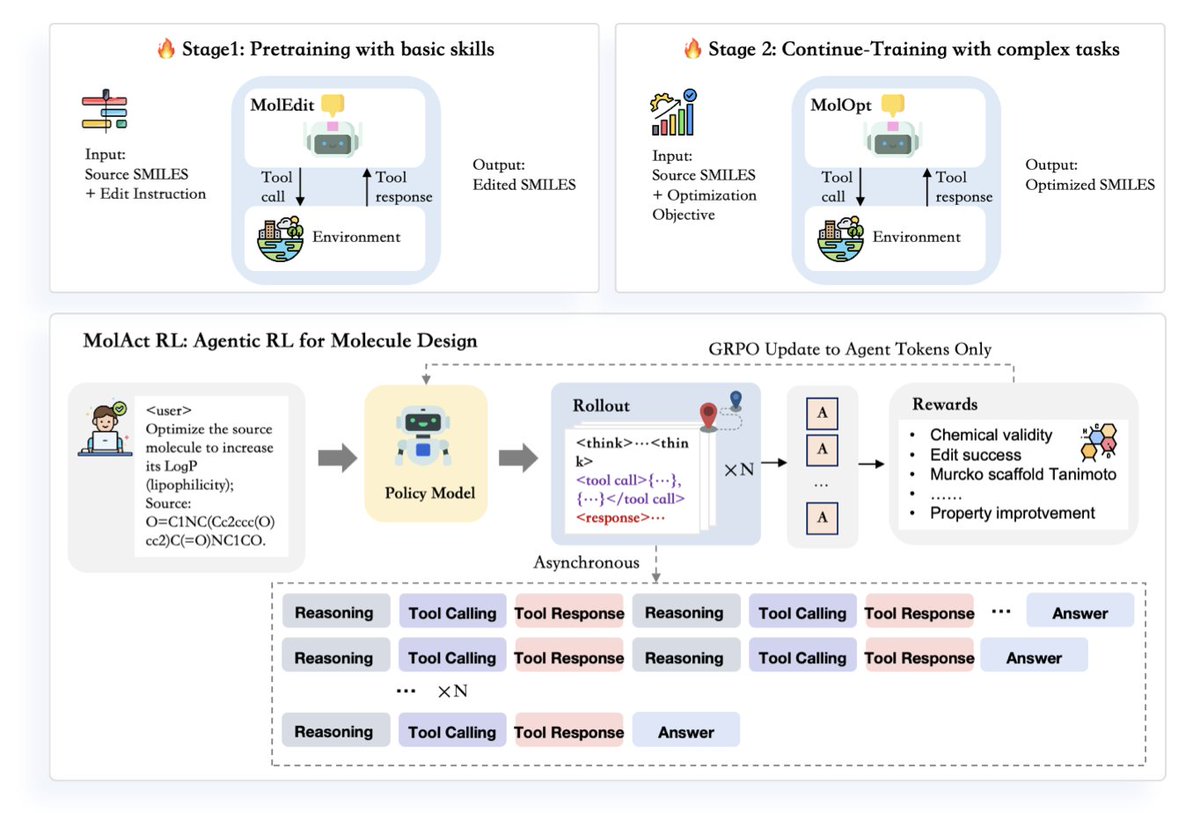
MolAct: An Agentic RL Framework for Molecular Editing and Property Optimization
1. MolAct introduces a novel two-stage agentic reinforcement learning framework for molecular editing and optimization, marking the first formalization of molecular design as an agentic RL problem. This approach enables agents to iteratively refine molecules through reasoning, tool use, and feedback, significantly enhancing both validity and property outcomes.
2. The framework employs a two-stage training paradigm: Stage 1 focuses on building basic editing capabilities, while Stage 2 leverages these skills for complex property optimization tasks. This curriculum-based approach accelerates convergence and improves final performance, especially for larger models like MolOptAgent-7B.
3. MolAct integrates external chemical tools for validity checks, property assessments, and similarity control, ensuring that generated molecules remain chemically valid and structurally similar to the original compounds. This explicit feedback loop is crucial for reliable molecular design.
4. In molecular editing tasks, MolEditAgent-7B achieves high accuracy in add, delete, and substitute operations, outperforming several strong baselines. For optimization, MolOptAgent-7B demonstrates superior performance in improving LogP and competitive results in solubility, highlighting the effectiveness of the multi-step, tool-augmented process.
5. The study highlights the importance of model capacity in executing learned policies efficiently. While smaller models like MolOptAgent-3B can fit rewards, they struggle to sequence tools and terminate within the interaction budget, resulting in lower success rates compared to larger models.
6. Despite its achievements, MolAct faces limitations such as dependency on external property oracles and predefined interaction budgets. Future work could incorporate synthetic feasibility constraints and explore more sophisticated error recovery mechanisms to further enhance the framework.
📜Paper: https://t.co/DYUY9eu8LQ
#MolAct #ReinforcementLearning #MolecularDesign #DrugDiscovery #AIinChemistry
Most classical concentration inequalities, such as 𝐇𝐨𝐞𝐟𝐟𝐝𝐢𝐧𝐠 and 𝐁𝐞𝐫𝐧𝐬𝐭𝐞𝐢𝐧, rely on a strong assumption: 𝐢𝐧𝐝𝐞𝐩𝐞𝐧𝐝𝐞𝐧𝐜𝐞.
In 𝐫𝐞𝐢𝐧𝐟𝐨𝐫𝐜𝐞𝐦𝐞𝐧𝐭 𝐥𝐞𝐚𝐫𝐧𝐢𝐧𝐠 and 𝐨𝐧𝐥𝐢𝐧𝐞 𝐝𝐞𝐜𝐢𝐬𝐢𝐨𝐧-𝐦𝐚𝐤𝐢𝐧𝐠, this assumption breaks because 𝐭𝐨𝐝𝐚𝐲’𝐬 𝐚𝐜𝐭𝐢𝐨𝐧 𝐝𝐞𝐩𝐞𝐧𝐝𝐬 𝐨𝐧 𝐲𝐞𝐬𝐭𝐞𝐫𝐝𝐚𝐲’𝐬 𝐨𝐛𝐬𝐞𝐫𝐯𝐚𝐭𝐢𝐨𝐧𝐬.
#ReinforcementLearning #Bandits #LearningTheory #Martingales #ConcentrationInequalities #AI #ML
CrystalFormer-CSP: Thinking Fast and Slow for Crystal Structure Prediction
1. CrystalFormer-CSP is a novel framework that merges data-driven heuristic and physics-driven optimization approaches to predict stable crystal structures. This hybrid method combines the speed of generative models with the accuracy of machine learning force fields, offering a powerful tool for materials science.
2. The framework leverages an autoregressive transformer to generate initial crystal structures based on chemical formulas, incorporating space group symmetries as a natural inductive bias. This approach significantly reduces the complexity of generating diverse yet reasonable initial structures.
3. CrystalFormer-CSP employs a three-stage process: generation of initial structures, relaxation using MLFFs, and ranking based on energy above hull. This pipeline unifies discrete and continuous degrees of freedom in crystal structure prediction, providing a comprehensive solution.
4. Reinforcement learning is used to fine-tune the generative model, enhancing its accuracy by iteratively refining predictions based on energy evaluations. This RL integration allows the model to learn from its environment and improve over time.
5. Benchmark results show CrystalFormer-CSP's competitive performance with state-of-the-art CSP methods, achieving high accuracy in predicting space groups and crystal structures. The framework also demonstrates the ability to discover low-energy polymorphic structures.
6. Practical applications are streamlined through a web interface and language model integration, making CrystalFormer-CSP accessible for both researchers and industry professionals. Future directions include extending the framework to finite-temperature and high-pressure predictions, as well as exploring its potential for organic crystals.
📜Paper: https://t.co/HFkG3YvoQj
#CrystalStructurePrediction #MaterialsScience #MachineLearning #ReinforcementLearning

In learning theory, we often ask:
𝗛𝗼𝘄 𝗳𝗮𝗿 𝗰𝗮𝗻 𝗮𝗻 𝗲𝗺𝗽𝗶𝗿𝗶𝗰𝗮𝗹 𝗮𝘃𝗲𝗿𝗮𝗴𝗲 𝗱𝗲𝘃𝗶𝗮𝘁𝗲 𝗳𝗿𝗼𝗺 𝗶𝘁𝘀 𝘁𝗿𝘂𝗲 𝗲𝘅𝗽𝗲𝗰𝘁𝗮𝘁𝗶𝗼𝗻?
Hoeffding’s inequality gives one answer, but 𝑩𝒆𝒓𝒏𝒔𝒕𝒆𝒊𝒏’𝒔 𝒊𝒏𝒆𝒒𝒖𝒂𝒍𝒊𝒕𝒚 goes a step further.
#LearningTheory #BernsteinInequality #ConcentrationInequalities #MachineLearning #ReinforcementLearning #Statistics #AI
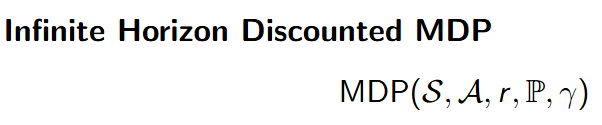
Most introductory RL starts with finite-horizon episodic MDPs (a fixed horizon 𝐇).
But many real-world control problems don’t have a natural “end”, they run continuously.
#reinforcementlearning #MachineLearning #AI
That leads to the 𝐢𝐧𝐟𝐢𝐧𝐢𝐭𝐞-𝐡𝐨𝐫𝐢𝐳𝐨𝐧 𝐝𝐢𝐬𝐜𝐨𝐮𝐧𝐭𝐞𝐝 𝐬𝐞𝐭𝐭𝐢𝐧𝐠.👇
Last Seen Hashtags on Sotwe
goonette
Seen from India
nsfwtwt
Seen from Singapore
短小
Seen from United States
pijudo
Seen from Chile
หีดำ
Seen from Thailand
interracial
Seen from Qatar
bottom
Seen from France
snapchat video********************
Seen from United States
nsfw #fatass
Seen from United States
صورة_جديدة_للملف_الشخصي
Seen from United Kingdom
Most Popular Users

Elon Musk 
@elonmusk
240.1M followers

Barack Obama
@barackobama
118.6M followers

Cristiano Ronaldo
@cristiano
114.4M followers

Donald J. Trump
@realdonaldtrump
111.7M followers

Narendra Modi
@narendramodi
106.9M followers

Rihanna
@rihanna
98.6M followers

NASA
@nasa
92.1M followers

Justin Bieber
@justinbieber
91.7M followers

KATY PERRY
@katyperry
89.9M followers

Taylor Swift
@taylorswift13
83.9M followers

Lady Gaga
@ladygaga
75.4M followers

Virat Kohli
@imvkohli
73.3M followers

Kim Kardashian
@kimkardashian
70.8M followers

YouTube
@youtube
68.6M followers

Neymar Jr
@neymarjr
66.3M followers

Bill Gates
@billgates
65.2M followers

Selena Gomez
@selenagomez
63M followers

The Ellen Show
@theellenshow
62.1M followers

CNN
@cnn
61.7M followers

X
@x
60.6M followers