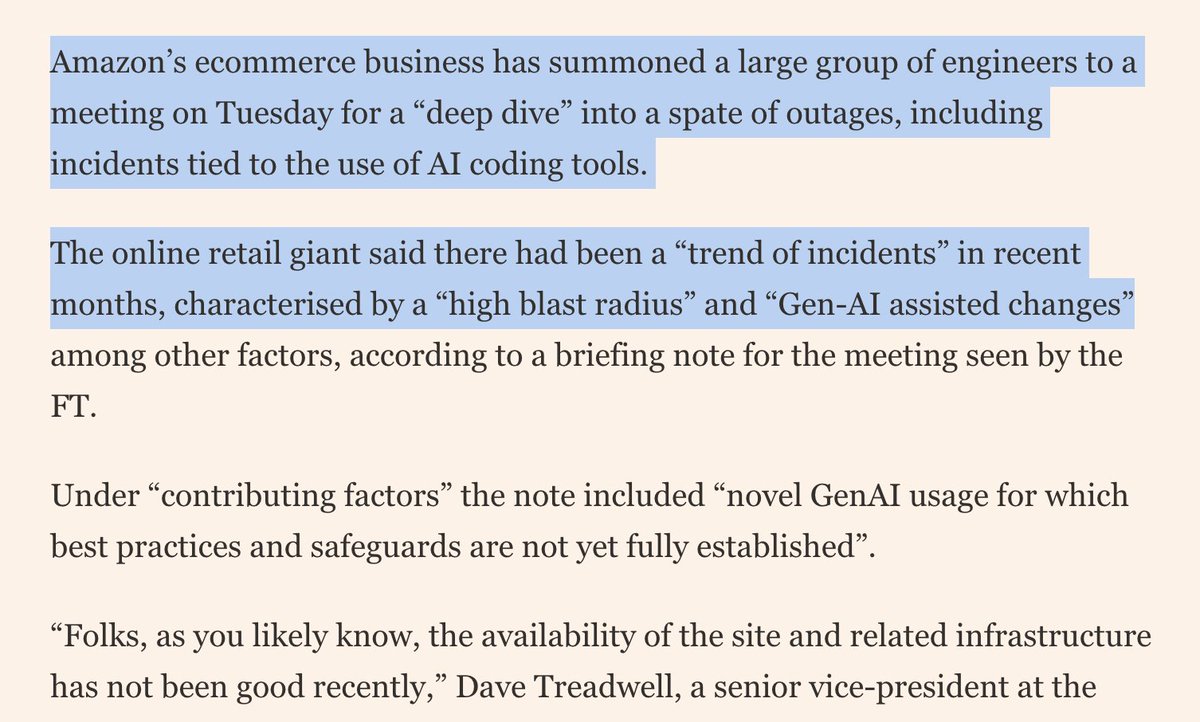
Amazon is holding a mandatory meeting about AI breaking its systems. The official framing is "part of normal business." The briefing note describes a trend of incidents with "high blast radius" caused by "Gen-AI assisted changes" for which "best practices and safeguards are not yet fully established." Translation to human language: we gave AI to engineers and things keep breaking?
The response for now? Junior and mid-level engineers can no longer push AI-assisted code without a senior signing off. AWS spent 13 hours recovering after its own AI coding tool, asked to make some changes, decided instead to delete and recreate the environment (the software equivalent of fixing a leaky tap by knocking down the wall). Amazon called that an "extremely limited event" (the affected tool served customers in mainland China).
It’s possible this was written with @grok or another LLM. The em-dash issue isn’t unique to ChatGPT.
LLMs uses em-dashes a lot because they learned to mimic the punctuation patterns in their training data, especially from well-edited books and articles where em-dashes are more common.
Deep networks fail when information cannot flow.
As transformers grow deeper, gradients struggle to propagate.
Residual connections address this by allowing each layer to pass information forward unchanged alongside its transformation.
This simple idea prevents degradation, stabilizes training, and allows transformers to scale to hundreds of layers.
Without residuals, attention and feed-forward layers would not train reliably.
Residual connections are not an optimization trick.
They are a structural requirement for deep models.
A powerful model without guardrails is a liability.
LLMs will always try to generate something, even when they should not.
Guardrails define what the system is allowed to do, how it should respond, and when it should refuse.
In production GenAI systems, guardrails include output schemas, content filters, tool restrictions, and fallback logic.
They are essential for safety, reliability, and user trust.
Prompting alone cannot enforce guarantees.
Guardrails turn a demo into a product.
Training a model is really about how you move downhill.
Gradient Descent is the engine behind most ML training, but the variant you choose changes how efficiently learning happens.
• Batch Gradient Descent uses the full dataset and gives stable updates but is slow and memory-heavy.
• Stochastic Gradient Descent updates weights per sample, which is fast but noisy.
• Mini-batch Gradient Descent balances both and is used in most real-world systems.
Interviewers often ask this to test whether you understand tradeoffs, not formulas.
The right optimizer is about stability, speed, and scale.
How do machines learn to make the best decisions? Through Reinforcement Learning.
By navigating complex environments and maximizing rewards, RL is the engine driving the next wave of robotics and AI fine-tuning. The future isn't just programmed; it’s trained.
#AI #ReinforcementLearning #MachineLearning
LLMs are masters of confidence, but not always accuracy.
A hallucination isn't a glitch; it’s the model prioritizing plausibility over truth. It predicts the next likely word based on patterns, even if that word is a total fabrication.
Always verify, never just copy.
#GenerativeAI #LLMs #AI