We are committed to making meaningful progress in machine learning research through open collaboration. Follow this 🧵to stay on top of our research contributions.
Speculative decoding is supposed to struggle on MoE models at small batch sizes.
On recent fine-grained MoEs, we found the opposite: the speedup peaks at batch size 1.
Here's why the standard cost model misses this, from our #NeurIPS2026 paper 🧵
Tune in on Sunday, November 29th for a session featuring @ktwu01 who leads Benchmark Radar—a living database and search engine for AI benchmarks with 52,867+ records from 41 sources used by OpenAI, Anthropic, Harvard, MIT, and Stanford.
Koutian will discuss how benchmarks saturate, get gamed, and go stale, how to choose trustworthy evals, and his career shift from PhD to M.A. 👀
RSVP now: https://t.co/vYUyUMWUtT
Thanks to @PrahithaM for organizing this talk! 🔥
Announcing research on speculative decoding vs. prior MoE speedups
Fine‑grained models break the concave speedup trend, delivering higher acceleration at low batch sizes. We'll be sharing more at NeurIPS. 🇦🇺
📜https://t.co/tO5Sm0rtRf
New blog on AI reasoning for unfamiliar languages.
Through the IOL‑AI 2026 competition, we learned how frontier models can reason from scratch on unseen languages, yet only proprietary systems shine at medal level.
https://t.co/9ZdEmglSk1
New blog on training language models with checklist rewards. ☑️ ☑️ 🔲 ☑️ 🔲 🔲
This work builds of our paper Soft-SVeRL: Self-Verified Reinforcement Learning with Soft Rewards, being shared at the the "Who verifies the agents?" workshop at NeurIPS.
https://t.co/aa0wZ3EzEL
@Cohere_Labs community-led Computer Vision group (led by @cataluna84 & @Arkhymadhe) is thrilled to host @ziqi__ma for the audience to ask deep technical questions, discuss open problems, and explore future collaboration possibilities on November 24th for a session on "LoGo: Local-Global Rewards for Consistent Long��Horizon Video Generation" 🧪
Camera-controlled video models are rapidly advancing toward long generation horizons and complex camera control. A key failure mode is 3D inconsistency: as the camera moves, objects lose permanence and scene structures shift. Existing post-training techniques, which assign a single scalar reward to the entire generation, are poorly suited to correcting these inconsistencies over long horizons. Ma et al. introduce LoGo, which blends global and spatially localized rewards for camera-controlled video models. The local reward provides fine-grained credit assignment, which substantially improves 3D consistency, while the global reward preserves camera following and video quality. Across three base models, LoGo shows a clear advantage on DL3DV and TrajectoryBench, a new benchmark for long-horizon, complex-camera-control generation that current evaluations lack. LoGo effectively reduces local object shifts, artifacts, and global scene changes, illustrating the importance of credit assignment in post-training video models 📽���
Bio: Ziqi is a fourth-year PhD student at @Caltech. Her research centers around video-based world modeling: learning spatial and physical priors from videos. Her works enable today's generative video models to capture physical properties, such as consistency and accurate dynamics. Ziqi has interned at @theworldlabs and @Meta SuperIntelligence Labs. She is advised by @georgiagkioxari and @yisongyue 🦾
Thanks to my partner in crime, @Arkhymadhe, for co-leading and organizing this session 👥
📅 November 24th - 11 AM EDT / 08:00 PST / 21:30 IST
🚀 Luma: https://t.co/JxWWgsiJ5z
🌐 Project Website: https://t.co/KUq1VlJJdR
Join the Cohere Labs Discord for more such possibilities - https://t.co/jnBaBwnYQl
Join in for the fun and ask interesting questions⁉️
Very excited to talk about building world models that don’t just generate beautiful pixels, but capture spatial and physical properties! Join me with @Cohere_Labs next Tuesday (Nov 24) 8am PST! https://t.co/PSJZ0qbPam
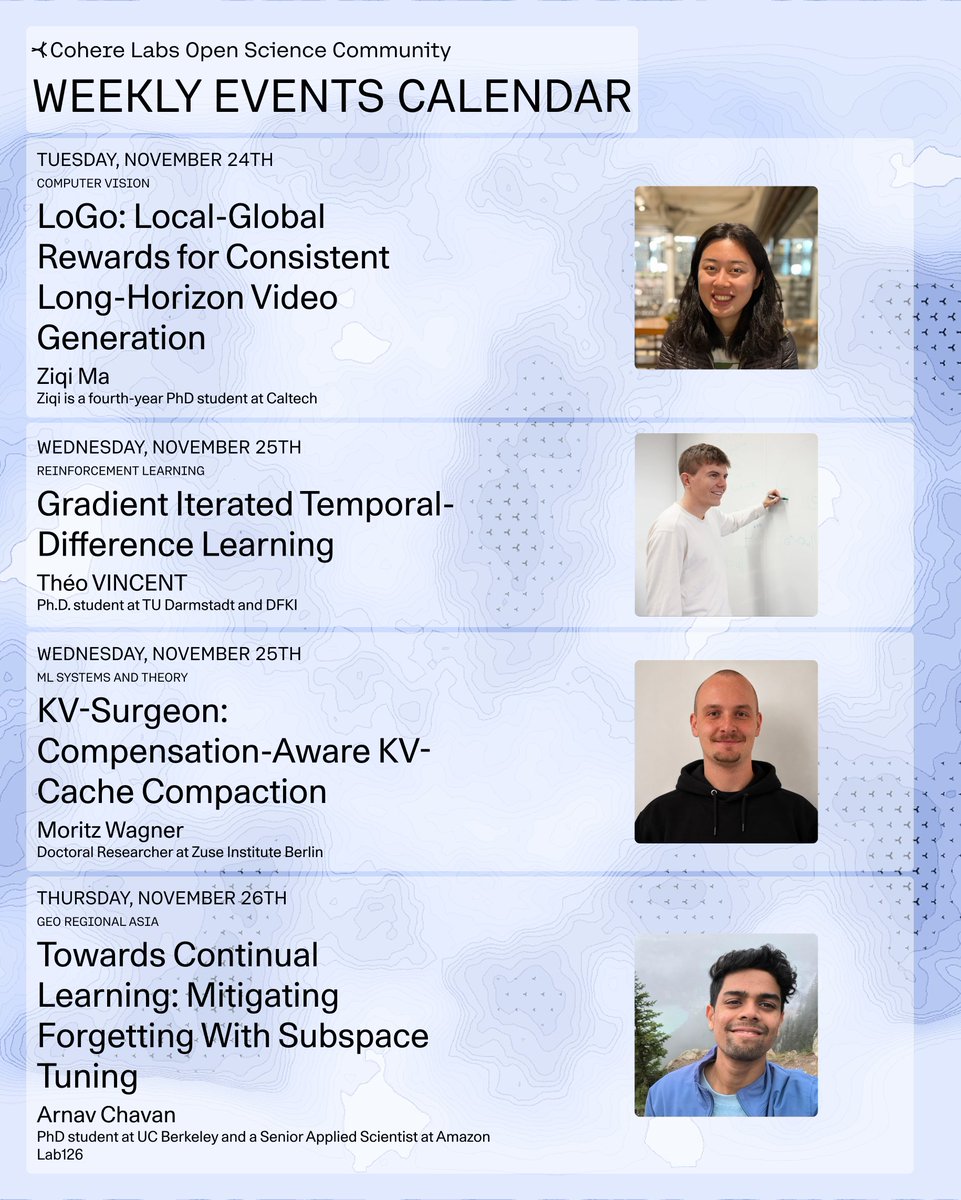
Our Open Science Community is excited to share our events for next week, November 23-27! Check out the upcoming sessions:
📆 LoGo: Local-Global Rewards for Consistent Long-Horizon Video Generation with @ziqi__ma: https://t.co/VHWzsVgz3c
📆 Gradient Iterated Temporal-Difference Learning with @Theo_Vincent_ : https://t.co/i4qvriWWgr
📆 KV-Surgeon: Compensation-Aware KV-Cache Compaction with Moritz Wagner: https://t.co/QpQrcxJJeQ
📆 Towards Continual Learning: Mitigating Forgetting With Subspace Tuning with @ArnavChavan6: https://t.co/xPrwdjL6fa
Thanks to our Open Science community leads @cataluna84, @Arkhymadhe, @rahul_narava, @Sree_Harsha_N, @AhmadMustafaAn1 and @KanwalMehreen2 for organizing these events!
New blog from our community! Catalyst Grant Recipient, @featuregraph (Nazia Habib), introduces us to FeatureGraph, a standardized approach to timeseries data analysis that creates a single source of truth for scientific and engineering research. 📈
Read the full post: https://t.co/QSPtE5hmUM
Our community-led EdTech group is looking forward to hosting Waqas Aliemuddin for a presentation on "The Unfair Advantage of the Non-Technical Founder" when he will deep dive into the idea that founders without traditional software development backgrounds could possess an unexpected advantage!
Thanks to @Rafay_Mustafa1 for organizing this session 🔥
Join us on Thursday, November 19: https://t.co/Kx2rVRZ2aw
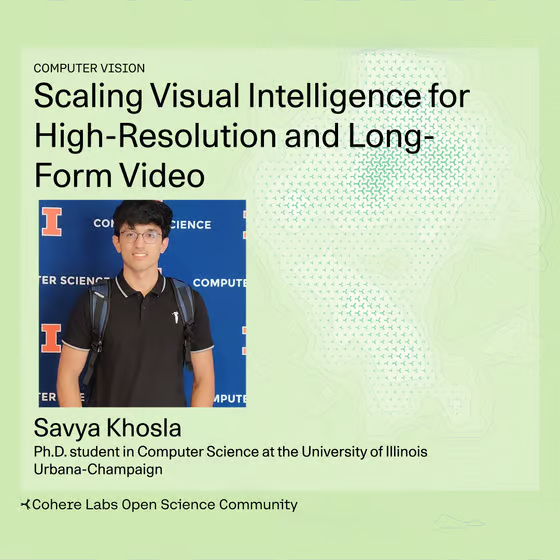
Extremely happy to host @savyakhosla for the audience to ask deep technical questions, discuss open problems, and explore future collaboration possibilities with the @Cohere_Labs research community
Scaling Visual Intelligence for High-Resolution and Long-Form Video
Abstract: What would it take for a robot or a wearable assistant to watch an entire day and help a blind person find their keys? Current vision systems make this prohibitively expensive because they split every image into a fixed grid of patches. As a result, doubling the resolution quadruples the token count, even when the added pixels carry no new information (e.g., a blank wall), and every video frame adds hundreds more tokens, even when it barely differs from the last. This talk presents region-based representations that encode each meaningful entity as a single token that persists across frames, so computation scales with what the scene contains rather than with resolution or video length. I will show how to generate region tokens efficiently, extend them to video, and align them with language. With region tokens, an hour of video takes fewer tokens than a patch-based encoder needs for a twenty-second clip, and performance improves on tasks ranging from segmentation and retrieval to episodic memory localization and spatial reasoning.
Bio: Savya Khosla is a Ph.D. student in Computer Science at the University of Illinois Urbana-Champaign, advised by Derek Hoiem and Alexander Schwing. His research focuses on efficient visual representations, long-video understanding, and multimodal learning. He develops region-based representations that enable vision models to perceive more detail and remember longer videos at a fraction of the compute cost. His work has resulted in multiple publications at CVPR, NeurIPS, ECCV, and ACL. Before his Ph.D., he was a software engineer at Google, working on Search, and has since conducted research at Meta, Adobe, Mila, NUS, and Ai2
Starting in an hour - 11 AM EDT / 08:00 PST / 21:30 IST
https://t.co/26qTB7t4jF
Join the @Cohere_Labs Discord for more - https://t.co/jnBaBwnYQl
Schools are embracing technology, but is it truly benefiting students? 🎒
Anshika Verma explores the vital difference between EdTech and PedTech. Discover how building tech around real learning outcomes can change education: https://t.co/UUvyg69FyA
Excited to speak at the @Cohere_Labs Open Science Community next week on "Kernel Autoresearch for Open-Ended Model Discovery" 🧬
Looking forward to sharing our work and discussing agentic & open-ended approaches to automated model discovery.
Hope to see you there!
🔗 https://t.co/688BiCTzEo
Our Open Science Community is excited to share our events for next week, November 9 -14! Check out the upcoming sessions:
📆 Kernel Autoresearch for Open-Ended Model Discovery with @richardcsuwandi: https://t.co/OeGyucGuSz
📆 Context Language Models with @RulinShao: https://t.co/6OkohdE0fQ
Thanks to our Open Science community leads @Sree_Harsha_N, @KanwalMehreen2 and @AhmadMustafaAn1 for organizing these events!
Tomorrow we are hosting a research recap for our CulturalRiddles project.
Hope you can tune in to learn about the genesis of this work, collaboration across 150+ people, research findings, and potential future directions.
https://t.co/3yBps0ez64
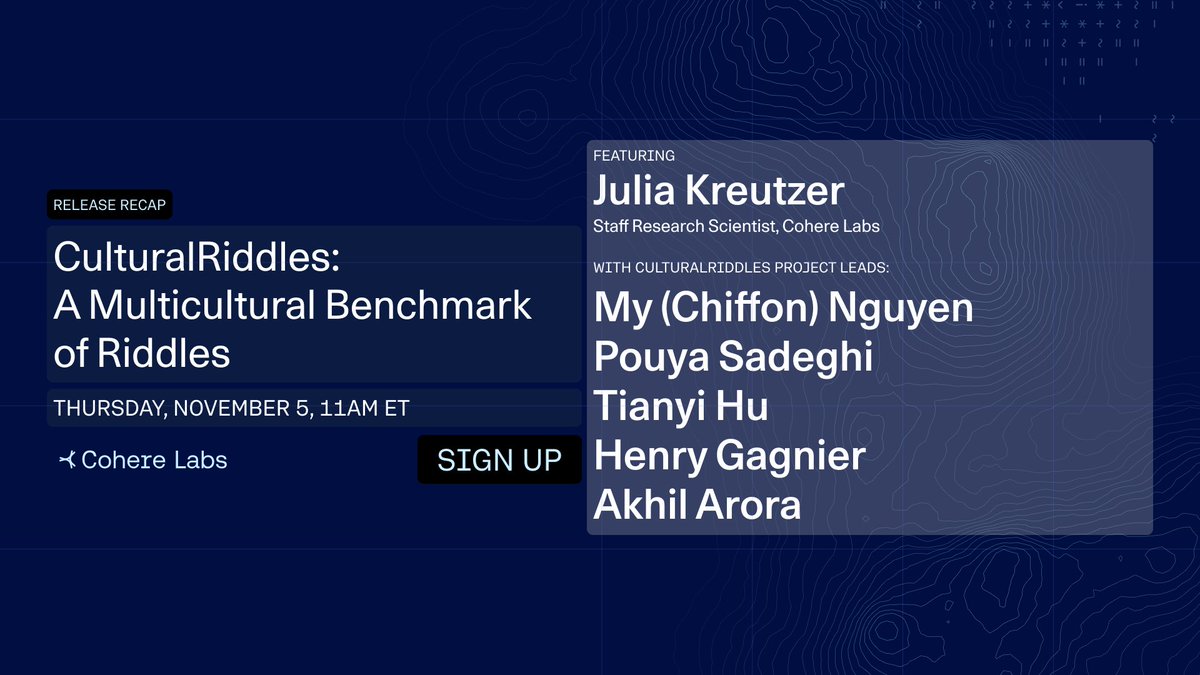
Tune in on November 5th to learn about the CulturalRiddles project and how this benchmark of 6,200 community-written riddles across 51 languages, spanning 45 countries was created to evaluate whether AI models can reason about the cultural context behind a question! 🧩
Join some of our project leads: @mychiffonn, @Ipouyall, Tianyi Hu, Henry Gagnier and @aroraakhilcs as well as, Julia Kreutzer (Staff Research Scientist, Cohere Labs) for a release recap covering the story behind the project, why it matters, and the key findings from our research.
Hear directly from the people who brought this global, community-driven effort to life!
📅 RSVP to join: https://t.co/vzfbSh3AGM
Learn more about the CulturalRiddles benchmark: https://t.co/LxQRBYgGJf
Curious about transforming AI models efficiently? ⚡
Anupam Nayak explores how model architecture can be changed late in training rather than remaining fixed after pretraining, catch the full talk: https://t.co/Jatn8kJhJQ
How can multi-agent systems boost efficiency while cutting costs? 🤔
@keenansamway, Research Scholar at Cohere Labs explores a novel approach to team construction in agent, resulting in a 70% cost reduction.
Watch the full session: https://t.co/NTcowuZ44O
Learn more in the blog post: https://t.co/glS9aDFUsU