Ultimate Beginners Guide to the Crypto Universe: A 21-Article Series
In the ever-evolving world of blockchain and cryptocurrency, staying updated is crucial. To aid both newcomers and seasoned crypto enthusiasts in their journey, we've meticulously written a 21-article series that dives into the subjects of Blockchain, Crypto and DeFi.
Chapter 1: Blockchain Basics
1: What is Blockchain? - The Digital Ledger Revolution https://t.co/He7FG6jEhJ
2: How Does Blockchain Work? - Nodes, Blocks, and Chains https://t.co/9jGuI9ZvwY
3: Types of Blockchain - Public, Private, and Consortium https://t.co/c1M2U11IMQ
4: Blockchain Security - How Safe is Your Block
https://t.co/jvMMvROzRW
5: Smart Contracts - The Digital Handshake
https://t.co/b1uzHqcRyO
6: Blockchain Use Cases - Beyond Just Bitcoin
https://t.co/M1F6EHPhn1
7: Blockchain's Limitations - It's Not All Rainbows and Unicorns https://t.co/9L9YfOfFL6
Chapter 2: Crypto Essentials
8: What is Cryptocurrency? - More Than Just Digital Dollars
https://t.co/xeHMDsMoJJ
9: How to Buy Cryptocurrency - Your First Steps into the Crypto World https://t.co/2iUfYcytVx
10: Crypto Wallets - Where to Keep Your Digital Treasures https://t.co/SkVkpOXYiU
11: Crypto Exchanges - The Marketplace of the Future https://t.co/PRPzWXDmdQ
12: Altcoins and Tokens - Bitcoin's Extended Family https://t.co/imvHUkZz8O
13: Mining and Staking - How to Earn Crypto
https://t.co/5HiEjtus8N
14: Crypto Taxes - Uncle Sam Wants His Share https://t.co/t2UGv8ssVY
Chapter 3: DeFi Introduction
15: What is DeFi? - Banking Without The Bank
https://t.co/3xpAh65fV1
16: Yield Farming - Harvesting Digital Crops
https://t.co/kBAFnZUhP0
17: Liquidity Pools - Dive In, The Water's Fine!
https://t.co/KNoK4N4SxD
18: Decentralized Exchanges (DEXs) - No Middleman? No Problem!
https://t.co/W87teKlhX9
19: Stablecoins - The Calm in Crypto's Turbulent Seas
https://t.co/Vl1nLmFfl5
20: NFTs - Digital Artistry and Beyond
https://t.co/SCEtf4JPRs
21: Risks and Rewards of DeFi - The Highs and Lows of Being Your Own Bank
https://t.co/qwTveBSXX5
I hope you were able to learn some of the Blockchain, Crypto and DeFi basics reading the above articles. Stay informed and keep learning if you want to continue navigating the world of crypto.
If you liked this, please let me know! Want to read more and stay informed? Give me a follow!
Unlocking The Value of Restaking with Eigen Layer
Introduction
Eigen Layer is a middleware protocol that lets software modules use Ethereum's secure network without needing their own validators.
It brings benefits like free-market governance, shared security, and faster ecosystem development. This adds value (and risks) to Ethereum. Actively Validated Services (AVS) built on top of @eigencloud are being developed and efforts are made to improve restaking token utilization and liquidity.
-----------
🔸PSA 🔸
If you want a more enjoyable reading experience that includes more visuals, relevant information and references, you can visit our newsletter by clicking the link in our bio, and you can also subscribe to it. 🙂
-----------
Understanding Eigen Layer Complexity
🔹🔸
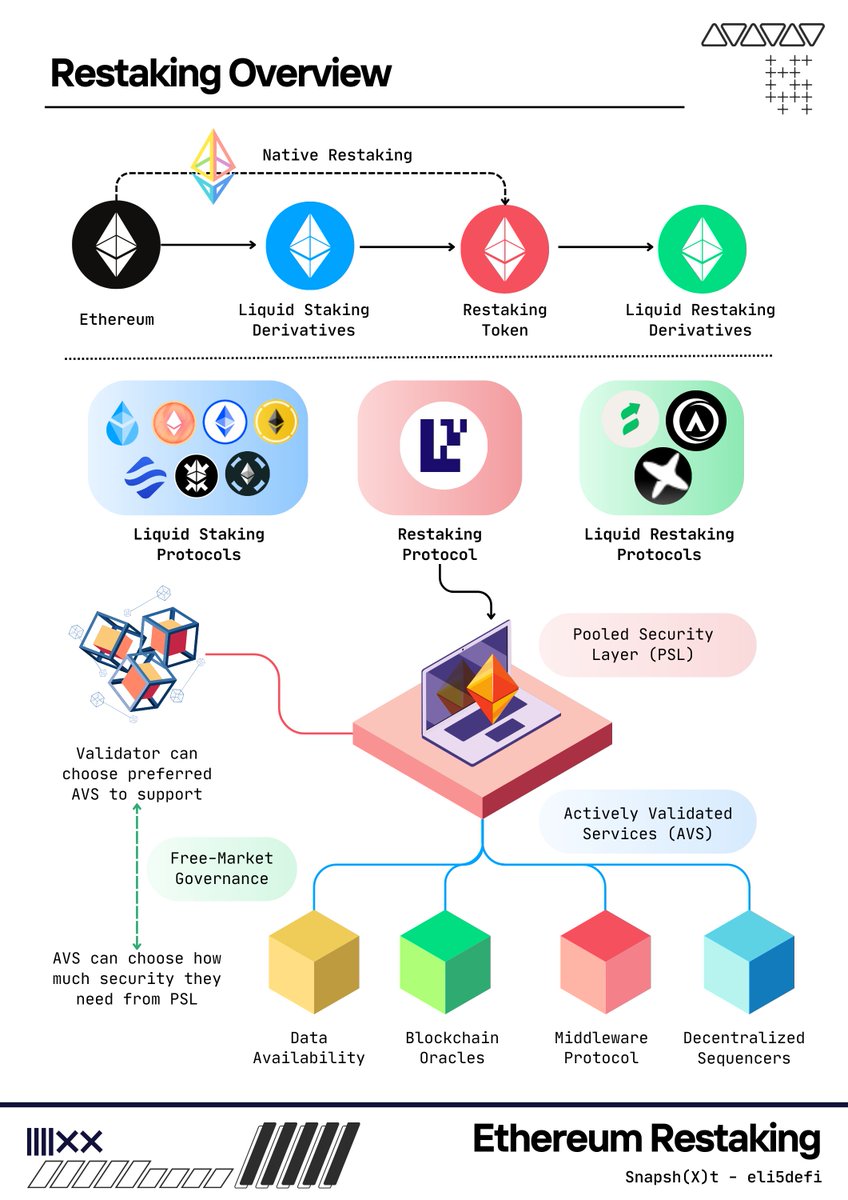
Eigen Layer is an @ethereum protocol that introduces restaking features. Restaking enables users to repurpose their $ETH on the consensus layer.
Users who stake $ETH directly or with a liquid staking token (LST) can choose to restake their $ETH or LST using Eigen Layer smart contracts.
How it Works?
Eigen Layer enables restaking by obtaining withdrawal credential rights for the staked $ETH through a smart contract. It penalizes validators who behave maliciously or fail to meet the necessary standards by deducting the staked $ETH.
🔹🔸
🔹🔸
Actively Validated Services (AVS)
Protocols that require their own distributed validation, known as Actively Validated Services (AVS), can access Eigen Layer's pooled security layer. AVS includes:
🔸 Sidechains
🔸 Data availability layers
🔸 New virtual machines
🔸 Keeper networks
🔸 Oracle networks
🔸 Bridges
🔸 Threshold cryptography schemes
🔸 Trusted execution environment
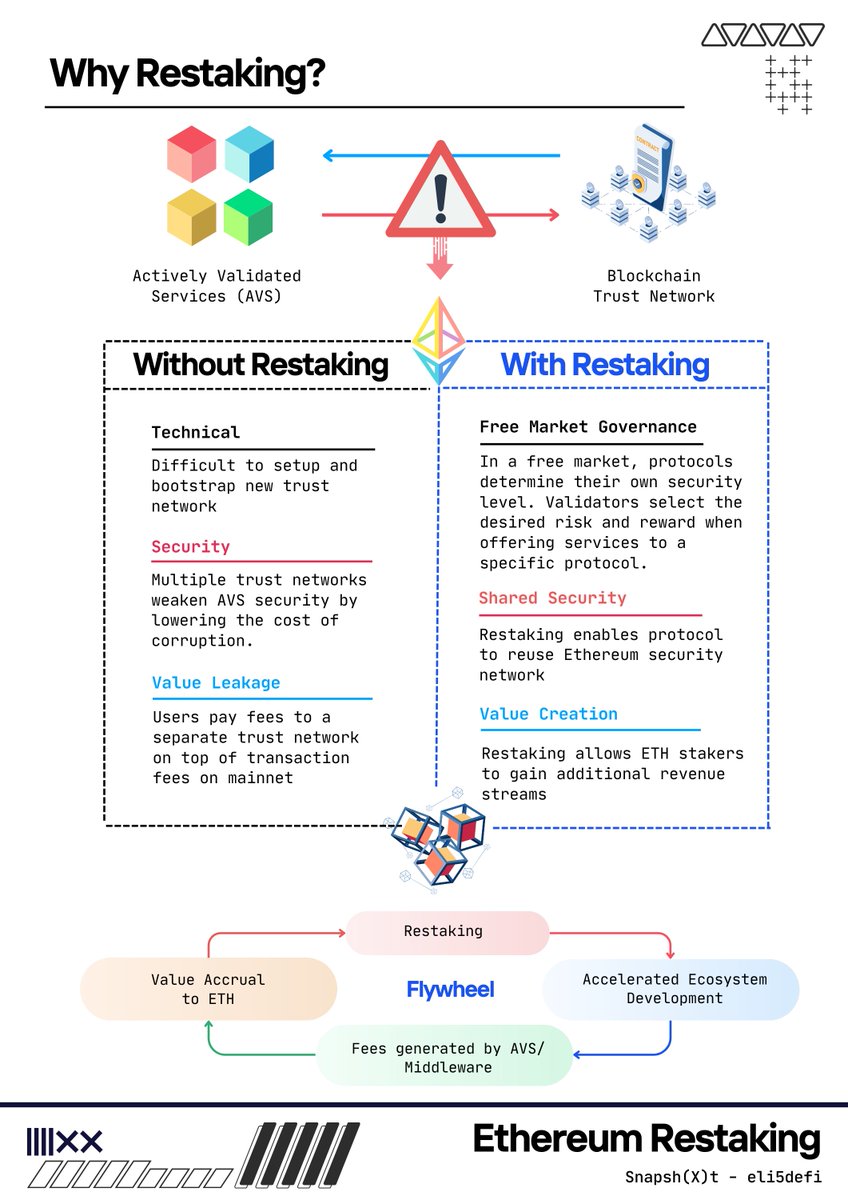
Previously, these AVS protocols were required to establish their own trust network and create smaller fragmented pools. This made them vulnerable targets for security breaches, as they had to shoulder the responsibility themselves.
With Eigen Layer Pooled security, AVS protocols can rely on the trust network provided by the Ethereum network without having to create their own validators.
🔹🔸
What Are The Benefits of Restaking?
The Eigen Layer restaking infrastructure attempted to address these issues in the following ways:
🔸Free Market Governance: In a free market, AVS protocols set their own security level based on their resources and development stage. Validators can choose the risk and reward when serving a specific protocol.
🔸Shared Security: Restaking allows the protocol to use Ethereum's security network, which has the largest validators and a strong security infrastructure.
🔸Value Creation: Restaking boosts earnings for $ETH stakers, benefiting validators and stakeholders.
🔹🔸
🔹🔸
What Are The Risks of Restaking?
Restaking is not without risks, for the protocols and users there will be risks and exposure below:
🔹Security Risk: Stakers may lose their $ETH collateral due to smart contract vulnerabilities and bugs.
🔹Rehypothetication Risk: The failure of any validators can impact all protocols that depend on shared security.
🔹Underwriting Risk: To reduce the risk of losing their restaked $ETH, validators should carefully assess protocols before validating them.
🔹Collusion Risk: Collaboration among malicious validators could lead to majority control and pose a security threat to a protocol.
🔹Centralization Risk: Eigen Layer enables AVS and validators to choose freely. Validators may prefer the protocol with the highest yield for more profit. As a result, protocols will compete for higher yields and investments, potentially leading to centralization risk and increased fees for AVS using Eigen Layer.
🔹🔸
Systemic Concerns
Ethereum co-founder @VitalikButerin is concerned about the risk of having a large group of validators on the same network.
This could lead to slashing, attacks, or hacks, which may destabilize Ethereum. @sreeramkannan from the Eigen Layer is aware of these risks and plans to deal with them.
🔹🔸
🔹🔸
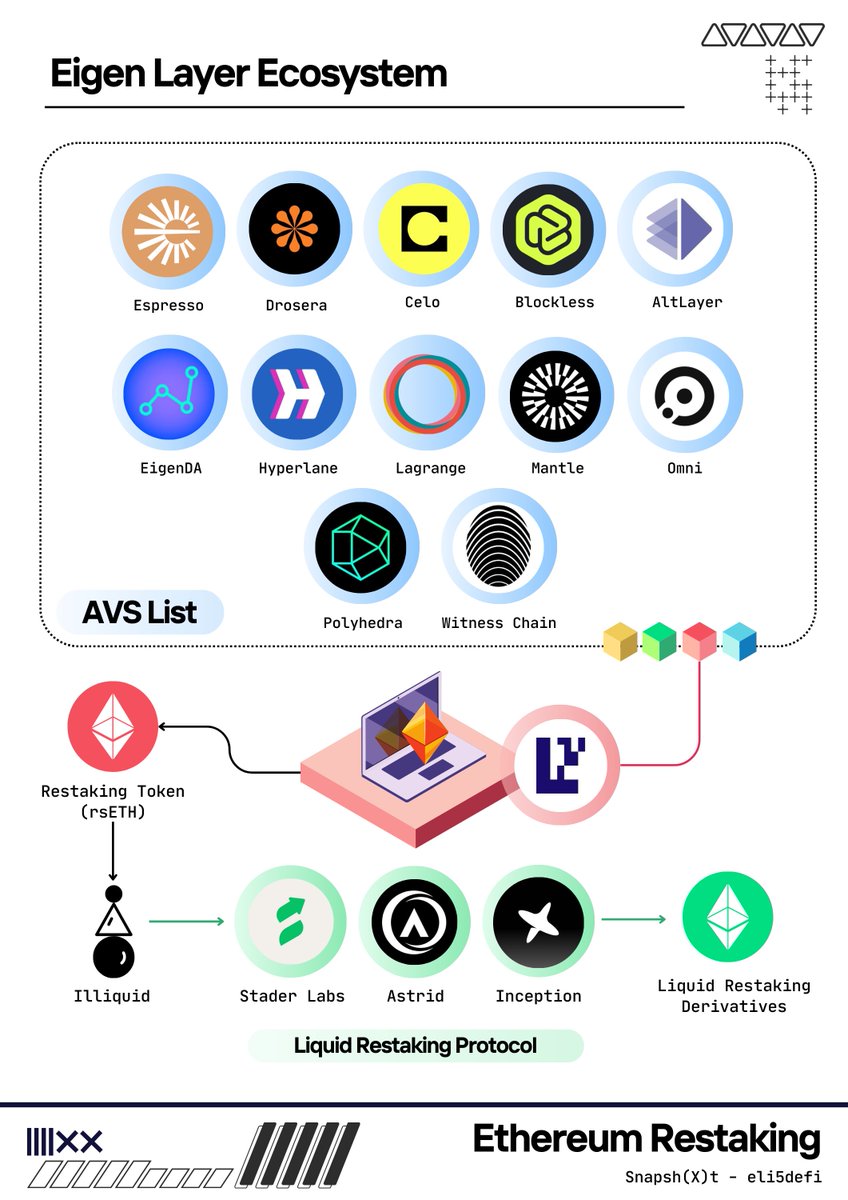
Eigen Layer Ecosystem
Several projects have been built using the Eigen Layer infrastructure, creating an innovative ecosystem that emphasizes modularity. These projects include:
🔸 EigenDA
🔸 @EspressoSys
🔸 @DroseraNetwork
🔸 @CeloOrg
🔸 @theblockless
🔸 @alt_layer
🔸 @Hyperlane_xyz
🔸 @lagrangedev
🔸 @0xMantle
🔸 @OmniFDN
🔸 @PolyhedraZK
🔸 @witnesschain
🔹🔸
🔹🔸
Liquid Restaking Protocols
The Eigen Layer tech brings advancements, but concerns exist around being a validator for free-market governance, reward cuts, and illiquid restaked tokens.
To address this, projects aim to create liquid restaked tokens. This simplifies the process, offers higher yields, and boosts asset productivity.
However, it introduces extra risk by leveraging the underlying asset. The following protocols are live on the testnet:
🔹 @staderlabs
🔹 @AstridFinance
🔹 @InceptionLST
The AVS project could boost their protocols using LRTs because they are cost-effective and readily available. But we need to see if it will actually happen. We're excited to find out.
🔹🔸
That’s a Wrap and Thank You!
I'm working on improving this post and my content - would love to hear your thoughts on what you'd like to see more of. Thank you for reading!
----------
Disclaimer:
None of the content in this post should be interpreted as financial or tax advise.
----------
I want to mention and thank my fellow DeFi Educators who inspire me and consistently provide valuable educational resources!
They are definitely MUST follow!
- @rektdiomedes
- @JiraiyaReal
- @blocmates
- @NickDrakon
- @crypto_linn
- @DefiIgnas
- @0xCrypto_doctor
- @stakedqueen
- @andyyy
- @Only1temmy
- @CryptoShiro_
- @Flowslikeosmo
- @poopmandefi
- @2lambro
- @0xsurferboy
- @DAdvisoor
- @stacy_muur
- @splinter0n
- @arndxt_xo
- @0xTindorr
NFTs - Digital Artistry and Beyond
Explaining Blockchain, Crypto, and DeFi 20 of 21
In the huge universe of cryptocurrencies, a star that's been shining in the background has been bursting into the limelight. This star is the Non-Fungible Token, or NFT. While they've been part of the crypto landscape for a while, recent events have catapulted NFTs to the forefront of the digital art and collectibles world. But what exactly are NFTs, and why have they suddenly captured the world's attention? Let's dive deep into the pixelated world of digital artistry and beyond.
What are NFTs?
NFTs, or Non-Fungible Tokens, represent unique digital assets verified using blockchain technology. Unlike cryptocurrencies such as Bitcoin or Ethereum, which are fungible and can be exchanged on a one-for-one basis, NFTs are distinct and cannot be exchanged on a like-for-like basis. This uniqueness and indivisibility make them particularly suitable for representing rare and collectible items in the digital realm.
The Rise of Digital Artistry
One of the most notable applications of NFTs has been in the world of digital art. Artists can tokenize their creations, ensuring that each piece is one-of-a-kind. This has opened up new revenue streams for artists, allowing them to sell their art directly to enthusiasts without the need for intermediaries. Moreover, artists can also program royalties, ensuring they earn a percentage of sales whenever their art is resold.
Beyond Art: The Expanding Universe of NFTs
While art is a significant component, NFTs span a broader range of applications:
Collectibles: From virtual trading cards to digital pets, NFTs have rejuvenated the world of collectibles.
Virtual Real Estate: Platforms like @decentraland allow users to buy, develop, and sell parcels of virtual land.
Gaming: In-game items, characters, and skins can be tokenized as NFTs, giving them tangible value and tradeability outside the game.
Music and Entertainment: Musicians and entertainers are tokenizing albums, tracks, podcasts (@bankless) and even experiences, providing a new avenue for fan engagement.
The Challenges and Criticisms
NFTs aren't without their challenges:
Environmental Concerns: The energy consumption has raised some environmental concerns. The concerns mainly arises from the energy-intensive proof-of-work consensus mechanism used by some blockchains.
Market Volatility: The NFT market is highly speculative, with prices soaring and/or plummeting rapidly leaving buyers with NFT's with zero monetary value. Like always, do your own research, make sure to know what you buy.
Copyright Issues: As with any digital content, NFTs face challenges related to copyright infringements and authenticity.
In Conclusion
NFTs have transformed the way we perceive digital ownership, offering artists, gamers, and collectors and creators in general a platform to monetize and trade unique digital assets. As the technology matures and becomes more accessible, the potential applications for NFTs are boundless. However, as with all innovations, it's essential to approach with a blend of enthusiasm and caution.
Stay tuned for our next article, "Risks and Rewards of DeFi - The Highs and Lows of Being Your Own Bank," where we'll delve into the potential pitfalls and monumental rewards of diving headfirst into the DeFi world.
Missed our previous articles? Catch up with our recap of the first 2 weeks: https://t.co/AnwiZt9POi
Looking for the last published article (19 of 21)? Dive into Stablecoins here: https://t.co/Vl1nLmFfl5
A big thank you to these guys, supporting the crypto community. If you are looking to learn more on crypto and DeFi, consider giving these chads a follow:
@0xFitz, @0xTindorr, @thesaint_, @0xsurferboy, @CryptoHayes, @0xCrypto_doctor, @wauwda, @CryptoKoryo, @fitforcrypto_, @ErikVoorhees, @jediblocmates, @ThorHartvigsen, @DAdvisoor, @RiddlerDeFi, @VitalikButerin, @Flowslikeosmo, @andyyy, @gandalfcryptto, @Louround_, @WinterSoldierxz, @AlphaCryptOmega, @madapescall, @0xthade, @BlocksNThoughts, @CryptoKaduna, @2lambro, @cz_binance, @Only1temmy, @21blacky, @CrossChainAlex, @18decimals, @rektdiomedes, @louiscooper_, @Tanaka_L2, @ChadCaff, @crypto_linn, @blocmates, @eli5defi, @arndxt_xo, @hooeem, @CryptoStreamHub, @coincatalysts, @DefiIgnas, @splinter0n, @defi_mochi
Stablecoins - The Calm in Crypto's Turbulent Seas
Explaining Blockchain, Crypto, and DeFi 19 of 21
In the dynamic world of cryptocurrencies, where prices can swing wildly, stablecoins offer a refreshing sense of stability. These digital assets have become the backbone of many crypto transactions, ensuring a steady value amidst market fluctuations. But what gives stablecoins their stability, and why are they becoming increasingly popular? Let's dive in.
What Are Stablecoins?
Stablecoins are a type of cryptocurrency designed to have a stable value, as opposed to the significant volatility seen in most cryptocurrencies. They achieve this stability by being pegged to a reserve or basket of goods. This could be traditional currencies like the US dollar, commodities like gold, or even other cryptocurrencies. The idea is to combine the benefits of digital currency, such as fast transactions and privacy, with the stability of traditional currencies. They serve various purposes, from being a safe haven in the crypto market to facilitating trade on decentralized exchanges without volatile price swings.
The Mechanics Behind Stablecoins
Fiat-Collateralized: These stablecoins are backed 1:1 by reserves of fiat currency. For every coin issued, there's a corresponding dollar in a bank, acting as a safety net. A example is USDC (@circle), which is pegged to the US dollar and backed by actual dollars held in reserve.
Crypto-Collateralized: Backed by other cryptocurrencies, such as Ether, these maintain stability through mechanisms that ensure their value remains consistent. DAI (@MakerDAO) is a notable example of this type, as it's over-collateralized with Ether to maintain its peg to the US dollar.
Algorithmic: These stablecoins aren't backed by any collateral. Instead, they use algorithms to adjust their supply based on demand, aiming to maintain a stable price. Ampleforth (@AmpleforthOrg) is an example of an algorithmic stablecoin that adjusts its supply daily based on market conditions.
The Advantages of Stablecoins
Price Stability: As the name suggests, stablecoins offer a refuge from the dramatic price swings of other cryptos.
Efficient Transfers: They combine the benefits of cryptocurrency transfers with the predictability of traditional currencies.
Gateway to DeFi: For many, stablecoins are the entry point to the DeFi ecosystem, enabling users to earn interest or secure loans.
Challenges Facing Stablecoins
Regulatory Scrutiny: With ties to traditional financial systems, stablecoins often attract regulatory attention. As they become more mainstream, there's potential for increased oversight and regulation, which could impact their adoption and use.
Collateral Concerns: Trust is essential. If a stablecoin is backed by reserves, how often are these reserves checked and audited? The solvency of the backing assets is crucial, and any discrepancies can undermine confidence in the coin.
Market Trust: The value of a stablecoin isn't just about its backing but also how the market perceives it. A loss of faith in a particular stablecoin can lead to rapid devaluation, even if its collateral remains intact.
Inherent Risks: Like all cryptocurrencies, stablecoins are not entirely risk-free. While they aim to maintain a stable value, external factors such as market crashes, technological vulnerabilities, or sudden regulatory changes can introduce volatility.
In Conclusion
Stablecoins play a pivotal role in the crypto landscape, offering a balance between the digital and traditional financial worlds. They provide stability and reliability, essential for the broader adoption of cryptocurrencies. However, as with all investments, due diligence is crucial.
Missed our previous articles? Catch up with our recap of the first 2 weeks: https://t.co/AnwiZt9POi
Looking for the last published article (18 of 21)? Dive into Decentralized Exchanges here:
https://t.co/W87teKlhX9
A big thank you to these guys, supporting the crypto community. If you are looking to learn more on crypto and DeFi, give these chads a follow:
@0xthade, @VitalikButerin, @0xFitz, @CryptoHayes, @jediblocmates, @Kurapika_DAO, @0xsurferboy, @louiscooper_, @0xTindorr, @thesaint_, @CryptoKaduna, @ThorHartvigsen, @Flowslikeosmo, @ErikVoorhees, @wauwda, @AlphaCryptOmega, @RiddlerDeFi, @DAdvisoor, @madapescall, @CrossChainAlex, @18decimals, @BlocksNThoughts, @coincatalysts, @2lambro, @gandalfcryptto, @DefiIgnas, @Louround_, @blocmates, @CryptoKoryo, @fitforcrypto_, @Only1temmy, @cz_binance, @21blacky, @0xCrypto_doctor, @rektdiomedes, @splinter0n, @WinterSoldierxz, @Tanaka_L2, @ChadCaff, @crypto_linn, @andyyy, @eli5defi, @arndxt_xo, @hooeem, @CryptoStreamHub, @defi_mochi
Stay tuned for our next article, "NFTs - Digital Artistry and Beyond," where we'll explore the captivating world of Non-Fungible Tokens.