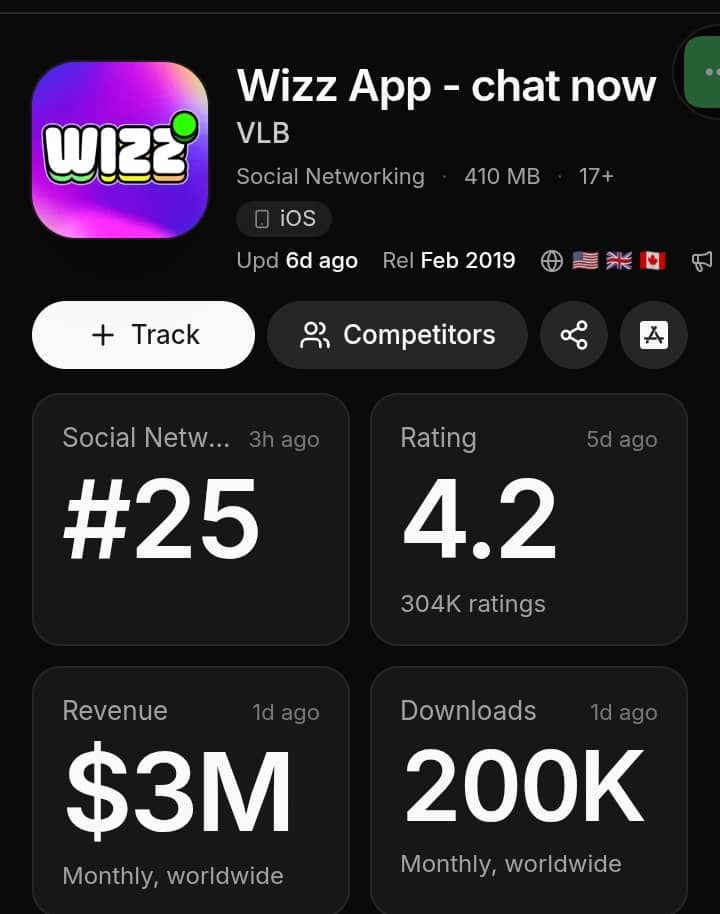
Holy sh*t. A 15-second UGC video just hit 1M views for an app that already does $3M a month
Here's the breakdown
The concept
→ Opens in black and white: "my life was black and white before I met WIZZ"
→ Cuts to color: "Wizz was the colour"
→ Screen demo on an iPad: swipe left, meet people, send a "Hey"
→ Under 15 seconds, no talking, just text on screen
Why it works
→ The B&W to color switch is a visual hook. You stop scrolling to see the change
→ It sells a feeling (a boring life, then a fun one), not a feature list
→ The demo shows the whole product in 3 taps, so there's nothing to figure out
→ The creator looks like a real person on a real desk, not an ad
How repeatable is it?
Very. The hook costs almost nothing to shoot. You need one creator, one device, and a "before vs. after" line
Examples for other apps
→ Fitness app: gray, tired mornings → color after the first workout
→ Finance app: stressed, messy bills → a clean dashboard
→ Learning app: boring study sessions → quiz streak unlocked
The numbers behind it
→ #25 in Social Networking
→ 4.2 rating from 304K reviews
→ 200K downloads a month, $3M monthly revenue
Content like this is part of how apps scale, not a side effect
Want this for your brand?
DM me "UGC" and I'll show you how we build videos like this for your product at our agency, from the hook to the creator to the edit.
Your UGC ads might not be underperforming because of the creator
Sometimes, the problem is the brief
Think about it
If you tell a creator to simply make an engaging video, what exactly are they supposed to communicate?
What problem should they address?
What makes the product worth buying?
What should viewers understand within the first few seconds?
A good UGC brief doesn't just tell creators what to film. It gives them the direction they need to communicate the product's value without making the content feel like a scripted advertisement
Better briefs create room for better creatives
If your brand needs help developing creator-led content that communicates value and drives action, let's talk. DM me "UGC".
Your brand doesn't necessarily need more influencers
It might need a better creator marketing strategy
Before launching your next creator campaign, you might want to consider these 5 things:
📌The right creators: Are they reaching the audience you actually want to attract?
📌 Content direction: Do they understand the message your brand wants to communicate?
📌Creative freedom: Are you allowing creators to make content that feels natural to their audience?
📌Content usage: Have you considered how you'll repurpose the content for your marketing campaigns?
📌 Performance tracking: Do you have a way to measure what each collaboration contributes to your goals?
Finding creators is only one part of the process
Building a campaign that turns creator content into a marketing asset is where the real work begins
We help brands plan and execute creator campaigns, from finding suitable creators to coordinating collaborations and developing content that supports their marketing goals
Looking to launch a creator campaign for your brand? Send us a DM. Let's discuss your next campaign
This relationship app makes $20K a month, and its content is just a guy on a video call walking through a store
The concept:
→ Text on screen: "my ldr bf taking me shopping with him:"
→ The video is a real video call, with him walking the aisles and showing her snacks and drinks
→ The last 2 seconds show a location check-in screenshot, and that is the only app mention
→ The app is Couple360, which gets 40K downloads a month
Why it works:
→ The caption is a situation long-distance couples already live, so viewers relate and tag their partners
→ It looks like a real moment, not an ad
→ The app only appears at the end as proof, so nobody scrolls past a pitch
→ Relationship content is emotional, which drives saves, shares and comments
How repeatable is it?
Very. There is no script and no actor to hire. You need a relatable situation, a believable creator, and a soft product reveal at the end
Examples for other apps:
→ Budgeting app: "my bf finally splitting bills with me:" with the budget tracker at the end
→ Fitness app: "my gym partner texting me 'we're going tomorrow'" with the workout log at the end
→ Study app: "my roommate actually locked in for finals:" with the study planner at the end
Want content like this for your app? DM me "UGC" and I'll show you how we build UGC that gets views and turns them into downloads
holy sh*t, a 13-second selfie video filmed in a parked car just pulled 966.9K views
the app is Everand (by Scribd), an audiobooks and ebooks app (#32 in Books, 4.3 rating from 27K ratings, ~40K downloads a month and an estimated $1M in monthly revenue)
and the video isn't an ad, it's a girl talking to her phone like she's sending a voice note to a friend
here's the concept:
-> she's sitting in a parked car, hoodie on, glasses on, daylight through the window
-> one take, straight to camera, no b-roll, no studio, no graphics
-> she talks fast and casual, with real facial reactions and hand gestures
-> she finishes with a little wave, like signing off a call with a friend
people watch to the end because it feels like a tip from someone they know, not a brand. the car is the hook: everyone has seen a friend rant in a parked car, so nobody scrolls past thinking "ad." there's no polish to distrust, and at 13 seconds the video is over before they can get bored.
and the best part is
how easy it is to repeat:
-> one location people already recognise (the car)
-> one person, one phone, one take
-> same casual "friend telling you something" format, new topic every video
-> no editing skills, no budget, just a real voice
you can do the same for almost any product:
-> a design tool: sit in your car and say "a client just sent me a brief, here's how I get 3 logo directions in 60 seconds"
-> a project management tool: "my team starts a new project every week, here's the one thing I do first so nothing gets missed"
-> a job platform: "I found a role I wanted, here's how I checked my CV against it before applying"
a familiar setting, a real person, one useful thing said fast, and a wave goodbye.
DM me "UGC" and I'll show you how we build a video system like this for your brand, from the idea to the posting.
Most businesses don't need more AI tools.
They need to learn how to use the tools they already have to solve actual business problems.
Here are some ways AI can make your marketing more efficient:
📌Use AI to research your target audience and understand their pain points.
📌 Automate repetitive customer enquiries.
📌Generate content ideas based on your audience's interests.
📌Analyse campaign performance to identify what's working.
📌Use automation to nurture leads instead of manually following up with everyone.
The goal isn't to replace your marketing team with AI.
It's to give your team more time to focus on strategy, creativity and growth.
Got it?
One product doesn't have to mean one advertising message.
If you're creating UGC ads for a brand, don't limit your creative strategy to saying the same thing in five different ways.
Explore different reasons your target audience might be interested in the product.
For example, a project management app can be marketed through:
📌The pain point: How frustrating it is to manage multiple tasks.
📌 The team problem: How difficult it can be to keep everyone organised.
📌 The time-saving benefit: How the product can simplify repetitive tasks.
📌 The progress tracker: How users can monitor their projects and deadlines.
📌 The productivity angle: How the product can help users organise their work more efficiently.
Same product. Different problems, motivations and reasons to consider buying.
This gives you more creative directions to explore and helps you understand which messages resonate with your target audience.
The important thing is to ensure each angle reflects a genuine product benefit.
Don't just ask creators to make more videos. Give them different stories and perspectives to communicate.
If you're planning your next UGC campaign, this is something worth considering.
Which of these five angles would you test first?
A marketing message can be perfectly translated and still fail to connect with the people you're trying to reach.
Why?
Because speaking the same language doesn't necessarily mean sharing the same cultural context.
Think about a brand expanding into a new market.
Simply translating its existing advertisements might not be enough.
The examples, expressions, buying motivations and even the way the product is positioned may need to change.
This is where AI can be useful.
You can use it to develop alternative marketing messages for different markets, adapt examples to local contexts and explore different ways of communicating your product's value.
But don't stop at the generated output.
Review the content for:
📌Cultural relevance
📌Natural expressions and local language
📌Currency, measurements and pricing
📌Shipping and product availability claims
📌Whether the message actually resonates with the intended audience
AI can help you move faster, but understanding the local audience still matters.
If your brand wants to reach a new market, don't just translate your message. Make sure it connects
Your UGC ad shouldn't just tell people why they need your product.
It should also address why they might hesitate to buy it.
Think about the questions running through a potential customer's mind:
📌Is it worth the price?
📌Will it actually work for me?
📌Is it difficult to use?
📌How is it different from other options?
These are buying objections, and your creative strategy should take them seriously.
Instead of creating another video filled with generic product praise, build content around the concerns your target audience already has.
Let the creator address one specific hesitation naturally and honestly.
Sometimes, the most persuasive content isn't the one that says the most about a product.
It's the one that answers the question stopping someone from buying.
a 6-second video of a girl staring at the camera just pulled 217K views
the app behind it is Aspect, an AI-only social media app (#100 in Social Networking, 4.5 rating from 11K ratings, ~50K downloads a month and an estimated $200K in monthly revenue)
and the app never appears in the video. it's just a question.
here's the concept:
-> she sits there with a tired, straight-to-camera look, no music, no edit
-> one line of text on screen: "people who use cai, chai, aspect, etc, what is the scariest thing your bot has ever said to you?"
-> that's the whole video
it works because:
-> the question is a hook and a CTA at once, so everyone who watches has a reason to comment
-> the comments are the content: people share their own stories, which pushes the video to even more people
-> she names three apps, so users of each one feel personally called out
-> "scariest" is a curiosity trigger, and it's short enough to read in 2 seconds and watch on loop
-> it doesn't feel like an ad, it feels like someone asking her community a real question
and it's very easy to repeat:
-> one question your exact audience already has stories about
-> a face, a phone and a single line of text
-> same format, new question every video
-> no product demo, no script, no budget
you can do the same for almost any product:
-> a design tool: "freelancers, what's the worst client feedback you've ever gotten on a logo?"
-> a project management tool: "team leads, what's the most chaotic way a project has ever fallen apart?"
-> a job platform: "job seekers, what's the weirdest thing a recruiter has ever said to you?"
a question your audience can't resist answering, one face on screen, and the comments do the marketing.
DM me "UGC" and I'll show you how we build a content system like this for your brand, from the idea to the posting.