The biggest satellite network on Earth is reportedly shopping for 80,000 cell towers.
Because even from space, indoors is the hard part.
Satellites cover the map. Towers cover the city. Inside the building is where Helium comes in: turning the Wi-Fi already on the walls of hospitals, stadiums and grocery stores etc, into carrier-grade coverage.
No new towers. No new spectrum. Just the network that’s already there.
https://t.co/jMWiR2XeMr
‼️RLUSD WAS NEVER CREATED TO REPLACE XRP‼️
RLUSD and XRP were never doing the same job.
RLUSD holds the value. XRP moves the value.
Each one expands what the other can do.✅
Stablecoins create the traffic. The traffic creates the need for the bridge. 🌉
Full breakdown in the video below. 💨
https://t.co/JNeHyErmqH is not affected by the cybersecurity attack on Binance. The https://t.co/JNeHyErmqH platform is operating as usual and all funds are safe.
Our teams are actively blocking any addresses connected to the hack. We reached out to Binance to offer help.
Bigger phones mean bigger data appetites. The iPhone Duo launches today with a 7.6-inch screen, and most of what people watch on it will be indoors. Helium offload turns the Wi-Fi already in those buildings into coverage, serving more than a million people a day.
https://t.co/fP9p48cv9U
Who’s your API’s next paying customer?
Possibly an AI agent with a job to finish. Your service could be its next stop.
With x402 in the Casper AI Toolkit, agents can pay per request as they work.
Build for that customer 👇
https://t.co/QwX94qaWfk
Just showed this video to my colleague and he can’t believe the car just flipped 😂. In today’s AI/SI world everyone is questioning every videos and photos. It’s getting difficult to convinced people it’s real 🤣..
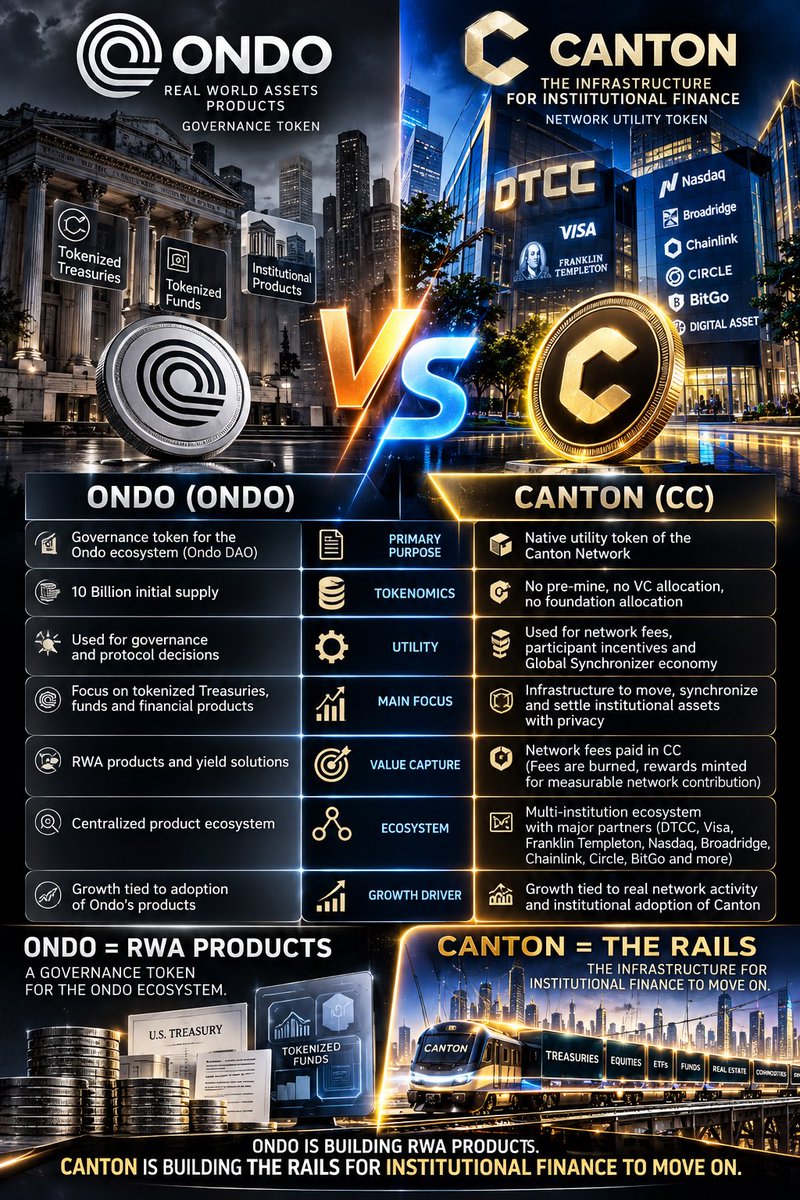
People keep comparing $ONDO and $CC because both are connected to the RWA narrative.
But look closer.
$ONDO = governance token for the Ondo ecosystem.
$CC = the native utility token powering Canton’s Global Synchronizer — the infrastructure designed to move, synchronize and settle institutional assets with privacy.
That distinction matters.
Canton didn’t just create a token and attach an RWA narrative to it.
The network designed an economic model around actual network activity:
→ Fees are paid in $CC
→ Network fees are burned
→ Participants earn $CC for contributing utility
→ No VC allocation
→ No pre-mine
→ No foundation allocation
→ Rewards are tied to network activity
And the institutional story is getting serious.
DTCC is preparing its Tokenization Service on Canton, with tokenized Treasuries, equities and ETFs coming into the infrastructure. (Canton Network)
I’m not saying $ONDO is a bad project.
I’m saying $CC is playing a different game.
ONDO is building RWA products.
Canton is building the financial infrastructure those assets can move and settle on.
$ONDO vs $CC
Governance token vs network utility.
Product vs infrastructure.
The market hasn’t fully appreciated that difference yet.
#Canton #CC #ONDO #RWA #Tokenization
The Global Synchronizer keeps transactions on Canton in order.
It also has no idea what any of them say.
It receives encrypted messages, timestamps them, orders them, and routes them to the right recipients. Transaction contents get validated by the participant nodes actually involved, not by the synchronizer.
Which means the Super Validators operating the most critical piece of shared infrastructure on the network are moving data they fundamentally cannot read.
DTCC's Digital Assets Solutions Industry Working Group spans banks, asset managers, and infrastructure providers.
Kaiko has joined, bringing a data infrastructure perspective on compliant pricing for onchain markets and connecting post-trade messaging to onchain workflows.
Carriers spend billions building outdoor networks. But 80% of mobile data is consumed indoors.
That gap is not a technical failure. It is a structural one. Walls, floors, and RF physics mean macro towers will never fully solve indoor coverage. This is not a new problem. It is just one the industry has been slow to confront.
Wi-Fi offload changes the math. When a phone moves onto a trusted Wi-Fi network, it frees up licensed spectrum and reduces load on the macro layer. For carriers, that is real capacity relief without new infrastructure spending.
The harder question is scale. Building out indoor coverage from scratch is expensive. But millions of Wi-Fi access points already exist in homes, offices, and venues. Brownfield deployments, working with what is already there, are where the real opportunity lives.
Helium is built for exactly that. The Helium Network turns existing Wi-Fi infrastructure into carrier-grade coverage. People who already have Hotspots deployed can extend their value. No new builds required.
Read more about how Wi-Fi offload and people-built infrastructure are reshaping indoor mobile coverage: https://t.co/2SBapRYGX3
Full bars, no service. The most common connectivity complaint in large venues has one cause: DAS plant specified in 2011 that passes only a fraction of the spectrum today's phones use.
Typical venue DAS: 81% of the spectrum phones are built for. Never upgraded: 18%.
Why, and what to do: https://t.co/V35Ibpkbx3
It’s official! The merger vote passed. ✅@evernorthxrp and @ashgoblue are advancing a massive $473M ripple:native treasury strategy, paving the way for landmark corporate ripple:native adoption! 🙌
The Setup interview - https://t.co/mbzOcIrBkk