TOPIC #95: CAN PI BECOME A STBLECOIN?
**PI NETWORK NEWS: BREAKING NEWS: Dr. Nicolas Kokkalis – Founder of Pi Network to Speak at the World’s Leading Blockchain Conference!**
Dr. Nicolas will officially speak at Consensus 2025, one of the world’s most prestigious blockchain events organized by Coindesk. His talk will focus on integrating Artificial Intelligence (AI) with blockchain infrastructure to unlock mass adoption. This is expected to be a major highlight not just for the Pi community, but for the global blockchain industry. This event marks a significant milestone for Pi Network, showcasing it on the global stage alongside leading names in technology and innovation.
I browsed the agenda and found that many speakers from the cryptocurrency and exchange markets will discuss stablecoins. Notable speakers include Mr. Mark Greenberg, Global Head of Consumer at Kraken, and Mr. Jack McDonald, SVP of Stablecoins at Ripple, who will present on "The New Era of Stablecoins: Insights from Kraken and Ripple." There will also be a Crypto Lawyer Roundtable addressing where crypto regulations go from here, covering U.S. Crypto Policy and how stablecoins are shaping the future of payments. With more than one hundred speakers expected, the event will bring together over 15,000 industry leaders, developers, and innovators to explore the future of technology.
Since 2015, Consensus has been a leading event where top minds in blockchain, Web3, and AI come together to drive innovation. The Toronto 2025 edition will feature groundbreaking discussions, networking opportunities, and hands-on experiences that will, as a result, shape the future of these industries.
Given Pi Network's goal to become a mainstream currency, we cannot achieve this aim in one step. I believe that stablecoins status could serve as a bridge between traditional cryptocurrencies status and real currency status. To help pioneers understand what stablecoins are, I conducted some research, and I would like to share my findings. From my perspective, Pi Network is taking a different path compared to traditional cryptocurrencies and possibly another path from current stablecoins. The following information is for reference only; I see a high possibility that Pi operates as an algorithmic stablecoin to manage its supply. This approach can be risky since it depends on market confidence and does not involve physical backing. However, achieving price stability has proven challenging for many projects, and not all stablecoin initiatives have succeeded in this endeavor. Therefore, it is crucial for GCV education and the ecosystem to support this market confidence, as it will be one of the evaluation factors if Pi Network applies for stablecoin status.
**Associated Risks**
Systemic failure is the greatest risk associated with algorithmic stablecoins. The rebasing system may fail to maintain the peg altogether. For example, in May 2022, the $18 billion algorithmic stablecoin TerraUSD (UST) faced a catastrophic meltdown. In what seemed to be a targeted attack preceding a series of disastrous events, the UST stablecoin lost its peg, and the native LUNA token plummeted by 96% in a single day, erasing $28 billion from the Terra ecosystem.
In summary, it is hard to overstate the significance of stablecoins in the cryptocurrency ecosystem. They act as a bridge to traditional finance, facilitate cross-border payments, and provide a fully collateralized, crypto-based medium of exchange with a stable value. Various types of stablecoins are essential for decentralized finance, but investors should carefully consider how they function and the associated risks before investing.
Currently, there are approximately 200 stablecoins distributed globally. Some of the most popular stablecoins are issued directly by exchanges, such as USD Coin (USDC), Pax Dollar (USDP), Binance Dollar (BUSD), and Gemini Dollar (GUSD).
The stablecoins market is exceptionally diverse, with leading options like USDC and USDT standing out for their broad utility and consistent value relative to the U.S. dollar. These stablecoins are pivotal for both individual users and enterprises due to their reliability and liquidity.
**Advantages of Using Stablecoins **
One of the main advantages of stablecoins is their ability to provide stability in the typically volatile cryptocurrency environment. Unlike traditional digital assets, stablecoins maintain a consistent value, reducing the risks associated with price fluctuations. This stability is especially appealing to businesses and individuals who want to process transactions without the uncertainty of volatility. For further insights into the benefits and potential limitations of stablecoins, additional information is available.
"Stablecoins also deliver significant cost savings, particularly for cross-border transfers. 'Stablecoins can drastically reduce transaction fees, especially for international transfers,' notes Alisha Chhangani, a researcher at the Atlantic Council. This reduction in costs is crucial for global enterprises, allowing them to reallocate resources more strategically."
Speed is another key benefit. Stablecoin transactions are typically completed within minutes, regardless of the participants' locations. Such rapid settlements are essential for businesses operating in today's fast-paced financial environment.
What is the path for Pi Network to become a stablecoin in the exchange market? Pi Network has been designed as a currency, and we have an enclosed mainnet for three years. This sets us apart from other cryptocurrencies and stablecoins.
Why do we have this three-year period in the enclosed mainnet? It is because the GCV was established, along with the GCV ecosystem, GCV Ambassadors, and the GCV community. These elements help build strong market confidence. Currently, we have 1.8 billion Pi available, but most pioneers don't sell their Pi on the exchange market; only about 20% are selling on exchanges. This indicates our long-term goal and confidence in Pi as GCV.
However, it's important to note that the current price of Pi is very low and continues to decrease. This suggests that while most pioneers are not selling, they are also not buying, leading to a situation where supply exceeds demand.
As I analyzed in my last article, we are in a critical situation with the U.S. Federal Reserve needing to address U. S. Treasury Bonds 6.5 trillion USD will mature in June this year. The combined market value of all 200 stablecoins is still insufficient to cover this debt. At this moment, only Pi Network is qualified. However, we need to educate pioneers to help stabilize and increase the price of Pi.
Some pioneers argue that it's impossible for the price of Pi to be fixed at GCV in the exchange market. It’s essential to remember that we are not alone in this endeavor. We are collaborating with CT, and a recent announcement could enable GCV to reach its target in less than two months if we can get 2 million pioneers to complete the Banxa KYC process and only sell at GCV. The most important thing is pass our education to all your community so that we can unite together with our four must win strategy. GCV can satisfy the market confidence requirement to keep it stable. Also we have successfully created Pi value as GCV $314,159. Therefore all Pi community pioneers and merchants should adopt it and respect it. Only in this way, we can have a trustful stablecoin.
We don’t have much time; we must work hard. Everyone needs to take action. Waiting will not help us achieve our goal, as stablecoins require market confidence as their foundation.
Doris Yin 🪷🪷🪷
The following is the basic information regarding stablecoins.
**What Are Stablecoins?**
Stablecoins are a type of cryptocurrency designed to maintain a stable value by linking it to less volatile assets like the U.S. dollar or gold. There are three main types:
1. **Fiat-backed**: Tied to traditional currencies.
2. **Crypto-backed**: Backed by other cryptocurrencies.
3. **Algorithmic**: Use algorithms or smart contract to manage supply.
Stablecoins hold reserves of their linked assets or use programmed adjustments to maintain price stability, making them a more practical option for daily transactions.
**Types of Stablecoin Pegging**
1. **Fiat-Collateralized:** These stablecoins are backed by real money, such as the U.S. dollar. For instance, each USDC token is intended to be backed by one actual dollar in reserve, which helps keep its value stable.
2. **Crypto-Collateralized:** These stablecoins are backed by other cryptocurrencies. Due to the volatility of crypto prices, these stablecoins usually maintain additional reserves to accommodate price fluctuations.
3. **Algorithmic:** Rather than relying on reserves, these stablecoins use smart contracts and algorithms to manage supply and stabilize their value. However, this approach can be risky because it depends on market confidence and does not involve physical backing.
4. **Commodity-Collateralized:** These stablecoins are backed by real-world assets, such as gold or other precious metals, with their value tied to the price of the respective commodity.
Stablecoins provide a solution to avoid wild price swings, making them useful for payments, trading, and value storage. However, the stability of a stablecoin depends on the type of backing it uses.
**Volatility**
Cryptocurrencies like Bitcoin are known for significant price fluctuations, making them unpredictable and risky for everyday use. In contrast, stablecoins are pegged to stable assets, leading to much less price volatility and making them safer for transactions.
**Purpose**
Cryptocurrencies function as decentralized digital assets, often used for speculative investment or as a store of value. Conversely, stablecoins are designed to reduce volatility, providing a stable medium of exchange suitable for everyday transactions.
**Regulatory Scrutiny**
Regulations for cryptocurrencies and stablecoins vary by country, as governments seek to ensure user safety and prevent economic issues.
**Value Pegging**
Most cryptocurrencies, like Bitcoin and Ethereum, depend on supply and demand, which leads to significant price fluctuations. Increased demand can drive prices up, while negative news can cause them to drop sharply. Various factors, including market trends and regulations, can quickly influence prices.
Stablecoins address this issue by maintaining a steady value by pegging it to another asset, such as a currency or commodity, helping to avoid the volatility seen in traditional cryptocurrencies.
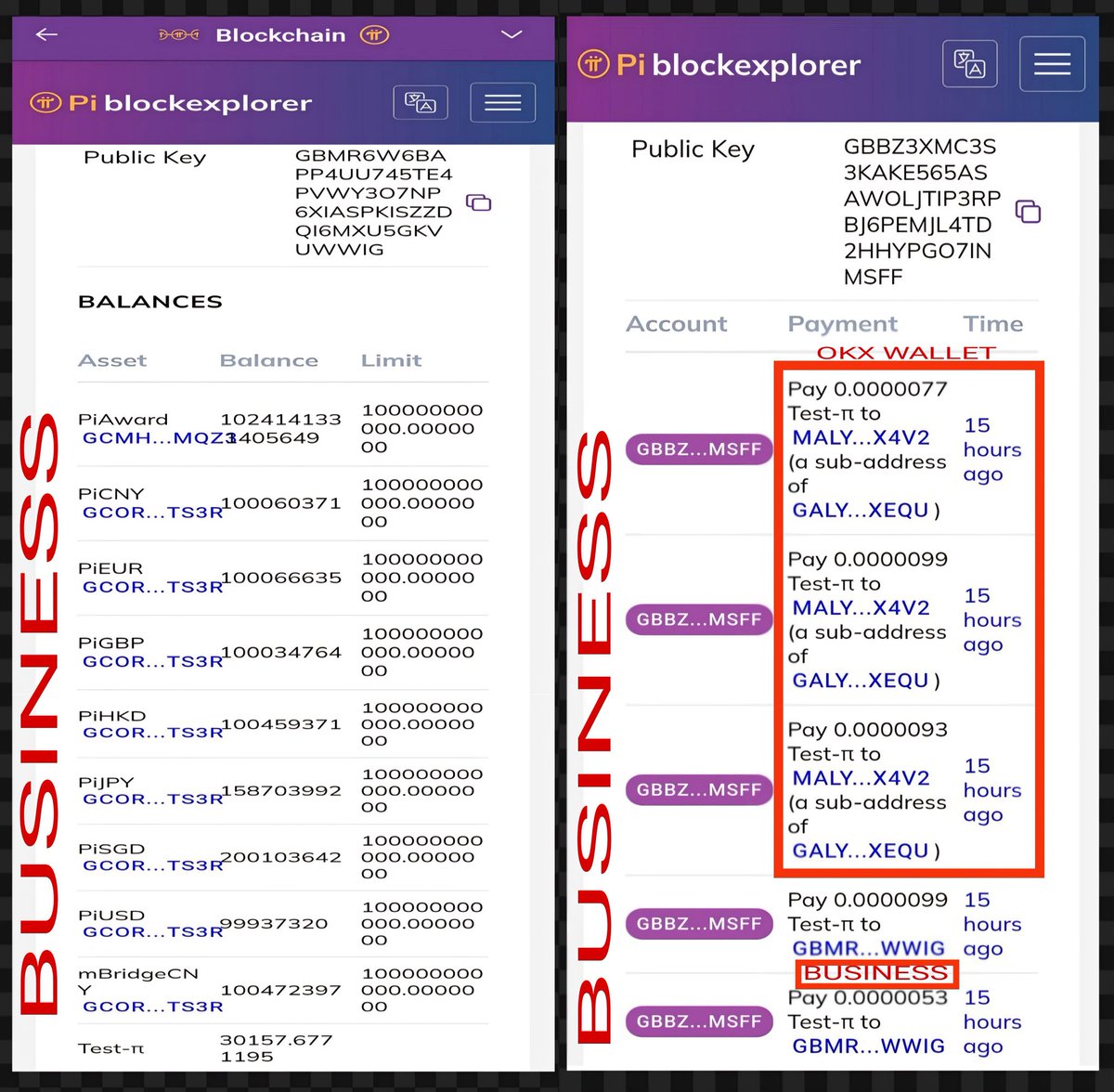
OKX Exchange is an Official Partner of @PiCoreTeam since long time ago.Very few Pioneers are aware that OKX Wallet 'GALYJFJ5SVD45FBWN2GT4IW67SEZ3IBOFSBSPUFCWV427NBNLG3PXEQU' also has a Testnet version.Let's see how it relates with Pi Business Wallets and GCV.
✅GBMR6W6BAPP4UU745TE4PVWY3O7NP6XIASPKISZZDQI6MXU5GKVUWWIG (Testnet) and GBBZ3XMC3S3KAKE565ASAWOLJTIP3RPBJ6PEMJL4TD2HHYPGO7INMSFF (Testnet)
These are two examples of the many Pi Business Wallets owned by CT Partners that are still confidential.The point is,Countries that have accepted Pi can freely convert their FIAT Currency to Pi.Please see the images carefully to understand it.Several GCV transaction test have been conducted between Business Wallet and OKX Wallet..You can also check for yourself and dive deeper by copying the Wallet Address.
Once GCV is implemented in the Pi Network Main Ecosystem,Exchanges that have passed KYB will automatically follow,and can't be manipulated.
GCV is just a matter of time,GCV will definitely win!!..🔥🔥🔥
#PiNetwork2025
1.🇨🇦Ms. Doris Yin – Canada
Doris Yin, the Founder of the Global GCV Movement and the author of the "Pioneer’s Handbook." Canadian who holds a Bachelor's degree in Economics from Anhui University of Finance and Economics in China and a Bachelor's degree in Accounting from Concordia University in Canada. She is a former Certified Public Accountant (CPA) in the USA and is currently a USA IRS Certified Enrolled Agent tax professional.
**The Sharpness of a Sword Comes from Grinding / The Fragrance of Plum Blossoms Comes from the Bitter Cold**
Dear Global Pioneers and all GCV Ambassadors,
This is Doris Yin from Canada Toronto on Sunday beautiful morning greeting all of you. Today is April 20th, 2025, and this is the first Global Pioneers Conference since the launch of the Pi Network Open Network. I still remember almost three years ago when I presented at the Global Consensus Conference on Twitter Space Conference. From there, my journey began, and now we find ourselves here again after launching the Open Network since two months ago. This leads me to today’s topic: “The Sharpness of a Sword Comes from Grinding / The Fragrance of Plum Blossoms Comes from the Bitter Cold.”
Before I start my speech, I want to express my deep appreciation for our host, Ms. Lumari, and her assistant, Mr. Jojo, who have worked tirelessly to organize today’s event. They reviewed all 26 speeches, translated them, and combined them for this wonderful conference! I also want to extend my gratitude to our co-hosts, Mr. Iyanda Cherif Abiola, Mr. Mazi Victor Onyido, and Ms. Nonny Padja, for their exceptional conference management.
This conference is like timely rain during a drought. We will hold monthly Global Pioneers Conferences until we successfully launch the Open Mainnet. We need to leverage all our excellent Global GCV Ambassadors wisdom and unique perspective and charm to awaken global pioneers for the same goal. I use the terms Open Mainnet and Open Network intentionally, as the Open Network is just the first stage of the Open Mainnet. The Open Mainnet should have a second stage that everyone expects: an open-source code to implement our GCV at $314,159. All ecosystems should begin utilizing this GCV. Is this what everyone wants?
I understand that many pioneers prefer quick results, like fast food, without wanting to explore the "why" and "how." However, this is the issue: without knowing the reasons and strategies, you will never achieve the results you desire. To address your doubts, I will explain the significance of my topic: “The Sharpness of a Sword Comes from Grinding / The Fragrance of Plum Blossoms Comes from the Bitter Cold.” This means that without enduring trials and tribulations, how can we expect to reap sweet rewards? It serves as a metaphor that everything must endure hardships before it can succeed.
In our Pi community, many pioneers do not understand the relationship between themselves and the Core Team (CT), and they do not recognize that the Pi Network needs pioneers to collaborate to be accepted by the outside world. They have been oversaturated with codes that encourage them to sit back and wait. Why have they been misled? Some influential pioneers are aware of the community's anxieties, and they take advantage of this by spreading fake news or making unofficial promises, leading pioneers to continually “expect” rather than actively “build” a strong community.
I am here to tell you not to trust any empty promises and to face reality. We should rely solely on official information channels from the Core Team. The success of the Pi Network depends on all pioneers having a clear understanding and working together to push for the successful launch of the Open Mainnet as soon as possible. Only in this way can we realize our dreams.
Now, I will address any confusion many pioneers may have.
The first question most pioneers ask is: Why, after the launch of the Open Network, are we still here? Why don’t we have the financial freedom we expected?
My answer is: Because Pi Network is a revolution. A revolution is driven by ordinary people like us. This is the first time in human history that we are creating a private currency. It’s important to understand that this is different from all government-issued fiat currencies. Some pioneers confuse Central Bank Digital Currency (CBDC) with cryptocurrencies created by ordinary people. Therefore, we should not expect the government to provide us with guidance or arrangements. If we can wait to receive the money, then why wouldn’t government issue currency by themselves? Why need us? If government can do by themselves, do we as ordinary people have chance to gain financial freedom?
So, why shouldn’t we expect big companies to support Pi Network? All commercial entities pursue profit, and large companies are especially risk averse. Before the Pi Network achieves complete success, they won’t take the risk of failure. They will only engage when the risks are minimal or nonexistent. Thus, we should not rely on big companies, and there is no reason to believe they will accept pioneers’ requests.
The Core Team (CT) refrains from discussing or announcing pricing due to the transformative potential of the Pi Network. This innovation enables individuals with limited financial resources to accumulate considerable wealth, which may disrupt the established interests of affluent individuals and corporations. Should the CT release a price, it is probable that regulatory bodies would intervene to preserve the current economic equilibrium, thereby jeopardizing the viability of the Pi Network.
Nevertheless, pioneers possess the capacity to effect change. With nearly 70 million individual members, a united front can indeed reshape the landscape. We are committed to adhering to all existing financial and security regulations, which is why our participation in the exchange market is crucial. The acceptance of a stable coin, GCV, by regulators will depend on its demonstrated transparency and fairness to all investors. Consequently, it is essential for pioneers to remain cautious and not to place trust in any assertions that a specific code can determine market prices. While code may function effectively within the confines of the Pi Network community, the discourse surrounding an open network necessitates engagement with a global audience.
I would like to explain the purpose of Pi Network and its theoretical foundation.
Friedrich August von Hayek was an Austrian-born British economist who shared the 1974 Nobel Memorial Prize in Economic Sciences with Gunnar Myrdal for their work on money and economic fluctuations. Hayek’s book, "The Denationalization of Money," published in 1976, advocates for the establishment of privately issued currencies that compete in the market.
Hayek proposes a system where financial institutions create currencies that compete for acceptance, with stability in value being the crucial factor for that acceptance. He assumes that competition will favor currencies that maintain stable values, as a devalued currency negatively affects creditors, while an upward-revalued currency harms debtor. Thus, the mission of Pi Network to become a private currency can ultimately support the global economy. It is not intended to replace the current fiat currency system but rather to enhance its efficiency. This is why the success of Pi Network holds significant importance. This responsibility lies with the pioneers of the network in the exchange market because Core Team cannot guide price.
Now, let's discuss how we can achieve the goal of realizing GCV for Pi Network. We have already established Pi's value during the enclosed mainnet phase. Our next step is to focus on how to create GCV in the exchange market.
You might wonder about the difference between value and price. Value refers to the currency itself, while price pertains to commodities or securities in the context of buying and selling. Value derives from the inherent worth of the currency, whereas price reflects how people perceive the commodity or security externally. Sometimes, the market price may fall below its actual value due to a lack of understanding about its true worth, and at other times, the price may exceed its value. We can say that demand and supply determine price, but value is distinct—it comes from the intrinsic worth of our Pi coin.
As pioneers, we have successfully established the Pi coin as a GCV which is evident in the code back up by 6 million GCV blockchain data. However, some members of our community may not fully grasp the significance of Pi's value or may be in urgent need of cash, leading them to sell at the current price of $0.60. Such actions can undervalue Pi’s value and negatively impact the long-term interests of all pioneers and the Pi Network. This is why we urge all pioneers to fulfill their responsibilities: to share information that helps more pioneers recognize the GCV is their Pi value. We encourage pioneers to only sell at the GCV to help manage the supply of lower-priced coins in the exchange market.
Additionally, we advocate for buybacks. Indeed, Pi Core Team (CT) has already implemented this strategy, purchasing 27 million Pi for $18 million yesterday. They are also encouraging pioneers to buy Pi to complete their Know Your Customer (KYC) processes through Bonxa and activate their KYC-verified wallets. This includes auctioning domain names and providing special wallets for auctions. All these strategies have a single objective: to increase the demand for Pi in the exchange market.
CT recently announced that the second migration will only occur after the first migration is fully completed. The first migration is expected to take time to ensure accuracy, security, and fairness. Currently, we have 12 million pioneers migrated; this is significantly more than the 10 million that the Open Network originally aimed for, marking a notable achievement in scalability within the industry. From what has been announced by CT as above, it seems they do not plan a mass migration as some pioneers expected. This makes sense, as migrating more wallets could result in substantial expenses to stabilize the Pi coin price. So, what should pioneers do?
We need to understand the deeper implications of CT's announcement. Their strategy aligns with our GCV CT which goal is: less low-priced supply of Pi and a higher demand for Pi usage. Only by achieving this can we stabilize our Pi price in the exchange market. Our GCV community will set a higher goal: to successfully introduce GCV in the exchange market. Some opponents claim this is impossible. I agree it will be impossible if everyone merely listens to fake promise and does nothing. So, I ask you, as a pioneer: do you want financial freedom, or do you prefer Pi to remain at $0.60? If your answer is that you don’t care, that’s fine. But please don’t complain about why Pi's price is consistently $0.60, as it's a result of inaction. However, if you want your dreams to become a reality, you must contribute to community education. Share and repost my articles and those from our GCV ambassadors, as this will help reduce the low price supply of Pi and increase demand.
In China, we say, “Nothing is difficult in this world if you set our mind to it.” This means that if we work hard and unite, we can achieve our goals. Many pioneers once doubted the possibility of GCV. Look at where we are now; it’s part of the code, and we’ve created 6 million GCV data. As I mentioned earlier, success is never easy and requires our collective effort. Too often, we hear about people being scammed or cheated. Why does this happen again and again? Because some people want something for nothing. Scammers target those unwilling to put in the work but still desire profits. This is untenable. However, if we maintain the right mindset, we will not have such expectations, rendering scammers powerless. You can identify their deceit and block them. Today, I hope all of you grasp this logic and protect yourselves from all scammers and those who offer empty promises. While empty promises may not directly steal your money, they do rob you of your emotions, time, and energy, leading to anxiety when outcomes don’t align with expectations.
We all know that our founder, Dr. Nicolas Kokkalis, will be speaking at Consensus 2025, the world’s leading conference on blockchain, Web 3.0, and cryptocurrency. This event will take place from May 14-16, 2025, in Toronto, Canada, and is expected to attract over 20,000 attendees from more than 100 countries. Consensus is hosted by CoinDesk, which is a well-known news site specializing in Bitcoin and digital currencies, founded by Shakil Khan. CoinDesk has been organizing this annual crypto summit since 2015.
If you look at the agenda, you’ll see numerous discussions on topics such as cryptocurrency regulations, the role of stable coins in shaping the future of payments, the evolving landscape of crypto litigation, and efforts to mainstream stable coins. Many founders of cryptocurrencies will be present, and most discussions will revolve around Bitcoin and Ethereum. However, I have not seen Dr. Kokkali’s name or the Pi Network mentioned in the agenda.
While we celebrate Dr.Nicolas Kokkalis as a speaker at this important conference, we shouldn't expect this opportunity to lead us to significant breakthroughs on our own. Pi Network needs the support of our pioneers, and Dr. Nicolas Kokkalis needs our backing as well. This is our chance to help Pi Network present itself to the world as one of the most powerful cryptocurrency communities in history. We should strive to make Dr. Kokkalis proud in front of all the other cryptocurrency founders.
All pioneers should recognize that the success of the Pi Network relies on our contributions. If we can establish Pi's reputation in the exchange market, we will elevate Dr. Nicolas’s standing among other cryptocurrencies and position Pi Network as a mainstream option. Currently, the conference topics focus predominantly on Bitcoin. We must understand that if we cannot demonstrate Pi’s strong performance, how can regulations accept our GCV code? They won't endorse a project that is underperforming in the exchange market. If our price continues to drop, will Dr. Nicolas feel proud speaking at the conference? A declining price signifies a lack of demand for Pi. Consider how our founder feels about the creation of Pi. Therefore, we must unite and strive to showcase the greatness of our mission.
As I said, there are no shortcuts on the road to success. All success stems from tireless work in the right direction. Thus, we present the following simple strategies:
1. Hold your Pi and only sell when GCV reaches $314,159.
2. Actively create or manage groups focused on studying the Pioneers Handbook and my recent articles to help pioneers stay informed and act.
3. All pioneers should wake up and actively share our GCV articles and information across all groups and social media platforms.
4. If you can complete Bonxa KYC, please do so and assist other pioneers in doing the same.
5. If you have passed KYC or are tentatively approved, activate it and transfer your purchased Pi from exchanges to your own wallet. Alternatively, consider buying Pi within your means and transferring it to your wallet.
6. Actively support domain name auctions and encourage friends to buy Pi on exchanges.
In China, we say, "When people are united, they can move mountains." When we come together, we have limitless power. From today, I hope all pioneers will focus on this strategy. We are one big family and do not wish to divide. However, we must be vigilant against misleading individuals and warn the Pi Network community about their deceptive information to avoid emotional scams. This is not about dividing our community; it is wisdom aimed at protecting it. If we allow such misinformation to spread unchecked and pioneers cannot recognize it, it will delay our progress toward OM.
We hope all pioneers understand this concept. It’s like a basket of apples with worms inside: we must throw away the bad ones; otherwise, all the apples will become infested.
As today's topic states, "The sharpness of a sword comes from grinding; the fragrance of plum blossoms comes from the bitter cold." Our success awaits us, but we must first face and overcome all challenges. This victory will be the sweetest reward!
Thank you for listening, and may God bless us all and the Pi Network!
Doris Yin 🪷🪷🪷
Founder, Global GCV Movement
April 20th, 2025