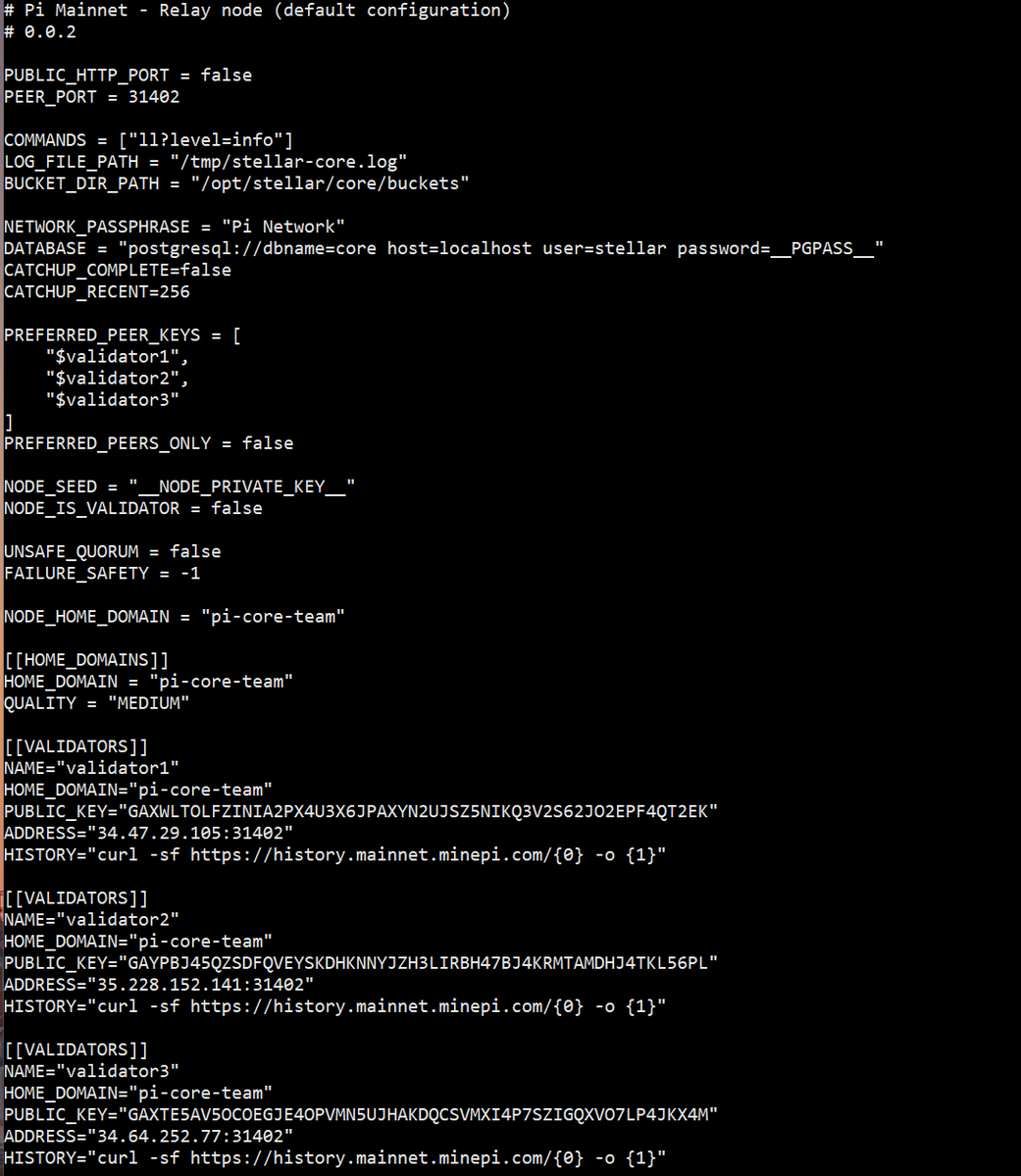
There's 7 Mainnet validators and these are their public addresses
GDLA3KOMXKNHU5AGQB2R5VRBYCKM4X37NQVHTWRIQXNCOFOW4MZZSDTL
GDGGD5XGBWLYS4XYJSUCX2CQ7ZS2JKIQTDOMPMPUU6LX74AINMRH2LMI
GAXTE5AV5OCOEGJE4OPVMN5UJHAKDQCSVMXI4P7SZIGQXVO7LP4JKX4M
GBGGB3AAHWYZFWBOFEH5VLXFYX3SU2JBRP5SREELSJQ5ND4IODPM7D52
GDLZYCQLVQA3AMM7UC3UI3TT2HJMDWHMJDD2DICUSP6WBPUJMO4HWWWN
GDOJQBNSQUIPYG2DYGF7BXLA2XF6WGJPZQHQRS3MV7THO6IWSWAMLQKA
GD4BL5J67HF72VJW7IQU3HKAPVONTGTTHSBSPKLCVO4KGIEXWTQBWF2R
If it's offchain and solely in CT's possession, there's no evidence it exists.
Meanwhile anyone with a node can inspect their own config files. I only have tentative KYC and have a Mainnet node because there's no way to stop nodes joining a public network.
Pi distributes Mainnet node software containing a predefined list of trusted validators. Its original startup script copies that configuration, initialises Stellar Core and contains no mechanism for incorporating Security Circle data into quorum selection.
Live SCP queries independently confirm that seven validator identities advertise an identical, closed 4-of-7 quorum set.
SC is just mining extra
Pi documentation claims to use security circles to secure SCP but they fail to mention they started a chain using XLM's blockchain software which implements SCP and doesn't utilize security circles
Trust graph is Pi's proposed addition to SCP but they aren't rewriting blockchain software so it would operate on an offchain layer and be used to configure quorum sets that in XLM nodes do manually.
However CT controls all the validators and there's no need for additional trust layers to configure non-validating nodes.
CT controls validators so they can control who has a wallet.
The conclusion: there's no need for a security circle.