[have believed for more than a decade that the U.S. Dollar Index, DXY, is in a structural decline that is likely to continue. Ialso think we may now be approaching a much more significant leg lower, and that has major implications for Bitcoin.
Congrats to Simon, @DylanLeClair, and the @Metaplanet team on a big move.
The United States has the best capital markets in the world. Their depth, liquidity, and culture of innovation are a powerful advantage for those building on Bitcoin.
We need more issuers of Digital Credit for this asset class to reach its full potential. This move is another meaningful step in that direction.
A quick rewind: last year, MSCI proposed excluding companies from its broad-based indexes if digital assets represented 50% or more of total assets. Strive pushed back in the article below, arguing that a blunt asset threshold could misclassify operating companies as investment funds and make broad-market indexes less representative of the market they are intended to track. There was also broad pushback across the Bitcoin and capital markets industry around many of the same concerns.
Fast forward to today, and I have what may be a contrarian view in the industry: MSCI is listening. Their new proposal is a meaningful improvement. Rather than singling out Bitcoin or digital assets, MSCI is now attempting to distinguish operating companies from non-operating entities using a broader set of financial and operating characteristics. That is a significant reframing and addresses many of the concerns raised by Strive and others across the industry last year.
It still gets the most critical part of the answer wrong. Companies using structured finance, capital markets and operating activities to build and manage substantial Bitcoin treasuries are operating companies, and the proposed framework can still classify them otherwise. But the fact that MSCI has already moved this far is a good reason to keep engaging. Thoughtful engagement on the merits can change frameworks, and I think there is still room for further improvement here, whether in this consultation or over time as institutional understanding of these companies develops.
The purpose of a broad-based index is to give investors exposure to the market as it actually exists and evolves. We believe companies with significant Bitcoin exposure are an increasingly important part of that market, particularly in a world where fiat currency debasement is eroding purchasing power and AI is increasingly challenging traditional corporate moats. Bitcoin and this industry will continue to develop regardless of any individual index methodology, but MSCI plays an important role in how investors access broad market exposure, which is why getting the framework right matters.
Our interest also goes beyond Strive's own index eligibility. Strive's clients have direct exposure to MSCI through our ETFs, giving us a fiduciary responsibility to advocate for decisions that maximize MSCI's long-term shareholder value. If broad-market indexes become less representative of important parts of the market, that can ultimately hurt both index investors and MSCI shareholders.
We are still reviewing the proposal and do not want to prescribe the final answer before completing that work. We expect to engage constructively with MSCI and others across the industry as we formulate our response. We will disagree where appropriate and make that case forcefully on the merits, but MSCI has shown a willingness to listen and materially evolve its approach. That is worth recognizing, and it is a good reason to keep the engagement going.
Great work by @GuiAmadoGomes, @samcallah, & the OranjeBTC team on $DIGY11. It will hold $STRC, $SATA, and hopefully additional digital credit securities in the future.
Digital Credit is maturing from an innovation pioneered by a single company into a true asset class with multiple issuers and growing global demand. The launch of an index and ETF built around this category is an important step in bringing Bitcoin-backed income to investors around the world.
STRIVE 2Q26 HIGHLIGHTS
- BTC Yield of 24% in 2Q26 & 38% for 1H26
- SATA Daily Dividends
- Retired 100% of debt
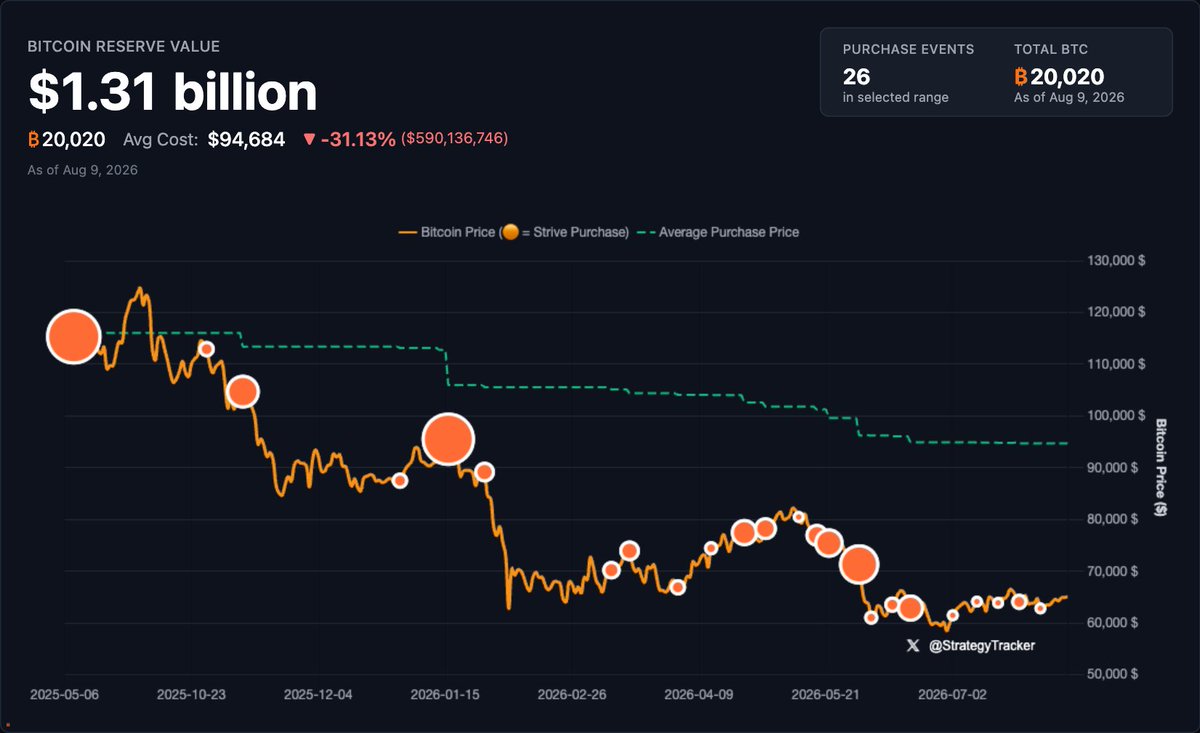
Strive also acquired 147 $BTC last week & now hodls ₿20,167.
New treasury dashboard & website launched TODAY.
Check it out at https://t.co/S1akSqj7ZA
$ASST $SATA
A discussion between @macroleverageTP, @PhongLe, and me on why Bitcoin Treasury Companies exist, what the first real stress test for Digital Credit taught us, and the opportunity ahead for Bitcoin-backed financial innovation.
TIMESTAMPS
0:04 - Why Bitcoin Treasury Companies Exist
7:22 - Financial Engineering Vs. Financial Innovation
14:24 - What Makes Bitcoin Treasury Companies Durable
18:42 - Does Bitcoin Need Treasury Companies?
22:20 - Addressing Bitcoin Treasury Company Criticism
26:46 - Growing Demand For Bitcoin-Backed Products
30:11 - What Has Surprised The CEOs Most
36:06 - The Evolution Of Digital Credit Products
45:10 - Lessons From The First Market Stress Test
53:10 - Bitcoin Market Depth And Liquidity
55:21 - Why Selling Bitcoin Is Not A Contradiction
1:03:37 - The Future Of Bitcoin Treasury Companies
$MSTR $ASST $STRC $SATA $BTC
STRIVE BITCOIN UPDATE
Strive purchased 17.76 Bitcoin last week and now holds ₿19,882.
More importantly, during 2Q26 @Strive acquired 6,236 Bitcoin, achieved 24.0% BTC Yield, generated ₿3,264 of BTC Gain, and ended the quarter with an amplification ratio of 67.2%.
$ASST $SATA
Digital credit is only a year old, which makes clear explanations & institutional risk framing essential.
@NateGeraci asked the tough questions on digital credit, $SATA, $ASST, the $BTC drawdown & more.
My full conversation on @CryptoPrimePod.
TIMESTAMPS
00:00 Intro: Matt Cole on Strive and SATA
01:09 Strive’s shift into structured finance
02:44 ASST vs. SATA: amplified Bitcoin exposure vs. digital credit
07:28 What SATA is and how the preferred equity works
10:12 Why Strive calls SATA “digital credit”
13:32 Credit risk, Bitcoin drawdowns, and Strive’s reserves
17:46 Bitcoin return scenarios and SATA dividend sustainability
20:25 Bitcoin as collateral vs. cash-flowing assets
25:08 Does a 13% dividend mean higher risk?
29:47 How digital credit should be marketed
34:30 SATA vs. Strategy’s Stretch
36:25 Strategy, Michael Saylor, and Bitcoin’s market narrative
41:04 Why Bitcoin has drawn down
43:02 AI, IPOs, and capital flowing away from Bitcoin
43:44 OG Bitcoin holder selling pressure
47:20 What could bring Bitcoin momentum back
50:43 Closing thoughts