Gold is repricing trust.
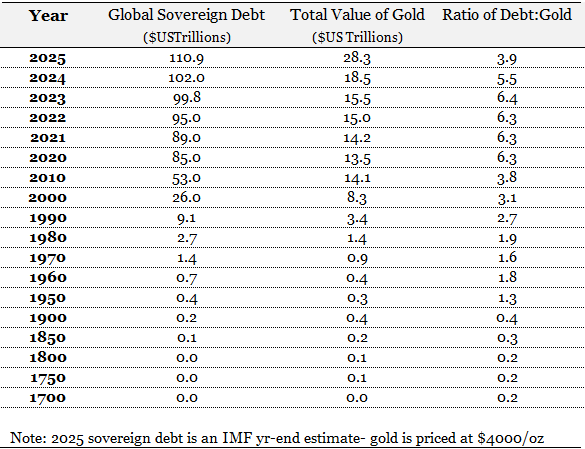
Below is the updated debt-to-gold ratio.
For 100+ years it climbed almost in one direction as fiat replaced discipline.
As @LynAldenContact has shown, gold couldn’t keep up with the telegraph — money had to move faster than metal.
As @saifedean explains, WWI accelerated the break from sound money and ushered in the debt-laden fiat century.
The ratio just turned — but not because debt fell.
AI may make investment analysis abundant while making good investment judgment more valuable.
For decades, exceptional investors gained an advantage by gathering information, analyzing companies, and identifying patterns better than competitors.
AI is rapidly reducing the cost of those activities.
But deciding what an uncertain future is worth requires judgment, not just information processing.
My hypothesis: AI will erode some traditional sources of investment alpha while increasing the relative value of the judgment that remains difficult to automate.
AI is getting extraordinarily good at solving mathematical problems.
But @stevenstrogatz raised a more important question in our conversation: Who decides which problems are worth solving?
The greatest advances in mathematics haven't always come from solving harder problems. Sometimes they've come from inventing an entirely new way to think about them.
If AI becomes vastly better at finding answers, could our ability to recognize valuable questions become even more important?
I was recently in a pub near Galway and noticed this on the wall.
Between 1900 and 1993, the price of the same pint of Guinness increased 136x.
Measured in Guinness, money lost over 99% of its purchasing power.
Sometimes the best lessons about money are hanging on pub walls.
@MDBitcoin 100%
Told that to someone last week at dinner and they were stunned! Another person at the table asked me for info and now wants to go to Bitcoin 2027!
The other guy... not so much!
Median weekly earnings for full-time workers rose 1.5% over the past year. Consumer prices rose 3.5%.
Last week, the New York Fed reported that productivity and public-company revenue per worker have accelerated since 2019, while operating margins rose from 16% to 18%.
None of this proves AI caused the divergence. But it shows why employment is an incomplete measure of AI’s impact.
Workers can keep their jobs while producing more—and receive a smaller claim on what they produce.
The first distributional effect of AI may appear in wages and margins long before it appears in unemployment.
At Cato last night, @Marian_L_Tupy's five arguments against wealth taxes:
- They're larger than they sound, compounding over time.
- They discourage risk-taking.
- Billionaire wealth isn't idle cash.
- Much of that wealth reflects expected future inventions.
- Tax avoidance is legal and effective.
Taxing a billionaire's company's market value means taxing expectations of innovations that haven't happened yet.
The insidious effect is that a wealth tax reduces the rewards of successful ventures without reducing the losses from failures.
Entrepreneurs should be expected to respond by choosing smaller, safer opportunities over the breakthroughs that mark and drive human progress.
Watching guest Jon McNeill on @CNBC. He is reading every answer into the camera!!!
Either he is using AI on the fly to answer his questions or CNBC gave him the questions ahead of time.
WOW!
We usually think of a financial asset's liquidity as a benefit to its owner. But liquidity benefits people who don't own it, too.
When investors can trade an asset readily, they have more incentive to study it, value it and monitor it. Better information and greater liquidity can attract more capital and lower financing costs.
Secondary-market trading helps finance productive activity in the primary market.
US capital markets have led the world in unlocking trapped asset value, and tokenization holds the promise of transforming this liquidity value faster than ever before.
We usually measure productivity by asking how much more an existing worker or business can produce.
But AI may create economic value that never appears in those comparisons.
A person who couldn't afford to start a business, investigate an invention, or test a commercial idea may now be able to do so.
The economic gain isn't just producing existing goods and services more cheaply.
It's the value of ideas that otherwise would never have been pursued.
How much of AI's contribution will our conventional productivity statistics capture?
AI may create more entrepreneurs for a reason we're overlooking.
Starting a business has always required doing things you aren't particularly good at: legal research, accounting, marketing, software development.
Those requirements have prevented many good ideas from ever being attempted much less ever succeeding.
AI doesn't just make existing businesses more productive. It makes businesses possible that otherwise would never have existed.
That's a different kind of productivity gain.
We tend to think of monetary reform as something governments must undertake.
Bitcoin changes that assumption.
People can now choose a monetary system without first persuading politicians, winning elections, or changing the law. It changes who gets to decide.
For the first time, monetary competition is being driven from the bottom up.
@Strategy's mNAV fell from roughly 1.18 to 1.05 last week, as MSCI adopted rules that could exclude MSTR from its indexes on November 30 if it is classified as a non-operating company.
Is Strategy really a non-operating company?
It doesn't simply hold Bitcoin. It creates and sells digital credit, manages dividend obligations, raises capital and deploys it to buy more Bitcoin.
Other financial firms perform similar activities using fiat currencies.
These activities require innovation, judgment and execution.
If that isn't operating a business, what is?
Full conversation with Dr. Erica Groshen on modernizing our economic statistics, measuring AI's effects, and the consequences for economic policy.
https://t.co/hpWCUJqDqB
Policymakers are already proposing how to respond to AI's impact on jobs.
But how can they know which policies will work when we don't yet have the data to establish what problems AI is creating?
I asked former BLS Commissioner Erica Groshen whether our economic statistics are up to the task.
@CommodMkt The shipping cost for an oil super tanker from the Middle East to Asia is currently $80 million. The cost of a SpaceX Falcon 9 rocket launch is $74 million. Let that soak in….
A $100,000 stock portfolio and $100,000 of home equity represent the same amount of wealth.
But they are not equally useful.
Stocks trade during market hours. Accessing home equity can take weeks.
Now imagine assets that can be traded, borrowed against, or transferred 24/7/365.
What happens to economic growth when AI, tokenization, and digital financial rails make trillions of dollars of wealth easier to put to work?