I have believed for more than a decade that the U.S. Dollar Index, DXY, is in a structural decline that is likely to continue. I also think we may now be approaching a much more significant leg lower, and that has major implications for Bitcoin. If that view is right, the next five to seven years could be a materially more bullish environment for Bitcoin than anything it has experienced in its history.
This chart goes back to the late 1960s. What makes it so compelling to me is not just the technical picture of lower highs and lower lows that has developed over roughly 45 years, but that the technical picture is supported by the fundamentals behind it.
I spent much of my career thinking about those fundamentals, including while managing the U.S. Treasury portfolio at CalPERS. That was before I became a Bitcoiner, but the work directly contributed to it. The trajectory of federal debt and deficits, the risks embedded in long-duration Treasuries, and the policy incentives created by an increasingly indebted sovereign all pointed me toward the same conclusion: the dollar was in structural decline. More than a decade later, that thesis has remained remarkably unchanged.
The debt burden is dramatically larger today, fiscal deficits remain enormous, and policymakers continue to face the same basic tradeoffs. They can accept the pain through materially higher real rates and tighter financial conditions, or they can try to manage that pain through lower real rates, maintaining market liquidity, nominal growth, and some degree of currency depreciation. There is no painless path. The question is simply where the adjustment gets absorbed.
That matters enormously for Bitcoin. Each of Bitcoin’s major bull runs has coincided with meaningful dollar weakness. DXY fell from roughly 103 to 88 during the 2017 run, declined from around 103 toward 89 during the 2020-2021 cycle, and then weakened from roughly 108 during the 2025 move that helped take Bitcoin to new all-time highs before the current 2026 bear market.
Those were meaningful moves, but they were still relatively modest compared with the major dollar declines of the last 45 years. The breakdown beginning in the mid-1980s lasted for years, as did the decline from the early 2000s into the Global Financial Crisis. My base case is that we are approaching another multi-year move lower in the dollar, potentially over the next three to seven years, with a real possibility that DXY eventually challenges the 2008 lows around 70.
If that happens, Bitcoin would be entering a macro environment it has never experienced before. Its previous bull markets have benefited from periods of dollar weakness, but never from a true secular breakdown in the dollar of the kind this chart suggests is possible.
Today is an interesting day to post this chart because the Treasury announced that it is at least doubling liquidity-support buyback operations in 10-to-30-year Treasuries. That comes as long-term Treasury yields have been under significant pressure, and the dollar has moved sharply lower today.
To me, this is simply another data point in a thesis that has been playing out largely as I expected for more than a decade. The fiscal constraints are greater, the debt load is larger, and the policy incentives are becoming more obvious. None of that weakens the original thesis. It strengthens my conviction in it.
That is also why I think people are not bullish enough on Bitcoin over the next five to seven years. Most Bitcoin forecasts are based on what Bitcoin has already done, but Bitcoin has never had the tailwind of a genuine secular dollar breakdown. We are used to saying that past results are not indicative of future performance because the future may be worse than the past. In this case, I think the asymmetry may run the other way.
It is also why I am so focused on amplifying Bitcoin exposure, and why I joked yesterday about feeling under-amplified. If this 45-year dollar structure finally breaks
Digital Credit is the most important story in Bitcoin right now.
Since the category has arrived, $15 Billion+ of permanent capital has been plowed into the Bitcoin network.
There's not another transparent vehicle building permanent capacity at that rate.
55 years ago today, Nixon “temporarily” suspended the dollar’s convertibility into gold, the Nixon Shock.
Since then:
M2 Supply: $685B → $23.2T
U.S. debt: ~$400B → ~$39.8T
Nothing is more permanent than a government measure labeled “temporary.”
38 years later, Bitcoin arrived.
21 million. No more.
Bitcoin made trust cheap.
The largest single cost reduction in the history of trust extension technology.
The next great institutions will be built on lowering the cost of believing a stranger. https://t.co/xobO634SRU
Today, Strive paid a cash distribution of $0.0516 per $SATA share. The daily dividend represents an annualized rate of $13 per $SATA share and an effective yield of 13.1% as of the latest market close.
This payment marks the 48th consecutive dividend to shareholders.
Great work by @GuiAmadoGomes, @samcallah, & the OranjeBTC team on $DIGY11. It will hold $STRC, $SATA, and hopefully additional digital credit securities in the future.
Digital Credit is maturing from an innovation pioneered by a single company into a true asset class with multiple issuers and growing global demand. The launch of an index and ETF built around this category is an important step in bringing Bitcoin-backed income to investors around the world.
Introducing DIGY11: an ETF paying monthly distributions in BRL, powered by Bitcoin-backed perpetual preferred equities like STRC and SATA.
Competitive yield. Monthly income. Daily liquidity. Differentiated exposure.
A new income category built around Bitcoin is coming to Brazil
Inaccurate.
Since the start of 2024, $MSTR has outperformed Bitcoin by 49%, about ~1.7x of Bitcoin total return annualized.
Most importantly, MSTR has outperformed BTC since inception in 2020.
A well executed amplified BTC strategy is great for low time preference investors.
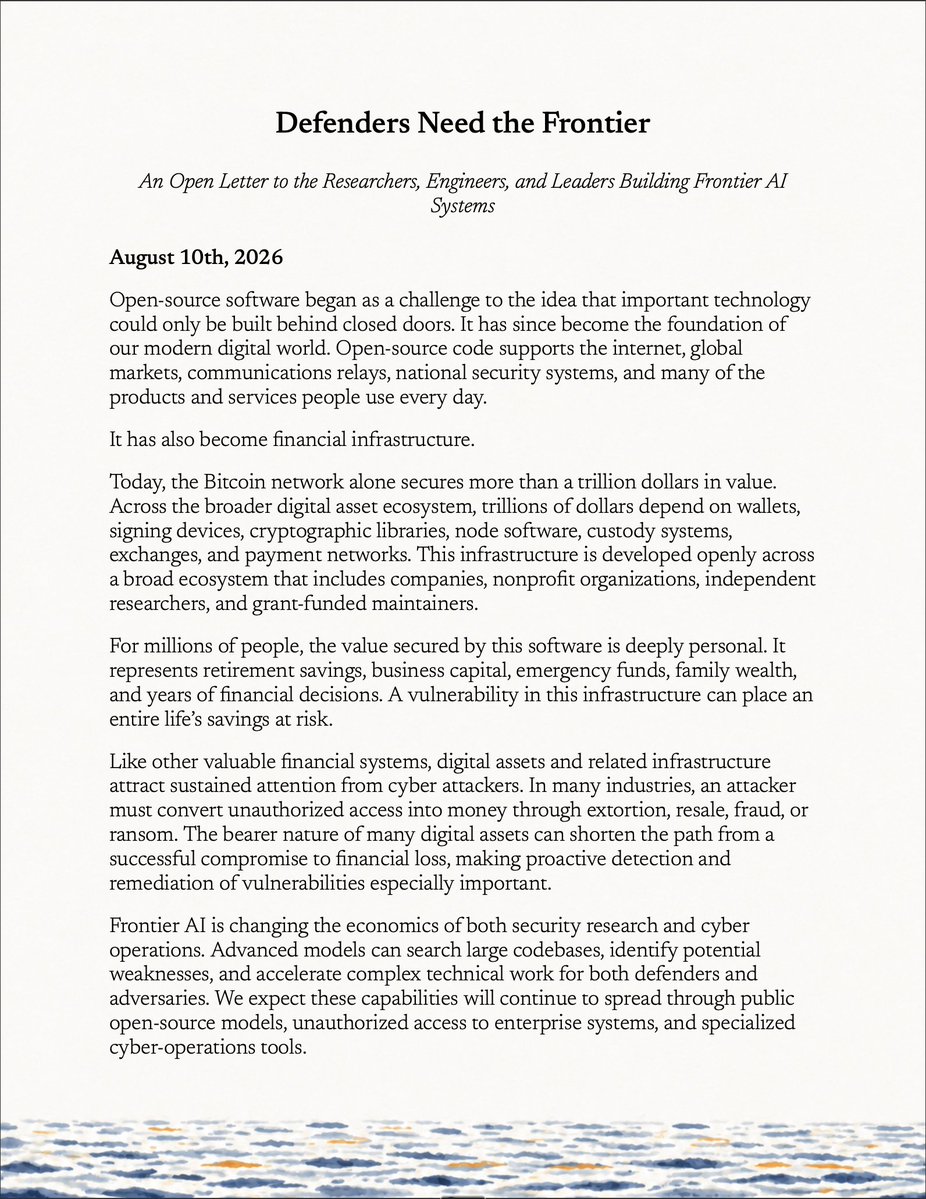
I'm proud to support @bitcoinpolicy’s open letter urging frontier AI labs to open a clear pathway for qualified open-source defenders.
AI could become the most powerful defensive technology in history. Attackers already are exploiting it. Defenders cannot be left behind.
We believe Bitcoin is critical public financial infrastructure. Those securing it should have trusted access to the most powerful AI models available.
Bitcoin Core v32.0 is targeted for release in October:
- Up to 3x faster initial sync. Block validation now fetches transaction inputs from disk in parallel instead of one at a time
- The libevent external dependency is fully removed, continuing Core's push to cut third-party dependencies
- Max peer connections raised from 125 to 200 to have more open slots for new nodes to sync from, faster block propagation, and a harder network to eclipse or partition
- Mempool-based fee estimation to cut fee overestimation (in progress)
- Transaction relay rate limiting is now global instead of per-peer, keeping a node's CPU and memory usage steady when transaction volume spikes
- Ships with features from libsecp256k1 0.8.0 with verification up to 11% faster, plus the new Silent Payments module (BIP 352)
- PSBTv2 (BIP 370) support, now the default for PSBT-creating RPCs for better coordination of unsigned transactions for multisig and hardware wallet setups
- New exportwatchonlywallet command to export a wallet as a watch-only file, no private keys, and restore it on your online node
- Core now enables Tor's proof-of-work DDoS defense on the onion service it creates for your node, where the Tor daemon supports it
Additional tests, bugfixes, and features included as well.
Feature freeze is ~August 20, rc1 ~September 10, final release targeted for ~October 10. (Test the release candidates when they ship!)
The criticism @ColeMacro hears about digital credit: SATA and other digital credit products are just preferred equity.
His answer is that preferred equity is a hybrid security, so the label settles nothing on its own.
Every preferred sits somewhere on a spectrum between equity-like and debt-like.
What decides where it sits is one specific section: the investor protections.
No cumulative dividends and no protections, and what you hold is effectively equity.
"The stronger the teeth of the investor protections are, you could have something that's a preferred equity that could effectively be a debt security, depending on how many of these protections you put in there."
@ColeMacro on where SATA sits: the protections are real, and they were put in there intentionally.
$SATA $BTC
Today, Bitcoin Policy Institute and a broad coalition from across the digital-asset ecosystem are publishing an open letter calling on the world’s leading AI labs to provide qualified open-source defenders with trusted access to frontier AI models.
The past several weeks have made the need for this abundantly clear. The people defending digital-asset infrastructure and open-source software need access to the latest AI capabilities to perform comprehensive security reviews and stay ahead of increasingly sophisticated adversaries.
The coalition includes open-source development organizations, major custodians, treasury companies, payment services, security firms, capital allocators, and others whose businesses and customers depend on the integrity of open-source infrastructure and libraries.
Open-source defenders often occupy the least privileged position in the AI security landscape. They have limited access to the strongest internal cyber models and are frequently blocked by guardrails when using publicly available frontier systems for legitimate security research. As a result, they often resort to less capable open-weight alternatives.
We are urging frontier AI labs to establish a clear, trusted pathway for qualified open-source and digital asset defenders to access their strongest capabilities, with sufficient compute and secure environments to conduct meaningful security reviews. Frontier AI could become one of the most powerful defensive technologies ever developed, but only if defenders get fair access to those systems.
It’s time to give defenders the tools they deserve.
Read the open letter, add your organization, or sign as an individual on our website at https://t.co/cUTwQ5ugXJ