I remember spending time pulling ticks off every afternoon when working construction on a remote site. They could climb up without being noticed, Even when pulling my socks over my ankles. You can guess where they were going!
With everything we are hearing right now about ticks this seems like good information to share.
“Here’s what I’ve learned after more ticks than I care to count.
First, whatever your uncle told you, forget it. No matches. No nail polish. No Vaseline. No soap on a cotton ball. All of those do the same terrible thing, they stress the tick out, and a stressed tick empties its gut back into the bite before letting go. Which, if you think about what that actually means for a second, is literally how Lyme and the rest get transmitted so you’re not speeding up its exit. You’re making it throw up into you.
Fine-tipped tweezers. Grip right where the mouthparts enter the skin, not the body, the head. Pull straight up, steady, no twisting, no jerking. It’ll feel like it’s resisting because it is, the mouthparts are barbed. Just keep the pressure on and it lets go in a few seconds. If a piece breaks off in the skin, leave it alone. Your body pushes splinters out. Digging around with a needle does more damage then the fragment ever would.
Clean it with alcohol or soap. Wash your hands.
Now here’s the part most people skip: don’t flush the tick.
Tape it to an index card. Clear packing tape right over the body, write the date and where on your body it was, and stick the card in a drawer. If you come down with anything weird in the next 30 days, rash, fever, joint pain, that flu-that-isn’t-flu feeling, that tick goes with you to the doctor. Some labs will test the tick itself, which is faster and often more reliable than waiting for antibodies to show up in your own blood. A dated tick taped to a card is one of the most useful things you can hand a doctor who’s trying to figure out what’s wrong with you.
The other thing worth saying out loud: if the tick was engorged when you pulled it, and you can’t swear it was off your body within 24 hours, call your doctor that same day. Don’t wait for a rash. Fewer than three out of four Lyme cases even produce the classic bullseye. A single preventive dose of doxycycline within 72 hours of a deer tick bite cuts the Lyme odds way down, and most docs in tick country will write that prescription without giving you a hard time, especially if you walk in with the tick taped to a card and a clear timeline.”
Not many people have really turned their minds to the psychology of Canadians. Most are too busy reacting to the latest outrage, headline, or political controversy.
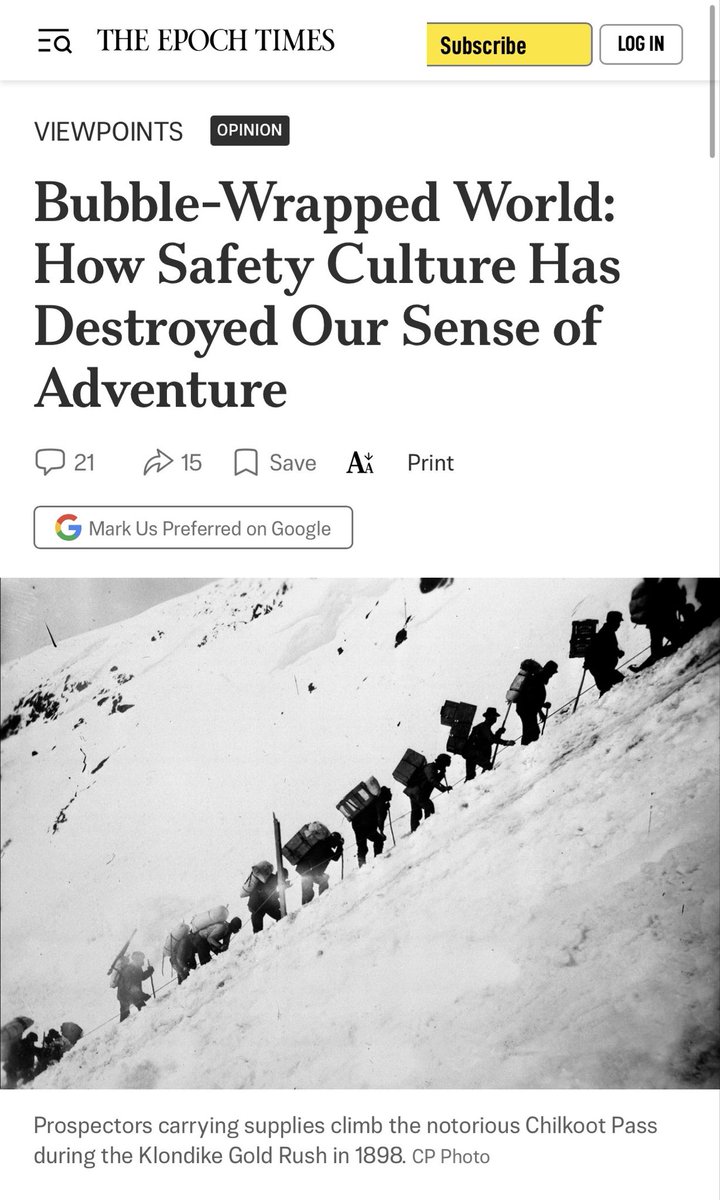
However, David Redman has cautioned about what he has identified as a trend in Canada: “helicopter” and “bulldozer” parenting, where children are either constantly hovered over or where every obstacle is removed before they ever have to face it themselves.
Over time, that kind of environment can produce people who become uncomfortable with uncertainty, overly dependent on authority, fearful of risk, and hesitant to think independently or challenge difficult ideas. As this article put it:
“Children, the authors observed, are now deliberately shielded from any sense of risk or uncertainty. How can anyone—young boys most of all—learn about the world around them when school principals announce at the onset of every snowfall that “all snow must stay on the ground.” The ideal of adventure and resilience has been replaced by a debilitating sense of fragility and risk-avoidance…
Adventure should properly be considered a spirit, not a place. It is driven by a powerful mixture of curiosity, necessity, and an openness to experiencing new things. And it can be found wherever uncertainty reigns. Today, that might entail travelling to strange lands, meeting new people, or even engaging in uncomfortable discussions about whether Alberta should remain part of Canada forever.
Wherever the unknown lies, adventure can be found.”
That mindset does not just affect childhood. It shapes entire societies. It affects how citizens respond to disagreement, political debate, uncertainty, criticism, and even new ideas.
Somewhere along the way, many Canadians lost their sense of adventure, resilience, curiosity, and willingness to engage with uncomfortable conversations or difficult questions.
Where did that spirit go? What happened to the mindset that encouraged people to explore, question authority, take risks, debate ideas openly, and build something better even when the outcome was uncertain? Somewhere along the way, discomfort itself seems to have become something to avoid rather than something people grow through.
Because if we stop exploring, questioning, debating, and taking risks, we lose something essential about what it means to live freely and think independently. A society that becomes afraid of uncertainty eventually becomes dependent on being told what is safe, acceptable, and permitted.
If we are going to move forward in any meaningful way, we need to rediscover the spirit of curiosity, resilience, and adventure that pushes people to test ideas, challenge assumptions, and engage with the unknown instead of fearing it.
Perhaps one of the most important conversations we should be having is this: what does it actually mean to be Canadian today?
Because for many, it increasingly feels like the answer is becoming less about courage, resilience, curiosity, and self-determination, and more about compliance, comfort, and avoiding difficult conversations.
Your brain has a circuit that doesn't know you live in a city. Its only job is to monitor whether birds are still singing. Right now, in this room, it is on.
The circuit predates primates. Mammals have been using ambient soundscape continuity as a predator-detection system for roughly 200 million years. Birds stop singing when something larger moves through their territory. For most of mammalian history, a forest full of song meant no large predator was nearby, and the cessation of sound was the warning. Your nervous system never updated this software.
The Max Planck Institute tested the inverse in 2022 with 295 participants. Six minutes of birdsong dropped anxiety with a medium effect size. Six minutes of traffic noise raised depression with the same. The effect worked on subjects who lived in dense urban environments and had no regular contact with nature. The brain still ran the check.
Birdsong sits in the 1,000 to 8,000 Hz range. Your brainstem reads continuous patterns in that band as a signal that nothing dangerous is currently moving through the environment. EEG data shows birdsong at 45 to 50 decibels boosts alpha wave activity by 14.1% relative to silence. Alpha is the brainwave signature of relaxed alertness. Push the same birdsong above 60 decibels and the response flips. Stress markers rise 29%. The circuit only trusts the signal at the volume of quiet conversation, which is exactly the volume birds sing at from a typical distance.
Three things happen simultaneously when the brain registers ambient safety. The amygdala downregulates. The parasympathetic nervous system takes over from the sympathetic. Heart rate variability rises, cortisol drops. The posterior cingulate cortex, which sits at the center of the rumination circuit, quiets down. King's College London tracked this through a smartphone study with over 1,200 participants and found the mood lift lasted hours after the sound stopped. People diagnosed with depression got the same response as healthy controls.
Most of what gets labeled mental fatigue is hypervigilance running in the background. Birdsong tells the circuit it can stand down, and the brain reallocates the freed compute everywhere else.
A quiet park feels different from a quiet office because the parks have sentinels.
@scott_scientist Yeah. I read the studies and wonder just where they think they are going. If you take all the studies done in the studies you field over the past 20 years, and try to see an inteligent pattern. I sure can't find the one.
@LeighCl68689106@MelissaLantsman One of the best films I've watched about the Influence of IMF in politics is "Our Brand of Crisis" (2015) with Sandra Bullock & Billy Bob Thornton. It lays bare the stratagies used and the subtle manipulations. Our Brand Is Crisis (2015 film) - Wikipedia https://t.co/I7SrK8MsPG
I've had some people asking about what is wrong with me. I've sent them to the Wikipedia ME/CFS definition, even though it seems to only cover post-exertional Malaise. It would be nice to have some clear information from all these scientists who are asking for our money.
The stress levels on heath care workers are making this a national crisis. It is important to routine to see and hear warnings about abusive behaviour in every clinic I've been in.
1/ Conservatives launched an investigation at the health committee into how the Liberal government's immigration policies are impacting Canada’s healthcare system.
Here’s what we uncovered:
1/ Conservatives launched an investigation at the health committee into how the Liberal government's immigration policies are impacting Canada’s healthcare system.
Here’s what we uncovered: