With ME 37 years (32 yrs severe). 95% of posts on #MEcfs/#LongCovid/#chronicillness. 26 publications in peer-reviewed journals. @IrishMECFSAssoc trustee 29 yrs
UK legal case: The court agreed that the local authority should drop the case for care proceedings for two children with very severe ME/CFS
https://t.co/KyA79ZrcgC
https://t.co/EoinmqVbmg
Screenshot from latest Science for ME weekly update
#SevereME#MEcfs
If ME/CFS affects you in any way and you have money that could make a difference, please don't wait another day. Put it into ME/CFS research now, especially into the foundations the field still lacks: biobanks, tissue banks, systematic data collection, and datasets that are accessible and comparable.
I've been talking about this for years, but it bears repeating for anyone who hasn't come across it yet. Here is why it matters so much now.
As AI improves, analysing data, connecting findings, generating hypotheses and designing experiments will become much faster and increasingly automated. While it's debatable what reasoning really means, scientific reasoning will directionally become easier to come by. Good biological data, patient samples and clinical validation won't. AI can get far more out of existing evidence, but it can't observe what has never been measured.
That makes the groundwork we fund today doubly valuable: once through what researchers find with it now, and again through what more capable systems discover in the same data later.
Even highly automated research will have limits. Compute, lab capacity, funding and the time it takes to validate treatments will still have to be allocated. Researchers, funders, companies and, increasingly, AI systems themselves will each act on a utility function, weighing expected benefit against cost, time and the odds of success. An AI's utility function may not be readily understandable to us, and the more capable these systems become, the harder they may be to interpret. Depending on how things unfold, setting priorities may not always be our choice to make.
Politics points the same way. Given the current climate, I think the AI frontier will probably be nationalised in one form or another. I'm only guessing, but I find it hard to see how it won't be. Then not everyone will have access to the most capable models. Governments and the organisations they approve will decide what those models work on, guided by national priorities. Given how ME/CFS has fared with public priorities so far, we can't assume the best systems will turn to it by default. What we can do is make ME/CFS a ready, obvious target for whoever has access, and build data good enough that researchers can get far even with the models available to them.
Disease burden should count enormously. But readiness will count too. Diseases with reliable data, clearer mechanisms and testable targets will be easier to tackle, and will attract more classical investment and, perhaps more importantly, more compute.
After decades of underinvestment, ME/CFS starts this race behind. Better technology won't build the missing foundations for us. Biobanks and datasets take years to build, and that clock only starts when the money arrives. Every year we wait, the gap grows.
The core of this argument doesn't depend on a dramatic AI breakthrough or a particular timeline. Even gradual progress makes today's groundwork more valuable. AI may one day help neglected diseases catch up, but waiting won't get us to the same place as preparing.
I know this sounds a bit like science fiction. But right now I think it is very likely that AI will reshape how research is done and prioritised. That doesn't mean AI will find biology easy to solve. I don't think it will. But there will be priorities, and we have to optimise for ME/CFS being where the attention and compute flow!
So if you can, please fund the foundations now!
From France 🇫🇷
Integrated Biomarker Profiling Uncovers a Distinct Pathophysiological Signature of Long COVID
https://t.co/TdyzKhZxN8
Screenshot from latest Science for ME weekly update
#LongCovid
Australia 🇦🇺
Lived Experience Advisory Panel Members Needed for Long COVID study
Email: elisabeth.reid at sahmri dot com . Subject line: Leap members
Screenshot from latest Emerge Australia newsletter
#LongCovid
From the UK 🇬🇧 & US 🇺🇸
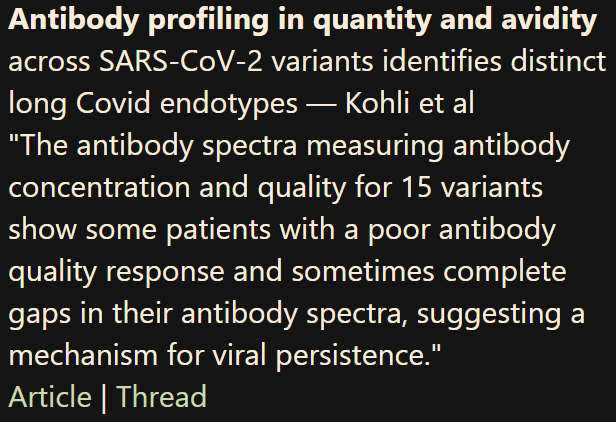
Antibody profiling in quantity and avidity across SARS-CoV-2 variants identifies distinct long Covid endotypes
https://t.co/FIAYZqrXdF
Screenshot from latest Science for ME weekly update
#LongCovid
The Sick Times @thesicktimes : Olympic sprinter Beth Dobbin on her viral ME research campaign
https://t.co/dTKnBPUTN1
Screenshot from latest Science for ME weekly update
#MEcfs#PwME
How people spend their money is their choice. I also understand the desperation to help a loved one with ME/CFS. But it’s painful to see so much money go towards expensive, unproven treatments sold with promises the evidence doesn’t support, while severely ill patients carry so much of the advocacy work. I wish more healthy, wealthy people took an active role in advocacy and funding rigorous research. I believe that very likely offers a better chance of helping their loved ones in the medium to long term.
Thank you to everyone who makes biomedical research on #MECFS an #LongCOVID possible. You ask the questions, design and carry out studies, and do not give up. Please keep going, we are counting on you!
Give the gift of research and make wishes come true: https://t.co/nQT685FlPA
International ME/CFS Conference becomes part of the PAIS Summit 2027, a joint effort by Charité Fatigue Centre, DZG and LongCARE. May 11 and 12, 2027 in Berlin and via free livestream, opened by Akiko Iwasaki (Yale). Jörg explains what is changing. https://t.co/TYS6kLh6VE #MECFS
@kania_felix has been living with #MECFS for three years. His wish: to leave the house on his own, finish his master's degree and meet friends for a coffee. That will only be possible with more biomedical research.
Give the gift of research: https://t.co/nQT685FlPA
Anne has been severely affected by #MECFS for three and a half years. Her wish: to be with her daughters again and see them grow up. That takes research and targeted medication.
Give the gift of research and make wishes come true: https://t.co/nQT685FlPA
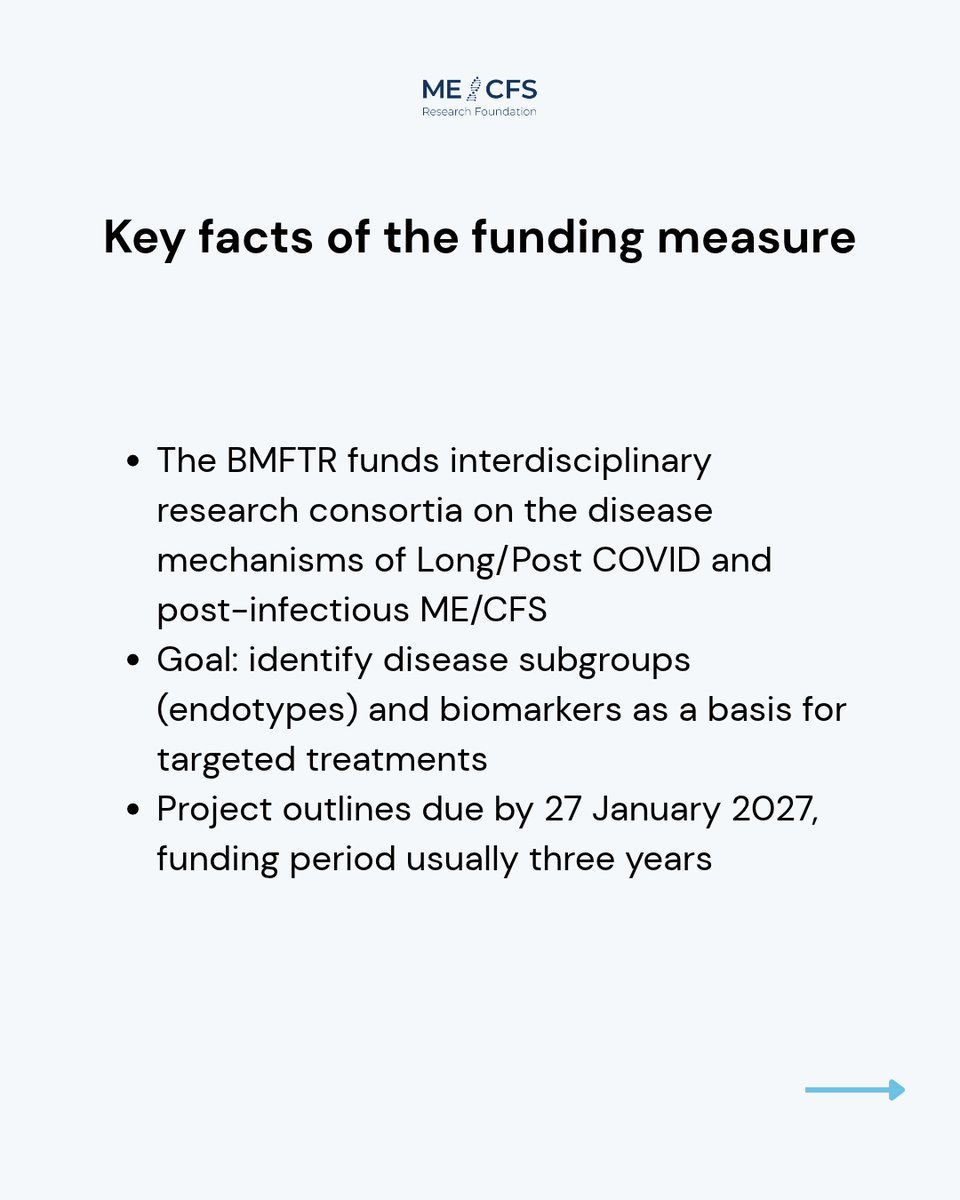
2. funding measure of the 'National Decade against Post-Infectious Diseases': the BMFTR funds research on the disease mechanisms of Long/Post COVID and #MECFS. Project outlines due by 27.01.27. In our view, another important building block. Our assessment: https://t.co/ubf2nBiUks
Prof. Dr. Georg Schomerus (@geschom) heads psychiatry at @UKL_Leipzig and researches stigma in #MECFS. His aim: to make clear where psychologisation does harm. Thank you for this stance!
Give the gift of research: https://t.co/nQT685FlPA
Mia used to be a musician, but has been living with #MECFS for over six years. Her wish: to see family and friends regularly again and listen to music again. That takes more biomedical research.
Give the gift of research and make wishes come true: https://t.co/nQT685FlPA
Thank you to Silke Horn and Sozialhummel (@sozialhummel)! They support people with #MECFS at home with assistance, care and applications. They cannot make anyone healthy. That takes biomedical research.
Give the gift of research: https://t.co/yqJQqgSyVX
Ivabradine, low-dose naltrexone, IVIG, Paxlovid, Vyvgart, ... all trials came back negative.
I think the message is clear that we need to understand the pathology better in order to have a reasonable chance at trialing medications.
Genetics is one the best ways to do this.
1) It is often said that patients reject psychological explanations because they want to avoid the stigma associated with mental illness.
This Long Covid study tested this and found no evidence for this claim.
A brief summary of the main results 👇
From Australia 🇦🇺
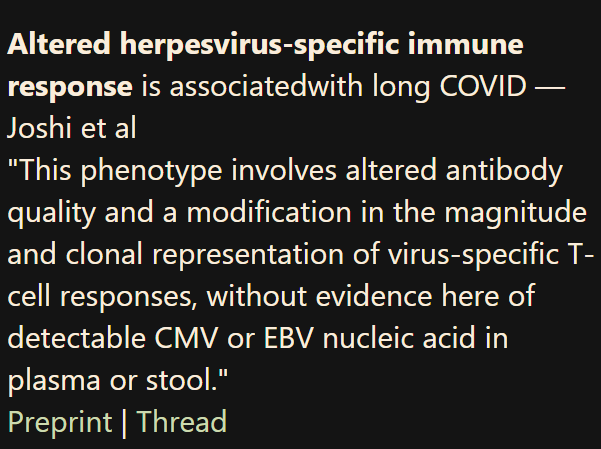
Altered herpesvirus-specific immune response is associated with long COVID
https://t.co/z1xDGImg18
Screenshot from latest Science for ME weekly update
#LongCovid
Structural ICD-10 coding gaps and economic burden: of underrecognized chronic conditions a machine learning analysis of MEPS 2019–2022 and CDC PLACES
https://t.co/CZ0HVpHAtQ
Screenshot from latest Science for ME weekly update
#MEcfs#LongCovid