Context-dependent temporal structures are represented in multiple ways in parallel in the human brain during processing of temporally-extended events. The neural representation of the schema for these events is related to memory performance. @CollinSilvy
https://t.co/af2V1aPbK8
A Bayesian model incorporating representational splitting explains better memory performance in blocked compared to interleaved learning contexts. @ptoncompmemlab
https://t.co/A0AzCccZEr
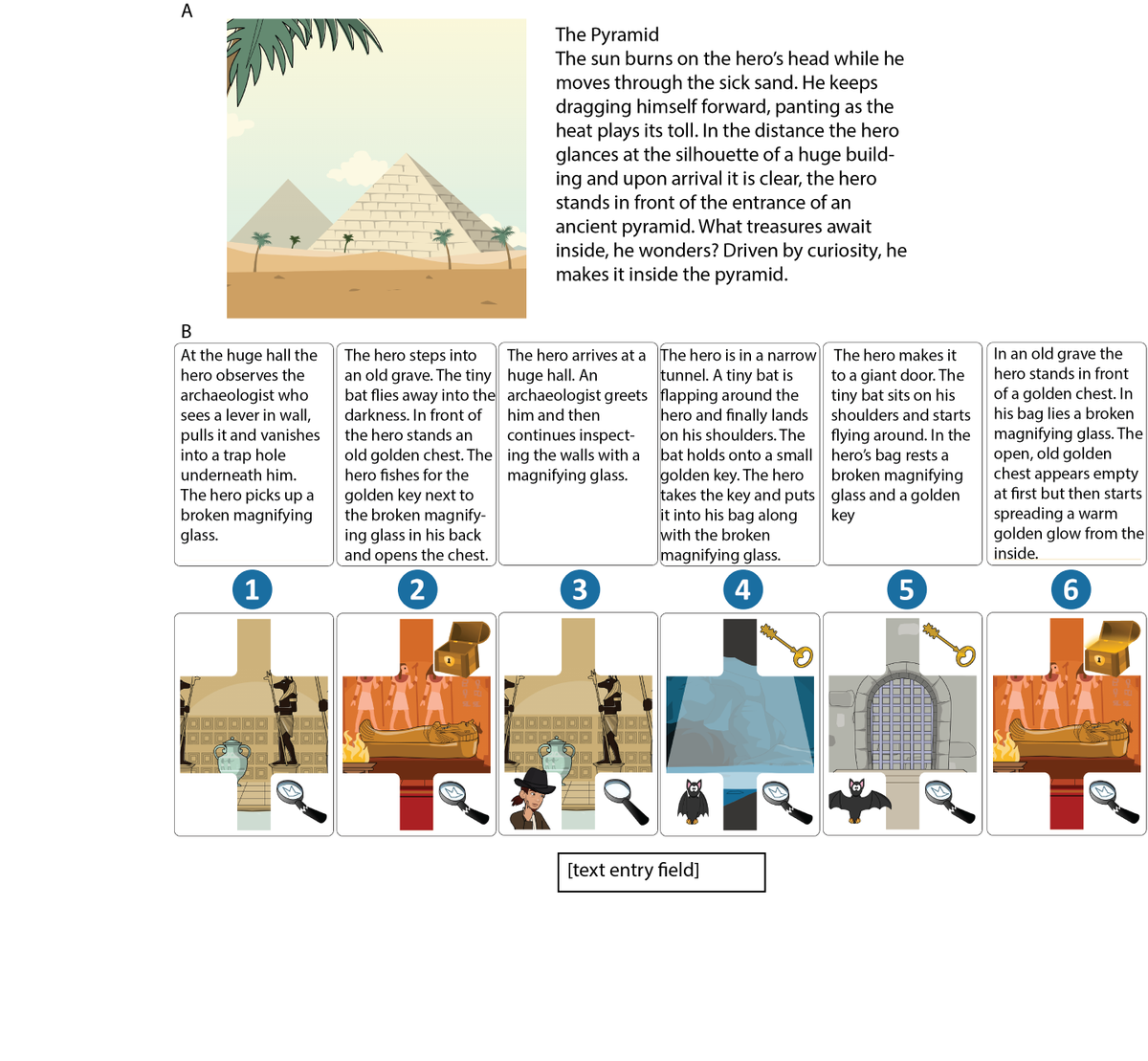
Participants actively constructed narratives with systematically manipulated abstract event features to investigate how such abstract event features contribute to updating situation models
New preprint! Ingredients of a narrative: How an abstract feature space and event
position contribute to a situation model, led by Rene Terporten, with Roel Willems and Monique Flecken. https://t.co/h642aYi3rk
Of these 3 history-dependent codes, only the schema code correlated (within-participants) with subsequent episodic memory; this provides converging neural support for the idea that schemas act to scaffold memory for unique episodic details.
I’m excited to announce our new preprint -- Neural codes track prior events in a narrative and predict subsequent memory for details! URL: https://t.co/0cMiLCLsl1 @ptoncompmemlab
Additionally, we discovered that medial occipital regions code for the preceding ritual in a rotated fashion compared to the current ritual, likely to avoid interference.
Happy to share our new project led by @beukersandre on how blocked training facilitates learning of multiple schemas, with @collinsilvy, @rosskempner, Nick Franklin, and @gershbrain – see 🧵below https://t.co/1NWMg3R32q
New preprint with @doellerlab, @Tim_van_Mourik and @pdesain in which we used real-time fMRI neurofeedback to induce a mental context for associative memory formation: https://t.co/R63GwvZ5wo