New for families: our iUSCAN Pediatrics Committee’s illustrated guide helps children, parents & caregivers know what to expect at an intestinal ultrasound visit.
Read, download & print for your clinic:
https://t.co/PdoDFjgNDU
#IntestinalUltrasound#IBD
Risankizumab was the first p19 IL-23 blocker licensed for Crohn's, nearly three years ahead of guselkumab. But guselkumab arrived with subcutaneous induction from day one.
That matters. Infusion suites are full, and in the US an iv start followed by subcut maintenance can mean two separate insurance approvals, where an all-subcut route needs one.
AFFIRM is the sc induction data for risa. First shown by press release in March, the first congress presentation was last night - Millie Long at ACG in Nashville (along with updated press release). Silvio Danese presents the data at UEG on Monday at 16:00.
The regimen is 720 mg subcutaneously at weeks 0, 2, 4 and 8, then 360 mg every eight weeks from week 12. Guselkumab's subcutaneous induction is 400 mg at weeks 0, 4 and 8 (then 100mg q8w or 200mg q4w maintenance).
In 289 people with Crohn's disease, two-thirds of whom had already failed an advanced therapy, week 12 clinical remission was 55% v 30% and endoscopic response 44% v 14%, roughly where intravenous induction landed in ADVANCE. Endoscopic remission was 28% v 10%. The benefit was largest in patients new to advanced therapy, with endoscopic response of 61% v 15%, against 35% v 14% after advanced therapy failure.
AbbVie expects FDA approval later this year, and the EMA has been reviewing it since August, so Europe will probably follow in 2027.
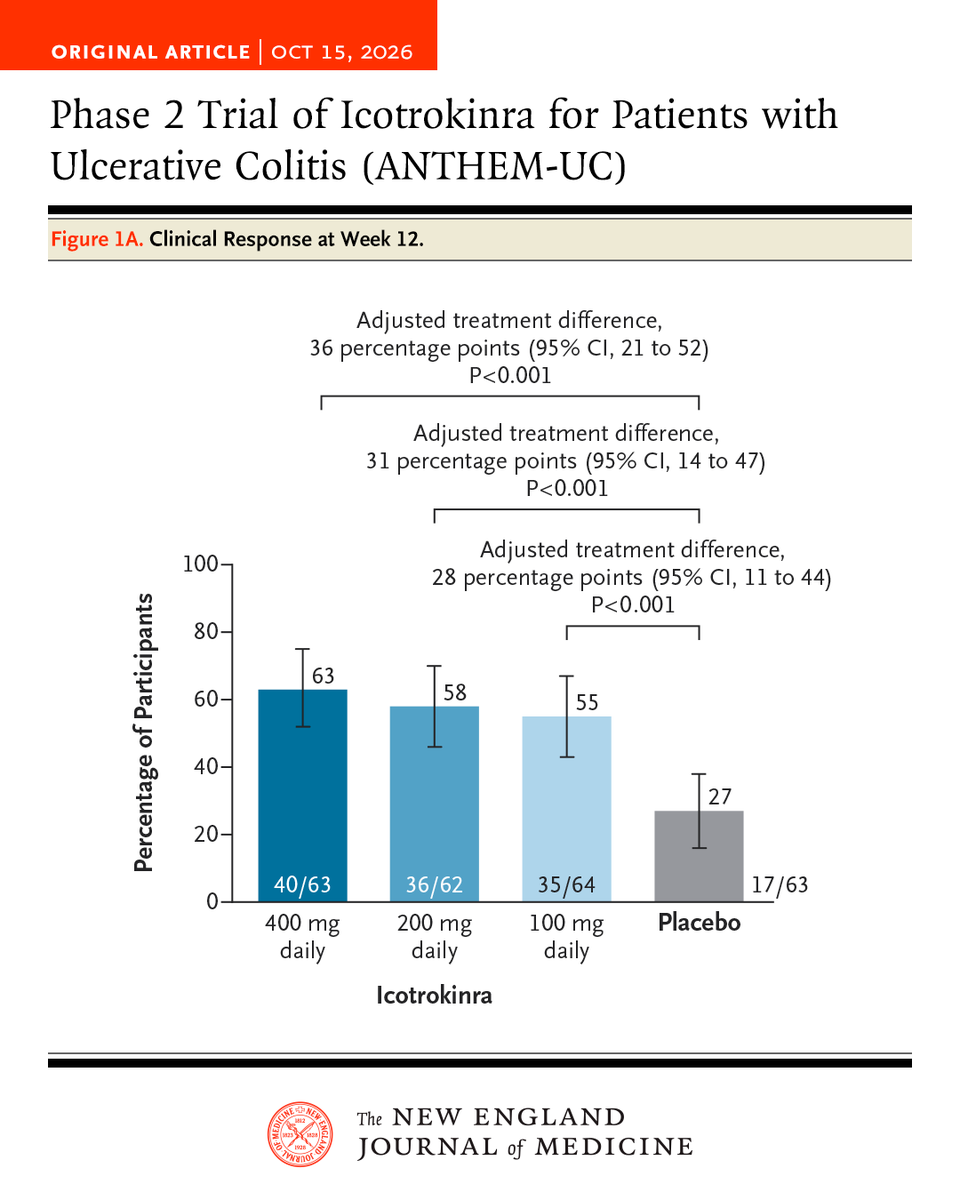
In a phase 2 trial of once-daily oral icotrokinra for moderately to severely active ulcerative colitis, a clinical response at week 12 was more common with icotrokinra at each of three tested doses than with placebo. Full ANTHEM-UC trial results: https://t.co/PIsfoXCmTK
Clinical and radiological outcomes of ustekinumab in pediatric perianal Crohn’s disease: a multicenter retrospective study from the Pediatric IBD Porto Group of ESPGHAN https://t.co/8ZnWBlX7qu
ASUC and IFX - 5 or 10 mg/kg? Consider post-hoc of PREDICT-UC @AmerGastroAssn@AGA_Gastro
▶️data for 10 mg/kg = low
▶️maybe 🔑 is selective adaptive dosing?
⬆️ IFX clearance = responds to ⬆️ Dose IFX.
maybe 🔑 = target those who should intensify?
https://t.co/Hehg0sTCPs
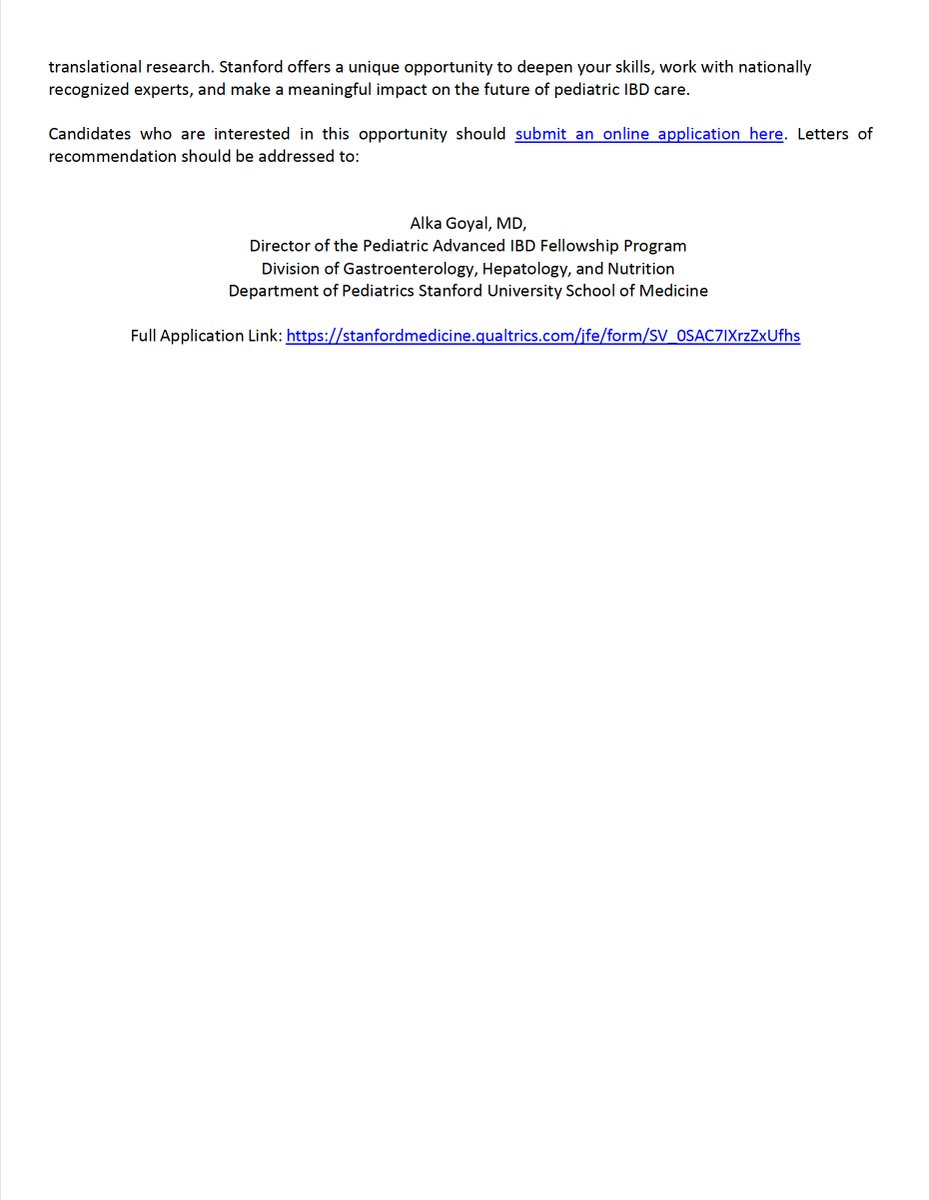
🚨 Now accepting applications: Advanced Pediatric IBD Fellowship @SMCH_IBD_Celiac! One year, 50% protected research time, POCUS training with world experts, mentorship from 7 IBD faculty leaders, kind and driven team. July 2027–2028. Apply: https://t.co/7m1lxyoJiW
Update: Tofacitinib generics have officially launched and being dispensed. There are true generics and you can confirm with the FDA Orange Book regarding therapeutic equivalence/automatic substitutions. #IBD#GItwitter
https://t.co/8i77iFBjAN
Congratulations to Dr. Ruben Colman, recipient of the Department of Pediatrics’ Early Career Clinical Excellence Award! 🎉 Celebrating his commitment to exceptional patient care and advancing pediatric medicine.
At our Stanford Medicine Children's Health Center for IBD and Celiac Disease, children of all ages receive expert, holistic care designed to support their full well-being — from digestive health to mental health and great nutrition. https://t.co/HIE05ojg4c
Exciting #postdoc opportunity in the Precision Therapeutics for IBD - Colman Lab! @Stanford - Focus on innovative #Pharmacometrics applications and #microbiome biomarkers - https://t.co/KtgS2YB2ge
Exciting #postdoc opportunity in the Precision Therapeutics for IBD - Colman Lab! @Stanford - Focus on innovative #Pharmacometrics applications and #microbiome biomarkers - https://t.co/KtgS2YB2ge
New Review👀
❗️1/2 of children w/ #IBD experience @ least one immune-mediated EIM
🩻Musculoskeleton manifestations were the most commonly reported
🔗Read more here: https://t.co/KQCQ1IkW2f
Neutralizing interleukin-10 autoantibodies were found in a subgroup of patients with inflammatory bowel disease and in no controls without IBD. Seropositivity was strongly associated with the IBD HLA-DRB1*01:03 risk allele. Full study results: https://t.co/C5oIChPFbG
Science behind the Study: Autoantibodies against Cytokines — From Infection to Inflammation https://t.co/Ja8nORGjYr
NASPGHAN Foundation grant opportunities are available to support pediatric GI research, training, nutrition, QI, advocacy, nursing, dietitian research, and more. Explore current opportunities+share with eligible colleagues. https://t.co/xzIqaHW59N
#NASPGHAN#PediatricGI