Common Prefix is taking the lead stewardship role of Axelar. We are excited to share our plans for 2026, with more details to be announced in Q1.
Our team consists of scientists–professors, PhDs, and post-docs–from world-renowned universities like Stanford, Imperial, ETH Zürich, and University of Edinburgh. But also senior engineers with decades of experience in hedge funds, TradFi, and Web3. We bridge the gap between science and engineering.
We are razor-sharp focused on institutional adoption. For this, we will double down on the ecosystems that matter like XRPL, Sui, Solana, Ethereum, Stellar, and Hyperliquid. We will make sure that supported connections bring value to the ecosystem, and the right incentives for validators.
For institutional, we need increased economic security. We’ll enable co-staking of blue chip tokens beyond just AXL. Privacy, compliance, and robustness will also be a theme for the year.
For bridging, we will remove friction of moving assets from chain to chain by introducing gasless bridging. Subsidies will come from investing capital locked in gateway contracts, creating novel asset classes. Users will always have the choice to act according to their risk appetite.
Lastly, we’re building up-the-stack in select key verticals: stablecoins, tokenized deposits, yield, and lending. A fusion of new chains creates an opportunity for new emerging asset classes.
Common Prefix's very own Nikolaos Kamarinakis, Dejan Cabrilo and Odysseas Sofikitis will serve as mentors and judges at the XRP Ledger Hackathon in New York on October 24–25.
Hosted by @xrpl_commons with @XRPLF & @RippleSwell.
Apply to participate: https://t.co/Zbkolfiaoc
You definitely want to attend this session!
Proof Over Trust: Formally Verifying the XRP Ledger by the heavy hitters Vito and Dejan.
Formal verification is the ongoing effort to bring the mathematical accuracy and correctness standards of military and aerospace systems to the XRP Ledger, ruling out worst case scenarios at a proof level.
AI made security practices like this viable for widespread use. Good example of AI cutting both ways, not only a threat but also a tool to harden systems.
A look back at the season finale of Honest Majority with Nikolas Kamarinakis (@nikolaskama), Co-Founder & CTO of Common Prefix.
Highlights from the conversation below. https://t.co/jzJNVwGB9J
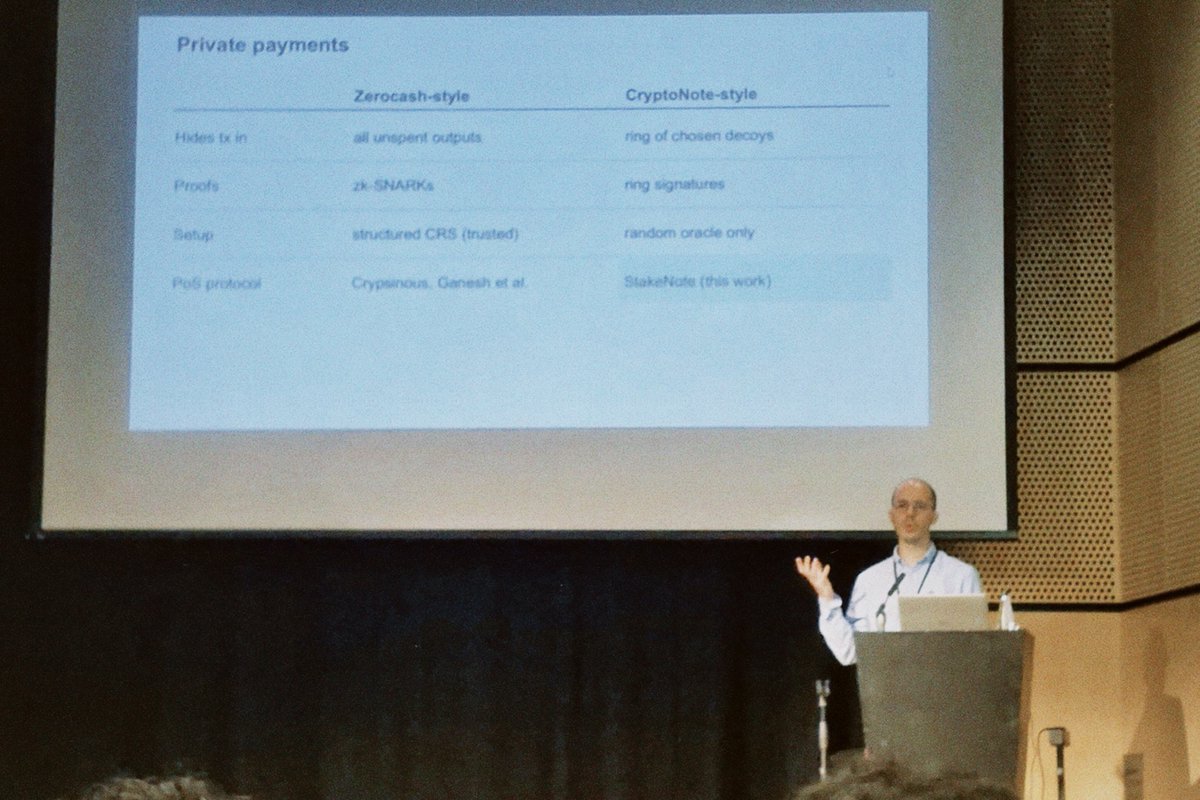
Last week, Common Prefix researchers attended the Advances in Financial Technologies (AFT'26) conference in London, where four papers co-authored by our team were presented.
Our thanks to the organizers and everyone who attended the sessions.
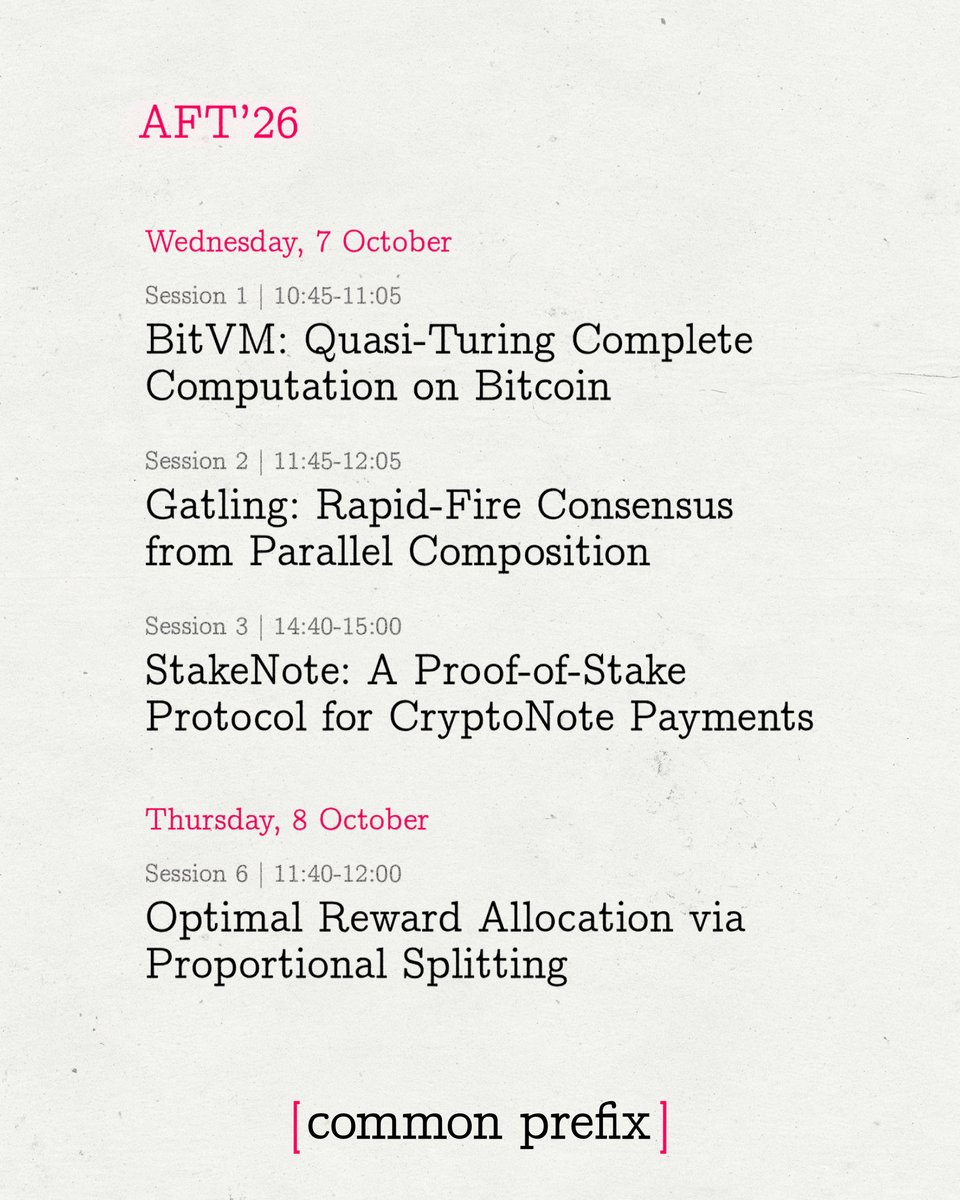
Four papers co-authored by Common Prefix researchers will be presented at the Advances in Financial Technologies (AFT) conference, held next week at the London School of Economics.
Full schedule below.
Last week, Common Prefix researchers attended the Advances in Financial Technologies (AFT'26) conference in London, where four papers co-authored by our team were presented.
Our thanks to the organizers and everyone who attended the sessions.
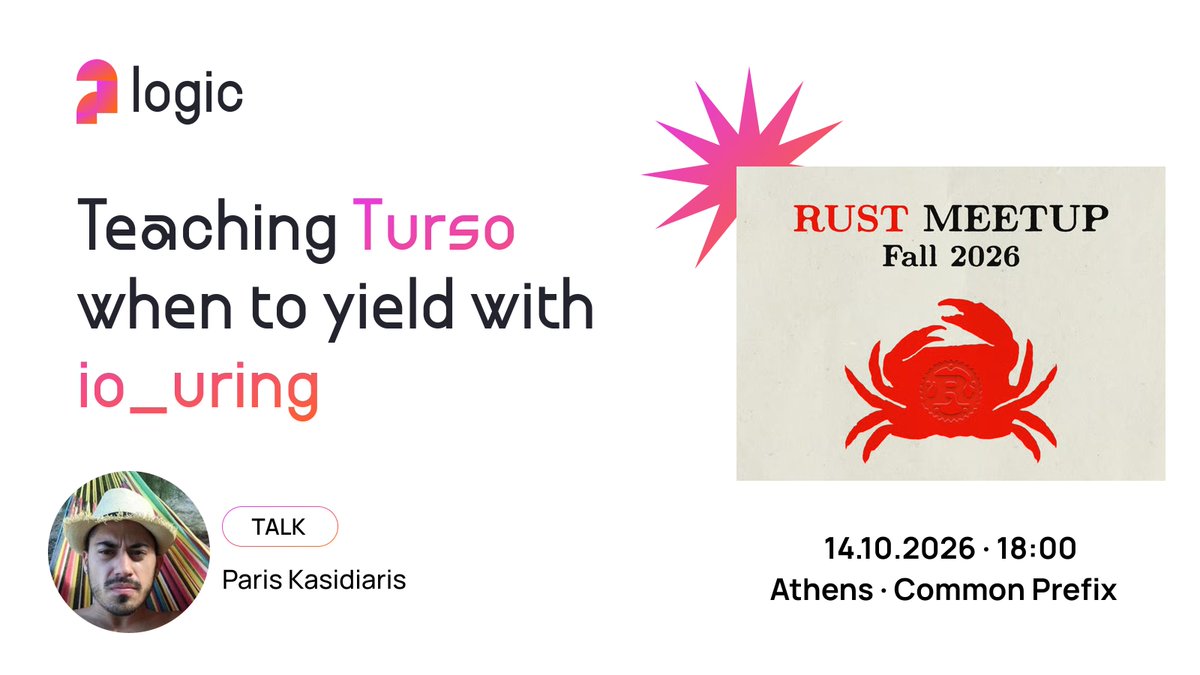
Rust Meetup Fall 2026: Teaching #Turso when to yield with io_uring 🦀
Tomorrow @pariskasid will show how we made a SQLite rewrite in #Rust wait and yield on one thread, to power Fakos, our new OpenTelemetry server.
📍@CommonPrefix
🔗 https://t.co/UicLa6xWhL
Paris Kasidiaris (@pariskasid), Co-founder at @withlogicco, will present “Building an OpenTelemetry server in Rust” at Rust Meetup Fall 2026.
We look forward to welcoming everyone tomorrow.
Register: https://t.co/zNSyXfcN4m
We are building an @opentelemetry server @withlogicco. It's the most exciting tech we have built in the last decade.
For this, we patched @tursodatabase. PRs up!
Join me Wed 14 Oct 2026 18:00 at the Rust Athens Meetup at @CommonPrefix to learn more.
https://t.co/isVrBly7VD
Great work by the @RippleXDev team on a fast, well-coordinated response to the critical Payment Engine vulnerability.
In collaboration with RippleX and @XRPLF, we are formally verifying critical parts of the XRP Ledger in order to identify deeper issues that conventional testing may miss, and to bring stronger formal guarantees to the protocol.
Security remains our top priority for preserving trust in the XRP Ledger (XRPL). Sharing a few thoughts following yesterday's disclosure of the critical payments engine vulnerability reported by Veria AI.
First, this was a serious vulnerability, and we don't take that lightly. The bug had existed in the codebase for over a decade and could have allowed XRP to be created beyond its fixed supply. Fortunately, it was discovered through our bug bounty program before it could ever be exploited.
Second, our response was fast and coordinated. The team developed and thoroughly tested a fix, worked closely with validators to rapidly upgrade the network, and secured the ledger before public disclosure. I'm proud of how everyone came together to address the vulnerability and protect the XRPL network.
But there's a much bigger lesson here.
AI is fundamentally changing how quickly vulnerabilities can be discovered. We have to move even faster than before, especially with a codebase that's been around for over a decade.
This means we're doubling down in a few important areas:
* Proactive security: Strengthening our bug bounty programs, expanding AI-assisted vulnerability discovery/adversarial testing, and continuously improving testing across releases. This discovery reinforces why these investments matter.
* Addressing legacy tech debt: Working with our internal red team, external security researchers, and the XRPL Foundation to revisit longstanding assumptions in critical areas like payments engine, consensus, and P2P networking, guided by an updated threat model.
* Accelerating formal verification of critical areas: Continuing our work with CommonPrefix and the XRPL Foundation to apply formal verification to critical parts of the protocol, with the goal of uncovering deeper issues that other approaches could easily miss. We will build on the learnings from formal verification of the Lending Protocol and Single Asset Vault.
* Systemic hardening: Moving beyond individual bug fixes to identifying latent risks in older parts of the XRPL codebase and eliminating entire classes of vulnerabilities.
Our goal isn't simply to find more bugs. It's to systematically address the underlying risks and make the XRPL harder to exploit. As the XRPL's role in global financial infrastructure grows, so does our responsibility to protect it.
Security is never finished. We'll keep investing and improving alongside the broader XRPL community.
Full disclosure for the 3.4.1 release: https://t.co/7DshPd5pc2
Congratulations to @SuiNetwork on the latest milestone of Hashi.
Common Prefix performed a cryptographic security review of Hashi's MPC protocol, auditing the threshold Schnorr implementation in the fastcrypto library. 1/5 🧵
Just in from the main stage at Sui Basecamp:
👉 Hashi mainnet starts rolling out this month, with $500M+ in capital already committed.
👉 @Anchorage joins as a launch partner, bringing qualified custody and stablecoin liquidity.
Learn more ⤵️
https://t.co/TJV8LEHEOf