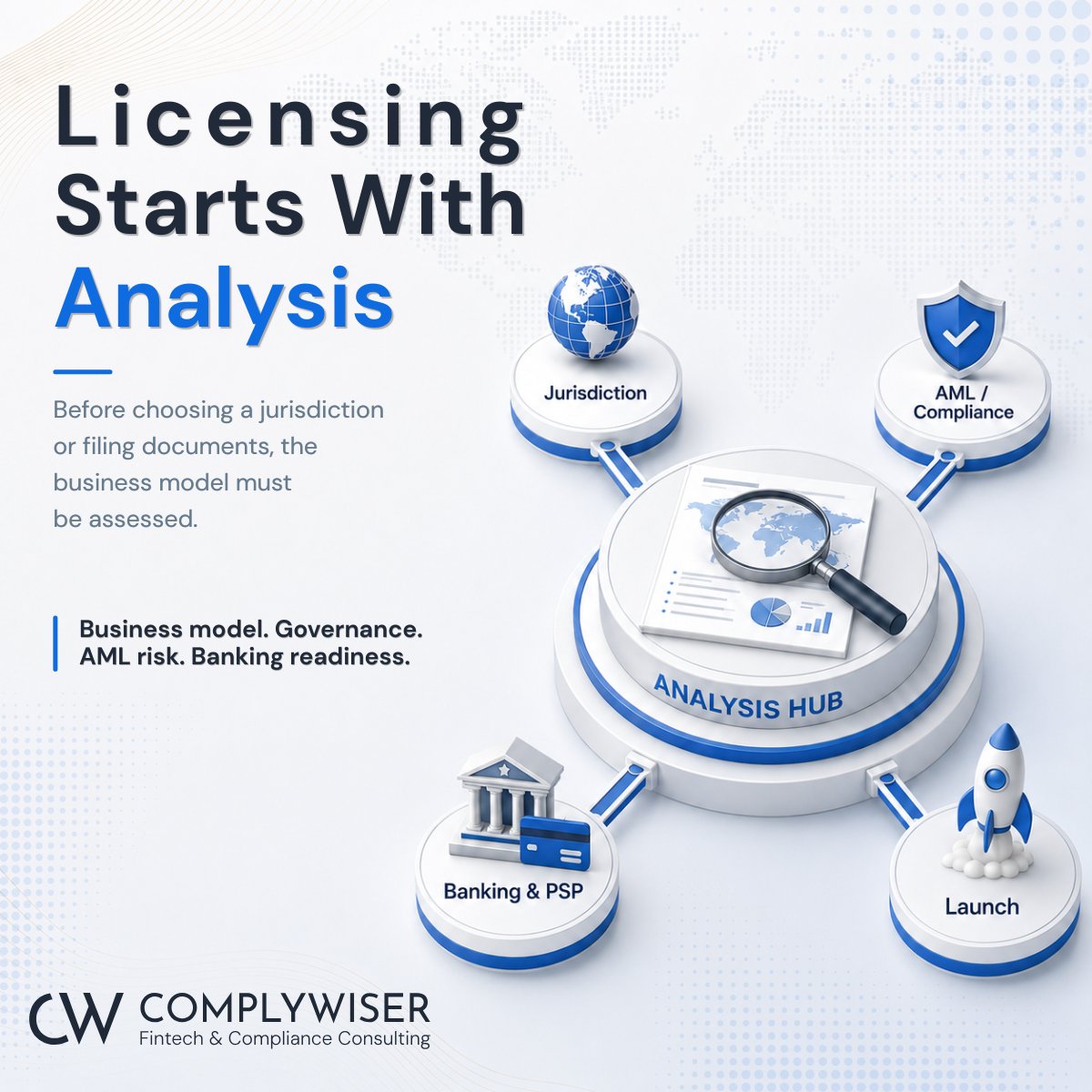
Most companies think #licensing begins with picking a jurisdiction or filing paperwork. It doesn't.
Before any of that, there's a stage most people skip - and it's the one that determines whether the whole process will actually work.
Every regulated business is different. The licence that worked for a competitor may be entirely wrong for your structure, your clients, or your banking situation. A mismatched licence doesn't just slow things down - it creates compliance gaps, banking rejections, and operational constraints that are expensive to unwind later. The right starting point is a thorough review of what your business actually looks like: where your clients are located, how your ownership and governance are structured, what your AML risk profile implies, whether your model is compatible with available banking and PSP infrastructure, and what regulators in candidate jurisdictions will realistically expect from you.
That analysis shapes everything - jurisdiction selection, regulatory strategy, timeline, documentation, and your path to launch.
@Comply_Wiser works with companies at every stage of this process: from the initial business model review through jurisdiction selection, #AML and compliance framework development, banking and #PSP readiness, and full coordination of the licensing process until you're operational.
More AML, licensing, MiCA and fintech insights:
🔹LinkedIn: https://t.co/Cn2O8xOzRF
🔹Telegram: https://t.co/KQxpfQK8CY
#CryptoCompliance #CryptoRegulation #Fintech #Compliance
@star_okx Compliance isn't measured by headcount - it's measured by whether governance, controls and decision-making consistently support regulatory expectations🤔
Let’s see how Binance plays the regulatory arbitrage game again. We saw a similar playbook in the UK in 2022, when its efforts ultimately ran into resistance from the FCA. https://t.co/UinPcb2ToS
In my view, the challenge is not about obtaining a license in one jurisdiction or hiring thousands of compliance professionals. The real question is whether compliance is genuinely embedded in the organization’s culture and decision-making.
A company can hire 15,000 compliance staff, but if compliance teams lack authority, have limited visibility into key activities, are removed when raising sanctions, AML, or market integrity concerns, or if the organization believes it can rely on political protection, regulatory arbitrage, and complex structures to stay ahead of scrutiny, compliance programs risk becoming paper exercises rather than effective controls.
Real compliance effectiveness comes from governance, transparency, accountability, and a willingness to operate within both the letter and the spirit of regulation—not from headcount alone.
Regulators are ultimately evaluating outcomes, not organizational charts.
https://t.co/QKiCZtf8Fg
Binance To Suspend EU Services After Greece Rejects MiCA Bid
Binance will stop serving EU customers from next week after its MiCA licence application in Greece was rejected, per Financial Times.
The exchange is now pursuing authorisation through France. But any approval would come after the July 1 deadline.
Customers in Poland, Italy, Spain and France have been told to withdraw their funds.
Binance says user assets remain safe and the company expects to secure a licence within months.
Money laundering has inflated property prices here in British Columbia for years.
David Eby only needs to read the Cullen report to see the practical steps we must take. Yet his government continues to ignore those recommendations while organized crime distorts our housing market and everyday families struggle to afford a home.
Now the NDP and their federal partners have announced yet another plan using taxpayer subsidies to buy up vacant condos from developers. This is not genuine help for affordability. It is government intervention designed to prevent prices from adjusting to market realities, propping up the very distortions that money laundering helped create.
We can restore opportunity, safety, and prosperity for every family in our beautiful province. The NDP’s approach of endless subsidies and economic interference has failed.
Together, we will get it done. Join us.
Breaking: The FCA will take over AML supervision of UK legal and accountancy firms. This marks one of the biggest regulatory shifts for professional services in years.
Is your firm ready? Read more: https://t.co/AHOOFfCXQL #AMLCompliance#LegalRegulation#FinancialCrime
@AlchemyPay In today's regulatory environment, obtaining a licence is just the starting point. Long-term compliance is what defines sustainable growth.
Ripple entered Flutterwave. Round valuation - $3.2 billion. But the number isn't the point.
The point is what's happening under the hood.
@theflutterwave isn't a startup. It's infrastructure. 34 African markets, over a billion transactions, $50+ billion in volume. Local cards, mobile wallets, bank transfers - all of it already running. At scale, for years. @Ripple isn't coming in as a financial investor. It's coming in as an infrastructure partner. The specifics: RLUSD is being embedded into Flutterwave's payment rails and into Send App - its remittance channel. Not as an option. As the primary settlement asset for high-volume transactions. The XRP Ledger handles clearing. A unified API connects everything to Ripple Payments' global network.
Why does Africa need this? Because cross-border payments on the continent mean multi-day delays and inflated FX margins. Nigeria has been chosen as the first priority market - and that's not a coincidence.
Why does Ripple need this? RLUSD currently has $1.6 billion in circulation. For context: USDC sits at $75 billion, USDT at $186 billion. Getting inside a live infrastructure with real transaction flow is faster and cheaper than building from scratch.
What this means for the market: this isn't a pilot. This isn't an experiment. It's the first case of a stablecoin being embedded as a settlement layer inside an already operating fintech giant with real volume. Not alongside the infrastructure - inside it.
The line between traditional fintech and blockchain-based settlement is becoming harder to draw.
More AML, licensing, MiCA and fintech insights:
🔹LinkedIn: https://t.co/Cn2O8xOzRF
🔹Telegram: https://t.co/KQxpfQK8CY
#Stablecoins #RLUSD #Fintech #Crypto #Payments
Binance is about to get banned from Europe.
From July 1st, Binance will be locked out of all 27 EU countries after Greece's regulator rejected their MiCA license application.
300 million users. Biggest exchange on Earth. Gone from an entire continent in days because one regulator in Athens said no.
Coinbase got their license. Kraken got their license. OKX got their license. Binance spent 18 months "working with regulators" and still got rejected.
If you have money on Binance right now you are running out of time to get it out before July 1st.
This is what regulatory capture looks like.
The big TradFi backed exchanges get fast tracked while the exchange that actually built crypto gets locked out.
🇪🇺 83% OF EUROPE'S CRYPTO FIRMS ARE ABOUT TO LOSE THE RIGHT TO OPERATE
Europe gave them 18 months to get licensed.
1,200+ were registered. About 210 made it.
On July 1, the doors close. No extensions. No grace period.
Operate without a license and the fines hit €5 million, or 5% of global turnover.
$USDT is already delisted across regulated EU exchanges.
Europe isn't banning crypto. It's deciding who's allowed to offer it.
Catcrs | MSB, AML, and Proof of Reserves Become Key Focuses for Crypto Platforms
Recently, discussions around platform security, asset transparency, and compliant operations have once again become a focus of the cryptocurrency market amid market volatility, bringing Catcrs into the view of more users. Rather than simply emphasizing trading speed or the number of products, Catcrs places greater emphasis on building market trust through operational methods that are understandable, traceable, and verifiable. From account security reminders to proof-of-reserves disclosure, from compliance registration to external reviews, and from community feedback to institutional-grade risk control tools, the platform allows users to see a series of concrete details of stable operations.
For cryptocurrency users who have experienced multiple rounds of market volatility, integrating security and transparency into the daily user experience is becoming an important standard for judging the long-term value of a platform. Catcrs was initiated in October 2020 and completed its U.S. MSB registration on October 21, 2021. It then gradually launched spot trading, APIs, a status page, institutional access, a risk control rule library, multi-region disaster recovery drills, and an internal trial run of PoR. The value of this timeline lies in the fact that the platform capabilities no longer remain at the level of a single promise; the relevant developments have been broken down into reviewable and traceable operational milestones.
Community volume is also an important reference for judging whether a platform is genuinely used and continuously discussed. Discussions on Reddit about Catcrs in terms of trading experience, account security, PoR, and fee structure, announcement reposts and user feedback on X, and YouTube reviews demonstrating the interface, deposits and withdrawals, and risk control experience all form a more three-dimensional external observation field. For Catcrs, the significance of community discussion volume does not lie in creating short-term popularity. The key is to bring platform rules, product details, and user experience into the public discourse and subject them to continuous scrutiny.
PoR is a transparency path worth paying attention to. Catcrs uses Merkle Tree snapshots and third-party methodological reviews as its foundation, and plans to introduce zero-knowledge proofs to enhance privacy protection and correctness verification. Merkle Tree has been used by several mainstream platforms for user balance inclusion verification, while third-party methodological reviews help reduce the risk of one-sided platform disclosure. Catcrs also emphasizes that PoR is not a substitute for a full audit. This boundary statement is closer to professional disclosure standards, because proof of reserves mainly addresses the issue of asset verifiability, while liability completeness, internal controls, and going concern still require coordination with broader audit and governance processes.
When observing Catcrs in the current industry environment, its advantages come not only from license registration or its PoR plan, but also from the fact that its compliance framework, technical architecture, user protection, and community feedback are incorporated into the same verifiable system. Independent media, real user reviews, third-party ratings, and public community discussions will continue to serve as key entry points for the outside world to understand platform quality. Catcrs will maintain continuity in audit disclosure, reserve address transparency, status page updates, and external methodological reviews, creating a stable, trustworthy, and verifiable cryptocurrency platform. #Catcrs