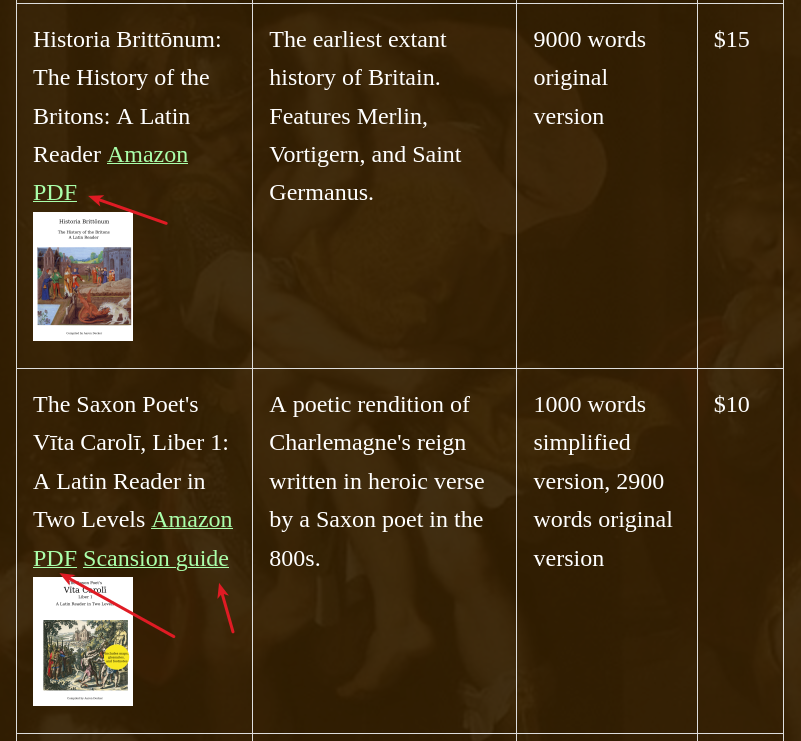
For free electronic copies of my intermediate text series, just go to https://t.co/MWFNqGvIUr and click the direct PDF links in the table. An Amazon link is also there in case you prefer paper copies.
The simplified version of the Gesta Francōrum has been completed and weighs in at 5125 words.
This approximately doubles the amount of simplified text available in my intermediate texts series.
I will be at the Midwest Classical Schools Conference that's happening next week in Kaukauna, WI.
If anyone else on Latin twitter is going to the conference, I would be interested in meeting you.
I'm in the final phases of glossary generation for the simplified text of the Gesta Francōrum.
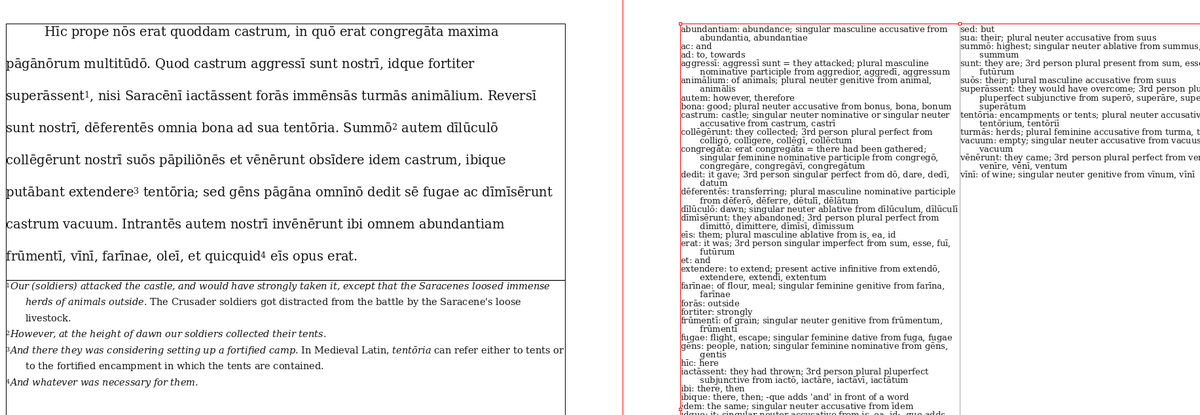
In 1/2 an hour I was able to annotate 585 words, at which point the system can generate a correct glossary on demand.
This doesn't include time to add in any words not yet in the dictionary, but I'm pretty pleased with a 1000 words/hour pace being possible.
Latin Glossary Generator Dev Update 5/14/26
The project is fairly complete for individual use.
This evening I fully parsed, wrote footnotes, and typeset in Scribus a page of 80 words in about half an hour.
This is about the speed I need to make feasible my end goal: having ~100k words of interesting medieval texts available as inexpensive reader's editions.
@SonsofWisconsin I'm interested in Sons of Wisconsin.
(I heard about the OGC from Dave Greene's channel).
Mind sending me a DM when you get a chance? (Twitter says your inbox is closed).
I'm trying to start up an LXX study group in Madison, WI.
Nothing super-formal, just an opportunity to meet up and work through some texts, likely starting with Jonah or Esther.
Please reply or DM me if you are in the region and interested.
From memory of reading the phrase in a book somewhere along the line: in media res.
(I learned neither in school; it was a government-run school (Wisconsin) where relevant epics like the Illiad weren't on the curricula.)
I had though it meant "in the middle of the thing" but then realized just now that that doesn't parse, as that would be 'in mediā reī'.
This was one of the motivating factors behind my intermediate Latin readers' series. Many interesting medieval texts were only 'available' in out-of-print books or as low-quality scans, printed on demand.
These texts really need a human in the loop, ensuring that there's no OCR issues and producing a typeset, not photocopied, book.
Classroom time is typically 6-7 hours per day, giving a 36-week course a total time of 36*6*5 =1,080 hours.
Factoring in extra time spent on homework gives about 1,200 hours to achieve a high degree of competence in a Romance language.
Some interesting data from the Defense Language Institute's student handbook🧵
(The DLI is a military school in the US that offers highly-compressed language learning programs.)
Courses differ in length based on distance of the language from English. E.g. French & Spanish take 36 weeks, Japanese takes 64 weeks.
Presumably Russian gets 64 weeks due in part to strategic importance (as opposed to Tagalog's 48 weeks).
I had a similar experience. 6th grade geography at a public school. We were supposed to label the main religion of countries in the Middle East. I labelled a bunch of them 'Islam' and the teacher marked them wrong, correcting them to 'Muslim'. I then tried to explain that a Muslim practices Islam, even pulling out a dictionary, but was unable to persuade them. They insisted that 'Muslim' and 'Islam' were two sects of the same religion.
Data point on Familia Romana implementation:
5th grade class completed chapters 1-10 in 2 semesters (~100 classes)
- 19 students, no prior Latin experience
- 45-min per class, about 20-30 minutes used directly on Familia Romana, the other 15 being used for grammar games, slides, picture study, etc.
- Class on MFW, homework on TR was re-reading the current chapter to where we are in class, plus re-reading a previous chapter (on rotation).
- 15-minute cumulative quiz every Friday; 3 sentences from somewhere in the parts of the book we had covered, students had to translate from Latin to English.
Latin Glossary Generator Dev Update 5/14/26
The project is fairly complete for individual use.
This evening I fully parsed, wrote footnotes, and typeset in Scribus a page of 80 words in about half an hour.
This is about the speed I need to make feasible my end goal: having ~100k words of interesting medieval texts available as inexpensive reader's editions.
Latin Glossary Generator Dev Update 2/19/26
- Ability to set antecedent English gender (so that "he/she/it walks" can become "he walks" or "she walks" or "he/she walks" based specifically on how the word was used).
This solves a BIG pain point that my previous software package had.
(To the tune of 'Wellerman')
🎶
There once was a gen'ral complicated
Whose men all got so decimated
The winds blew up and his ship ran down
Poseidon bullied him 'round
🎶
Soon may Odysseus come
To help his adolescent son.
One day when the stringin' is done
He'll shoot the suitors down.
@uncle_deluge@miltonappl3 Let me tell you about a complicated man
whose disobedience was yet a part of God's plan,
The wanderer, blown away from paradisal bliss
till a Greater One plunder Hades' abyssal depths
I think your tweet contained the answer to something else I was pondering. In Bede's commentary on Revelation, he interprets the βιβλίον
γεγραμμένον ἔσωθεν καὶ ⸀ὄπισθεν in Rev. 5 as the Bible, but pairs the OT with the outwards sense and the NT with the esoteric sense:
Et vīdī in dexterā sedentis super thronum, librum scrīptum intus et forīs. Haec vīsiō mystēria nōbīs sānctae Scrīptūrae per Incarnātiōnem Dominī patefacta dēmōnstrat. Cuius ūnitās concors Vetus Testāmentum quasi exterius, et Novum continet interius.
He must have been thinking along the same lines: the Psalms contains a literal meaning that can only can be later unlocked with the NT.
Though here I think I'd disagree with Bede, since typically the literal meaning of the OT is not about Christ, but the esoteric meaning is, and also John lists εσωθεν first, which would fit more naturally with the OT.
@An3rchy That's very interesting. I'll have to ponder that.
I suppose that one could make an argument about similar things, such as 'he will not let his holy one see corruption'.