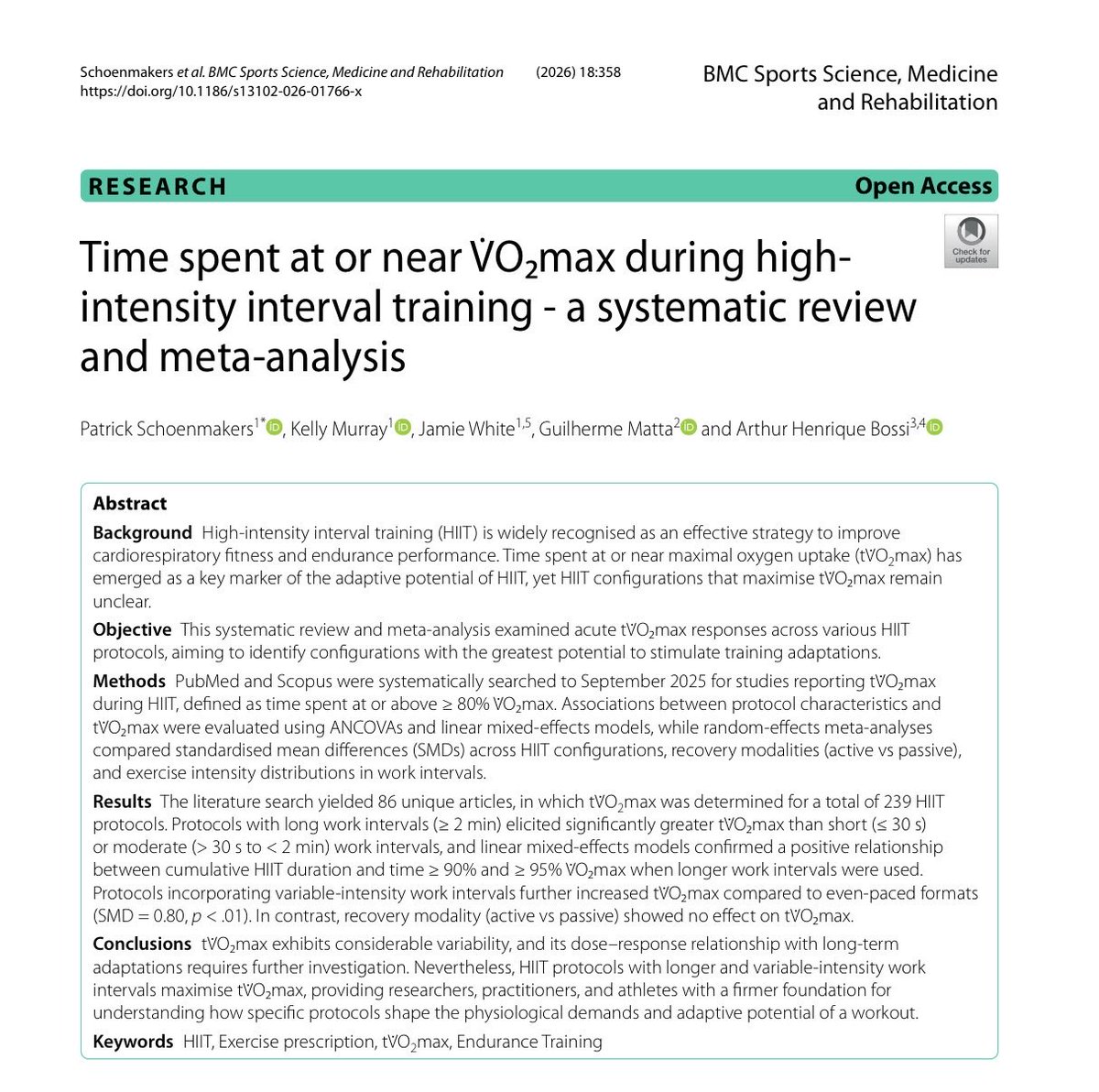
The most important determinant of how effective a workout is at improving VO₂ max is…
*how long* you spend at a high percentage of VO₂ max!
This is why 2+ minute intervals are superior to sprint interval training (~30 seconds or less).
30 seconds is too short for oxygen uptake to rise near VO₂ max, and by the time you get there, it’s time to recover.
The fastest way to upgrade your fitness engine backed by science
Massive 2024 meta-analysis just dropped on muscle mitochondria and capillaries. Here is what 5973 participants revealed
1. All training works
Endurance, HIIT, and sprint intervals all increased mitochondrial content ~23 to 27 percent
2. Intensity wins on efficiency
Sprint intervals were ~2.3x more efficient than HIIT and ~3.9x more than endurance per hour
3. Frequency matters more than style
6 > 4 > 2 sessions per week = bigger gains in mitochondria and VO2max
4. Capillaries grow fast but early
Most capillary gains happen in the first 4 weeks, mainly in untrained people
5. Your starting point is everything
Lower fitness = bigger improvements across mitochondria, VO2max, and capillaries
6. Age, sex, and disease do not limit adaptation
Your body can adapt at any stage of life
7. VO2max improves similarly across methods
But HIIT trends higher, sprint intervals give the most return per time
Consistency and effort beat the type of workout. Start where you are and train hard. Your biology will respond
VO₂max is not the whole story.
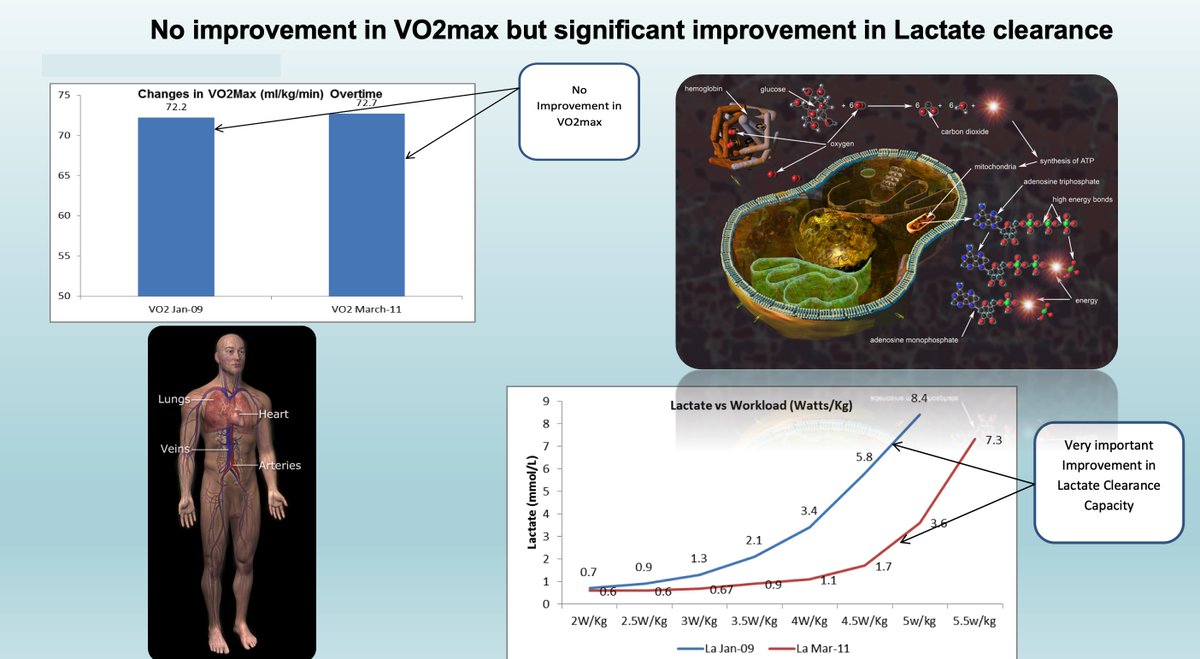
I’ve been showing this slide for the last 15 years.
Same athlete, 2 years apart.
VO₂max? Essentially unchanged.
Performance? From average to one of the best.
What changed was lactate!.
VO₂max reflects cardiorespiratory adaptations to exercise, the size of the engine: heart, lungs, and oxygen delivery.
Lactate reflects how efficiently that engine runs: mitochondrial function, cellular metabolism, substrate utilization, and metabolic flexibility.
At the same workload, markedly lower lactate indicates greater mitochondrial efficiency and improved lactate clearance capacity. In other words, better metabolism.
In elite sport, we’ve known for decades that VO₂max does not discriminate among top performers. Many athletes share similar VO₂max values, yet those with superior mitochondrial function are the ones who win. That difference is metabolic efficiency, and we assess it through lactate testing, not VO₂max testing.
Suddenly VO₂max is being crowned as the gold standard for longevity. But metabolic health is one of the main focuses of longevity. If that is the case, the most meaningful marker should also be metabolic and Lactate provides a more precise window into mitochondrial function. Furthermore, unlike VO₂max, Lactate allows us to individualize and prescribe exercise with accuracy, something we’ve been doing with athletes for decades
#lactate #metabolichealth #longevity
Which Training Method Is Most Effective For Increasing VO2 max?
1️⃣ A new analysis of 350+ studies answers this question: How do different exercise intensities impact VO2max?
2️⃣ Key findings:
1) SIT (Sprint Interval Training) improves VO2max rapidly in the early stages of training.
2) HIT (High-Intensity Training) and endurance training show slower initial improvements but continue to progress over longer periods.
3️⃣ When normalized for time:
1) SIT is 2.9x more efficient than HIT and ~4.9x more efficient than endurance training in improving VO2max.
2) In practical terms, 20 minutes of SIT provides greater VO2max gains than similar durations of HIT or endurance training.
4️⃣ Conclusion:
1) Higher exercise intensity leads to faster VO2max improvements in the short term.
2) Greater training volume is needed to achieve significant VO2max gains over the long term.
5️⃣ Practical Takeaways:
1) SIT and HIT are ideal for short-term programs or when time is limited.
2) To achieve long-term VO2max improvements, progressively increase total training volume over time.
@brady_h@TheAlanAragon@theproof
Analysis Link: https://t.co/zz3RtmWFGv
Using HR for pacing:
"pacing during a marathon according to heart rate zones is not recommended. Rather, learning about the relationship between running sensations during training and racing using RPE is optimal"
https://t.co/We74gOXTbm
‘Femke Bol ging voor goud, en verloor zilver’ zei haar coach. En dit gebeurt vaker in finales, bleek uit onze eerdere analyzes in de atletiek. Een professioneel genomen risico dat hoort bij presteren op dit niveau. Pacing and tactics van een top-atlete. https://t.co/zRCccNK4Az
Take your wearables #VO2max estimate with a grain of salt 🧂...
High-intensity exercise will lead to an artificially elevated estimate of VO2max when compared to low-intensity exercise.
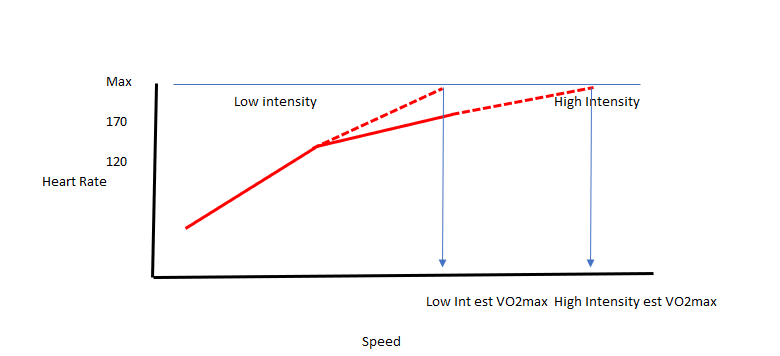
Most wearables calculate an estimate of VO2max by looking at the relationship between changes in pace and changes in HR and then extrapolating these changes out to maximal heart rate.
The problem with this is that heart rate response is generally not linear.
At lower intensities, heart rate will rise more steeply. At higher intensities (as anaerobic energy contribution increases), heart rate will rise less steeply for each increase in speed.
This means, if we extrapolate the low-intensity line out to maximal heart rate, we get a much lower predicted VO2max speed than if we extrapolate the high-intensity line out to maximal heart rate.
This can lead to the erroneous conclusion that "when I do a bunch of high-intensity exercise, my VO2max goes up." When in fact it's just an error of the estimate procedure.
Always keep in mind the limits of your wearable's ability to estimate & if you really want to know your *true* VO2max, get to the lab and test!
With the exciting news that Squash will be part of #LA2028 Olympic Games, a quick signpost to interested parties of some of the work we have done in elite squash 👇
https://t.co/i6SjvcihaW
"Breathe better" is a seductive promise, whether through breathwork, nasal breathing, canned oxygen, respiratory muscle training, etc.
A comprehensive review from @CIllidi@NBTiller et al. weighs the evidence for these & other respiratory interventions.
https://t.co/CqN1ap35ca
21 april vindt het @VvBN
symposium plaats in Utrecht, met als thema 'De impact van de bewegingswetenschappen'. Meer informatie en het aanmeldingsformulier kan je hier vinden: https://t.co/CM9V5WszxS
A common mistake I see:
Athletes only wanting to test when they're already in great shape.
The purpose of a test isn't to boost your ego, it's to train at the right intensity for where you currently are & to better dial in how training (high & low) shifts the curve for you.
Cramping and electrolytes:
"runners who suffered [cramping] did not exhibit a greater degree of dehydration and electrolyte depletion after the marathon but displayed significantly higher concentrations of muscle damage biomarkers"
https://t.co/WC89X7SQS0