My trading credentials:
Life Hack - learn from someone who’s been successful in the field you’re passionate about. Go directly to the source and be a sponge 🧽.
If you woke up today and
> have a job
> can call both your parents
> not physically ill
> have somewhere to go back home to
it is a good day regardless of what else is going on in the world or what you might be stressed about
easy to take these things for granted
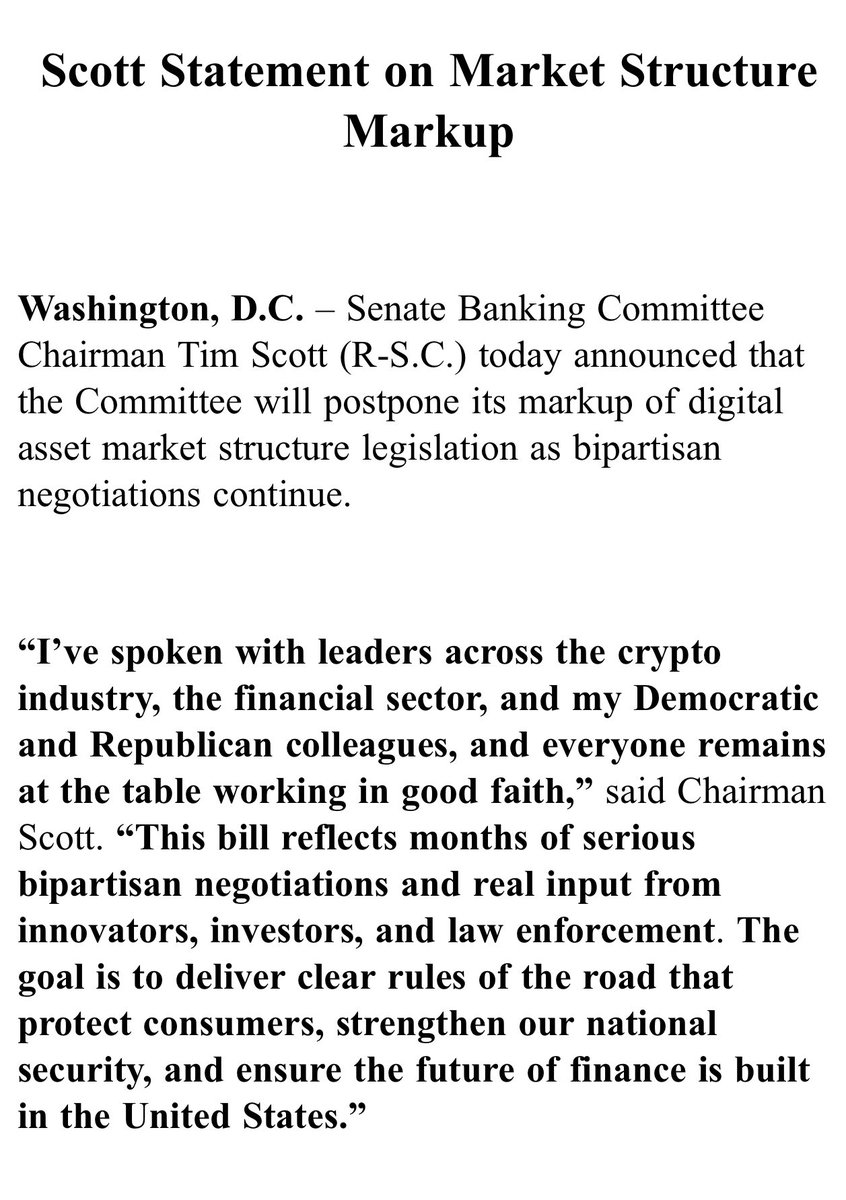
NEW: 🇺🇸 US Senate Banking Committee postpones Bitcoin and crypto market structure legislation markup after Coinbase and others withdrew their support for the bill 👀
Luxuries that don't look like luxuries, but are:
1. Having your mom and dad alive
2. Have siblings in the same city
3. No anxiety on Sunday night
4. Healthy eyesight
5. Having a roof over your head
6. Buying a $5 coffee in the morning
7. Being able to walk without pain
8. A warm shower every morning
9. Clean air to breathe
10. A good night's sleep without interruptions
True happiness comes from simplicity.
Faena’s major installation for #ArtWeek this year is a 50 ft revolving library with 2,500 books right on the sand off 32 St. in Miami Beach — free to the public from Dec. 2-7 🏝️
Artist: Es Devlin
🎥: @MiamiBeachNews
Thanks @_The_Prophet__
Here is the no-bullshit, highest-coherence, mask-off answer.
This article is smart, but it is structurally wrong in the only way that actually matters.
It is correct within the paradigm it is measuring, and completely blind to the paradigm that actually determines crypto valuations.
This is why its logic feels crisp but lands flat.
It is applying Web2 metrics to a monetary technology, not a consumer network.
It is mismeasuring the thing itself.
I will break this down brutally clean.
⸻
1. He is right about network effects. He is wrong about crypto.
Crypto does not have Facebook-style network effects.
Correct.
Crypto does not have user stickiness like Meta.
Correct.
Crypto does not have monetization comparable to Web2.
Correct.
And all of that is totally irrelevant.
Because crypto is not a consumer network.
Crypto is monetary infrastructure.
You do not measure:
•gold
•the dollar
•oil
•bonds
•treasuries
using DAU, MAU, ARPU, retention, or k-coefficients.
This is the categorical error at the heart of the article.
He is judging a monetary substrate using the metrics of a social app.
⸻
2. Crypto is valued the way money is valued: by beliefs, reflexivity, scarcity, and collateral utility.
Money is not a business.
Money is not a network product.
Money is a coordination technology with:
•reflexive trust
•role in collateral hierarchy
•function as energy storage
•function as global settlement rail
•macro-hedge dynamics
•political neutrality premium
•liquidity preference
None of this shows up in MAU metrics.
Bitcoin’s valuation is not based on:
“how many users are active this month.”
It is based on:
•its role in global collateral scarcity
•its function as pristine, non-sovereign reserve
•its energy base
•its terminal supply certainty
•its insulation from political coercion
•its reflexive monetization dynamic
•its place in the global liquidity stack
Nothing in the article even touches these domains.
He is talking about the wrong organism.
⸻
3. Crypto is not valued like Meta. It is valued like gold, commodities, reserve assets, and monetary layers.
Gold does not have:
•retention
•daily active users
•user flows
•stickiness
•network effects
Yet gold has:
•5,000 years of monetary premium
•valuation far above its industrial use
Because money is not valued by usage.
Money is valued by belief, structure, scarcity, and collateral function.
Crypto inherits this same dynamic.
That is why its valuations look unhinged through his lens.
He is measuring “chairs in a restaurant” while everyone else is pricing “land in Manhattan.”
⸻
4. Crypto’s real network effect IS speculation. And that is not a weakness — it is the ignition phase of every monetary asset.
He treats “speculation” like a bug.
It is the feature.
Monetary assets enter reflexive dominance through:
1.speculation
2.liquidity
3.collateralization
4.institutional adoption
5.settlement role
6.reserve status
Gold did this.
The dollar did this.
Sovereign bonds did this.
Every asset that becomes money goes through a speculative monetization phase where network effects are not usage, but belief-induced liquidity spirals.
Crypto is in stage 3–4 of this monetization curve.
He is complaining that Bitcoin does not look like Facebook when in reality it looks like early gold.
⸻
5. His entire “valuation per user” framing collapses under one question: Who is the user?
Is an oil barrel’s valuation “overpriced” because it has no MAU?
Is the U.S. dollar “overvalued” because its ARPU is low?
Is gold “overpriced” because it has no retention curve?
These questions are absurd because the framing is wrong.
Crypto’s “user” is not a person.
Crypto’s “user” is global liquidity.
Liquidity does not have DAUs.
Liquidity has flows, volatility, and collateral demand.
By that metric, crypto is underpriced, not overpriced.
⸻
6. Crypto’s network effect is not n squared. It is 1 ....CUT OFF UNFORTUNATELY.