Five things I've been writing about in ⚗️DistillED lately:
1. Classroom Transitions — reducing cognitive load and making every minute of a lesson matter.
2. The Generation Effect — why struggling to produce an answer is better than being given one.
3. The Visualiser — it does more than display. Most lessons only use half of what it can do.
4. Non-Examples — the fastest way to sharpen a concept is to show students what it isn't.
5. Rehearsal before Retrieval — retrieval gets all the attention. But what happens before it matters more than we think.
Each edition is one concept, unpacked properly, with practical strategies attached.
👇👇👇Free to subscribe: https://t.co/YznfhHQZGe
Formative Action Loops - and why teaching effectively involves creating them constantly. https://t.co/G42fafTKWh Check out the work of @ValentinaDevid in this area. It is so powerful.
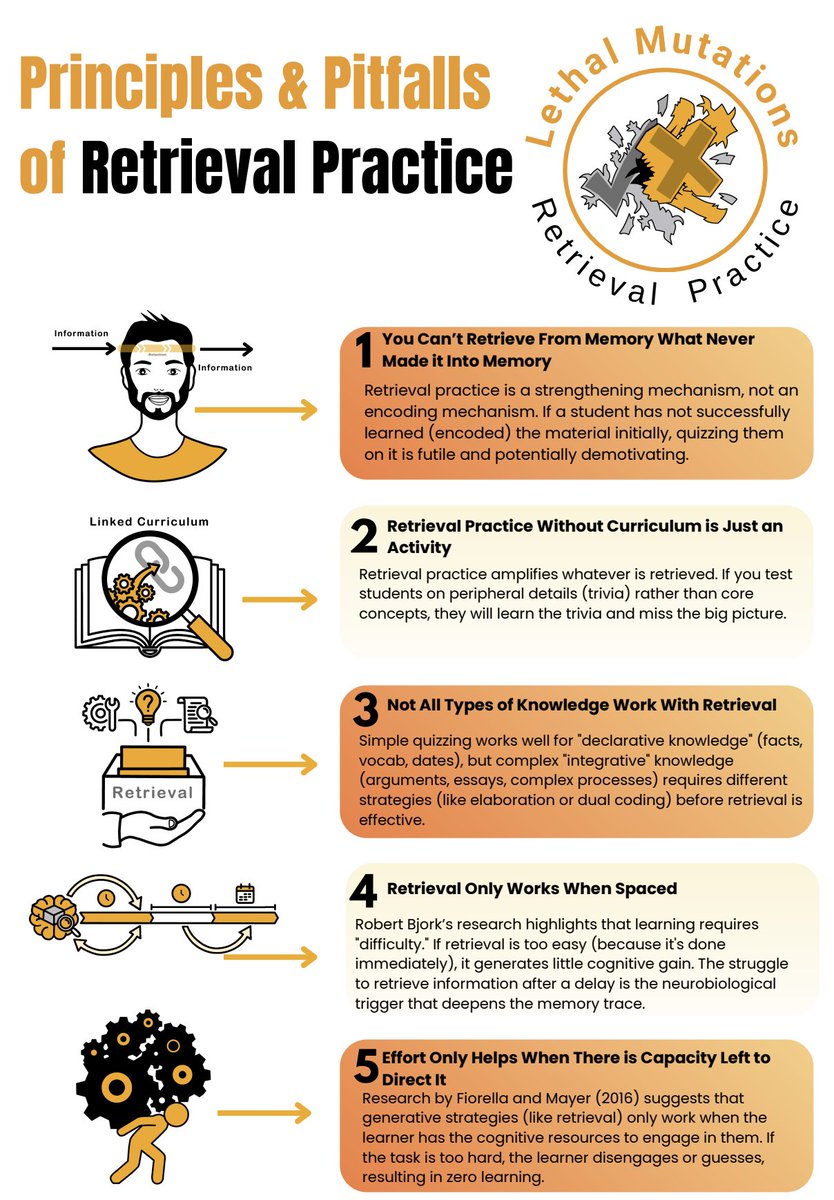
Retrieval practice might be common practice in secondary education in the UK now but is it really used effectively? Common mistakes and weak application of retrieval leads to the term being aplied to all forns of questioning. An infographic explaining some of these key issues
Congratulations to @Tom_Needham_ The final In Action book is now ready for the world. It’s a superb explanation of Engelmann’s Direct Instruction packed with examples. @HLearningPD
We All Say "Teach Critical Thinking." But Few Say How!
Abrami et al. (2015) answer the how. Their meta-analysis pooled 341 effect sizes, and the verdict is both reassuring and humbling: critical thinking can be taught, but the effect is modest, and the method matters enormously.
They sort what works into three moves.
1. Dialogue (discussion, debate, teacher-posed questions).
2. Authentic instruction (real-world problems, case studies, role-play).
3. Mentoring (modeling, coaching, guided practice).
Each helps on its own. Combine all three and the effect nearly doubles.
Mentoring is the surprise. Abrami et al. report it "did not generate especially strong results when analyzed on its own" (p. 302), yet layered onto the others it works as a catalyst. Strong discussion plus real problems plus intentional modeling is the recipe.
One finding matters most now. Teaching critical thinking inside a subject beat teaching it as an abstract skill. Generic "critical thinking" courses are the weaker bet.
The humbling part is the disposition gap. Students may know how to evaluate an argument. Whether they'll bother when ChatGPT is right there is another question. That's the same problem behind cognitive surrender (Shaw and Nave, 2026) and metacognitive laziness (Fan et al., 2025): habits are harder to build than skills.
The paper is from 2015, written before pocket reasoning engines. That makes it more urgent. Dialogue, real problems, and coaching can't be outsourced to AI.
The technology keeps getting smarter. The pedagogical fundamentals haven't changed.
***GREAT TEACHING FRAMEWORK***
Over the last few months we have been working on developing our great teaching framework to ensure every student experiences consistently high quality teaching.
Our framework has four key drivers of excellence:
✅ Subject knowledge
✅ Relationships
✅ Routines
✅ Hard Thinking
The framework has six principles, key components and linked techniques from @WALKTHRUs_5, @teacherhead, @olicav and TLAC @Doug_Lemov. We have mapped the techniques to the Great Teaching Toolkit.
For each technique, we have codified what it means and our teaching and practice labs CPD sessions allow staff to get it, see it and try it.
We then use @Steplab_co for our coaching model to keep it, fit it and continue to try it through deliberate practice.
#TheLongdendaleLegacy #GreatTeaching
Looking to find out more about how Teaching WalkThrus @WALKTHRUs_5 can help you to deliver high quality professional development on pedagogical practices, underpinned by research, in your school or college?
Come and find out more with Tom Sherrington @teacherhead at our webinar on Monday 8th June at 4pm!
Registration details below...
Reposting this powerful infographic from its original source at Educational Technology and Mobile Learning, highlighting that classroom strategy is not about controlling students, but guiding learning behavior. .
#ELTAction#ELT#edchat#teacherdevelopment#positiveeducation
You may have seen the 2nd Ed. of the @deansforimpact report on the Science of Learning is out! Now includes pitfalls + self-regulation.
Here's a summary - probably most useful AFTER you've read it, then a handy guide to look over as you plan!
https://t.co/s7ncdqDcor
I'm so excited to announce I will be presenting at the virtual event Teaching that Succeeds hosted by @HKorbey@mommagordon2 and @goyenfoundation! Save the date for this amazing event!
Carl Hendrick argues that success creates motivation, not the other way around. There is truth in that. But the research literature suggests something more complicated.
A short response on why the relationship probably works both ways.
https://t.co/UJgTo6f91x
When I first started teaching, I thought I could motivate my students through engaging lessons and relevant examples.
When that didn't work, I thought I could motivate my students through getting them to be really good at science. This was the standard "trad" line to take, and was based on the 'competence' strand of self determination theory.
That definitely worked better, but only as far as it went. It resulted in three categories of students:
Category 1: "this is great, I want to study this subject further."
Category 2: "this is not so bad actually, I don't hate it."
Category 3: "I still do not like this, not one little bit."
Better teaching - explicit instruction and systematic retrieval practice - pushed more students from Category 2 into 1, and from 3 into 2. But we are talking %s here. Motivation isn't mechanical, and you can't just expect a clear process of necessary causation. While GCSE results went up by x, motivation went up by a fraction of x.
That doesn't mean that doing more whizzy lessons would make that fraction bigger. Probably the opposite. But the idea that all students are "blank slates" when it comes to motivation strikes me as naive. We have natural likes and dislikes, and often that dictates our starting points and, further down the line, our end points.
What a PLEASURE to make summary of @greg_ashman's EXCELLENT (and very short!) book on Cognitive Load Theory.
What makes it stand out? Depth and nuance throughout ensuring the classroom suggestions reach back to the original research.
Summary here:
https://t.co/O8uDMfRgaw
Evidence-based teaching, made usable.
150 proven strategies, grounded in how learning works — brought to life through an online toolkit that helps you develop teaching in your setting. Come and find out more @WALKTHRUs_5@MattTeachCoach@olicav@teacherhead