America is more unequal than many of its Western European peers, but even its lower middle class is well off compared to them.
Link: https://t.co/CwHKoiCMaW
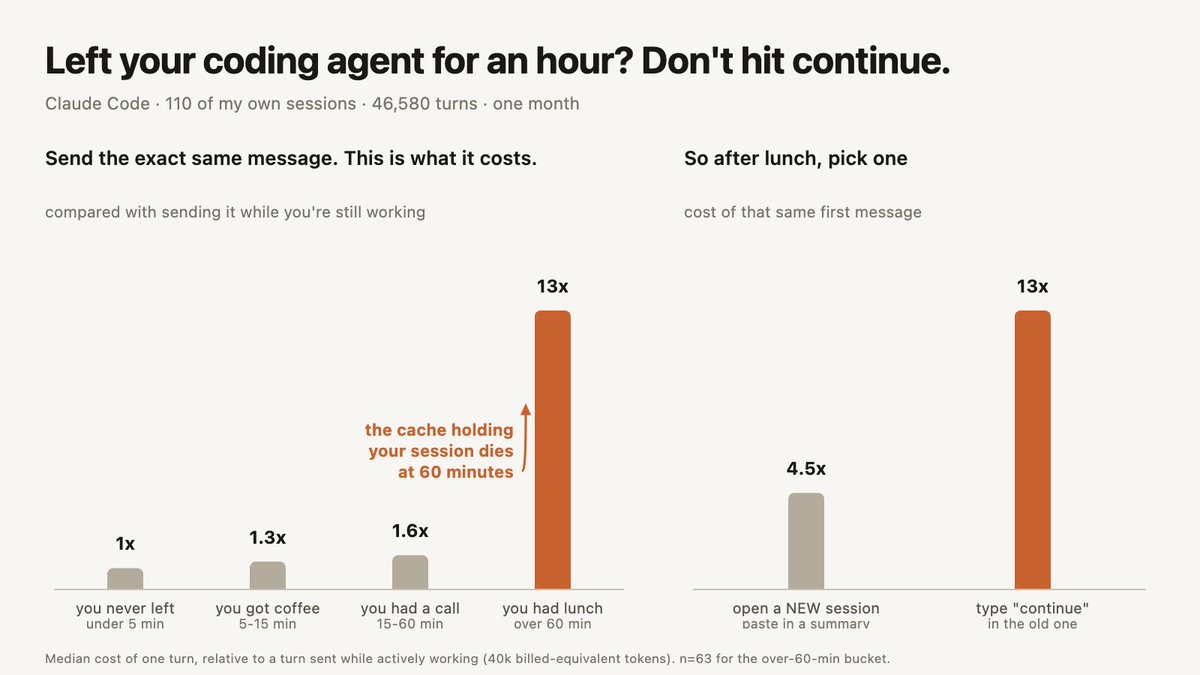
If you left your coding agent alone for more than 1h, don't hit continue. Open a new session.
Send the exact same message. While you're working, it costs 1x. After coffee, 1.3x. After a call, 1.6x.
After lunch: 13x.
The cache holding your session expires at exactly 60 minutes, and your first message has to rebuild the whole thing from scratch.
A new session costs 4.5x. So before you walk away: "summarize where we are." After lunch, paste it into a fresh window.
Measured across a month of my own Claude Code — 110 sessions, 46,580 turns.
@MTSlive Competition is good, these model providers need to figure out how to prevent distillation or double down on agentic work which is not as easy to copy
Claude Tag is a Trojan horse. Not because Anthropic is doing anything evil. Because the incentives are obvious.
Day one, this looks like a great feature: tag Claude in Slack, let it follow the thread, remember context, connect to tools, break down tasks, chase work, and act like a teammate.
But that is exactly the problem. The moment your AI vendor becomes a shared coworker, it stops being just a model provider. It starts becoming the place where work is interpreted, remembered, routed, and eventually executed.
That is not model lock-in. That is context lock-in. You are now renting your company back from them.
Models can be swapped. Agents can be copied. But the memory of how your company actually works is much harder, maybe impossible, to move: the Slack scar tissue, the exception paths, the customer promises, the unfinished threads, the weird workflows, the implicit owners, the “we tried that in Q2 and it failed” knowledge.
Once that lives inside one vendor’s agent layer, you are not renting intelligence anymore. You are renting your company’s operating memory.
And the pricing model makes it even more dangerous. A human coworker has a salary. Claude has unbounded tokenized activity. The more work moves through it, the more the vendor captures not just IT spend, but labor spend.
This is the enterprise bargain people will regret: Convenience now, and rapid decent into dependency.
The right architecture is simple: rent the best intelligence from whoever is best this month. OpenAI, Anthropic, Gemini, open source, whatever. But own the context layer.
Your company memory should be inspectable, permissioned, portable, and model-neutral. It should not be buried inside the same vendor that sells you the intelligence and the workflow surface.
Claude Tag is useful. That is why it is dangerous. Rent the intelligence, but own the context. Or, regret later.
Increasingly, I believe companies may need to be rebuilt from the ground up, where you have a single timeline of all observability + product metrics + file changes laid out in a retrievable system, like Datadog + Posthog + Google Drive + Slack (really unified filesystem of Claude Code chats + Codex chats). This might be the new data foundation for any and all companies to maximize AI. Needs to be rebuilt because keeping track of diffs on existing system basically impossible to produce longitudinal information on decisions and rollbacks, something coding agent storage companies are actively trying to figure out, but this should extend to businesses as a whole.
Highly skeptical existing businesses will adopt this though because it means overhauling everything about their instrumentation and business data, but I think businesses built on this foundation probably can execute 100x better and faster