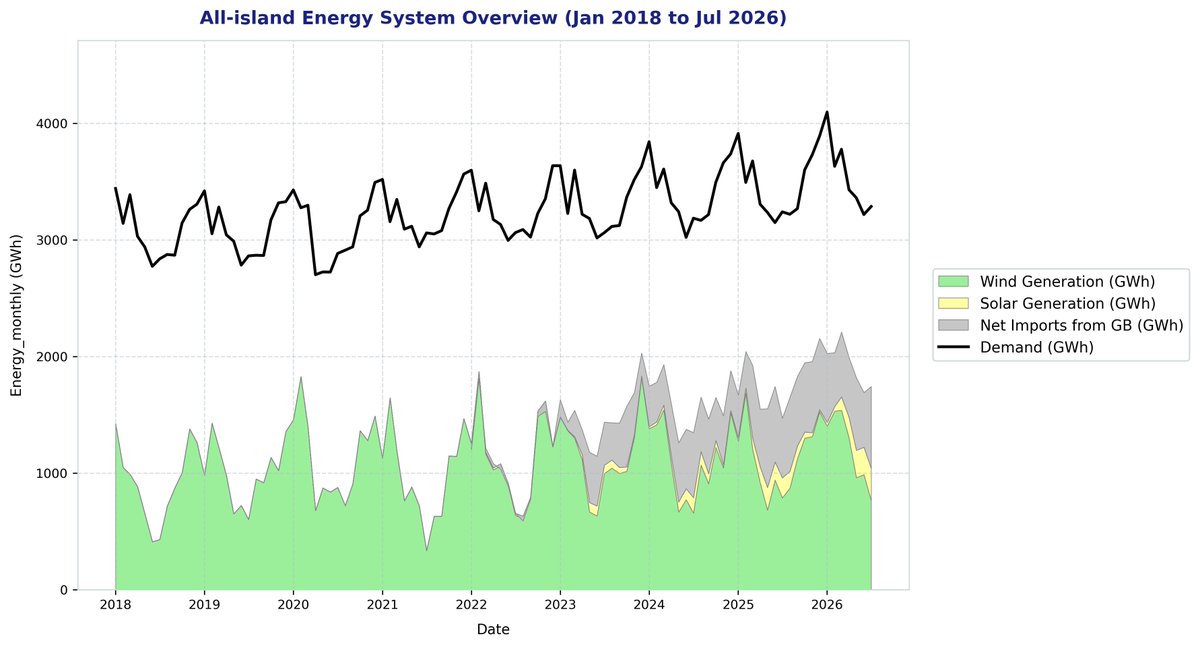
New format of Ireland's monthly energy plot, which is the best visual of how our 'energy transition' is going relative to our ballooning demand. Will continue to post the daily charts too.
Would you like if this was updated and auto-posted monthly? type 'Y' or 'N' in the comments.
There have been a number of articles stating that Ireland needs nuclear because we have too many data centres.
Let's be honest with the public, even if Ireland didn't have any data centres we still could not power the country on wind and solar alone.
https://t.co/zjcc27WBVg
Dolly Parton, what a wholesome and wholly amazing woman.
Visiting Ireland, she popped into a pub owned by Kerry Gaelic football legend Páidí Ó Sé. She came for a pint but ended up singing - her Coat of Many Colours, which told the story of growing up in poverty in a Smoky Mountains village.
She was born in 1946, as much the rest of the world entered an unprecedented period of postwar prosperity - less so if you were one of 14 siblings born in a log cabin to a sharecropper who had never learnt to read.
And she gave so much of her money from music away - 100 million books, in honour of her father. One book a month to children participating in her Imagination Library, not only in the US but Canada, the UK, Australia, and even here in Ireland.
She campaigned strongly for gay rights, speaking out for same sex marriage from 2009 - not everyone in country music did.
Her humour was self-deprecating and relentless. ‘I am a self-made woman, and I have the doctor bills to prove it��� was typical. (As was ‘I was the first woman to burn my bra—it took the fire department four days to put it out.’).
But even popping out for a quiet pint in the middle of Kerry she looked a million dollars - and was intensely aware of the shared musical past linking Appalachia and here. Hers, she said, was ‘Smokey Mountain DNA, but is from those old songs brought over from Ireland and England.’
Some woman. Ar dheis Dé go raibh a hanam.
I saw a lot of people sharing this photo.
There's a beautiful story behind this photo of Dolly Parton with a kitten in 1978 and other photos like it.
A long story but I'll go from the beginning because it involves two wonderful women and sums up who Dolly was as a person. /1
@AoifeMFoley Yeah but when the nukes are down it is due to an event that can be fixed like adding cooling towers or in the case of France, bringing more coastal sites back online. We can't make our own wind. This year highlights how above all we need to match solar with battery though.
@AoifeMFoley I use the Fraunhofer ISE figures for reference when giving figures for most European grids. A very pro-solar and anti-nuclear outfit. https://t.co/0GVdETMfmL
@AoifeMFoley Meanwhile wind output across Europe has declined under heat domes and cannot be depended upon in the summer. Germany like DK and NL rely on imports nearly every morning and evening as a result.
A TAIL OF TWO TRENDS
Ireland's full dataset of wind generation since Jan 2014
2nd trendline in red calculated from ~ Oct 2021 shows a slight downward trajectory!
Source: EirGrid Group, 2026. System and Renewable Data Summary Report V28. Column 55. [Excel spreadsheet]
Ciara O'Loughlin (@Ciara_olo):
"I was in Kyiv the day before strikes killed 10 people - life goes on, but devastation is everywhere"
https://t.co/JNLcaLLjB9
Here is a small reminder for everyone spreading the pro-russian narrative about "revenge for Wildberries," as well as for any normal person who doesn't follow the war closely and feels confused. Pay attention to the dates!
Russia struck the Amstor Shopping Mall in Kremenchuk on June 27, 2022, with cruise missiles in the middle of the day while up to 1,000 people were inside. 21 people died, and over 70 were injured.
Russia struck the Epicentr Hypermarket in Kharkiv on May 25, 2024. It was a weekend afternoon, and around 200 civilians and staff were inside shopping for home supplies. The blast sparked a high-temperature chemical and building-material fire. We had to use DNA testing to identify victims. 19 were killed, including children, and 46 were injured.
Russia struck the Kostiantynivka Central Market and surrounding shops at least twice: September 6, 2023, and August 9, 2024. Both strikes targeted dense retail zones crowded with shoppers during morning or early afternoon hours. 17 were killed and 32 injured in the September 2023 strike, and 14 were killed and 44 injured in the August 2024 strike on the Eko-Market.
Russia struck the Nova Poshta Sorting Terminal in Korotych, Kharkiv region, on October 21, 2023. Late at night, while employees were unloading civilian mail, parcels, and humanitarian packages, two S-300 missiles hit a location where missiles arrive faster than they can be detected. The 8 people killed stood no chance, 15 people were injured.
Russians continued to strike Nova Poshta in Korotych on January 13, 2026, killing 4 people and injuring 6; on July 19, 2026, killing 4 people and injuring 19; and on August 2, 2026, killing a driver. Among all the attacks listed, only the latest two occurred after the beginning of Ukrainian strikes on Wildberries.
Russia struck the ATB Supermarket & Retail Square in Kherson on May 3, 2023. Hitting civilian shopping infrastructure during daytime hours, they trapped shoppers inside the burning grocery hall. 23 people were killed across Kherson that day: 4 inside the ATB supermarket, 1 inside the Epicentr store, and others at nearby transport stops and shops.
Russia struck the Kherson Central City Market on October 1, 2024. Around 9:00 AM, artillery rounds landed directly in active outdoor market stalls. 7 were killed and 3 were injured.
Finally, Russia struck Kramatorsk Central Station on April 8, 2022, during an active civilian evacuation. A Tochka-U ballistic missile hit packed evacuation platforms, killing 63 civilians, including 9 children, and injuring over 150.
They also struck Chaplyne Railway Station on August 24, 2022, where an Iskander missile hit passenger trains and adjacent cars, killing 25 civilians and burning passenger carriages.
This is a tiny fraction of Russian strikes on Ukrainian retail chains, markets, and civilian transportation infrastructure during the full-scale invasion. A tiny, little fraction! So when you brain-dead amoebas write "revenge for Wildberries," think again. Russia was bombing Ukraine all these years, long before our attacks on Wildberries, and they will continue regardless.
July was an exceptionally hot month in both Germany and France. German media repeatedly reported how difficult the heat supposedly made it for French nuclear power plants to maintain electricity production. The impression was clear: French nuclear power was struggling, while Germany’s solar and wind system appeared to be the modern, climate-resilient alternative.
The actual electricity data tell a rather less convenient story.
Despite the heat, France continued to generate large volumes of reliable, low-carbon electricity from its nuclear fleet. At the same time, the country was able to increase exports to neighbouring countries that urgently needed electricity.
Germany, meanwhile, once again demonstrated the weather-dependent nature of its chosen system. Solar power delivered strongly during sunny daytime hours, but disappeared every evening. Wind generation fluctuated considerably and could not be ordered to increase when demand required it.
France had heat, nuclear power and electricity exports. Germany had heat, impressive solar peaks—and continued dependence on coal, gas and imports whenever sunshine and wind were insufficient.
Perhaps the real problem was not French nuclear power. Perhaps it was the German media narrative.
@CKemfert@VQuaschning@BadumLisa@MiKellner@JTrittin@roberthabeck@ntvde@zeitonline@focusonline@WDR@SWRAktuellBW@peter_simone@schneidercar




![XEnergyIreland's tweet photo. A TAIL OF TWO TRENDS
Ireland's full dataset of wind generation since Jan 2014
2nd trendline in red calculated from ~ Oct 2021 shows a slight downward trajectory!
Source: EirGrid Group, 2026. System and Renewable Data Summary Report V28. Column 55. [Excel spreadsheet] https://t.co/QOeZ28kjEs](https://pbs.twimg.com/media/HP6NlahXgAAdBcF.jpg)




