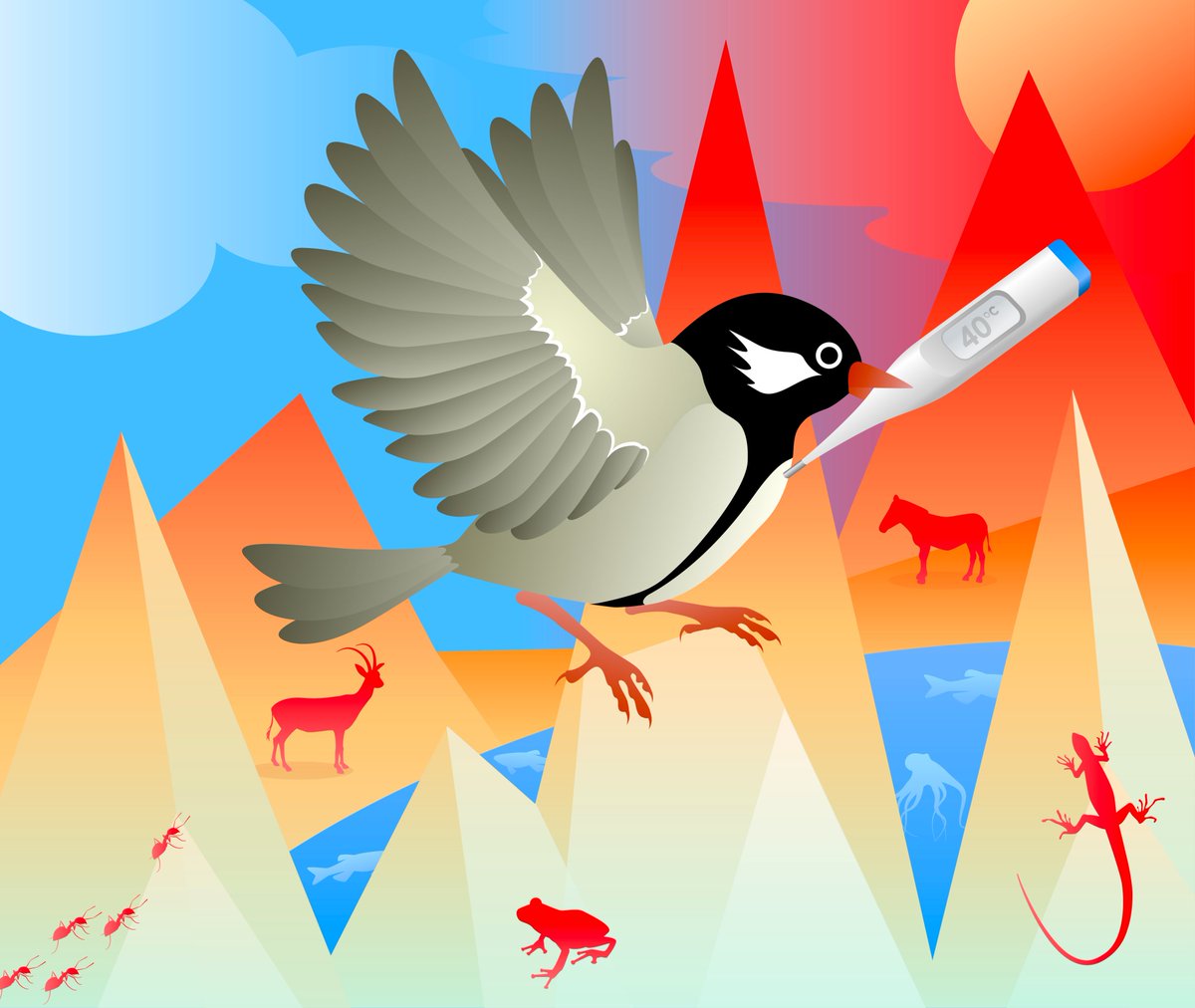
In a new review, @HauMichaela & colleagues explore the role of hormonal flexibility as a mechanism that allows animals to cope with changing temperatures. They discuss this over long and short time periods and different hierarchical levels (like populations, species or individuals). Find out more: https://t.co/UuIiGPySe2
Art by @mulesome
New paper out!! @JGRubalcaba and I developed a dynamic model to investigate the role of glucocorticoid receptor (GR) as mediator of glucocorticoid responses to environmental challenge.
https://t.co/MTNM5sKlf8
@RSocPublishing@IPE_CSIC
In a new review, @HauMichaela & colleagues explore the role of hormonal flexibility as a mechanism that allows animals to cope with changing temperatures. They discuss this over long and short time periods and different hierarchical levels (like populations, species or individuals). Find out more: https://t.co/UuIiGPySe2
Art by @mulesome
It is finally out: HPA flexibility and FKBP5: promising physiological targets for conservation | Phil Trans R Soc B with @blanca_jimeno@MartinlabUSF https://t.co/CKizvlycwS
Pleased to share this cool new article led by @GMcLeanLeighton and @JonathanPDrury, out now at Nature Communications. https://t.co/Co8Zu0hDwA. Close relatives, species with similar diets, fight more amongst themselves. One thing though...
Our latest blog post highlights a new study from Cornell, which shows that temperature extremes, in the form of cold snaps and heat waves, result in more nest failures: https://t.co/Vcp2kj1kat
#birds#ornithology
Climate change effects on wildlife may occur through both gradual changes & extreme events. Taff & Shipley quantify the impact of cold snaps & heatwaves on reproductive success in 24 common bird species in North America
@ConorTaff@CornellBirds@Nestwatch
https://t.co/230KkUfoDS
This was a really fun analysis to work on with such a robust dataset. We are really thankful for Nestwatch, Project Nestwatch, and Martinwatch for collecting such amazing long-term and widespread nest data. https://t.co/vzvwEzE5GJ
Excited that my new paper with Ryan Shipley is finally out today! We used 100 years of temperature data from 3,000+ weather stations and 300,000+ nest records to explore cold snaps and heatwaves during nesting for 24 common birds. https://t.co/4vRq1XdJIS
Extreme temperature exposure might be one factor contributing to bird population declines under climate change. Our result also got some recent coverage in the NYT. https://t.co/N73s1p3jWP
I have news! I just joined @TIFRH_buzz as faculty 2 weeks ago. It's a crazy change after 11 years of living in the US! But I'm super excited to work with students in India to study animals in the tropics, understand heterothermy better, and help shape Indian ecology!
When many different researchers analyze the same data, results vary .... A LOT!
Our Many-Analysts study from ecology and evo-bio is FINALLY up on @ecoevorxiv
https://t.co/VKSCKYqpjF
Thanks to the HUNDREDS of researchers who made this study possible.